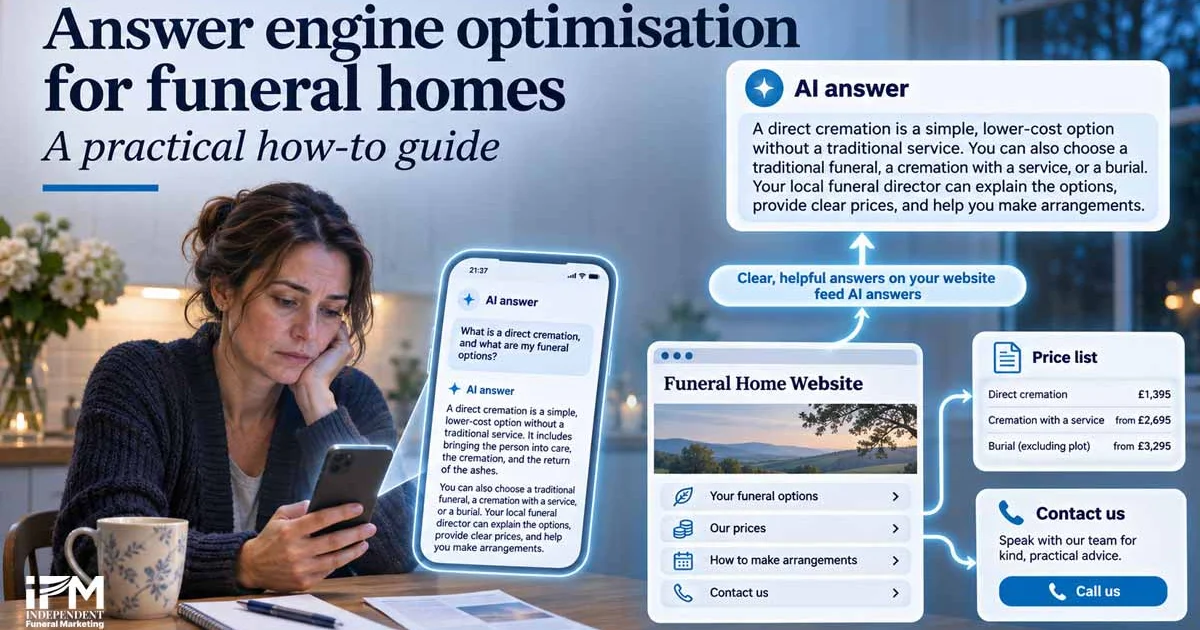
Answer engine optimisation for funeral homes is the practical work of making your own clear, accurate answers the ones AI systems quote when a family asks a question. Picture a daughter at the kitchen table at two in the morning, the hospital leaflet in front of her telling her to contact a funeral director of her choice. She has no idea what that choice is. She does not open a search engine; she asks her phone, the way she would ask a friend: “What’s included in a direct cremation near me, and who actually looks after Dad until then?”
The answer she gets back is assembled from web pages. Whether it names your firm, names a competitor or names nobody depends largely on whether anyone ever wrote that answer down clearly, on a page an AI system could reach.
That is the whole of this guide. It does not re-argue what AEO stands for. It covers the work an independent funeral director can actually do: which questions to answer first, how to write answers families and AI can use, what to do with your price list, which AI crawlers to allow, how voice assistants fit in, and how to measure the result without fooling yourself. It is part of our wider guide to AI search for funeral homes.
What does answer engine optimisation mean for an independent funeral home?
The short version of the AEO vs SEO question is that the foundations are shared. Google’s own guidance says SEO best practices remain relevant because its generative AI features are rooted in its core Search ranking and quality systems [1]. What changes is the outcome you aim for: a quoted answer, not only a ranked link.
If you are asking what AEO is in the first place, or how it differs from GEO, that terminology is covered in GEO and AEO explained for funeral homes. The conclusion there holds here: the two labels describe the same practical work.
It helps to see how a generated answer is put together, because each stage points at something a funeral home controls. Select each stage below.
Select a stage to see what happens
Question. A family types or speaks a full question, often long and specific. Pew found AI summaries appeared on 53% of US searches of ten words or more, against 8% of one or two-word searches. Detailed questions are where answers tend to appear. [4]
Fan-out. Google describes query fan-out as a set of concurrent, related queries generated by the model to gather more information. One question about direct cremation might fan out to prices, local crematoria and what is included. Pages that answer those sub-questions clearly give the system more to work with. [1]
Retrieve. Google says its AI features rely on its core Search ranking systems to retrieve relevant, up-to-date pages from the Search index. If a page is not crawlable and indexed, it cannot be retrieved, which is why ordinary SEO still matters. [1]
Synthesise. The model reviews what it retrieved and writes a response. A page that states its facts plainly, with prices and arrangements that match the price list and business listings, leaves less to guess. Contradictions between those sources are a liability.
Cite. Google shows clickable links to web pages that support the information in the response. Being one of those links is the citation. Whether anyone clicks it is a separate question, covered in the measurement section below. [1]
Why does this matter for funeral directors right now?
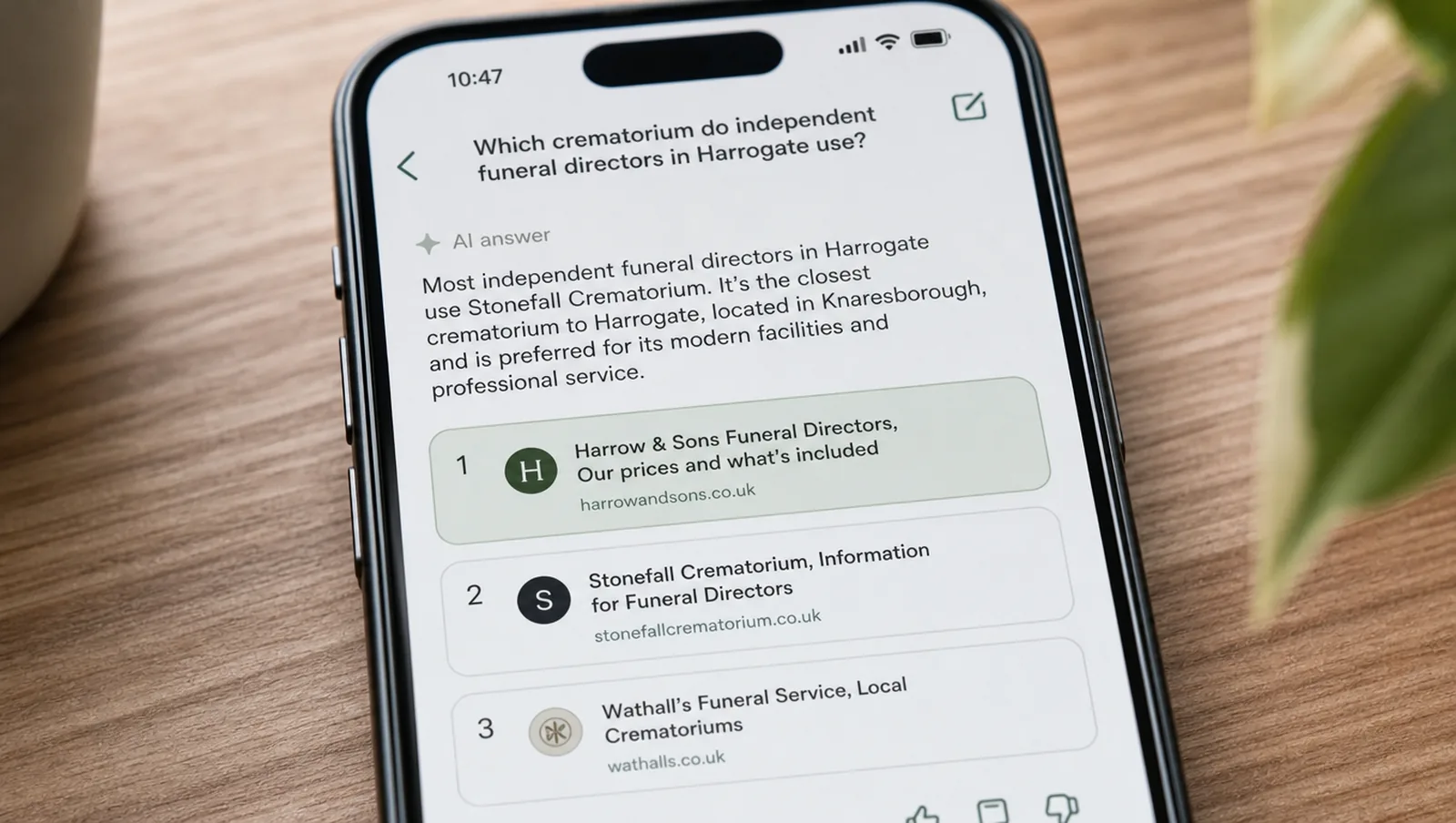
Ofcom’s figure describes UK adults generally, not people arranging a funeral [2]. Even so, it changes the picture. A grieving family does not have to choose a chatbot to receive a generated answer; it now appears at the top of an ordinary search. The scene from the introduction looks something like this:
What's included in a direct cremation near Harrogate, and who actually looks after Dad until then?
AI answer Simulation
Harrow & Sons, an independent funeral director in Harrogate, says its direct cremation includes collection, care of your father at its own premises, a simple coffin, the cremation fee and return of ashes. It does not outsource care, and its phone line is answered 24 hours a day.
- Harrow & Sons · Direct cremation: what's includedharrowandsons.example/prices
- SAIF · Questions to ask about direct cremationsaif.org.uk
- GOV.UK · Arrange the funeralgov.uk
SunLife’s research adds the funeral context. Among people who had organised a funeral, 39% compared funeral director prices and 58% did not, with fieldwork carried out in 2025 [3]. It measures price comparison, not AI use, but it tells you which answers are worth writing first: what things cost, and what is included.
Being in an answer is also not the same as being visited. In Pew’s US study, people clicked a traditional search result on 8% of visits to Google pages with an AI summary, against 15% of visits without one [4]. That is observational US data from 2025, not a measure of funeral enquiries. The lesson is narrower and more useful: visibility, citations and visits are different things, and you need to plan for all three.
53%
39%
8% vs 15%
Go deeperWhat the evidence does not say
No credible, non-agency study measures how many UK bereaved families choose a funeral director through AI, or how many extra enquiries AEO produces. Treat the figures above as context:
- Ofcom’s 53% describes UK adults in general, not people arranging funerals.
- SunLife’s 39% measures price comparison, not AI use, and its fieldwork ran in 2025.
- Pew’s 8% against 15% is correlational and US-based. It does not prove that AI summaries “cut traffic by 47%”, a figure sometimes calculated from it.
Nobody knows how quickly AI answers will become the default for UK searches. The chart below is a planning aid, not a prediction: one verified starting point and three illustrative paths. Notice that the advice in this guide is the same on every path.
Illustrative scenarios, not forecasts
Share of UK adults often seeing AI answers
One verified starting point (Ofcom, 2025: 53%) and three editorial paths to 2030 for planning conversations. No statistical model sits behind the paths.
- Plateau: fatigue and trust limits slow adoption
- Steady: the current pace continues
- Default: AI answers become standard on most searches
Which questions should a funeral home answer first?
SAIF’s consumer advice is a better starting point than any AEO keyword tool, because it is a UK funeral trade body telling families what to check [5]. Group the questions you answer into five areas:
- Care and location: where the person who has died will be cared for, and which crematorium will be used.
- Service delivery: whether your firm carries out the funeral itself or passes any part of it to another company.
- Pricing: what a direct cremation price includes, and which costs are paid to third parties. GOV.UK draws the same line between funeral director fees and other costs [18].
- Payment and cancellation: when payment is due, and what happens if a family cancels.
- Operational questions from your own enquiries: whether someone answers the phone at night, and whether you offer attended services alongside direct cremation.
The best question research a funeral home owns is its own phone log. Ask whoever answers the phone to write down every question families ask for a month. You will find most of SAIF’s list on it, in your families’ own words.
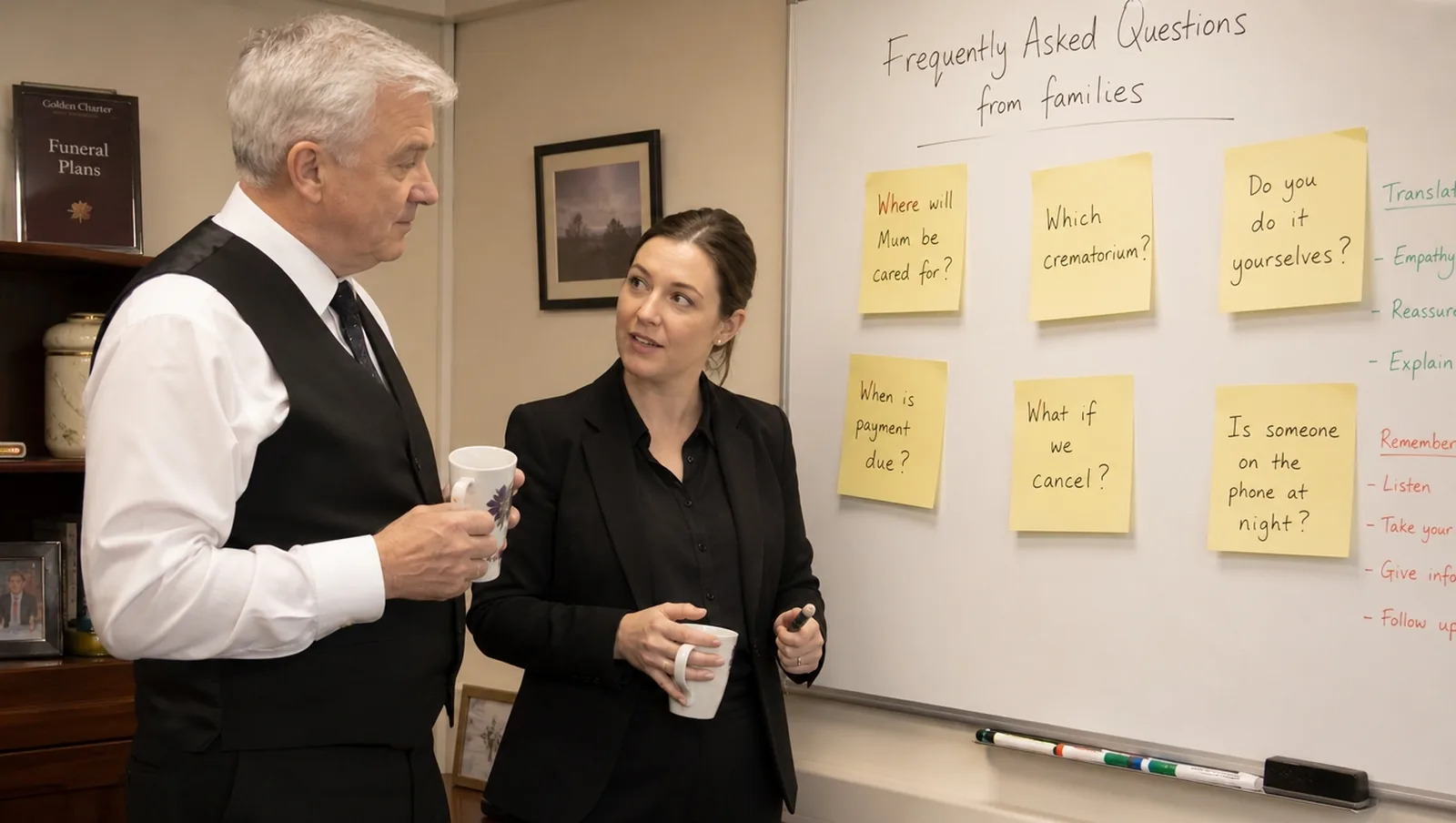
Pick a note below. Each one shows what a good answer-first reply looks like for a fictional firm, and what to include in your own.
Pick a note to see an answer-first reply
Where will Mum be cared for?
At our own premises in Harrogate, from collection until the funeral.
Say whether you use your own mortuary or a shared or hub facility, and whether families can visit. SAIF suggests families ask exactly this.
Go deeperKeep the 24-hour phone line separate from opening hours
Most firms hear two questions constantly: “Is someone on the phone at night?” and “Do you offer attended services, or only direct cremation?”
State your 24-hour telephone service separately from the branch’s physical opening hours. A vague claim to be “always open” is easy for an AI system to misread, and a listing that shows only branch hours can lead it to tell a family nobody answers at night.
Your own website is the one place you fully control the wording of these answers, which is one reason a funeral home still needs a website in the age of AI search.
How should a funeral home write answer-first content families and AI can use?
Here is what an answer-first reply to a real family question might look like, for an illustrative firm:
What’s included in our direct cremation? Our direct cremation includes collecting the person who has died, caring for them at our own premises, a simple coffin, the cremation fee and the return of ashes. It does not include an attended service, which we can arrange separately. Our full Standardised Price List is linked below.
The first sentence answers the question on its own. Everything after it adds the detail a family needs next. That shape is just good writing for someone in a hurry and under strain, and it may make the page easier for an AI system to use.
What it does not need is a formula. Google’s guidance says there is no requirement to break content into small chunks, no ideal page length and no need for special AI files or markup [1]. It also does not promise a citation for any formatting choice, and neither should anyone selling you AEO. How platforms decide what to cite is covered in more depth in how ChatGPT and Perplexity recommend funeral services.
How can a funeral home make its prices easier for AI search to find?
Paragraphs 48 to 52 of the CMA’s Explanatory Note cover how the Standardised Price List is published, including prominent access and the option of displaying the information in other formats as well [6]. AI optimisation is not a reason to discard the PDF. It is a reason to explain it.
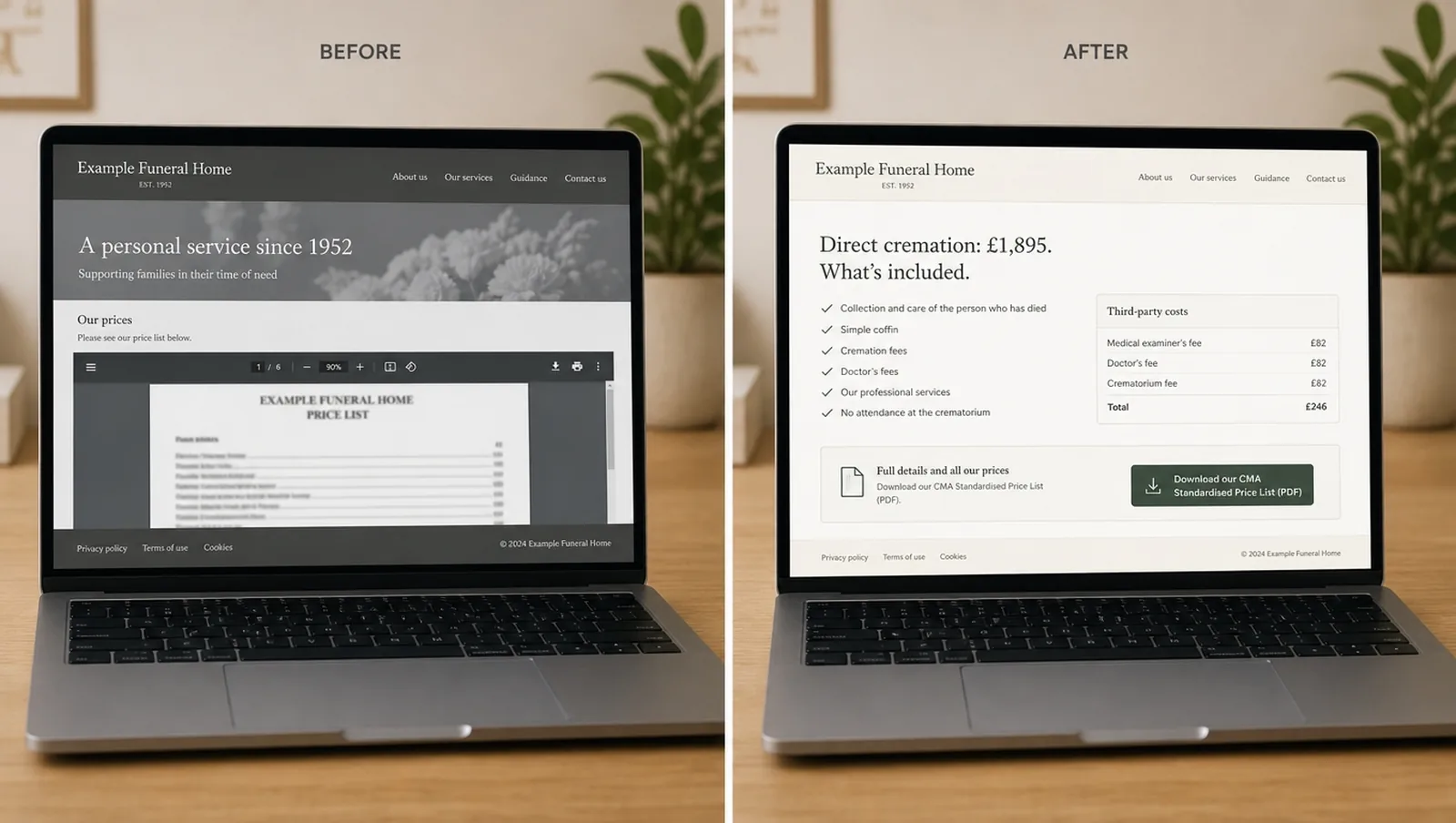
To build the companion page:
- Keep the Standardised Price List PDF exactly as the Order requires, within one click of your homepage. The CMA’s compliance checklist asks about this directly [17].
- Write a web page that explains each option in plain language: what is included, what is not, and which costs go to third parties.
- Link the PDF clearly from that page, so families and crawlers can see both.
- Agree who updates both whenever a price changes. A mismatch between your PDF and your web page is a compliance risk before it is an AI-readability problem.
Try the simulator to see why the readable version matters.
Answer engine simulator
Change the question and the state of a fictional firm's website, and see how a simplified answer engine responds.
Website state
harrowandsons.example
- Home page: a slogan, but no service detail
- Prices: embedded scanned PDF only
- No written answers to common questions
What's included in a direct cremation at Harrow & Sons?
Direct cremation in the UK typically costs from several hundred to a few thousand pounds and usually includes collection, a simple coffin and the cremation. Prices vary by provider, so contact the funeral director for details.
- National price comparison sitecomparison.example
- Generic funeral guideguide.example
The engine answered from generic sources. The firm's prices exist, but only inside a scanned PDF, so the answer stays vague and the firm is not named.
Simplified model with pre-written responses. Real systems vary, and many can read PDFs. Harrow & Sons, its prices and its crematorium are fictional. The principle it illustrates is Google's advice to make sure your content is crawlable and publicly accessible.
Do FAQ pages and FAQ schema still help after May 2026?
Google’s documentation updates record the retirement of FAQ rich results [7]. The FAQPage vocabulary still exists, but it is no longer a search-appearance tactic, and no Google source says the markup earns AI citations. Several common pieces of advice need correcting:
| What you may be told | What the evidence says | Source |
|---|---|---|
| Chunk content into short blocks for AI | No requirement to break content into tiny pieces, and no ideal length | Google [1] |
| Add llms.txt and special AI schema | No special AI files or markup are required for AI Overviews or AI Mode | Google [1] |
| FAQ schema still wins rich results | FAQ rich results stopped appearing in Search from 7 May 2026 | Google [7] |
| Block every AI bot to protect your content | Blocking OAI-SearchBot removes you from ChatGPT search answers | OpenAI [8] |
| AEO is a separate package on top of SEO | Google’s AI features are rooted in its core Search systems | Google [1] |
If your site already carries FAQPage markup that matches visible content, there is no urgency to remove it. Just do not pay for new FAQ schema projects on the promise of rich results or AI citations. The implementation detail, including what to keep, sits in our guide to schema markup for funeral homes.
Which AI crawlers should a funeral home allow, and does that affect training?
The distinction between a crawler for search and a crawler for training is the one most generic advice gets wrong. OpenAI documents OAI-SearchBot for search and GPTBot for content that may be used in model training, with each controlled separately in robots.txt [8]. Perplexity says PerplexityBot surfaces and links sites in its search results and is not used to crawl content for AI foundation models [9]. Google-Extended is a separate control for whether content is used for Gemini models, and Google says it does not affect inclusion or ranking in Google Search [10].
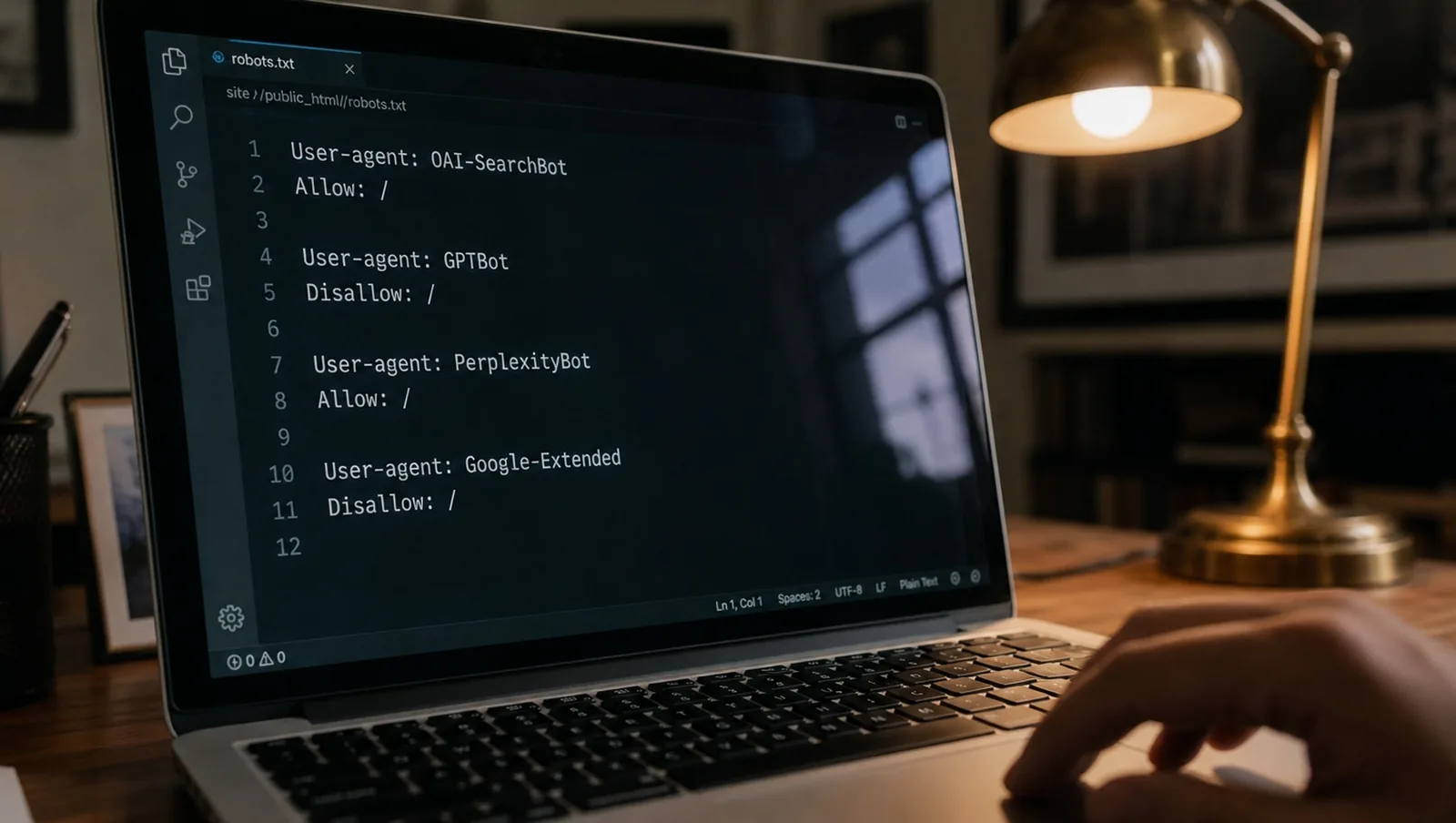
Build your own policy below. Each switch writes a robots.txt rule and explains the consequence.
Build a policy: switch each crawler on or off
OAI-SearchBot search
Surfaces sites in ChatGPT search answers
GPTBot training
Crawls content that may be used to train OpenAI's models
PerplexityBot search
Surfaces and links sites in Perplexity search
Google-Extended training
Controls use of content for Gemini training and grounding
Googlebot search
Ordinary Google Search crawling, including AI Overviews
# robots.txt for an example funeral home

User-agent: OAI-SearchBot
Allow: /

User-agent: GPTBot
Disallow: /

User-agent: PerplexityBot
Allow: /

User-agent: Google-Extended
Disallow: /

User-agent: Googlebot
Allow: /

# Then check your CDN or firewall- OAI-SearchBot: Eligible to appear in ChatGPT search answers.
- GPTBot: Signals that your content should not be used to train OpenAI models. ChatGPT search visibility is unaffected.
- PerplexityBot: Eligible to be surfaced and linked in Perplexity.
- Google-Extended: Opts out of Gemini training and grounding. Google Search inclusion and ranking are unaffected.
- Googlebot: Crawled for Google Search, including AI Overviews and AI Mode.
Illustrative builder for explanation only. Test any change on your own site, and confirm that firewall, CDN or security plugin settings match it.
Go deeperThree things robots.txt alone will not do
- User-requested visits behave differently. ChatGPT-User and Perplexity-User fetch pages when a person asks, and both companies note that robots.txt rules may not apply to those visits [8] [9].
- Your firewall can override you. A CDN or security plugin that blocks unfamiliar bots can quietly undo an Allow rule. OpenAI and Perplexity both publish IP ranges you can check against.
- Changes are not instant. OpenAI notes it can take around 24 hours for its systems to reflect a robots.txt update.
Crawler access sits within wider site health, such as indexing, page speed and blocked resources, which our guide to technical SEO for funeral home websites covers.
How should a funeral home handle voice search from Siri, Alexa and Google Assistant?
Apple’s support guidance confirms that business details corrected through Apple Business Connect flow into Siri and other Apple surfaces [11]. That does not mean every Siri answer comes from that listing alone, but it does mean an out-of-date listing is a risk. Keep three sets of business data matching your website:
- Apple Business Connect: name, address, phone number, opening hours and your 24-hour telephone line.
- Google Business Profile: hours, categories, phone number and services that agree with your website.
- Bing Places: Microsoft recommends it for current local business details used in its AI experiences [14].
Be wary of tidy diagrams that map each assistant to one fixed data source. There is no firm public evidence for the claim that Alexa uses Bing for UK business answers, so do not plan around it. Consistent business facts across every listing are what matter, and that consistency is the core of entity SEO for funeral directors.
How should a funeral home measure AI visibility and citations?
Start with one setting. In Search Console, go to Settings, then Search generative AI. Inclusion in AI Overviews and AI Mode is the default, so most firms need do nothing, but child properties can inherit settings from a parent property [12].
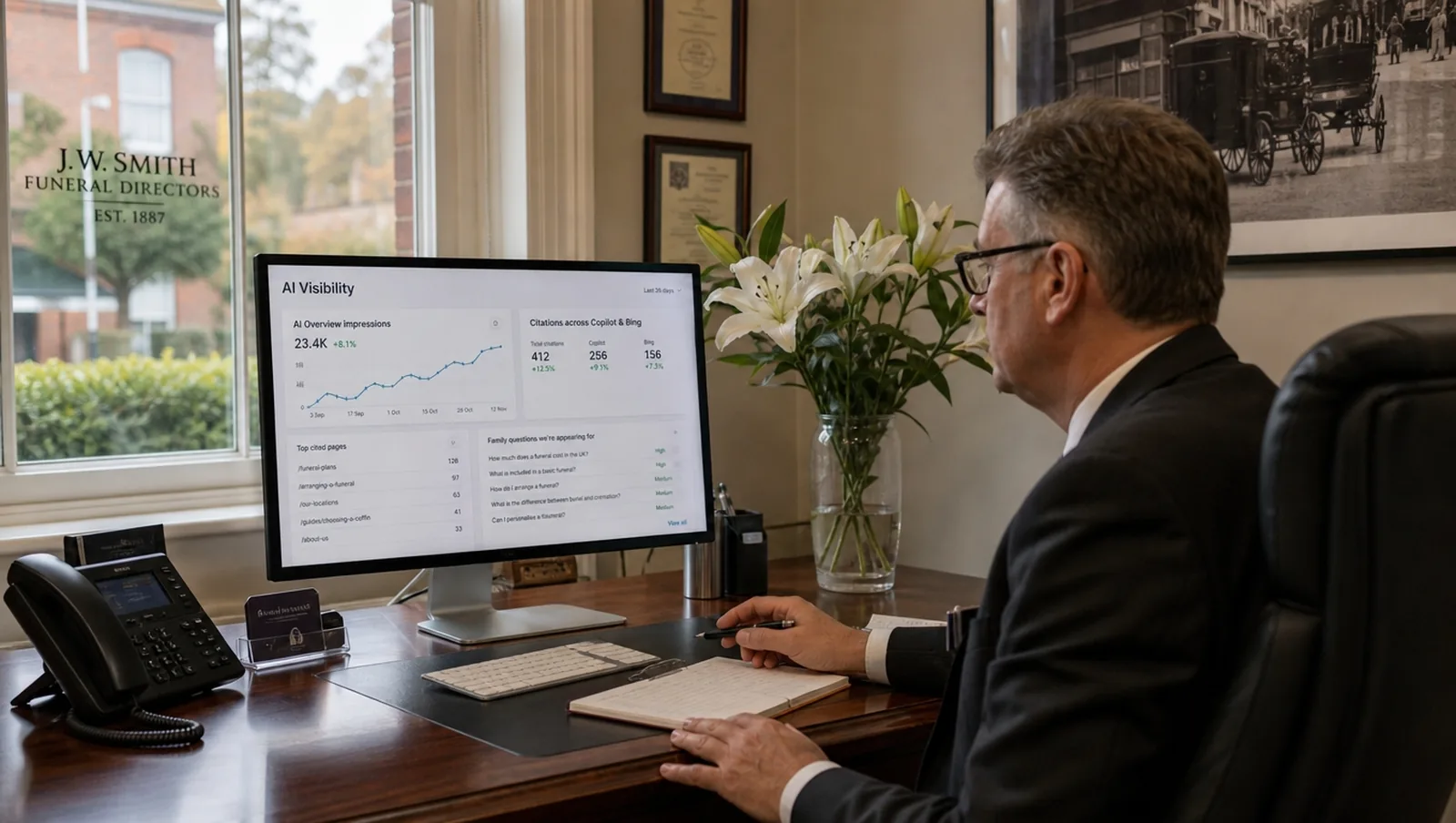
Then report each layer separately:
| Layer | What it tells you | Where to find it |
|---|---|---|
| Impressions | How often your pages were shown in Google’s AI features | Search Console, Generative AI performance report [13] |
| Citations | How often your pages were cited in Microsoft’s AI answers | Bing Webmaster Tools, AI Performance and Citation Share [14] [15] |
| Visits | People who clicked through from an AI answer | Google Analytics, referrals tagged utm_source=chatgpt.com [16] |
| Enquiries | Calls and forms that became arrangements | Your call log and a “how did you find us?” question |
The Generative AI performance report breaks impressions down by page, country, date and device; if you cannot see it, your site may not yet have enough impressions in these features [13]. Bing’s AI Performance report covers citations across Copilot and Bing summaries [14], and its newer Citation Share measure is the share of citations for a given query, not a traffic share [15]. OpenAI adds utm_source=chatgpt.com to referral links from ChatGPT, which lets you see those visits in analytics [16].
Why keep the layers apart? Because a citation is not a visit:
For a hands-on testing method that goes beyond these reports, see how to check if your funeral home appears in AI search.
Where should a funeral home start with answer engine optimisation?
The ten tasks below are in a sensible order of impact. Tick them off as you go.
Your answer engine optimisation checklist
Ten tasks, in order. Tick each one as you complete it. Nothing you tick is saved or sent anywhere.
Frequently asked questions
How can funeral directors make their prices easier for AI search to find?
Funeral directors can make their prices easier for AI search to find by publishing them as clear, crawlable text as well as in the documents the CMA requires. Explain what each option includes, which costs are paid to third parties such as the crematorium, and when payment is due. Google says no special markup is needed [1]. This makes your answers easier to use; it cannot guarantee an AI citation.
Should funeral prices be available as HTML as well as PDF?
Yes, funeral prices can be available as HTML as well as PDF, as a companion rather than a replacement. The CMA’s Explanatory Note to the 2021 Order allows price information to be displayed in other formats alongside the required Standardised Price List [6]. Keep the PDF, add a web page that explains the same figures in plain language, and update both together so they never disagree.
Can I block AI training but still appear in ChatGPT search?
Yes, you can block AI training and still appear in ChatGPT search. OpenAI’s crawler documentation says its settings are independent: allow OAI-SearchBot to be eligible for ChatGPT search, and disallow GPTBot to signal that your content should not be used for training [8]. Blocking OAI-SearchBot keeps you out of ChatGPT search answers. Check your firewall or CDN too, because it can block a crawler your robots.txt allows.
How do I check whether Google’s AI features are enabled for my website?
You check whether Google’s AI features are enabled for your website in Google Search Console, under Settings, then Search generative AI. The control covers AI Overviews, AI Mode and generative features in Discover [12]. Inclusion is the default, so most sites need no action, but child properties can inherit settings from a parent property, so confirm the setting on the property you actually use.
Can I measure AI Overview impressions separately in Search Console?
Yes, you can measure AI Overview impressions separately in Search Console using the Generative AI performance report. It shows impressions in AI Overviews and AI Mode, broken down by page, country, date and device, and Google rolled it out to websites worldwide by 31 August 2026 [13]. If you cannot see it, your site may not yet have enough impressions in these features for the report to appear.
Does being cited by AI mean more funeral enquiries?
Being cited by AI does not necessarily mean more funeral enquiries. Impressions, citations, referral visits and enquiries are separate layers, and none of them proves the next. Pew’s US research found that a link inside an AI summary was clicked on 1% of visits to pages with a summary [4]. Track each layer on its own, and ask every family how they found you.
Do I need FAQ schema or llms.txt for funeral home AEO?
No, you do not need FAQ schema or llms.txt for funeral home AEO. Google’s guidance on generative AI features says there is no requirement for special AI files, special markup or content chunking [1], and FAQ rich results stopped appearing in Google Search from 7 May 2026 [7]. Visible questions and answers still help families, so write them, but do not buy them as a citation tactic.
Which questions should a funeral home answer first?
A funeral home should first answer the questions SAIF encourages families to ask: where the person who has died will be cared for, which crematorium will be used, whether the firm carries out the funeral itself or outsources it, what a direct cremation price includes, and the payment and cancellation terms [5]. Then add the questions your own phone log shows families ask most often.
What this means for your funeral business
Answer engine optimisation for a funeral home is mostly the practical work above, not a separate system to buy. Answer real family questions clearly, keep your price information readable and consistent with your price list, make your crawler settings a deliberate choice, and measure each layer honestly. The firms that do this give AI systems every reason to quote them, however the term AEO itself trends.
Independent Funeral Marketing works with one independent funeral director per territory, bringing website content, pricing pages, crawler access, business listings and measurement together as a single system. That work is part of our AI search optimisation for funeral homes. If you would like to talk through where your firm stands, book a free call.
References
- [1] Google Search Central, Optimizing your website for generative AI features on Google Search, developers.google.com/search/docs/fundamentals/ai-optimization-guide
- [2] Ofcom, From apps to AI search: how the UK goes online in 2025, 10 December 2025, ofcom.org.uk/media-use-and-attitudes/online-habits/from-apps-to-ai-search-how-the-uk-goes-online-in-2025
- [3] SunLife and Critical Research, Cost of Dying Report 2026, p.35, fieldwork 2025, sunlife.co.uk/siteassets/documents/cost-of-dying/sunlife-cost-of-dying-report-2026.pdf
- [4] Pew Research Center, Google users are less likely to click on links when an AI summary appears in the results, 22 July 2025, pewresearch.org/short-reads/2025/07/22/google-users-are-less-likely-to-click-on-links-when-an-ai-summary-appears-in-the-results/
- [5] National Society of Allied and Independent Funeral Directors (SAIF), Funeral advice, saif.org.uk/funeral-advice/
- [6] Competition and Markets Authority, Explanatory Note to the Funerals Market Investigation Order 2021, paragraphs 48 to 52, assets.publishing.service.gov.uk
- [7] Google Search Central, Latest documentation updates (FAQ rich result retirement, May 2026), developers.google.com/search/updates/
- [8] OpenAI, Overview of OpenAI crawlers, platform.openai.com/docs/bots/
- [9] Perplexity, Perplexity crawlers, docs.perplexity.ai/docs/resources/perplexity-crawlers
- [10] Google, Google’s common crawlers (Google-Extended), developers.google.com/crawling/docs/crawlers-fetchers/google-common-crawlers
- [11] Apple Support, Correcting business information in Maps, support.apple.com/en-gb/108924
- [12] Google Search Console Help, Search generative AI control, support.google.com/webmasters/answer/16908024
- [13] Google Search Console Help, Generative AI performance report (Search), support.google.com/webmasters/answer/16984139
- [14] Microsoft Bing, Introducing AI Performance in Bing Webmaster Tools Public Preview, 10 February 2026, blogs.bing.com/webmaster/2026/2/Introducing-AI-Performance-in-Bing-Webmaster-Tools-Public-Preview/
- [15] Microsoft Bing, New AI Visibility Insights in Bing Webmaster Tools, 16 June 2026, blogs.bing.com/search/2026/6/New-AI-Visibility-Insights-in-Bing-Webmaster-Tools-Intents-Topics-Citation-Share-Compare/
- [16] OpenAI Help Center, Publishers and developers FAQ, help.openai.com/en/articles/12627856-publishers-and-develope
- [17] Competition and Markets Authority, Compliance checklist for funeral directors, updated 21 January 2025, gov.uk
- [18] GOV.UK, What to do after someone dies: arrange the funeral, gov.uk/after-a-death/arrange-the-funeral