Funeral homes can run Google Ads. Most that try see poor results, not because Ads don’t work, but because the campaigns aren’t built correctly for this type of business.
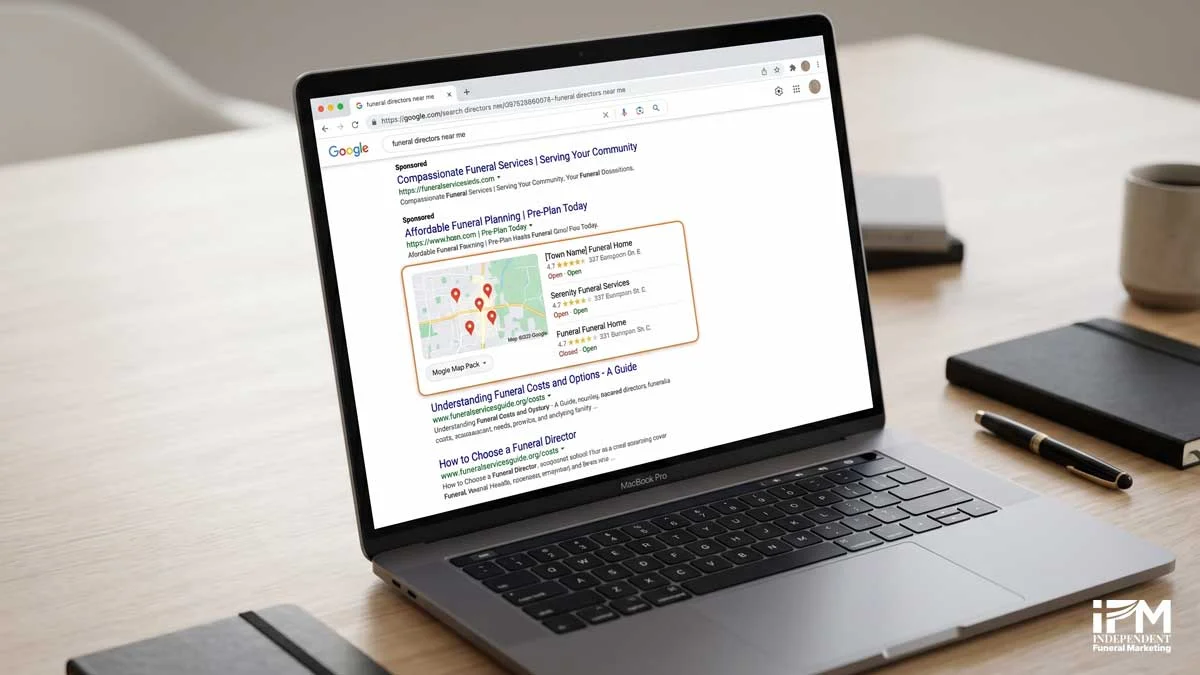
Google Ads places your funeral home at the top of search results the moment someone in your area types “funeral directors near me” or “cremation services [your town]”. The enquiry can arrive the same day the campaign goes live. No other marketing channel moves that quickly. But Google’s platform is not designed with funeral homes in mind, the policies are nuanced, the keyword environment is unusual, and the cost of getting it wrong is higher than in most industries. This guide covers everything an independent funeral director needs to know before running a single pound through Google Ads.
What are Google Ads and how do they work for funeral homes?
Google Ads is a paid advertising platform that places a funeral home’s website at the top of Google search results when someone searches for funeral services in their area. Funeral homes pay only when a potential client clicks the ad. Ads appear above organic results and can generate enquiries within hours of going live.
When a family in your area searches “funeral directors [town]” or “direct cremation near me”, Google’s auction system runs in milliseconds. It evaluates every advertiser bidding on that keyword, assesses each ad’s relevance and quality, and places the highest-scoring ads at the top of the results page. Your bid per click is one factor. The quality of your ad and landing page, the Quality Score, is another. High-quality ads pay less per click than poor-quality ads competing for the same position.
For funeral homes, the mechanics matter because the searches that trigger your ads are among the most intent-rich in any industry. A family typing “funeral home open now” is not browsing. They have an immediate need. The challenge is making sure your ad reaches them, earns the click, and converts into a call.
Are funeral homes allowed to advertise on Google, and are there any restrictions?
Yes, funeral homes are allowed to run Google Ads. There are no restrictions on funeral homes advertising their services through keyword-targeted Google Search campaigns. However, Google does impose specific restrictions on personalised advertising linked to bereavement, and funeral homes cannot use remarketing lists, Customer Match audiences, or interest-based targeting based on bereavement status.
Google’s personalised advertising policy [1] classifies bereavement as a sensitive personal hardship category. The full breakdown of what is and is not permitted:
| Advertising method | Permitted for funeral homes? |
|---|---|
| Standard keyword search campaigns | Yes, unrestricted |
| Google Local Services Ads (LSAs) | Yes, where available |
| Call-only ads | Yes, unrestricted |
| Display Network image ads (non-targeted) | Yes, with caution |
| Remarketing lists for search ads (RLSA) based on bereavement | No, explicitly prohibited |
| Customer Match audiences based on bereavement status | No, explicitly prohibited |
| Interest-based or affinity audience targeting based on bereavement | No, explicitly prohibited |
| YouTube targeted ads to bereaved audiences | No, prohibited under same policy |
The practical consequence is straightforward: build campaigns around what people search for, not around who they are. Keyword targeting is the permitted model. Audience targeting tied to personal hardship is not.
What does Google’s policy on advertising to bereaved families actually mean in practice?
Google’s policy prohibits funeral home advertisers from using bereavement as an audience targeting signal. In practice, this means funeral homes cannot run retargeting display ads to people identified as recently bereaved, and cannot build Customer Match or remarketing lists segmented by bereavement intent. Standard search campaigns, targeting keywords rather than audience attributes, remain fully permitted and unaffected.
The distinction is between capture and targeting. If a family finds your ad by searching for a keyword you bid on, that is permitted regardless of why they are searching. Google’s objection is to the reverse: identifying someone as recently bereaved and then pursuing them with advertising. The former serves the family’s expressed need. The latter exploits a personal hardship for commercial gain.
What this means operationally for an independent funeral home:
- Search campaigns: Fully permitted. Bid on service keywords, location keywords, and competitor terms.
- Call-only campaigns: Fully permitted. Often the highest-converting format for at-need searches.
- Remarketing to your own website visitors: Approach with caution. A blanket remarketing list of all visitors is technically permitted, but if the campaign is structured in a way that targets bereaved individuals specifically, it risks policy violation.
- Display advertising: Permitted if non-targeted. Placement targeting on relevant content (funeral planning resources, obituary sites) does not use personal hardship as the signal.
The safe and effective approach is to build the entire campaign on keyword intent, which is also where the highest-converting traffic originates.
Should independent funeral homes use Google Ads in 2026?
Whether a funeral home should use Google Ads depends on three factors: the current state of its organic search presence, the competitive landscape in its local area, and the budget available for sustained investment. Google Ads works well as a bridge for funeral homes building organic visibility, and as a permanent layer in highly competitive urban areas where top organic positions are dominated by large corporate chains.
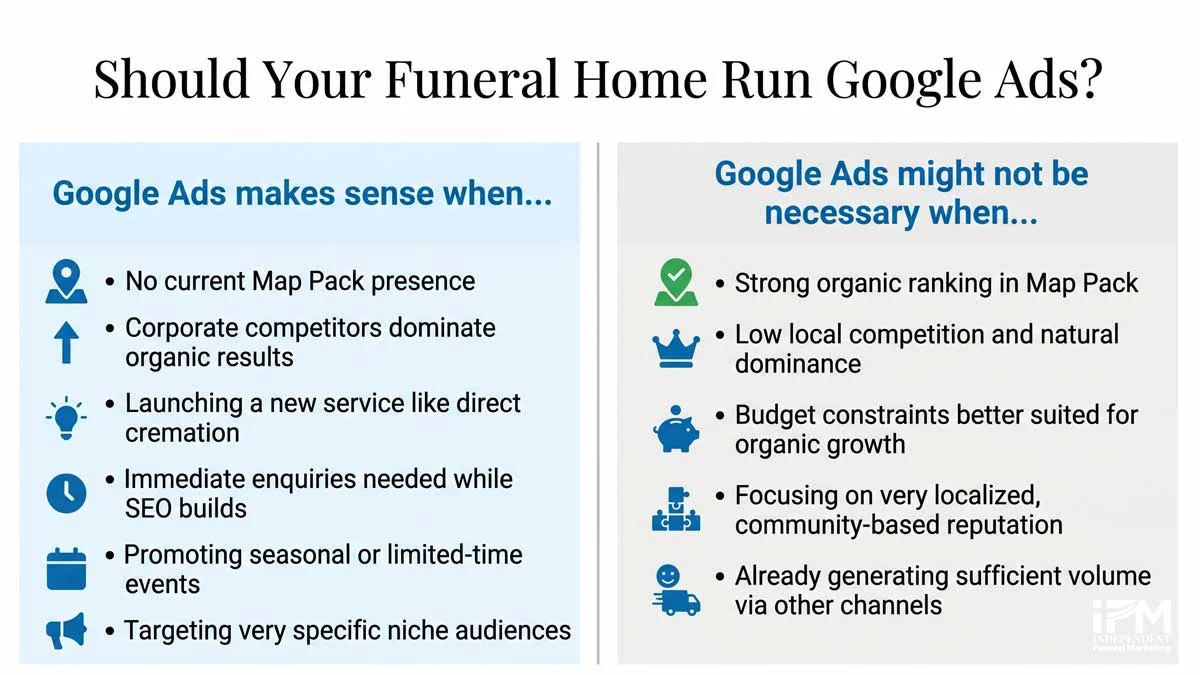
The case for using Google Ads is strongest when:
- Your funeral home has no Map Pack presence yet and needs immediate enquiries while SEO builds
- You serve an area with Dignity Funeralcare, Co-op Funeralcare, or other well-funded competitors who dominate organic results
- You have launched a new service, such as direct cremation, and want to test demand before investing in long-form content
- You are in a town or city where the CPC is low enough that the cost per enquiry is acceptable against your arrangement fee
The case is weaker when:
- Your Map Pack rankings are already strong and organic traffic is generating consistent enquiries
- Your area has very low search volume, meaning the pool of available clicks is too small to justify the campaign management overhead
- Your budget is under £300 per month, which in most UK markets is insufficient to generate reliable data
The honest answer for most independent funeral homes is: yes, with proper setup. The at-need search intent Google Ads captures is among the most commercially valuable in any business category. The question is not whether to use it, but how to structure it so it earns its budget rather than consuming it without return.
How much does Google Ads cost for a funeral home, and what budget do you actually need?
Google Ads costs for funeral homes vary by location and competition, but UK funeral homes typically require a minimum of £300 to £500 per month in ad spend to generate consistent enquiries. In competitive urban areas, effective budgets range from £800 to £1,500 per month. A $2,000 per month US budget typically generates 15 to 25 qualified enquiries per month according to published funeral home PPC keywords data from Dignified Inbound [2].
UK CPC ranges for core funeral home search terms:
| Keyword category | Estimated UK CPC range | Notes |
|---|---|---|
| At-need: “funeral directors [town]”, “funeral home near me” | £3 to £8 | Highest competition, highest intent |
| Direct cremation: “direct cremation [town]“ | £1.50 to £4 | Lower competition, growing search volume |
| Pre-need: “prepaid funeral plan”, “plan ahead funeral” | £2 to £6 | Longer consideration cycle |
| Branded: own business name | £0.30 to £1.50 | Defensive bidding, low volume |
Suggested UK budget tiers by market type:
| Market type | Minimum monthly budget | Expected outcome |
|---|---|---|
| Small town, low competition (population under 30,000) | £300 to £500 | 5 to 12 enquiries per month |
| Medium town, moderate competition (30,000 to 100,000) | £500 to £1,000 | 10 to 20 enquiries per month |
| City or high-competition area (London, Manchester, Birmingham) | £1,000 to £2,000+ | 15 to 30+ enquiries per month |
These figures assume well-structured campaigns with call tracking in place. Poorly configured campaigns in the same markets can generate zero tracked conversions on any budget. For a full breakdown of UK CPCs by keyword, location, and budget tier, see how much Google Ads cost for funeral directors in the UK.
US data from DataForSEO [3] shows CPCs ranging from $3.96 for broader funeral marketing terms up to $21.79 for high-intent local funeral service searches in major metropolitan areas. UK figures are generally lower due to smaller geographic markets and less advertiser competition outside London.
What keywords should a funeral home bid on in Google Ads, and which should it avoid?
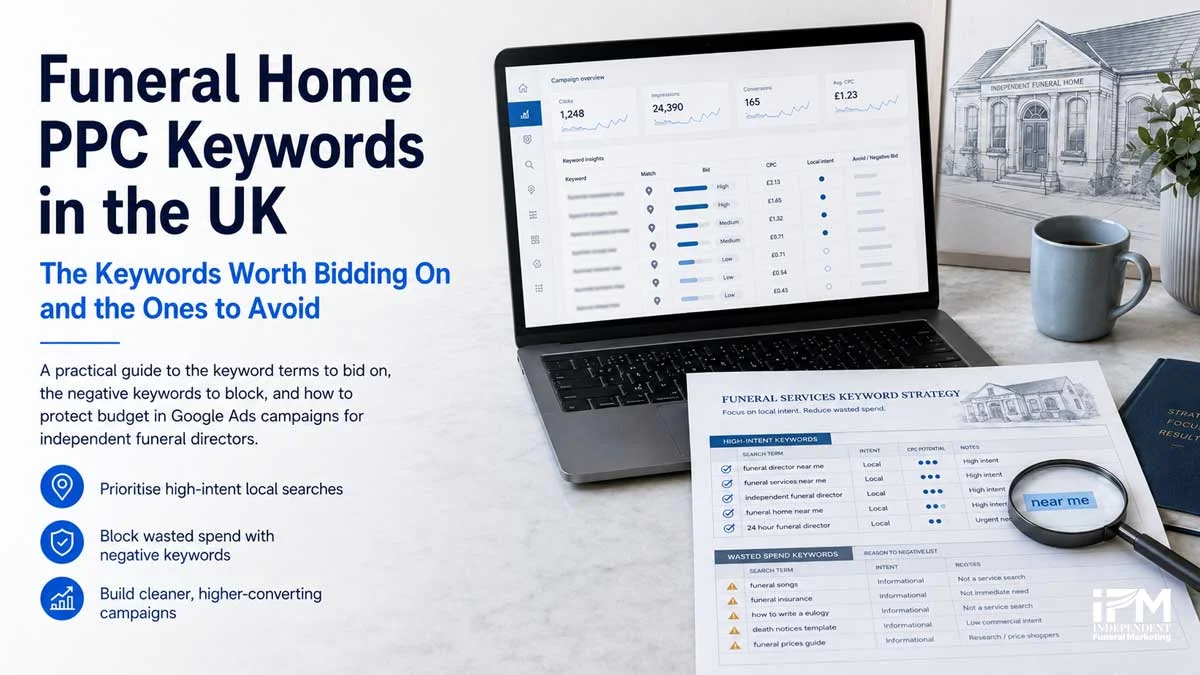
The highest-value Google Ads keywords for funeral homes are transactional and location-modified: “funeral home near me”, “funeral directors [town]”, “cremation services [town]”, and “direct cremation [town]”. These terms match families who are in immediate need, the highest-intent searches in the funeral service category. Negative keywords, terms that trigger ads but indicate no purchase intent, are equally important for preventing wasted spend.
Priority keyword tiers:
Tier 1 — Immediate at-need (bid exact and phrase match):
- funeral directors [town name]
- funeral home near me
- funeral home [postcode/area]
- cremation services [town name]
- funeral home open now
- direct cremation [town name]
Tier 2 — Service-specific (bid phrase match):
- funeral arrangements [town]
- coffin prices [town]
- funeral cost [town]
- green burial [town]
- humanist funeral [town]
Tier 3 — Branded defence (bid exact match):
- [your funeral home name]
- [your funeral home name] phone number
- [your funeral home name] reviews
Negative keyword categories (add before launch):
| Category | Example negative keywords |
|---|---|
| Employment | funeral home jobs, funeral director vacancy, funeral home apprenticeship |
| Property | funeral home for sale, funeral home business for sale |
| Education | funeral director training, how to become a funeral director |
| Informational | what to wear to a funeral, funeral etiquette, funeral poem |
| DIY/cost avoidance | free funeral, funeral financial assistance, funeral poverty payment |
| Other businesses | funeral home franchise, funeral software, funeral home supplies |
Not adding negatives before launch is one of the most expensive mistakes in funeral home PPC. Without them, a significant share of your budget will serve ads to job seekers, students, and people researching funeral customs rather than buying funeral services.
What are Google Local Services Ads, and are they better than standard Google Ads for funeral homes?
Google Local Services Ads (LSAs) are a separate advertising product from standard Google Ads. They appear above all other ads and organic results, display the funeral home’s name and star rating, and use a pay-per-lead model rather than pay-per-click. LSAs require Google verification and a background check for the business owner. For funeral homes, LSAs typically deliver higher-intent enquiries at a lower cost-per-lead than standard search ads.
The key differences:
| Feature | Standard Google Ads | Google Local Services Ads |
|---|---|---|
| Position on page | Below LSAs, above organic | Very top of results page |
| Pricing model | Pay-per-click | Pay-per-lead |
| Ad content | Customisable headlines and descriptions | Google-generated from your profile |
| Trust signal | None by default | Google Screened badge |
| Verification required | No | Yes, including background check |
| Call button | Via extensions | Built in, prominent |
| Review display | No | Yes, star rating visible |
| Control over targeting | Full keyword control | Limited, Google manages |
| Availability in UK | Full | Rolling out, check current availability |
The strategic recommendation is to pursue LSAs if they are available in your area, as the Google Screened badge and top-of-page position provide a significant trust advantage that standard ads cannot replicate. Run both in parallel if budget permits: LSAs capture the highest-intent searchers at the top, standard search ads capture the volume below.
For the underlying local search strategy that supports both, our organic SEO foundations address the profile, review, and content work that makes paid campaigns more effective.
Is Google Ads or SEO better for funeral homes, or should you use both?
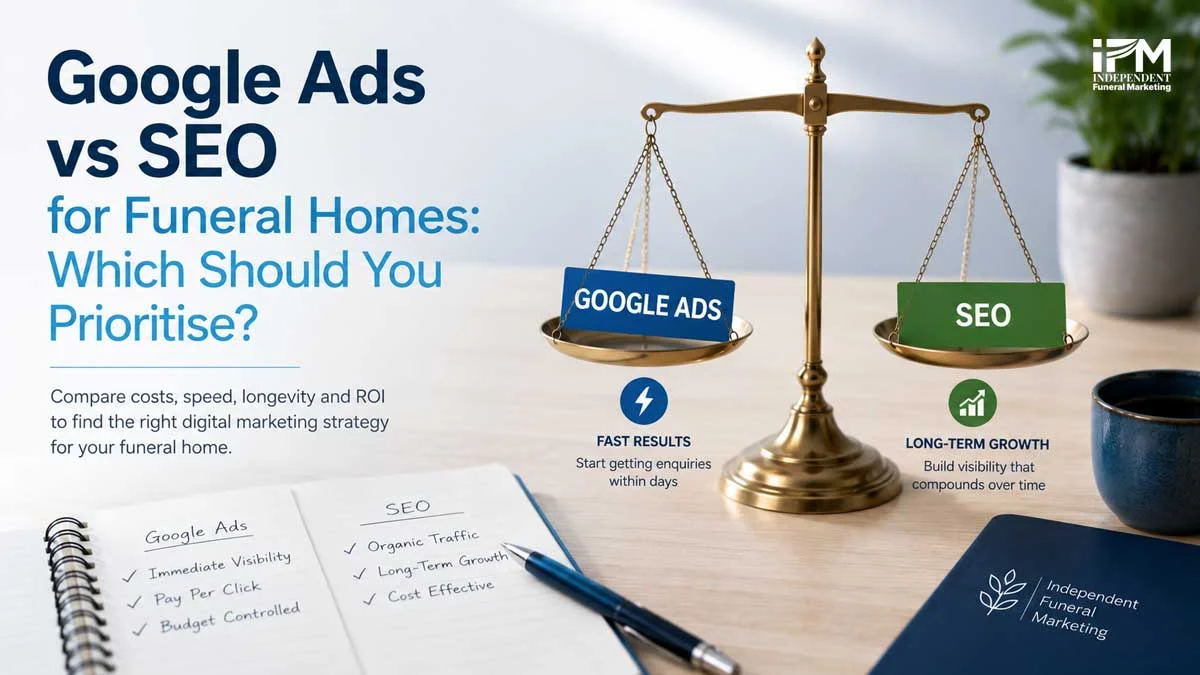
Google Ads and SEO serve different purposes for funeral homes and perform best when used together. Google Ads provides immediate visibility for at-need searches, results can be live within 24 hours, but stops the moment the budget runs out. SEO builds a permanent organic presence that generates enquiries without per-click cost, but typically requires six to twelve months to achieve competitive positions. The optimal strategy is Ads now, SEO building in parallel.
The combined approach works like this in practice:
- Month 1 to 3: Google Ads is live, generating enquiries immediately. SEO work begins: website optimisation, Google Business Profile, citation building. No organic traffic yet.
- Month 4 to 9: SEO begins to show early Map Pack appearances and long-tail organic traffic. Ads continue to carry at-need volume.
- Month 9 to 12+: Organic positions strengthen. Funeral home has both paid and organic presence for priority keywords. Ad spend can remain flat or reduce as organic takes share.
- Long term: SEO generates enquiries without ongoing per-click cost. Ads maintained for highest-competition terms or used for new service launches.
Funeral homes that run only Google Ads are permanently dependent on that spend. Funeral homes that invest only in SEO leave immediate at-need traffic to competitors while rankings build. The two are complementary, not competing. For a detailed cost and ROI comparison across both channels, see Google Ads vs SEO for funeral homes.
Should funeral homes use Google Ads or Facebook Ads, and what is the difference?
Google Ads and Facebook Ads work differently for funeral homes. Google Ads captures demand, reaching families who are actively searching for funeral services right now, at the moment of need. Facebook Ads creates demand, building brand awareness and engaging a broader audience with pre-need planning content. For at-need enquiries, Google Ads significantly outperforms Facebook. For pre-need engagement and community presence, Facebook and Instagram offer genuine value.
The core distinction is intent. A family searching “funeral directors near me” on Google has an immediate, expressed need. A person scrolling Facebook may have no thought of funeral planning. Getting someone to act on a Facebook ad requires shifting them from passive scroll to active consideration. Google captures people already in that active state.
Where Facebook and Instagram earn their place in a funeral home’s marketing:
- Building brand recognition in the local community before a family needs to search
- Pre-need planning content for older demographics in your service area
- Promoting community events, charitable work, and service launches
- Running awareness campaigns for direct cremation as an affordable option
The rule of thumb: allocate primary budget to Google for at-need, direct-response results. Use Facebook for brand building and pre-need awareness if the budget exists and someone can manage it consistently. Do not expect Facebook to replace Google’s at-need performance.
How do you set up an effective Google Ads campaign for a funeral home?
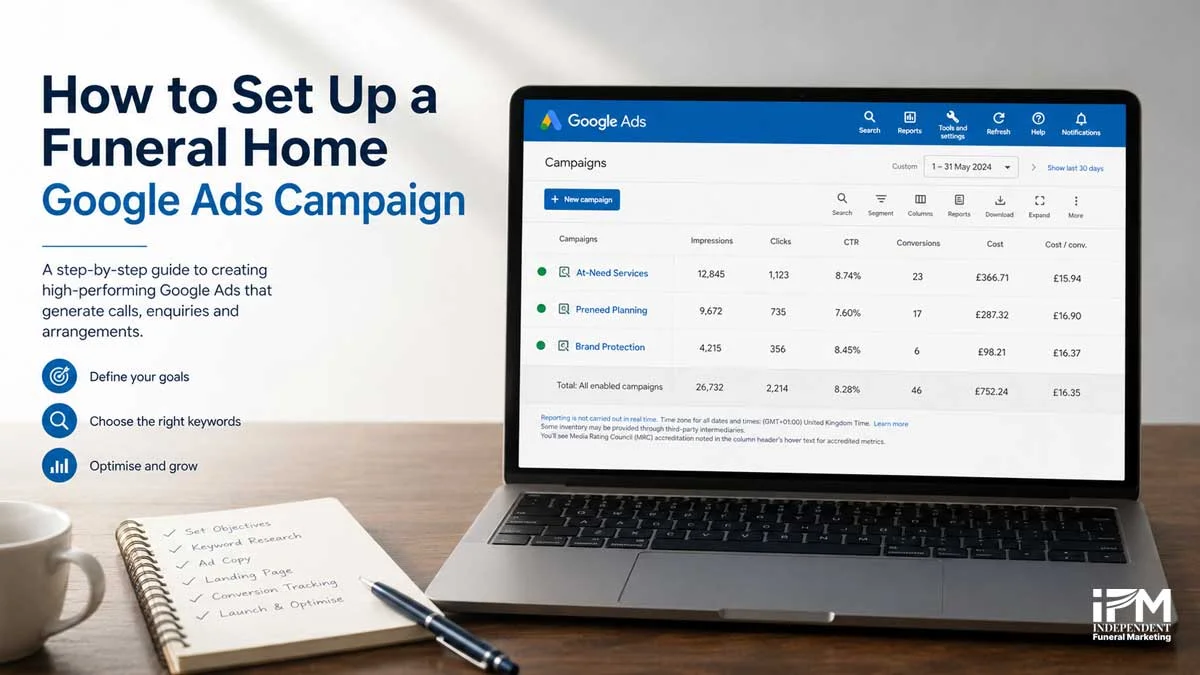
An effective Google Ads campaign for a funeral home requires five core elements: a tightly defined keyword list with essential negative keywords, ad copy that is clear and dignified without clinical coldness, a dedicated landing page for each service advertised, call tracking to record phone enquiries as conversions, and a local geographic radius set to the funeral home’s actual service area. Missing any one of these typically results in significant wasted spend.
The seven-step setup process:
1. Define your campaign structure
Create separate campaigns for each primary service: at-need funeral services, direct cremation, and pre-need planning. Separate campaigns allow independent budget allocation, separate geographic targeting where relevant, and cleaner performance data. Do not put all keywords into one campaign.
2. Build the keyword list with negatives first
Populate your Tier 1 and Tier 2 keywords from the list above. Before adding a single positive keyword, build your negative keyword list. Use the categories in the table above. Add negatives at the campaign level so they apply across all ad groups.
3. Write clear, dignified ad copy
Each ad needs three headlines (30 characters each) and two descriptions (90 characters each). Lead headline: service and location. Second headline: trust signal (years established, family-run, professional membership). Third headline: call to action. Descriptions carry the detail: what you offer, what makes you different from corporate chains, and a reassuring tone without euphemism.
Example headlines for an at-need campaign:
- “Funeral Directors in [Town]"
- "Family-Run, Est. 1987. NAFD Member"
- "Call Now for Compassionate Guidance”
NAFD and SAIF membership displayed in ad copy is a credible trust signal that independently-owned funeral homes can use where corporate chains cannot.
4. Build a dedicated landing page for each campaign
Do not send paid traffic to your homepage. Each campaign needs its own landing page with a keyword-matched H1 heading, a phone number visible above the fold with click-to-call enabled, a brief description of the service, your trust signals (years established, professional body memberships, testimonials), and a short contact form. The landing page must match what the ad promised.
5. Set up call tracking
Add a Google call extension with a forwarding number. Set a 60-second call duration as your conversion event in Google Analytics 4 or directly in Google Ads. Without this step, phone enquiries are invisible to the campaign. Google’s bidding algorithm cannot optimise for conversions it cannot see.
6. Set geographic targeting to your actual service area
If your funeral home serves a 12-mile radius, set 12 miles. If you cover a specific set of postcodes, use postcode-level targeting. Broad targeting is the fastest way to waste budget on clicks from outside your service area.
7. Choose the right bid strategy
Start with Manual CPC. This gives you control and visibility while the campaign accumulates data without algorithmic interference. Once you have 30 to 50 conversions recorded, switch to Target CPA. At that point, Google’s algorithm has enough data to optimise bids against your actual conversion cost.
Why are funeral home Google Ads not converting, and how do you fix it?
The most common reason funeral home Google Ads fail to convert is not the ads themselves, it is tracking failure. If call tracking is not set up, phone enquiries are invisible to Google’s algorithm, and the campaign receives no conversion signals to optimise against. The result is ads that appear to generate zero results while actually generating calls that are simply not being recorded.
The five most common failure points, and what to do:
Problem 1: No call tracking Fix: Add a Google forwarding number via call extensions. Set a 60-second call duration as a conversion event. Verify in the Google Ads conversion tracking dashboard that calls are being recorded before increasing budget.
Problem 2: Traffic sent to the homepage Fix: Build a service-specific landing page for each campaign. Homepage bounce rates for paid traffic are typically 70 to 85 percent. A dedicated landing page aligned to the ad’s message reduces this significantly.
Problem 3: Broad match keywords without negatives Fix: Audit your search term report weekly in the first month. Every irrelevant query that triggered an ad should be added as a negative. The search term report is the single most important optimisation tool in the early weeks of a campaign.
Problem 4: Insufficient budget for the market Fix: Review the keyword competition for your area. If average CPC is £5 and your daily budget is £5, you are running one click per day. In a competitive area, that produces no meaningful data. Budget must be sufficient to generate at least 10 to 15 clicks per day to generate actionable insights.
Problem 5: Ad copy that is too clinical or too generic Fix: Review CTR by ad. If click-through rate is below 3 percent on at-need terms, the ad copy is not compelling. Test headlines that speak directly to the family’s situation, not corporate-sounding descriptions of your services.
How do you measure whether Google Ads are working for your funeral home?
The primary metric for funeral home Google Ads is cost per enquiry, the total monthly ad spend divided by the number of qualified phone calls or form submissions the campaign generates. This is the only metric that directly connects advertising investment to business outcomes. Clicks, impressions, and CTR are operational metrics, useful for campaign management but not the measure of whether the campaign is earning its place in the budget.
Key benchmarks for a well-managed funeral home Google Ads campaign:
| Metric | Benchmark range | Notes |
|---|---|---|
| Click-through rate (CTR) | 5% to 12% for at-need terms | Below 3% indicates weak ad copy or poor keyword/ad match |
| Conversion rate (click to enquiry) | 8% to 20% | Depends heavily on landing page quality and call tracking setup |
| Quality Score | 7 to 10 | Below 6 means you are paying more per click than competitors with better copy |
| Impression share | 40% to 70% target | Below 30% in your core area suggests budget or bid is too low |
| Cost per enquiry (target) | £30 to £120 depending on location | Compare against your average arrangement fee, not just ad cost |
A funeral home with an average arrangement fee of £3,500 and a cost per enquiry of £80 is spending 2.3 percent of revenue on acquisition. That is commercially sound. A campaign generating enquiries at £400 each is not, regardless of how impressive the click volume looks.
Monthly reporting should track cost per enquiry as the headline number, supported by conversion volume, Quality Score trends, and search term report analysis. Everything else is secondary.
How should Google Ads fit into an independent funeral home’s wider marketing strategy?
Google Ads works best as one component of an integrated funeral home marketing strategy, not as a standalone solution. Used in isolation, Google Ads generates immediate visibility but no long-term asset. Combined with local SEO, a well-optimised Google Business Profile, content marketing, and consistent reputation management, Google Ads accelerates the visibility that the rest of the strategy is building.
The strategic framing is straightforward. Google Ads buys time. It generates enquiries while the longer-term assets, organic rankings, Map Pack position, and review volume, are being built. Once those assets are established, Google Ads transitions from a primary enquiry source to a supplementary channel for competitive terms and new service launches.
For independent funeral homes competing against Dignity or Co-op Funeralcare, this sequencing matters. Corporate chains have marketing budgets that can sustain Google Ads indefinitely. An independent cannot compete purely on paid spend over the long term. The advantage shifts when the independent has strong organic rankings, a well-reviewed Google Business Profile, and deep local content, all things corporate chains typically underinvest in.
For a comprehensive picture of how Google Ads fits within a full marketing system, the Google Ads guides for funeral directors cover the complete channel mix and campaign setup. IFM works exclusively with independent funeral directors, building this integrated system around your specific market and competition.
Frequently Asked Questions: Google Ads for Funeral Homes
Can funeral homes run Google Ads?
Yes, funeral homes can run Google Ads on the Search Network. There are no restrictions on keyword-targeted search advertising. Google does prohibit personalised advertising and remarketing based on bereavement status, but standard keyword campaigns remain fully permitted and are the primary vehicle for at-need funeral home advertising.
Are there restrictions on Google Ads for funeral homes?
Yes. Google classifies bereavement as a sensitive personal hardship category under its personalised advertising policy. Funeral homes cannot use remarketing lists, Customer Match audiences, or interest-based targeting when bereavement is the audience signal. Standard keyword search campaigns are unaffected. The restriction is on targeting people because of their bereavement, not on advertising funeral services to people who search for them.
Can funeral homes use remarketing on Google?
No, not when bereavement is the basis of the audience. Google explicitly prohibits personalised advertising, including remarketing, targeting people based on personal hardships such as bereavement. Funeral homes cannot run RLSA or display remarketing campaigns where the audience definition is derived from bereavement intent. A blanket remarketing list of all website visitors, not segmented by bereavement, sits in a grey area and should be approached with caution.
What is a good budget for funeral home Google Ads in the UK?
For a small town with low competition, £300 to £500 per month is a workable starting point. Medium-sized towns with established competitors typically require £500 to £1,000 per month. London and other major cities where corporate chains dominate paid results require £1,000 to £2,000 or more per month to achieve meaningful impression share. Budget below these thresholds generates insufficient click volume to draw reliable conclusions.
How much does Google Ads cost per click for funeral services?
UK CPCs for at-need funeral search terms range from £3 to £8 for high-intent local terms such as “funeral directors [town]”. Direct cremation terms are typically lower at £1.50 to £4. Branded keyword bids on your own business name cost £0.30 to £1.50. US data shows CPCs from $3.96 to $21.79 depending on market competitiveness. UK costs are generally lower outside London.
What keywords should funeral homes bid on?
Priority keywords are transactional and location-modified: “funeral directors [town]”, “funeral home near me”, “cremation services [town]”, “direct cremation [town]”, and “funeral home open now”. These match at-need intent and deliver the highest conversion rates. Equally important are the negative keywords you exclude: employment terms, business sale queries, educational searches, and informational queries must be added before launch to prevent budget waste.
What are Google Local Services Ads for funeral homes?
Google Local Services Ads are a separate product from standard Google Ads. They appear at the very top of search results, above all paid ads and organic listings, and display your business name, star rating, and a direct call button. They operate on a pay-per-lead rather than pay-per-click model and carry a Google Screened trust badge. Where available, LSAs are the highest-value paid position for a funeral home because they combine top placement with visible social proof.
What is the difference between Google Ads and Google Local Services Ads?
Standard Google Ads are pay-per-click with full creative control over headlines, descriptions, and keyword targeting. Google Local Services Ads are pay-per-lead, appear above standard ads, require Google verification and background checks, and carry a Google Screened badge. LSAs offer higher page position and better trust signals; standard Google Ads offer more targeting flexibility and broader keyword coverage. The optimal approach is to run both where budget permits.
Is Google Ads or SEO better for funeral homes?
They serve different purposes. Google Ads provides immediate at-need visibility from day one but requires continuous spend. SEO builds long-term organic presence that generates enquiries without per-click cost but takes six to twelve months to show competitive results. The most effective strategy is to run Google Ads while SEO builds, then reduce ad dependency as organic rankings develop. Neither alone is optimal.
Should funeral homes use Google Ads or Facebook Ads?
Google Ads and Facebook Ads serve different functions. Google Ads captures demand from families actively searching for funeral services, the highest-intent moment in the purchase journey. Facebook Ads creates demand by building brand awareness for pre-need planning. For at-need enquiries, Google Ads significantly outperforms Facebook. For pre-need community presence and brand building, Facebook and Instagram are valuable. Budget priority should be Google for at-need, Facebook as a secondary channel.
Why are my funeral home Google Ads getting zero conversions?
The most common cause is call tracking not being configured. Google Ads measures clicks, not calls, by default, and most funeral home enquiries come by telephone. Without a Google forwarding number and a call duration conversion event, every phone enquiry is invisible. Other common causes are sending paid traffic to the homepage rather than a dedicated landing page, running broad match keywords without a negative list, and budgets too low for the local CPC environment.
How do I track phone calls from funeral home Google Ads?
Add a Google call extension with a forwarding number in the Google Ads Extensions tab. In your conversion settings, create a Phone Call conversion with a 60-second minimum duration threshold. This records calls lasting over one minute as measurable conversions and feeds the data to Google’s bidding algorithm. Without this setup, smart bidding strategies have no signal to optimise against.
How long does it take to see results from funeral home Google Ads?
Enquiries can arrive within 24 to 48 hours of a campaign going live, provided the campaign is correctly structured and the area has active search volume. Meaningful performance data for optimisation requires 30 days minimum. Smart bidding strategies such as Target CPA need 30 to 50 recorded conversions before they optimise reliably. Budget for at least 90 days of consistent running before drawing conclusions about campaign viability.
How do independent funeral homes compete with corporate chains on Google Ads?
The advantage for independent funeral homes is local precision and authentic credentials. Target hyper-local keywords with town and postcode modifiers that corporate chains often overlook in favour of broad category terms. Use ad copy that emphasises local ownership, named family contacts, and years of community service. Bid on your own business name to prevent competitors capturing branded searches. Call extensions allow you to display a direct personal number, where corporate chains route to call centres.
What landing page should a funeral home use for Google Ads?
Paid traffic should always go to a service-specific landing page, not the homepage. The landing page needs a keyword-matched H1 heading, a click-to-call phone number visible above the fold, a concise service description, trust signals such as professional body memberships and years established, and a simple contact form. Sending paid traffic to a homepage with multiple navigation options and no clear call to action reduces conversion rates by 30 to 50 percent compared to a focused landing page. For the Google Ads for funeral homes service, this is included as standard.
References
[1] Google Ads Help, Personalised advertising policy, support.google.com/adspolicy/answer/143465
[2] Dignified Inbound, published data on funeral home Google Ads performance, November 2025, dignifiedinbound.com
[3] DataForSEO, Keyword Research Report: Google Ads for Funeral Homes, April 2026, dataforseo.com