If you’ve ever searched for your own funeral home on Google and seen Dignity or Co-op Funeralcare sitting above you in the results, you’ll know the frustration. They have dedicated marketing teams, significant content budgets, and domain authority that has been built over years. On the face of it, the numbers don’t look encouraging for an independent firm.
But that picture is only half the story. There are two separate competitions happening in Google search, and most funeral directors are measuring their performance in the wrong one. The competition that actually determines whether a family contacts you, whether your name appears when someone in your town searches for help in the worst moment of their life, plays by a different set of rules. And those rules happen to favour independent funeral homes in ways that no marketing budget can simply replicate.
This article makes a specific, evidence-based argument: independent funeral homes can outperform corporate chains in local search, the Google local pack and “near me” results, because of structural advantages that are built into what it means to be a single-location, owner-operated business embedded in a community. The evidence from actual SERP data supports it. But those advantages don’t activate automatically. They require attention.
What is local search, and why is it a different competition to broad organic SEO?
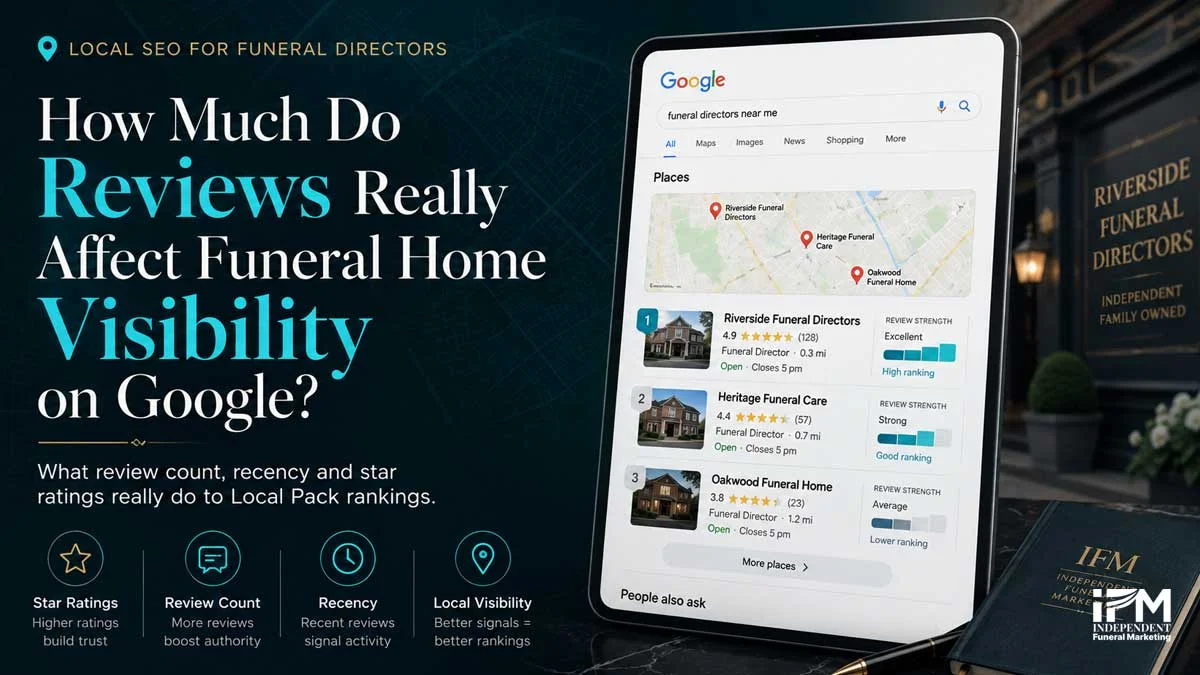
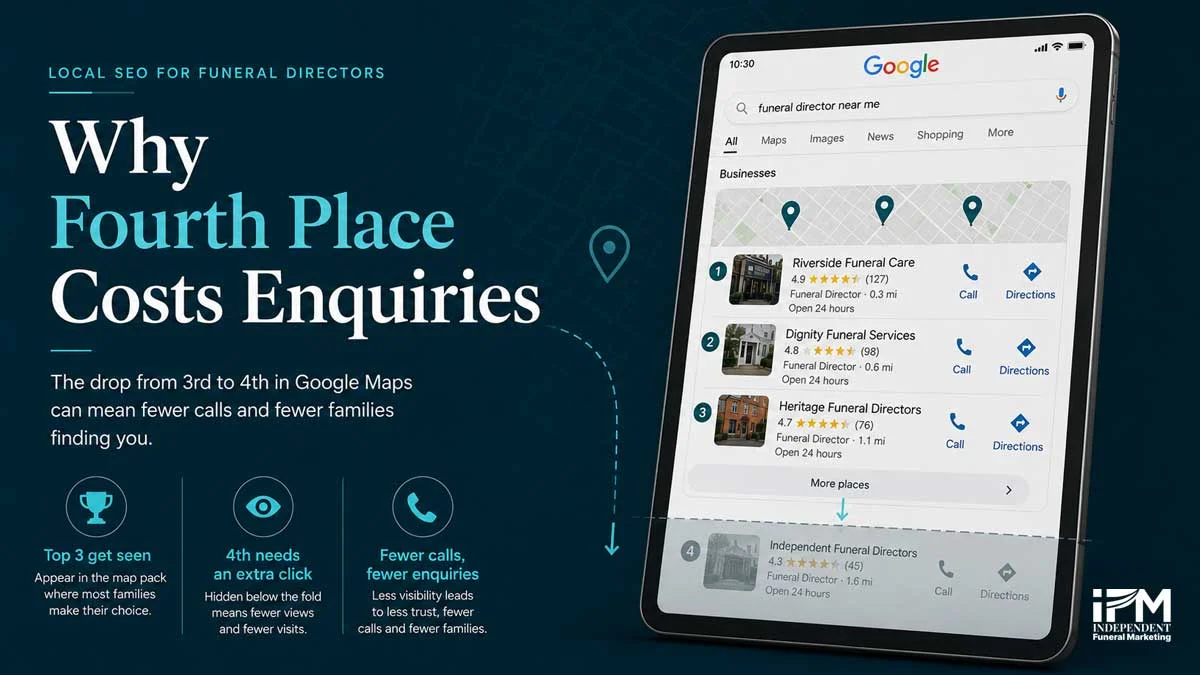
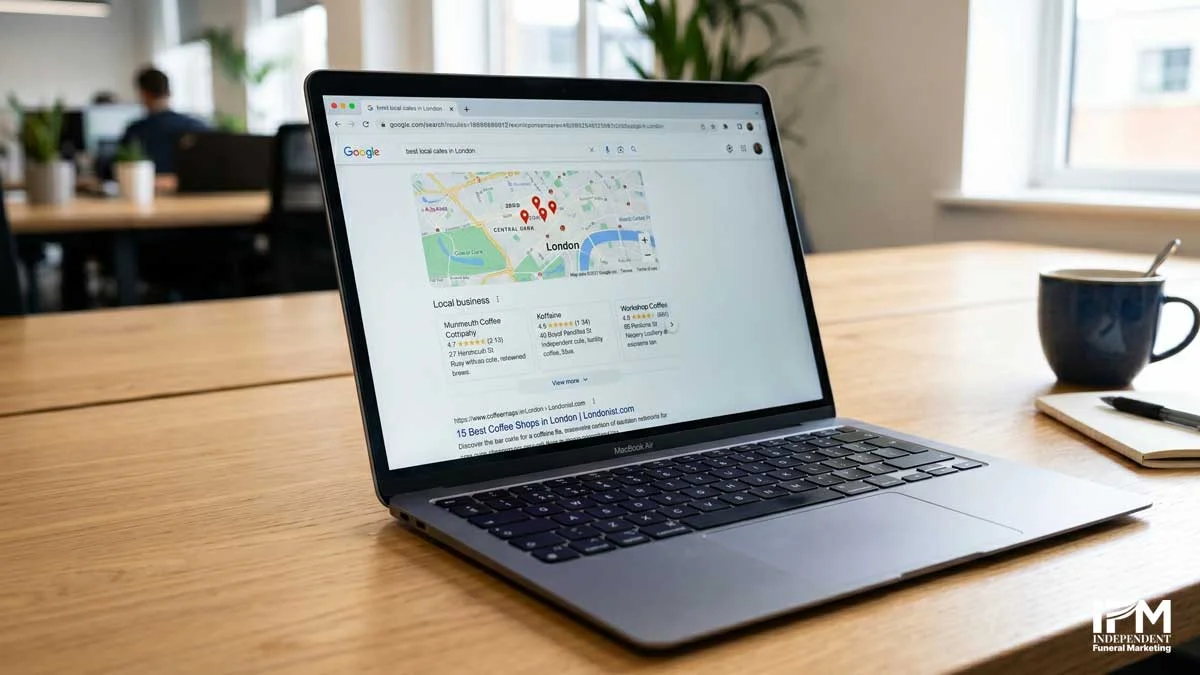
Local search refers to Google results triggered by proximity-intent queries: searches that include “near me”, a town name, or an implicit location signal from the searcher’s device. For funeral services, the dominant local search result is the Google local pack, the block of three business listings with a map that appears above all organic website results, capturing the majority of clicks for at-need queries.
This is the primary conversion point. “Funeral directors near me” is searched around 9,900 times a month in the UK (DataForSEO, September 2026). “Funeral home near me” is searched around 200,000 times a month in the US (DataForSEO, September 2026). Research suggests the local pack captures approximately 44% of all clicks for local search queries, and for high-urgency at-need searches, that concentration is likely higher still. A family making contact on the day of a bereavement is not scrolling past the first three visible results.
The local pack is powered by different signals to the organic results below it. Local pack results are determined primarily by proximity to the searcher, Google Business Profile completeness and activity, and local prominence signals including reviews, citations, and community presence. Organic results, the website listings below the map, are determined primarily by domain authority, content quality, and backlinks.
This distinction matters enormously. It means the competition for the three local pack positions is not the same competition as the race for organic search rankings. They share some signals, but they’re weighted very differently, and that difference is where the opportunity for independent funeral homes lies.
To understand what families are looking for when they search funeral directors near me, it helps to start with the SERP itself: who appears, and why.
Do corporate funeral chains have better SEO than independent funeral homes?
Corporate funeral chains have significant advantages in broad organic SEO. Higher domain authority, larger content budgets, and established technical infrastructure all contribute to national-level visibility. The numbers are clear: coop.co.uk’s parent domain ranks for over 121,447 keywords in the UK and attracts an estimated 3 million monthly organic visits (DataForSEO, April 2026). dignityfunerals.co.uk ranks for more than 12,618 keywords (DataForSEO, April 2026). Most independent funeral home websites rank for a fraction of those numbers.
That’s the honest picture. A reader who has watched Dignity outrank them for a broad term like “funeral services” is right to notice the gap. Corporate chains have invested heavily in content, technical SEO, and brand authority over many years, and it shows in organic search.
But this comparison measures the wrong battlefield for an independent firm’s marketing objectives. The domain authority gap matters for national brand terms and informational content. It does not automatically translate into local pack dominance for the specific town or postcode that an independent funeral home actually serves.
Consider this: despite Dignity Funerals’ significant domain authority, SERP data shows independent firms holding local pack positions above Dignity branches in many local searches. Proximity and local signals frequently level the playing field in ways that a marketing budget cannot simply override.
The distinction to hold clearly in mind is this. Corporate chains are strong competitors in organic SEO and national brand visibility. That’s where their spending buys real advantage. The local pack is a different kind of competition, one that rewards local presence, local data accuracy, and local trust signals, and those are areas where independent firms have inherent structural strengths.
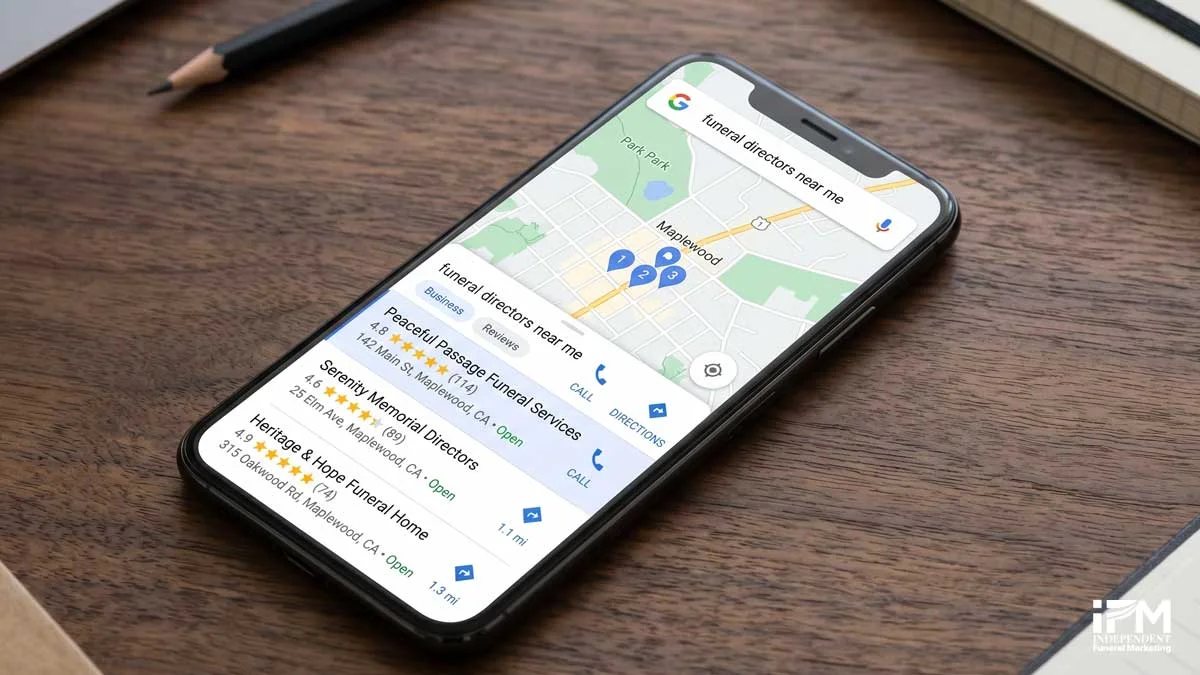
How does Google’s local ranking algorithm actually work for funeral home searches?
Google’s local ranking algorithm determines which businesses appear in the local pack using three documented signals: relevance, distance, and prominence. For funeral home searches, understanding how each signal works is the foundation for understanding why independent firms can compete effectively.
Relevance: does your profile match what families are searching for?
Relevance measures how closely a business’s Google Business Profile matches the search query. It’s controlled by the primary and secondary categories selected on the GBP, the business description, service listings, and how well the website content aligns with the same themes. An independent firm with a single, clearly defined GBP category, “Funeral Home” or “Funeral Director,” has a relevance advantage over a chain branch that may carry multiple service categories across a wider area, diluting the match signal for any single query type.
Distance: the ranking factor no budget can buy
Distance is the most democratising factor in local search. Google uses the searcher’s IP address, GPS location, or stated location to calculate physical proximity. A funeral home 0.4 miles from the searcher will naturally outperform a chain branch 4 miles away in proximity-weighted results, regardless of the chain’s domain authority or advertising spend. An independent funeral home that is genuinely in a town, with a registered address, a physical premises, and a GBP location pin in that town, simply is local in a way that a hub-and-spoke chain branch cannot fully replicate for every community it nominally serves.
Prominence: where independent firms can build real advantage
Prominence reflects how well-known and trusted Google believes a business to be. It’s driven by review volume and velocity, local citation accuracy, domain authority, and brand mentions across the web. This is where chains have the most budget-driven advantage, but it’s also where consistent, independent effort by a single firm can build genuine competitive strength. A well-maintained and fully optimised Google Business Profile, a consistent stream of authentic reviews, and accurate citations across local directories all build prominence incrementally, and they compound over time.
What structural local SEO advantages do independent funeral homes have over corporate chains?
Independent funeral homes have five structural local SEO advantages over corporate chains: physical proximity to their service community, single-location Google Business Profile consistency, the capacity to generate higher-density authentic reviews, genuine hyperlocal content knowledge, and community prominence signals. None of these advantages can be replicated simply by increasing marketing spend. They’re built into the model of an owner-operated, single-location business embedded in a specific community.
Proximity
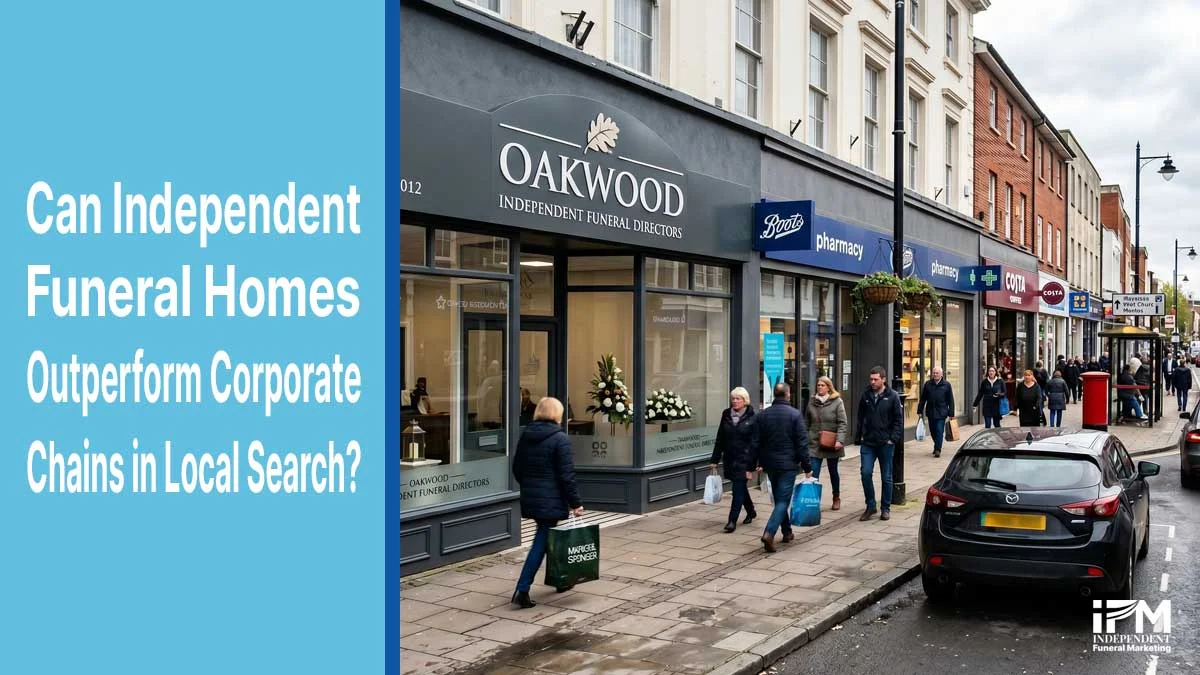
An independent funeral home in a town is the local funeral home. Its registered address, its GBP location pin, and its physical premises are all in the town families are searching from. A Co-op or Dignity branch that nominally serves multiple towns from a hub address is, for proximity purposes, further from some searchers than the independent that has been on the high street for 40 years.
Google’s distance factor is documented in its local search guidelines as a primary ranking signal. It cannot be gamed with budget. No amount of advertising spend moves a business closer to the searcher. For independent firms, this is an advantage that simply exists, as long as the GBP address is accurate and verified.
Single-location GBP consistency
One location means one Google Business Profile to maintain. One address. One phone number. Zero risk of NAP (Name, Address, Phone) conflict between locations. Co-op Funeralcare manages over 1,000 UK branch profiles simultaneously. Maintaining data quality, review response times, local content, and NAP consistency across that many profiles is structurally difficult in a way that a single-location firm never faces. One incorrect address update, one unclaimed branch profile, one outdated phone number, compounds across hundreds of listings. An independent firm has none of that complexity. Its GBP data is inherently cleaner, and clean entity data is a ranking signal.
Authentic review generation
A funeral home that conducts 80 to 100 funerals per year in one town, served by the same owner and family who live in that community, has the conditions to generate authentic, emotionally resonant Google reviews. These reviews reference the town, name staff, and describe specific personal moments. They’re the kind of review that signals to Google that a business is genuinely local and genuinely serving real customers in that place.
Review velocity, the rate at which new reviews accumulate, is rated highly by local SEO experts, though Google hasn’t confirmed it as a factor. A corporate chain branch conducting higher volumes across a wider area doesn’t generate the same review density in any single location. The personal, one-to-one nature of bereavement care creates a connection that produces these responses naturally. It’s a structural capability, not a guaranteed outcome, but independent firms have the conditions for it in ways that chains don’t.
Hyperlocal content knowledge
The owner-operator of an independent funeral firm knows every crematorium, church, and cemetery in their service area. They know local customs, local community figures, and local bereavement charities. They know which roads close on a Saturday morning and which church requires a specific arrangement for a committal. That knowledge is the raw material for hyperlocal content: service area pages, community guides, and blog posts that no chain copywriter producing standardised branch templates can replicate with the same authority or specificity.
Google’s local algorithm rewards genuine local relevance. Content that demonstrates it, authentically and specifically, builds the kind of topical signals that branch-level chain content simply cannot match. Understanding the specific search terms and intent behind how local families search for funeral services is the starting point for that content strategy, and keyword research for funeral directors covers the data in detail.
Community prominence signals
Independent funeral homes are embedded in their communities in ways that chains aren’t. Local newspaper coverage of a charity fundraiser. A mention in a local bereavement support group. A link from the parish council website. Sponsorship of a community event. These unstructured citations and local links are prominence signals that Google factors into local rankings. They accumulate organically over years and decades for established independent firms, and they represent a form of community trust that can’t be manufactured at scale.
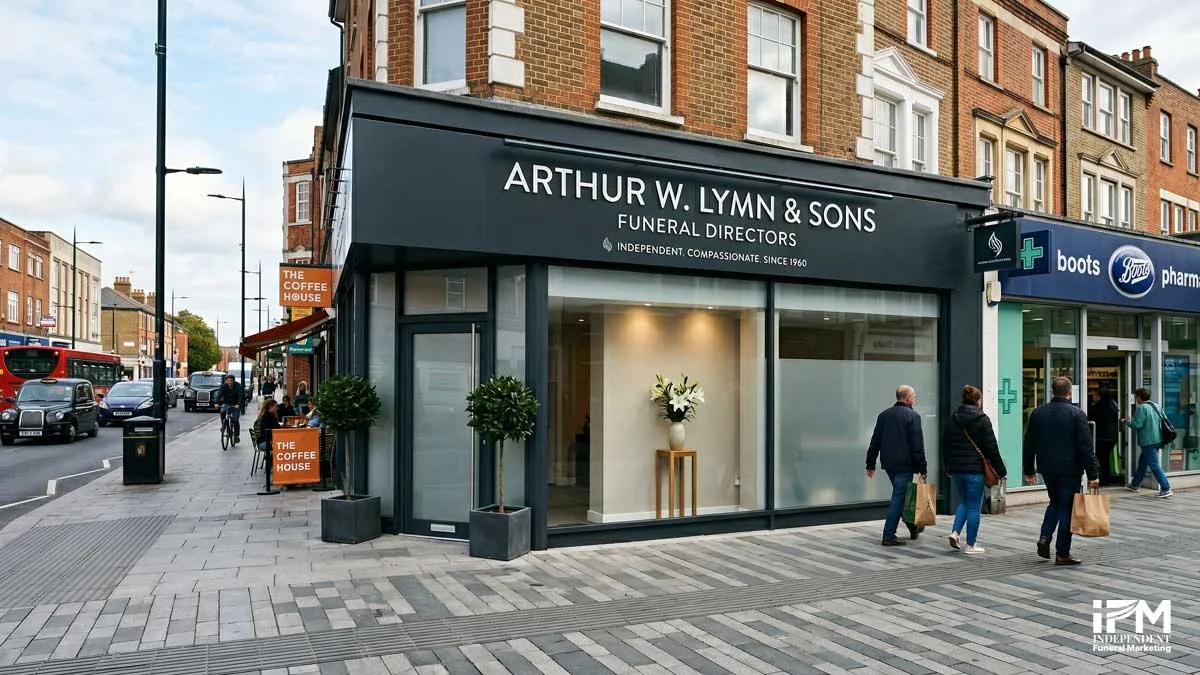
Why do corporate funeral chains struggle to maintain local search presence at branch level?
Corporate funeral chains face a specific local search challenge that doesn’t affect independent firms: maintaining accurate, optimised, and active Google Business Profiles across hundreds of branch locations simultaneously. Co-op Funeralcare operates over 1,000 locations in the UK. Managing GBP data quality, review responses, local content, and NAP consistency at that scale is structurally difficult in a way that no single-location firm ever encounters.
Multi-location GBP management at scale. Hundreds of profiles mean hundreds of potential data quality issues: unclaimed branches, outdated phone numbers, wrong categories, incorrect addresses after a branch move. Each one is a ranking suppression risk. The chain’s marketing team cannot be in 1,000 places at once, and local managers rarely have the digital expertise to maintain their GBP effectively without central support.
Standardised content equals thin local relevance. Chain branch pages often share identical or near-identical content templates, with only the town name changed. Google’s local algorithm de-prioritises thin local content in favour of pages and profiles that demonstrate genuine hyperlocal relevance. An independent firm’s genuine local knowledge, written naturally, consistently outperforms a template in this respect. The structural and content elements that make a page locally relevant in Google’s assessment are covered in the on-page SEO guide for funeral homes.
Centralised management means absent engagement. The person managing a branch GBP is often a head-office marketing team, not the local manager. Review responses are delayed or templated. Local questions go unanswered. GBP posts go unpublished for months. A firm that responds to every review within 48 hours and posts regularly shows families that the business is active and locally managed.
Corporate acquisition disrupts everything. When a chain acquires an independent, it typically changes the business name, may change the address or phone number, and needs to reclaim the GBP. Each change is a local SEO disruption event. Review history associated with the old name may not fully transfer. Citation data across hundreds of directories needs updating, creating a window of NAP inconsistency that can hold back local rankings.
What does the SERP evidence show about independent funeral homes in local search?
Analysis of Google local pack results across multiple crawl dates in Q4 2025 and Q1 to Q2 2026 reveals a consistent pattern. For qualified local searches, those that include the word “independent,” “best,” or “local family,” independent funeral firms occupied all three local pack positions in every instance recorded. Corporate chains were absent. For unqualified proximity searches, chains appeared in some local pack positions, confirming that the advantage for independents is concentrated in searches where families are actively expressing a preference (DataForSEO Historical SERP, April 2026).
| Search query | Local pack composition | Corporate chains present? |
|---|---|---|
| “funeral directors near me” (UK) | Mixed, Dignity held positions in 2 of 3 crawls (Feb 2026) | Yes, when branch GBPs are maintained |
| “independent funeral directors near me” (UK) | 100% independent firms across all crawl dates | No, zero presence confirmed |
| “best funeral directors near me” (UK) | 100% independent and regional family firms | No, absent or marginal |
The finding for “funeral directors near me” is worth holding honestly. In February 2026, Dignity Funerals appeared in two of three local pack positions for this query. Chains can rank locally when their branch GBPs are well-maintained. This is not a competition where independent firms win automatically.
But the picture for qualified searches is striking. For “independent funeral directors near me,” all three local pack positions in every crawl (December 2025, January 2026, March 2026) were occupied by independent firms. Zero corporate chain presence. Families who add that word to their search have already made a preference decision, and Google’s algorithm reflects it entirely.
For “best funeral directors near me,” the local pack across all crawl dates was dominated by independent and regional family firms: R. Good Funeral Services, J F Knight Independent Family Funeral Directors, Full Circle Funerals, CM Walkers, Fosters. The common thread is personal service, community roots, and authentic review profiles.
The interpretive point is clear. When searchers self-qualify, adding words that signal a preference for independence, quality, or local ownership, the SERP self-selects for independent firms. Families who search this way are higher-intent prospects who have already filtered out the corporate chains themselves.
How do Google reviews give independent funeral homes a local search edge?
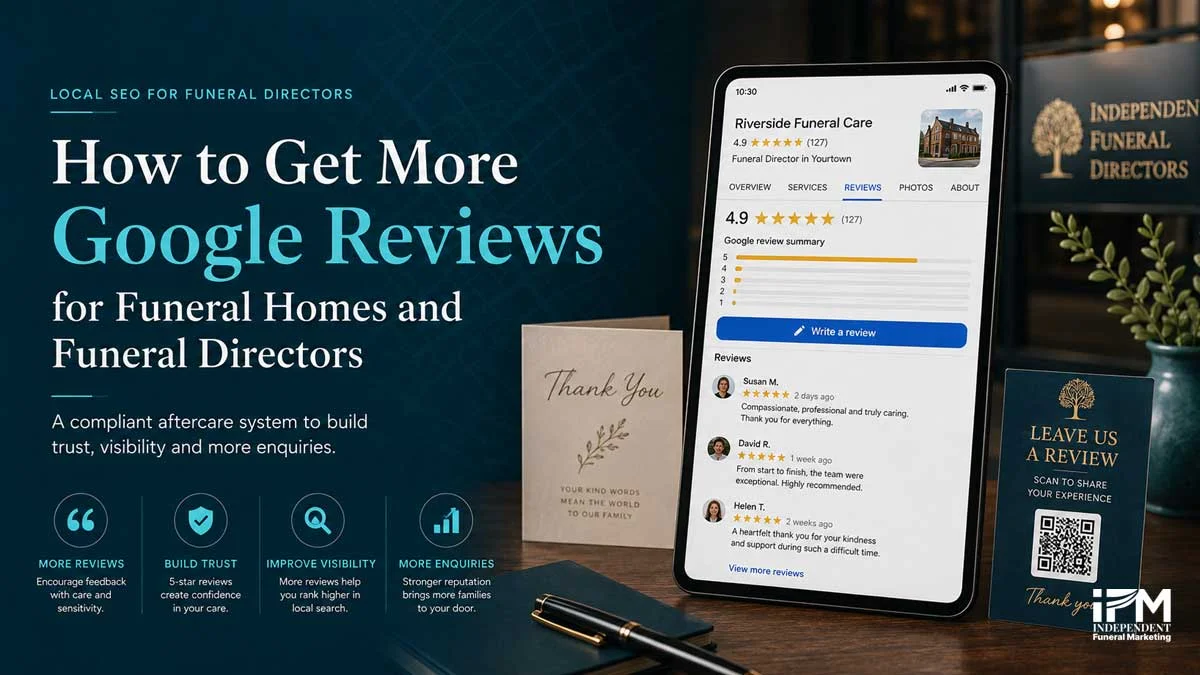
Google reviews are a confirmed local ranking signal, affecting both local pack position and the click-through rate of local search listings. Independent funeral homes have a structural advantage in review generation: the personal, one-to-one nature of bereavement care creates the conditions for authentic, emotionally resonant reviews that families choose to share publicly, and that Google’s algorithm treats as genuine quality signals.
Why review velocity matters. Local SEO experts rate a steady flow of recent reviews highly, and families notice when the newest review is two years old. A firm receiving two to three reviews per month presents a very different profile from one with the same star rating but no recent activity. Reviews need to keep coming in, which means the ask process needs to be a consistent part of how a firm operates after each funeral.
Why independent firms can generate higher review density. A funeral home serving 80 to 100 families per year in one community generates reviews that are geographically concentrated. Every reviewer is, in effect, a local customer of the same firm, in the same town. A chain branch serving a wider area generates reviews spread more thinly across multiple communities, diluting the local density signal in any one place.
Why review authenticity matters. When families choose, unprompted, to mention a member of staff, the town, or a specific moment of personal care, the review reads as genuinely local and genuinely earned. Google’s review policy says businesses shouldn’t ask for that kind of content, so it has to come naturally. These reviews are harder to earn at chain scale, where the service model is necessarily more standardised and the personal connection between the family and a single named director is less consistent.
A consistent approach to asking for, managing, and responding to reviews is a core part of any local visibility strategy.
How does a single-location Google Business Profile give independent firms a local SEO advantage?
A Google Business Profile for a single-location funeral home is inherently cleaner, more consistent, and easier to optimise than a branch profile within a multi-location corporate chain. One address, one phone number, one set of service listings, and one review pool means no NAP conflict, no duplicate location confusion, and no diluted category signals, all of which contribute to more reliable local pack eligibility.
NAP consistency. One address and one phone number means zero risk of location data conflict between the GBP and directory citations across the web. NAP inconsistency across listings is a documented local ranking suppression factor. For a chain managing hundreds of branch profiles, even a single incorrect update can create inconsistency across dozens of dependent citation sources. An independent firm’s data is consistent by default.
Category clarity. A single-location funeral home selects its primary GBP category, “Funeral Home” or “Funeral Director,” and secondary categories, without needing to accommodate multiple service areas or diverse service types. That clarity of category signal strengthens relevance matching.
Q&A and post engagement. The owner or senior staff member of an independent firm can personally respond to Google Q&As and publish relevant local posts. Chain branches rarely have this operational capacity. Posts and Q&As are either ignored or handled by a distant marketing team, with responses delayed and personalisation absent. Active GBP engagement is a ranking signal. An engaged, locally managed profile consistently outperforms a passive one.
Photo quality and recency. One location means one team’s care over one GBP’s photo library. Fresh, locally authentic photographs of the actual premises, the actual staff, and the actual service environment outperform stock imagery and outdated uploads. For families evaluating providers before making contact, photographs are often the deciding factor between two otherwise similar listings.
As covered in our GBP guide for funeral directors, the completeness and activity of the GBP is the single highest-return action available to any funeral home for local search visibility.
What happens to a funeral home’s local search presence when a corporate chain acquires it?
When a corporate funeral chain acquires an independent funeral home, the business typically undergoes changes that disrupt its local search presence: the business name changes to the chain’s brand, the Google Business Profile may require reclaiming or updating, and local review history associated with the original business name is effectively orphaned. Each of these is a local SEO disruption event.
The GBP name change. When a business is renamed from, say, “Smith and Sons Funeral Directors” to “Co-op Funeralcare, Anytown,” families searching for the original name lose the connection. Reviews under the old name may not fully transfer or retain their association with the new listing. The community trust that the original firm built over years, reflected in those reviews and searches, doesn’t automatically move with the brand.
Address and phone changes. Chains sometimes consolidate branch operations, changing the registered address or contact number in the process. Any address change is a local SEO disruption. The GBP needs updating, citations across dozens of directories need correcting, and until that process is complete, NAP inconsistency can hold back local rankings.
Review continuity. Families who knew the local funeral directors may not recognise the chain brand. Organic review generation, the rate at which new reviews accumulate from local families, often slows after acquisition as the personal connection between the community and the business is reset.
Citation update requirements. Hundreds of directory listings referencing the old business name and address must be updated. It’s a time-consuming process that creates a window of NAP inconsistency, during which local rankings for the acquired business typically fall.
The lesson for independent funeral directors is this: the local search equity your firm has built over years is a real asset. It’s accumulated in reviews, in community citations, in branded searches, and in the GBP data that reflects your specific location and specific service to a specific community. It can be protected, maintained, and strengthened. Or it can be handed over to a corporate brand and partially lost.

Can an independent funeral home with a limited marketing budget compete locally with Dignity or Co-op?
An independent funeral home doesn’t need a large marketing budget to compete with corporate chains in the Google local pack. The ranking signals that matter most for local search, physical proximity, Google Business Profile completeness, consistent review accumulation, and accurate NAP data across directories, are available to every funeral home regardless of budget. The chain’s marketing spend primarily buys organic SEO advantage, not local pack position.
Here’s what costs nothing or very little.
Proximity. You’re already there. It cannot be purchased.
GBP optimisation. Free. Completing every field, selecting the correct primary category, adding photographs, publishing posts, and responding to reviews all cost nothing but time. The return on that time investment is a consistent local pack presence.
Review generation. The cost is care and a consistent ask. Asking every family for a Google review, at the right moment and with a direct link, costs nothing. It does require making it a routine part of how your firm operates after each funeral.
NAP consistency. Auditing your name, address, and phone number across citation sources takes time, but it’s not expensive. Tools exist to check consistency across the main directories. Corrections, once made, hold.
Local content. One well-written service area page, or a handful of posts about local community involvement, builds hyperlocal relevance at very low cost. It doesn’t need to compete with a national chain’s content volume. It needs to be specific, accurate, and locally authentic.
There are areas where budget helps, technical SEO, paid content production, Google Ads, and link building all benefit from investment. But the local pack baseline, the conditions for appearing in the three listings that most families choose from, is accessible without significant spend.
The structural advantages that independent funeral homes have in local search are latent, not automatic. They exist because of what it means to be a single-location, community-embedded, owner-operated firm. But they don’t activate without attention and maintenance. That’s where the difference between a firm that appears at the top of local results and one that doesn’t is actually made.
What does the evidence say, can independent funeral homes actually outperform corporate chains in local search?
The evidence supports a specific and qualified conclusion: independent funeral homes can outperform corporate chains in local search, specifically in the Google local pack for proximity-intent and preference-qualified searches, because they possess structural advantages in proximity, GBP consistency, review generation, and local content relevance that no marketing budget can simply purchase.
The five structural advantages are real and measurable. Proximity gives independent firms a distance signal advantage in the communities they serve. Single-location GBP consistency removes the data quality risks that chain branches face at scale. The capacity for authentic review generation from personally served local families creates stronger local prominence signals. Genuine hyperlocal content knowledge produces relevance that no template can replicate. And community prominence signals, accumulated over years of local involvement, build the kind of entity recognition that Google’s algorithm rewards.
The SERP data from DataForSEO Historical SERP analysis, across multiple crawl dates from Q4 2025 through Q2 2026, confirms the pattern. For searches where families self-qualify, using words like “independent,” “best,” or “local family,” independent firms occupy the local pack entirely. Corporate chains are absent.
Where chains ARE competitive, and the data shows this clearly for generic “funeral directors near me” searches, it’s because their branch GBPs are well-maintained. When they neglect branch-level optimisation, well-maintained independent firms consistently hold the positions above them.
The qualified part of this conclusion matters. The advantages are structural and latent. They require maintenance to translate into local pack presence. A funeral home with an unclaimed GBP, no recent reviews, and inconsistent NAP data across directories is not benefiting from its structural advantages, regardless of how strong its reputation is in the community.
It’s also worth noting who’s asking this question in 2026. Research from SparkToro (March 2026) shows that the IFM audience over-indexes on Perplexity by 28.2%. Funeral directors are researching strategy using AI search tools, and those tools draw from the same structured, evidence-based content that performs well in Google. The answer to “can independent funeral homes outperform corporate chains in local search?” is increasingly being given to funeral directors by AI, not just search engines. Getting the content right serves both.
Frequently Asked Questions
Can independent funeral homes rank higher than corporate chains on Google?
Yes, specifically in the Google local pack for proximity-intent and preference-qualified searches. The three local pack ranking factors, relevance, distance, and prominence, give independent firms structural advantages that do not depend on budget. SERP data from multiple crawl dates in 2025 and 2026 shows independent firms holding all local pack positions for “independent funeral directors near me” and “best funeral directors near me” consistently. Corporate chains have advantages in broad organic SEO, but local pack position is contestable by any well-optimised independent firm.
What is the Google local pack and how do funeral homes get into it?
The Google local pack, also called the Map Pack or local 3-pack, is the block of three business listings with a map that appears above all organic results for local search queries. For funeral home searches, it captures the majority of enquiry clicks. Ranking in it depends on three factors: Google Business Profile completeness, physical proximity to the searcher, and prominence signals including review volume and quality, local citations, and NAP consistency across directories.
Does proximity affect which funeral home Google shows?
Yes. Distance is one of Google’s three documented local ranking factors. For “near me” searches, physical proximity to the searcher is a primary signal. A funeral home 0.5 miles from the searcher has an inherent local pack advantage over a chain branch 3 miles away, regardless of domain authority or marketing budget. This is the ranking factor no competitor can simply outspend.
Why do corporate funeral chains struggle with hyperlocal SEO at branch level?
Chain branches often have Google Business Profiles managed by central marketing teams rather than local staff, standardised website content with thin local relevance, and limited capacity for personalised review responses and local post engagement. Co-op Funeralcare manages over 1,000 UK branch profiles simultaneously. Maintaining accurate, optimised, and active local data at that scale is structurally difficult in a way that a single-location independent firm never faces.
What advantages do independent funeral homes have in local search over corporate chains?
Independent funeral homes have five structural advantages: physical proximity to their service community, single-location Google Business Profile consistency with no NAP conflict risk, capacity to generate higher-density authentic reviews, genuine hyperlocal content knowledge of local crematoria and community, and community prominence signals such as local press mentions, charity links, and community citations that accumulate over years and decades.
How do funeral home Google reviews affect local search ranking?
Reviews affect both local pack ranking and click-through rate. Google says more reviews and positive ratings can help local ranking, and local SEO experts rate a steady flow of recent reviews highly. Independent funeral homes serving 80 to 100 families per year in one community earn reviews that are geographically concentrated and personally specific, often mentioning local details and specific moments of care unprompted. These are harder to earn at chain scale and carry real weight with the families reading them.
Do corporate funeral chains have better SEO than independent funeral homes?
In broad organic SEO, yes. Corporate chains have significantly higher domain authority and content investment. Co-op Funeralcare’s parent domain ranks for over 121,000 keywords in the UK. Dignity Funerals ranks for more than 12,600. But in local pack SEO, the ranking factors, proximity, GBP quality, and local reviews, mean the advantage is contestable. Well-optimised independent firms regularly hold local pack positions above chain branches.
What happens to a funeral home’s Google ranking when a corporate chain buys it?
Corporate acquisition typically triggers a business name change, potential address or phone update, and a GBP reclaiming process, all of which temporarily disrupt local search signals. Review history associated with the previous business name may not fully carry over. NAP data across all directory citations must be updated, creating a window of inconsistency. The local search equity an independent firm built over years is effectively reset or reduced when it changes brand.
How can an independent funeral home with a limited budget compete locally with Dignity or Co-op?
Proximity is free. GBP optimisation is free. Review accumulation costs care and a consistent ask process. NAP consistency requires time but minimal spend. These are the primary local pack ranking signals. A well-maintained independent GBP regularly outperforms a neglected chain branch regardless of the chain’s domain authority. The chain’s marketing budget primarily buys organic SEO advantage, not local pack position.
Why does adding “independent” or “best” to a funeral director search change the results?
Qualified search terms signal a consumer preference for independence, quality, or a specific service type. Google’s local algorithm reads these qualifiers as intent signals and surfaces businesses whose GBP, reviews, and content match those signals. Corporate chains don’t match “independent,” and their standardised service model makes “best” matching more difficult at branch level. This is why all three local pack positions for “independent funeral directors near me” are consistently occupied by independent firms, with zero corporate presence recorded across multiple crawl dates.
The evidence is clear. Independent funeral homes can outperform corporate chains in local search, but only when the structural advantages they already possess are actively maintained. An unclaimed GBP, a stagnant review profile, or inconsistent NAP data doesn’t benefit from proximity or community roots. The advantage is there. The question is whether it’s activated.
The funeral home SEO guides cover each of these factors in depth, from on-page optimisation to keyword research and technical SEO. IFM’s SEO for funeral directors is built around converting these latent structural advantages into measurable, consistent local search visibility. IFM works exclusively with independent funeral directors, one firm per territory. If you want to understand exactly where your current local search position stands and what it would take to hold it against the chains in your area, a free consultation is the place to start.
References
[1] DataForSEO Labs, Google Keyword Overview and Historical SERP data, April 2026, dataforseo.com
[2] SparkToro, Audience intelligence report for IFM market segment, March 2026, sparktoro.com
[3] Google Business Profile Help Centre, How your business information appears on Google, support.google.com/business