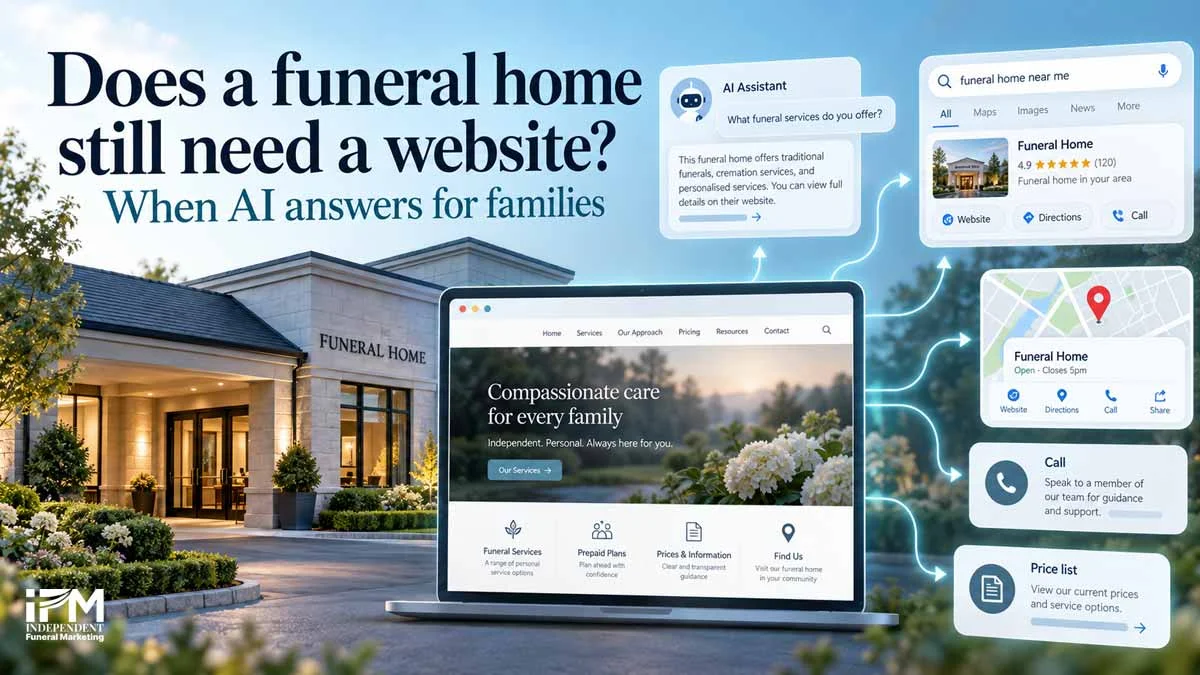
Does a funeral home need a website if AI is going to answer families’ questions for it? A claim is doing the rounds in marketing videos that business websites will soon be all but useless, because AI assistants and agents will find, compare and contact businesses on people’s behalf.
The claim draws on something real. In April 2026, Google’s CEO Sundar Pichai told the Cheeky Pint podcast: “If I fast-forward, a lot of what are just information-seeking queries will be agentic in Search. You’ll be completing tasks. You’ll have many threads running.” A moment later he added: “Search would be an agent manager in which you’re doing a lot of things.” [1]
So will a funeral home still need a website? Yes. But its job is changing, and a funeral director who keeps judging it by the old job will misread what is happening.
Will funeral homes still need a website as AI search grows?
The debate usually runs two separate ideas together. The first is that fewer people click through to websites from Google. That is true, and the evidence is covered below. The second is that websites therefore stop mattering. That does not follow.
Google’s own guidance on its generative AI features is direct about where those answers come from: “our generative AI features on Google Search are rooted in our core Search ranking and quality systems” [2]. An AI Overview that summarises local funeral options is summarising pages Google has indexed. If a funeral director’s pages are thin, out of date or missing, the summary is built from someone else’s.
What has changed is the job the website does. It is read more often by software and consulted more often as a second check, and it is clicked less often as a first stop.
| What it used to do | What it is becoming |
|---|---|
| Win the click from a Google search | Supply the facts Google and AI assistants summarise |
| Persuade a stranger from scratch | Confirm a recommendation made elsewhere, by AI, a friend or a hospice |
| Act as an online brochure | Hold legally required price information (UK) |
| Collect form enquiries | Provide a reliable contact point for people and, increasingly, software |
| Measured by visits | Measured by calls, enquiries and arrangements |
That last row matters most. IFM judges a funeral director’s website by the enquiries it supports, not by sessions in an analytics report. A website that gets fewer visits but is quoted accurately in AI answers and confirms a family’s choice before they call is doing its job. The wider picture of how this works is set out in our guide to AI search for funeral homes.
Click a reader to see what it takes from the website
Search and AI systems
People
Regulation (UK)
Illustrative summary of documented behaviour and UK regulation, not a screenshot of any product.
What did Google actually say about AI agents and the future of search?
The interview was an episode of Cheeky Pint, published on 7 April 2026 and hosted by John Collison with Elad Gil [1]. The quotes below are taken from the published transcript.
Agentic search, in plain terms, means software that completes a task across several sites instead of handing the person a list of links. Pichai’s description of Search as an “agent manager” fits that: the person states a goal, and several agents work on it at once.
The 2027 remark is where most commentary goes wrong. John Collison asked when Google might produce its first fully agentic business forecast, with no human in the loop. Pichai replied: “I definitely expect in some of these areas, ’27, to be an important inflection point for certain things.” That is a comment about AI taking over internal work inside companies. It is not a prediction that websites become less important, and he did not call 2027 the year of the AI agent.
He also struck a more measured note elsewhere in the same conversation. He called the current period “an expansionary moment” that “feels so far from a zero-sum game”, and said that only “0.1% of the world” is living this future today [1].
Here is what actually exists in September 2026, and whether any of it touches a UK funeral director yet:
| Development | What it is | Status (Sept 2026) | UK relevance |
|---|---|---|---|
| Google AI optimisation guidance | How Google’s AI features select and use content | Published May 2026 [2] | Applies to UK sites now |
| Agent2Agent (A2A) | Open standard for AI agents to discover each other and share tasks | v1.0 in March 2026, 150+ organisations [3] | Infrastructure, not a consumer feature |
| WebMCP | Proposed standard letting websites expose actions to AI agents in the browser | Experimental origin trial, Chrome 149 [4] | Developer trial only |
| Meta Muse calling | AI assistant places phone calls to businesses | Beta, US businesses only [5] | Not available in the UK |
Why are funeral home websites getting fewer clicks from Google?
The evidence on falling clicks is strong, but almost all of it is from the US or from global datasets. There is no equivalent published UK study, so treat the figures below as the best available direction, not a UK measurement.
SparkToro found that 68% of US Google searches in the first four months of 2026 ended without a click to any website [6], up from 58.5% in its 2024 study [7]. Separately, Ahrefs found that when an AI Overview appears, the page in position one gets about 58% fewer clicks [8], up from 34.5% in its April 2025 study [9]. The two 58% figures measure different things, one the share of all searches with no click, the other the loss of clicks for a top result, so they should not be added together.
| Study | Market | Finding | Date |
|---|---|---|---|
| SparkToro | US | 68% of searches ended without a click (58.5% in 2024) | June 2026 |
| Ahrefs, 300,000 keywords | Global Search Console data | AI Overview linked to 58% lower click-through for position one (34.5% in April 2025) | June 2026, December 2025 data |
| Pew Research Center, 900 adults | US | Clicked a result on 8% of visits with an AI summary, 15% without; 1% clicked a link inside the summary | 22 July 2025 |
| Agarwal and Sen (ISB and Carnegie Mellon), 1,065 users | US | AI Overviews cut organic clicks by 38% where they appeared; draft paper, not peer reviewed | April 2026 |
| Seer Interactive (agency data) | 53 client brands | Organic click-through on AI Overview queries recovered from 1.3% to 2.4% between December 2025 and February 2026 | April 2026 |
The Pew Research Center study [10] is the clearest picture of ordinary behaviour, because it tracked what people actually did rather than estimating it.
A randomised field experiment by Saharsh Agarwal and Ananya Sen found a similar effect, with AI Overviews reducing organic clicks by 38% on the searches where they appeared [11]. Balance matters here too. Seer Interactive’s 2026 update found click-through on AI Overview queries recovering after 18 months of decline [12]. Semrush found that the zero-click rate on the same keywords fell slightly, from 33.75% to 31.53%, once AI Overviews began appearing for them [13]. Google, for its part, says it “consistently direct[s] billions of clicks to websites daily” [14].
For a funeral director, the exposure is uneven. Informational searches, such as what a funeral costs or what to do when someone dies at home, are the ones most likely to be answered on the results page. A “funeral directors near me” search often ends with a family tapping the call button in the Local Pack. That is a zero-click search, but it is not a lost enquiry. It is the reason to count calls and arrangements, not website sessions.
What happens when a funeral home’s information lives somewhere else?
AI answers have to cite something. If the funeral director is not the clearest source of its own information, another site becomes that source.
IFM ran this test using the DataForSEO LLM Mentions data for Google’s AI Overviews and AI Mode in the United States, looking at queries containing “funeral home website”. Across 13,406 mentions, the domains AI answers named most often were these [15]:
| Domain named in Google AI answers | Mentions | Type |
|---|---|---|
| legacy.com | 4,864 | Obituary platform |
| youtube.com | 1,536 | Video platform |
| familysearch.org | 1,280 | Genealogy |
| tributearchive.com | 1,280 | Obituary platform |
| everloved.com | 1,024 | Memorial platform |
| facebook.com | 768 | Social network |
| Individual funeral home domains | 1 each | Funeral homes |
Method: IFM analysis of DataForSEO LLM Mentions data, Google AI Overviews and AI Mode, United States, partial match on the phrase “funeral home website”, retrieved 23 September 2026. Equivalent UK citation data was not available in the dataset.
The families asking these questions are mostly looking for things funeral directors create: notices, obituaries, service times and details about the person who has died. The funeral home wrote the content. The platform received the mention.
This fits a wider pattern. Pew found that Wikipedia, YouTube and Reddit were among the most common sources in Google’s AI summaries [10]. Large third-party sites start with an advantage, and a small local business has to be deliberate about being the source for its own facts.
The UK version of the same question is funeral notices, which attract around 33,100 searches a month (IFM keyword data, September 2026). This is not a case against notice platforms, which reach people and are where families expect to look. It is a case for publishing on the funeral home’s own website as well, so that the business is an original source rather than only a name inside someone else’s page.
Is a Google Business Profile enough without a website?
The CMA rules are precise. A funeral director’s website must carry all the information displayed in branch, in appropriately named PDFs, and “the Standardised Price List must be displayed in a PDF separate to all other information, accessible in one link from the home page” [16]. A firm without a website is not excused: if it markets its services online, it must display the information on those online channels or social media platforms instead [17].
So, strictly, UK law does not require a website. It requires the price information to be online somewhere. For most independents, a website they control is the simplest and most reliable place to meet that duty.
Discovery is spread across several channels, and US data shows how quickly that can change. The US National Funeral Directors Association found in 2025 that 40% of consumers had used a funeral home they found on Facebook, up from 21% in 2023 [18]. Each channel does a different job:
| Google Business Profile | Facebook page | Own website | |
|---|---|---|---|
| Who controls it | Meta | The funeral director | |
| Full price information (CMA, UK) | Not suited | Possible, awkward | Required location if a site exists |
| Notices and obituaries | No | Posts only | Yes, permanent pages |
| Source for AI answers | Yes, business facts | Limited | Yes, full first-party detail |
| Main job | Get found and called | Community reach | Get chosen and verified |
A Google Business Profile and a website are not rivals. The profile gets a funeral director found. The website helps a family choose, and gives Google and AI tools the detail the profile cannot hold.
What does a funeral home website do that AI cannot?
AI assistants summarise what exists. They do not know a funeral director’s prices, opening arrangements or the name of the person who answers the phone at night unless someone has published those facts somewhere they can read. The website is where the funeral director publishes them in its own words.
- Source of truth. The one place where services, areas covered, prices and contact details are stated by the business itself, rather than guessed at by a directory.
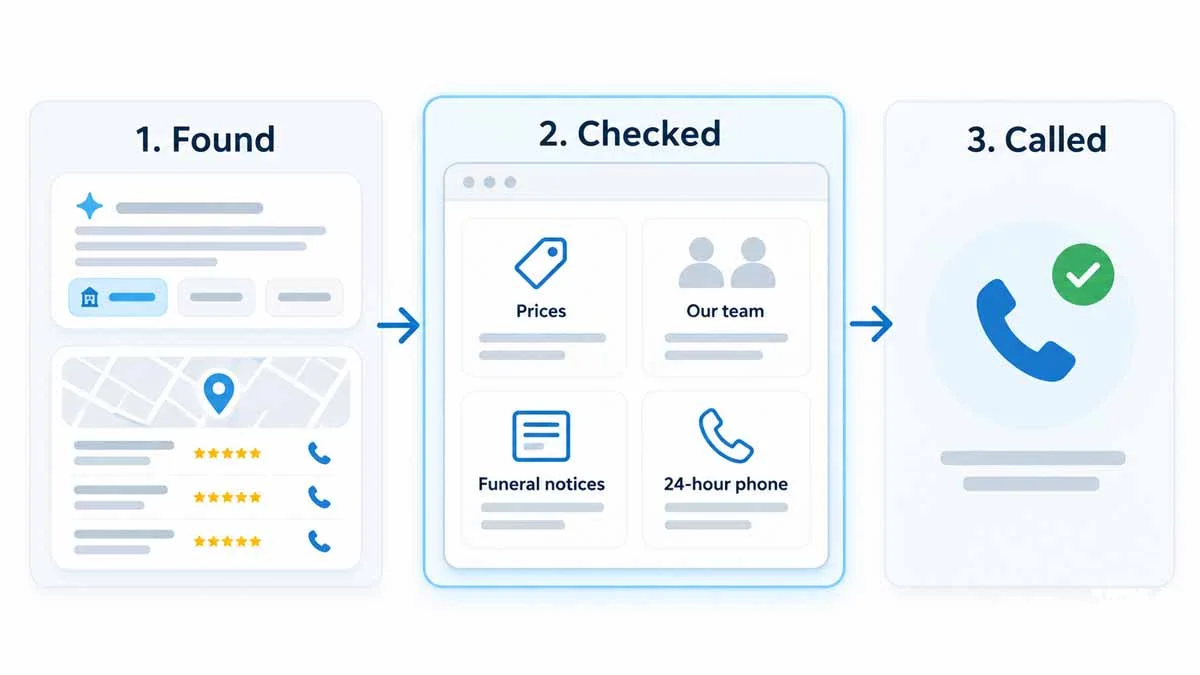
- Verification after a recommendation. A family given a name by an AI assistant, a friend or a hospice nurse usually checks before calling. The website is where that check happens.
- Compliance. In the UK, the website is the expected home for the CMA Standardised Price List and related information.
- First-hand content. Named people, photographs of the premises, funeral notices and local knowledge that no aggregator can invent.
- Contact and action. A clear telephone number, 24-hour availability and a way to begin arrangements, for people now and for software later.
This is where independent funeral directors hold a natural advantage. An AI system cannot fabricate a named proprietor, three generations of family ownership or a genuine connection to a town. It can only repeat those facts when the funeral director has published them clearly.
How should a funeral home prepare its website for AI search and AI agents?
Most of this is not new. It is good practice that AI has made more important. Start with step 1, because every later step relies on the facts being consistent:
- Check every fact matches. Name, address, telephone number, hours and services should be identical on the website, the Google Business Profile and the main directories.
- State services in plain words. Burial, cremation, direct cremation, transfers from hospitals and care homes, 24-hour availability, religious and cultural services, and the towns and villages covered, written as page text rather than implied.
- Keep prices easy to find. In the UK, the Standardised Price List should be one link from the home page as the CMA requires. Add a short HTML summary of price guidance as well, since a PDF on its own is harder for families and machines to read.
- Show real people and places. Named funeral directors with short biographies, photographs of the premises and genuine local knowledge. This is the first-hand detail that shapes how AI assistants choose which funeral directors to recommend.
- Publish notices on the website. Put funeral notices on the funeral home’s own site as well as on the notice platforms families use.
- Use structured data that matches the page. Schema markup should describe what visitors can see. Google’s guidance is explicit that “structured data isn’t required for generative AI search” and that there is no need for llms.txt files or AI-only versions of pages [2].
- Make sure the phone is answered. AI calling is a US beta today, but answered phones already decide funeral enquiries. A person, not a long menu, should pick up at any hour.
- Measure calls, not clicks. Track calls, enquiries and arrangements, and check whether your funeral home appears in AI search at regular intervals.
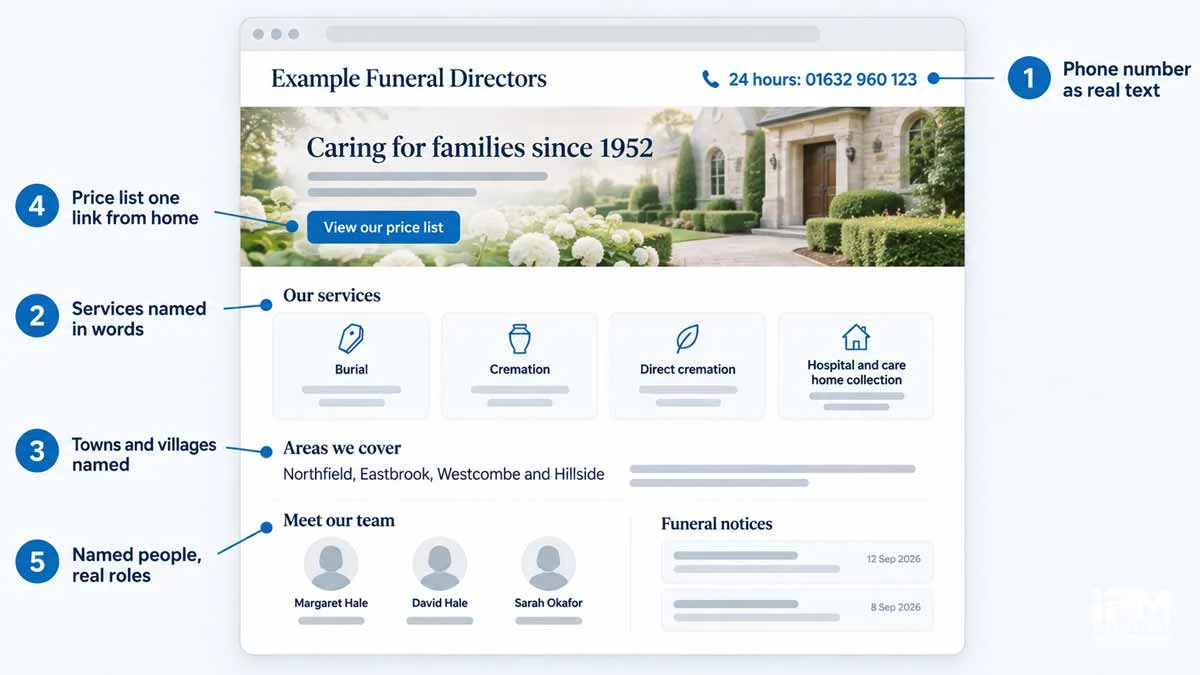
Together, these steps make the funeral director easy to understand, for a family on a phone at midnight and for the systems that increasingly answer on that family’s behalf.
Will AI agents replace funeral home websites entirely?
Meta’s Muse assistant is a useful reality check. In September 2026 Meta began a beta that lets Muse place calls to US businesses [5]. Within days, Reuters reported that Meta had been testing a “human concierge” in which contractors quietly handled some of those calls. A Meta vice president said it was “a miss” to test contractor-placed calls without proper disclosure, and that Meta had “rolled back this feature” for now [19]. The technology is real, but it is not finished.
Funeral arrangements add a further limit. They involve grief, cultural and religious detail, and judgement about people. It is reasonable to expect AI to take on more of the research and logistics, such as finding options, comparing prices and checking availability. The choice of who to trust with someone who has died is likely to stay with families, made after speaking to a person.
The sensible planning assumption for the next year or two is more AI-mediated discovery, not the end of the website. The discipline of being found and cited by those systems is generative engine optimisation, and it starts with the website.
Frequently asked questions
Does a funeral home need a website if it has a Google Business Profile?
Yes, a funeral home still needs a website if it has a Google Business Profile. The profile helps families find the business and call it, but Google controls it, it cannot hold permanent funeral notices or detailed service pages, and in the UK it is not a practical home for the full price information the CMA requires. The two work together: one gets a funeral director found, the other helps families choose.
Will AI make funeral home websites obsolete?
No. AI is unlikely to make funeral home websites obsolete, because AI answers are built from web content. Google states that its generative AI features are rooted in its core Search ranking and quality systems. What AI is changing is how often people click through, so the website’s value will come from being the accurate source that AI and families check, not from raw visitor numbers.
Is it a legal requirement for a UK funeral director to have a website?
No, a website is not strictly a legal requirement for a UK funeral director. The CMA Funerals Market Investigation Order 2021 requires price information to be published online, though. A firm with a website must show its Standardised Price List there, one link from the home page. A firm without a website that markets itself online must publish the information on those online channels instead.
Why is my funeral home website getting fewer visitors?
A funeral home website is usually getting fewer visitors because Google now answers more searches directly on the results page, through AI Overviews and the Local Pack. Informational questions about costs or what to do when someone dies lose the most clicks. Fewer visitors is not the same as fewer enquiries, so check calls and arrangements before drawing conclusions.
What is agentic search?
Agentic search is search that completes a task for the user rather than returning a list of links. Software agents gather information across several sources and act on it, for example comparing options or placing a call. Google’s CEO described Search becoming an agent manager in April 2026. For funeral homes, most of this is still early and largely US-only.
Can ChatGPT recommend a funeral director without visiting its website?
Yes, ChatGPT can recommend a funeral director without visiting its website, because it also draws on directories, review platforms, news and other third-party sources. That is exactly the risk: if the funeral director’s own information is thin or missing, ChatGPT describes the business using whatever other sites say. Accurate first-party information improves what AI tools say.
Should funeral notices go on our own website or a notices platform?
Funeral notices should go on both a funeral home’s own website and the notice platforms families already use. Platforms reach people who search there, while notices on the funeral home’s own site make the business the original source that search engines and AI tools can cite. Publishing only on a platform hands that source role to the platform.
Does a funeral home need an llms.txt file?
No, a funeral home does not need an llms.txt file to appear in Google’s AI features. Google’s guidance says site owners do not need to create new machine-readable files, AI text files, markup or Markdown versions of pages to appear in Google Search. Time is better spent making the visible page content complete and accurate.
What should a funeral home website include as AI search grows?
As AI search grows, a funeral home website should include clearly stated services, named service areas, 24-hour contact details, price information (in the UK, the CMA Standardised Price List one link from the home page), named staff and premises, funeral notices, and answers to the questions families ask. Every fact should match the Google Business Profile and directory listings.
How do I know whether AI tools are finding my funeral home?
To know whether AI tools are finding a funeral home, ask ChatGPT, Perplexity and Google’s AI Mode the questions local families ask, using the same fixed list of questions each month, and record whether the business is named, what is said about it and which sources are cited. Compare the results with calls and enquiries over the same period.
What this means for a funeral home right now
The question is no longer whether a funeral home needs a website. It is what the website is for. Over the next few years its job is to be the accurate, first-hand source that Google, AI assistants and families all check, and in the UK the compliant home for published prices.
That work does not sit in isolation. Search, AI answers, the Google Business Profile, notices and content all feed the same picture of a funeral director. IFM runs them as one integrated visibility system for a single independent funeral director in each territory. If you would like to see where your firm stands, start with AI search optimisation for funeral homes.
References
- [1] Cheeky Pint, The history and future of AI at Google, with Sundar Pichai, hosted by John Collison with Elad Gil, cheekypint.substack.com/p/the-history-and-future-of-ai-at-google, 7 April 2026
- [2] Google Search Central, Optimizing your website for generative AI features on Google Search, developers.google.com/search/docs/fundamentals/ai-optimization-guide
- [3] Agentic AI Foundation, A2A joins AAIF’s open agentic stack, aaif.io/blog/a2a-joins-aaif, 17 August 2026
- [4] Google Developers Blog, All the news from the Google I/O 2026 Developer keynote, developers.googleblog.com/all-the-news-from-the-google-io-2026-developer-keynote, 19 May 2026
- [5] TechCrunch, Rival AI agents, Instinct and Meta’s Muse, both add the ability to make calls, techcrunch.com/2026/09/17/rival-ai-agents-instinct-and-metas-muse-both-add-the-ability-to-make-calls, 17 September 2026
- [6] SparkToro, When Google stops sending clicks, what still works?, sparktoro.com/blog/zero-click-search-what-still-works, 10 June 2026
- [7] SparkToro, 2024 Zero-Click Search Study, sparktoro.com/blog/2024-zero-click-search-study-for-every-1000-us-google-searches-only-374-clicks-go-to-the-open-web-in-the-eu-its-360, 2 July 2024
- [8] Ahrefs, Ryan Law, 10 SEO trends I’ve seen firsthand in 2026 (with data), ahrefs.com/blog/seo-trends, 18 June 2026
- [9] Ahrefs, Ryan Law, AI Overviews reduce clicks by 34.5%, ahrefs.com/blog/ai-overviews-reduce-clicks, 17 April 2025
- [10] Pew Research Center, Google users are less likely to click on links when an AI summary appears in the results, pewresearch.org/short-reads/2025/07/22/google-users-are-less-likely-to-click-on-links-when-an-ai-summary-appears-in-the-results, 22 July 2025
- [11] Agarwal, S. and Sen, A., Indian School of Business and Carnegie Mellon University, randomised field experiment on AI Overviews (working paper, not peer reviewed), papers.ssrn.com/sol3/papers.cfm?abstract_id=6513059, 3 April 2026
- [12] Seer Interactive, AIO impact on Google CTR: 2026 update, seerinteractive.com/insights/aio-impact-on-google-ctr-2026-update, April 2026
- [13] Semrush, Semrush AI Overviews study, semrush.com/blog/semrush-ai-overviews-study, updated 15 December 2025
- [14] The Register, Google statement in response to the Pew Research Center study, theregister.com/software/2025/07/22/google-ai-overviews-are-killing-the-web-pew-study/857001, 22 July 2025
- [15] IFM analysis of DataForSEO LLM Mentions data, Google AI Overviews and AI Mode, United States, retrieved 23 September 2026, dataforseo.com
- [16] GOV.UK, Competition and Markets Authority, Funeral directors with 4 or fewer branches, gov.uk/government/publications/working-with-the-funerals-market-investigation-order/funeral-directors-with-4-or-fewer-branches, updated 21 January 2025
- [17] GOV.UK, Competition and Markets Authority, Funeral directors and crematorium operators guidance, gov.uk/government/publications/working-with-the-funerals-market-investigation-order/funeral-directors-and-crematorium-operators-guidance
- [18] National Funeral Directors Association, 2025 Consumer Awareness and Preferences Study release, republished by Connecting Directors, connectingdirectors.com/71605-nfda-consumer-awareness-and-preferences-study, October 2025
- [19] Reuters via BNN Bloomberg, Meta testing a human concierge for its new personal AI agent, Muse, bnnbloomberg.ca/business/artificial-intelligence/2026/09/22/meta-testing-a-human-concierge-for-its-new-personal-ai-agent-muse-reuters-exclusive, 22 September 2026