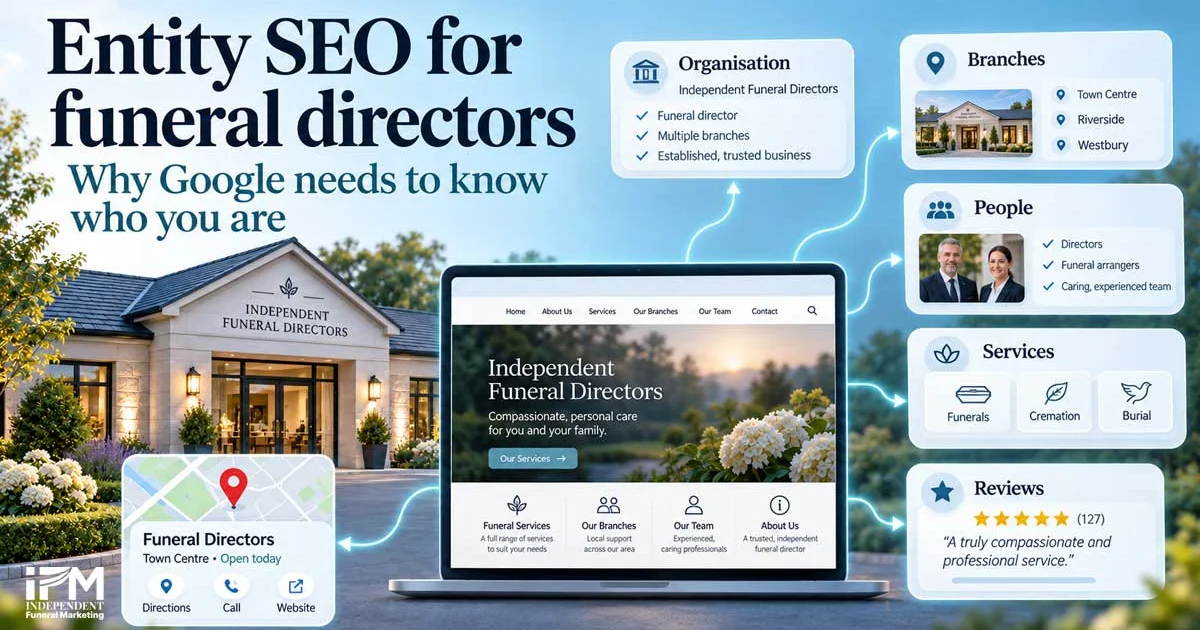
Entity SEO is how a funeral director helps Google understand exactly who the business is, not just which words appear on its website. Picture a family on the evening after a death, searching for the firm a neighbour recommended. They find a website, then a box beside the search results, then a map listing. Each shows a name, an address and a phone number. The question that matters is whether every one of them is clearly the same business.
Your website probably lists a trading name, an address and your services. What it may not make clear is the structure behind them: the registered company, which branches belong to it, who runs it, and what each branch actually provides. Those are separate facts, and search systems have to fit them together from whatever you, and everyone else, have published.
The box beside your branded search result also deserves a closer look. A Google Business Profile can look very like a knowledge panel, but Google treats them as different things, and much of the confusion about entity SEO starts there. This article explains what entity SEO means for an independent funeral business, how your branches, people and services should connect, and where schema markup fits. It is just as clear about what none of this can promise.
What is entity SEO, and why does it matter for funeral directors?
An entity is an identifiable real-world thing. Google’s own help documentation describes knowledge panels as covering entities such as people, places, organisations and things [1]. Schema.org, the shared vocabulary search engines use for structured data, starts from the same idea: its most general type is simply called Thing [5].
The definition of entity SEO above is our working editorial definition, not an official Google term or certification. It is useful because it separates two questions that often get blurred. Keyword research asks how families describe what they need. Entity work asks which real business, branch or service those words refer to.
| Keyword research tells you | Entity SEO adds |
|---|---|
| Which phrases families use | Which business those phrases refer to |
| How a service is described | Who provides it and where it is available |
| Which questions need answering | Who wrote the guidance and how they connect to the firm |
| Which towns people search in | Which genuine branch serves each town |
This matters in the funeral sector because names repeat. Two unrelated firms in different towns can share a family surname, a similar trading name, or even the same founder’s name a generation apart. A name is one attribute of a business, not its whole identity. Addresses, the official website, the people involved and the relationships between them are what allow search systems, and families, to tell one firm from another.
None of this means keywords have stopped mattering. Clear service pages written in the language families actually use remain essential. Entity work sits underneath that writing and makes sure the business it describes is unmistakable.
What counts as an entity for a funeral business?

Our view is that a funeral firm is best thought of as a network of entities rather than a single listing. That framing changes how you plan your website. Instead of asking “what pages do we need?”, you ask “which real things make up this business, and have we explained how they fit together?”
Some distinctions catch out even well-run firms. The registered company and the trading name may differ, which does not make them two businesses; the relationship simply needs explaining. A town your branch serves is a place, not another branch. A director who writes your guidance is a person who works for the organisation, and that connection is worth stating.
Select an entity to see its relationship
One fictional funeral business, described as connected things.
The organisation: Operates its branches.
State the trading name, explain the legal name where it differs and identify the official website. A change of wording is not a second business.
Illustrative teaching model, not a representation of Google's Knowledge Graph.
| Element | Possible entity type | Example relationship |
|---|---|---|
| Funeral business | Organization | Operates its branches |
| Physical branch | LocalBusiness | Belongs to the organisation |
| Director or owner | Person | Works for the organisation |
| Funeral arrangement | Service | Has a genuine provider |
| Town or county | Place | Falls within an actual service area |
| Planning guide | Article | Has a named author |
| Official profile | URL listed in sameAs | Identifies the same organisation |
These are possible descriptions, not a requirement to mark up everything. In Schema.org, worksFor connects a person to an organisation [6], provider connects a service to whoever provides it [7], and areaServed describes where a service is available [9]. A clear branch page or a visible staff biography should make each of those relationships obvious to a reader before any developer describes them in code.
How does Google connect a funeral business to its Knowledge Graph?
The Knowledge Graph is best understood as Google’s internal map of things it recognises and how they connect. When a knowledge panel appears for a person or organisation, it is a snapshot of that understanding. Google is direct about how panels come about: “Knowledge panels are automatically generated.” [1]
That sentence sets the boundary for everything else in this article. Your website is a source of information about your firm. It is not a control panel for how Google interprets that information.
What a clear website can do is communicate relationships. The useful ones for a funeral business include:
- The organisation operates a named physical branch.
- The branch is located in a particular town.
- A named funeral director works for the organisation.
- A genuine service is available within a stated area.
- A planning guide was written or reviewed by an identifiable person.
- An official external profile represents the same organisation.
Not every relationship needs schema. Navigation, page titles, ordinary links between pages, author biographies and well-written branch pages all carry relationships to a reader and to a search engine. Google describes structured data as a way to help it understand page content [2], which means it should describe facts that already exist in the visible page, not be the only place they live.
It is equally important to be clear about the limits. Adding schema does not create a Knowledge Graph entry. Google’s organisation markup guidance frames that markup as helping Google understand an organisation’s administrative details [3], and its general guidelines are explicit that using structured data does not guarantee any particular display [8]. Many independent funeral businesses will never have a knowledge panel, and that is not a sign of failure.
A practical starting point is to look for contradictions before looking for more mentions. If two of your own pages disagree about which company operates a branch, more content will not settle the question. Correct the source information first.
Is your Google Business Profile the same as a knowledge panel?
This is the most common misunderstanding we see. An owner searches for their firm’s name, sees a box on the right of the results with their photos, opening hours and reviews, and assumes it is their knowledge panel. For most local funeral businesses, that box is their Business Profile. Google’s knowledge panel help page addresses this directly in its section on Business Profiles, noting that the two look similar [1].
They are not entirely separate, though. Google’s developer guidance on business details says that once you verify ownership of a listing, your local business information can show up in Google Maps and in the knowledge panel [10]. The accurate description is different but overlapping, not one and the same.
| Concept | What it is | Who controls it |
|---|---|---|
| Business Profile | Local business information shown in Search and Maps | The verified business manages it, within Google’s guidelines |
| Knowledge Graph | Google’s organisation of entities and their relationships | Google, entirely |
| Knowledge panel | An automatically generated snapshot of an entity | Google generates it; an official representative can claim an existing panel and suggest changes |
Claiming deserves a precise explanation. Where a knowledge panel already exists, an official representative may see an option labelled “Claim this knowledge panel”. Google says that if you are the subject or an official representative of an entity, you can claim the panel and suggest changes [1]. Claiming is not the same as creating a panel, and verification does not give you full editorial control over what appears.
Search layouts also vary by device, location and query, so it is unwise to diagnose which system you are looking at from the position or shape of a box alone. For most firms, the practical priority is the information you can actually manage: the correct website link, current branch details and a description that matches your site. If that is your next task, our guide to optimising your Google Business Profile covers setup and ongoing management in full.
How do you help Google recognise your funeral business?
If you are wondering how to help Google recognise your business, start with the facts a family would need to recognise it too. In our experience, the strongest entity strategy for a funeral director starts with business structure, not schema. Entity SEO for funeral directors is, first of all, a matter of getting your own house in order.
The foundations, in the order we recommend working through them:
- Settle the trading name and use it consistently. Use the business’s genuine name everywhere, rather than varying it to suit different searches or directories.
- State the legal name where it differs. If the registered company name is different from the name over the door, explain the connection on your website rather than leaving readers to work it out.
- Build a substantial About page. This is the single page that describes the organisation: who operates it, its history where you can support it, its branches and its leadership. SEO practitioners sometimes call this the “entity home”; that is an industry term, not a Google one.
- Name your owners and funeral directors accurately. State real roles and genuine qualifications, and keep biographies current when people join or leave.
- Give every genuine branch its own page. Each should help a family understand that specific location, not simply swap a town name into a template.
- Keep contact details current everywhere. Review names, addresses and telephone numbers across your website, your Business Profile and the other records where your firm appears.
Your website is the natural place for these facts to live, because it is the one source you fully control. Our article on whether a funeral home still needs a website as AI answers more questions explains why that role as a source of truth is growing rather than shrinking.
Before and after
The same fictional business, explained more clearly. Move the slider through the clean-up.
Before: disconnected clues
After: connected facts
Every relationship is explicit. This does not mean Google has verified them or will display them.
Illustrative example. No real firm or contact details are shown, and no search result is projected.
Name, address and phone consistency, often shortened to NAP, is one input to this work, not the whole of it. A phone number repeated perfectly across fifty directories still does not explain which organisation operates which branch. Settle the structure and the wording together, then ask your web developer to describe the established facts.
How should your branches, people and services connect?

Google’s local business structured data guidance is clear on the core point: “Define each local business location as a LocalBusiness type.” [4] The distinction that matters is between the organisation that runs the business and the places a family can actually visit.
- Organisation. Explain the overall business and its ownership once, clearly, and use the same explanation on your About page and branch pages.
- Branches. Give each genuine location its own name where applicable, its address, telephone number, opening information and page, and state which organisation operates it.
- People. Connect each person’s real role to the business. Qualifications should be genuine, current and visible on the page, not added only in markup, and nobody needs to be described as an expert in everything.
- Services. Make clear which organisation or branch provides each service. Do not assume every branch offers every option, and describe only services you genuinely provide.
- Service areas. State your real operational coverage. Schema.org defines
areaServedas “The geographic area where a service or offered item is provided.” [9] It describes availability; it does not establish premises or a ranking radius.
The service area point deserves emphasis because it is where well-meant advice goes wrong. A service area is not a branch. Creating location pages for towns where you have no premises, written to look like branches, misrepresents the business to families and to search engines. Useful local guidance can talk about a town you serve without claiming an address there.
Think of a family who lands directly on one of your service pages from a search. They should not have to return to the homepage to discover which firm provides the service or whether it is available at their nearest branch. Clear connections make that journey easier without adding anything artificial.
What role does schema markup play in entity SEO?
In entity SEO, schema is the machine-readable layer that sits on top of the facts you have already established. Google recommends JSON-LD as the format for it [2]. In plain English, the four types that matter most for a funeral business are Organization for the company [3], LocalBusiness for each physical branch [4], Person for named people [6] and Service for each genuine service [7].
Google’s general guidelines set the expectations plainly: “Google does not guarantee that your structured data will show up in search results.” [8] The same guidelines require markup to represent content that is visible on the page. Markup that describes things a visitor cannot see is not a shortcut; it is a quality problem.
| What schema can do | What schema cannot guarantee |
|---|---|
| Describe the organisation and its administrative details | Higher organic rankings |
| Describe each physical branch as its own location | A knowledge panel or local pack placement |
| Connect people, services and service areas to the business | An AI recommendation or citation |
| Point to profiles that identify the same organisation | The display of any rich result |
One funeral-specific caution: as checked on 2 November 2026, there is no FuneralHome type in Schema.org’s current vocabulary [12]. Some plugins and AI tools suggest one anyway. Do not use it because a tool recommends it. Our practical schema markup guide for funeral homes covers type choice, multi-branch setups and testing in detail; this article deliberately stays with what schema is for, and leaves the implementation to that guide and your web developer.
What should sameAs include?
The sameAs property points to pages that unambiguously identify the same thing [5]. The test is identity, not prestige: does this page identify this exact organisation or person?
Pages that usually pass that test include your official social media profiles, official registration or regulator records for the business, trade body profiles that clearly identify your firm, and an existing Wikipedia or Wikidata record if one genuinely represents you. Pages that do not pass include every directory listing you have ever claimed, news stories that mention you, the crematoria and cemeteries you work with, charities you support, and any similarly named business. Those may be related to your firm, but they are not the same entity.
Do not create Wikipedia or Wikidata entries simply to have something to list here. The purpose of sameAs is to remove ambiguity, not to collect links.
Where else does Google look to confirm who you are?
Google states that the information in knowledge panels comes from sources across the web [1]. External records matter for that reason, but it is not a numbers game. No source shows that a particular count of mentions produces a knowledge panel, and anyone who quotes you one is guessing.
It helps to separate two kinds of external evidence. Some records identify your organisation itself, such as an official registration. Others document an activity involving it, such as a local newspaper article about a community event. Both have value for families, but they do different jobs, and only the first kind belongs in sameAs.
UK funeral directors
- Use the term funeral director, which is what UK families search for and expect.
- Where your trading name and registered company differ, make sure official records and your website explain the same relationship.
- Use UK address and telephone formats consistently, including on branch pages.
- List only genuine, current memberships and qualifications, and update them when they lapse.
- Tie local guidance to the real crematoria, cemeteries and councils you work with, without presenting them as part of your business.
Treat registers and association memberships as corroborating evidence of who you are. Nothing in Google’s documentation says that a particular register or membership changes how the Knowledge Graph treats a business.
US funeral homes
- Both funeral home and funeral director are used; describe the business and the licensed people separately.
- Licensing is set at state level and varies by jurisdiction, so check what applies before describing any licence.
- Keep each location distinct from the parent organisation, with its own address and contact details.
- List only current, verifiable affiliations.
- Do not assume arrangements that apply in one country, or one state, apply in another.
Accuracy matters more than collecting badges. If a membership has ended or a branch has closed, the responsible action is to update the record, not to keep it live as a supposed signal.
Does entity SEO help your funeral business appear in AI search?
Google’s own guidance on its generative AI features is useful here, because it removes one popular myth. It says “Structured data isn’t required for generative AI search, and there’s no special schema.org markup you need to add.” [11] The same guidance describes how AI responses are grounded in retrieved web content and supported by related fan-out queries, and it continues to recommend structured data as part of an overall SEO approach.
| Evidence level | What it means for entity SEO |
|---|---|
| What we know | Knowledge panels are automatic, structured data helps Google understand content, and no special markup is required for Google’s generative AI features |
| What is reasonable | Consistent facts and explicit relationships reduce ambiguity for people and automated systems alike. This is our practical rationale, not a proven visibility effect |
| What is not proven | That entity SEO, schema, sameAs links or a knowledge panel cause AI Overview inclusion, AI citations or assistant recommendations |
The defensible message is reduced ambiguity, not guaranteed mentions. Being understandable is a sensible prerequisite. Being selected for a particular answer is a separate decision made by each platform, and guidance about Google should not be treated as a documented rule for every other AI assistant.
Entity work is one layer of generative engine optimisation, the wider discipline of making a business visible in AI-generated answers. If your question is why AI tools name some firms and not others, our guide to how AI assistants recommend funeral services covers the platform mechanics. The narrower job here is making sure that, when any system looks, your business is unmistakable.
What can entity SEO not guarantee?
It is worth being plain about the outcomes no one can promise:
- Higher rankings in Google’s organic results.
- A knowledge panel for your business.
- Rich results or any other enhanced display.
- A place in the local pack.
- Inclusion in AI Overviews or AI Mode.
- Recommendations or citations from ChatGPT, Perplexity or other assistants.
Honest expectations matter because this area attracts confident sales claims. Be cautious of anyone offering a guaranteed knowledge panel: Google says panels are generated automatically [1], so no agency can deliver one on request. A credible scope of work can promise an audit, corrections, clearer branch relationships and a reviewed implementation. It should not promise decisions that belong to a search platform.
That does not make the work less valuable. It changes how you judge it: fewer contradictions, clearer responsibility and information your team can maintain. Our AI search guide for funeral directors sets this layer alongside the rest of the AI visibility picture.
What might an evidence-led search experience feel like?

Everything in this section is a design exploration, built on facts that are documented now. Structured data gives search engines a standard way to describe an organisation and its relationships [2]. The sameAs property links a description to pages that identify the same thing [5]. Google’s AI features already ground their responses in content retrieved from the web [11].
Imagine not a brighter search result, but one you can inspect. A family asks which branch provides a particular service. Instead of accepting a confident summary, they can see the branch page, the provider relationship and whether an external record agrees. Where the sources contradict each other, the contradiction stays visible rather than being smoothed into a confident answer.
Speculative prototype
Follow the evidence, not just the answer. Select a scenario. These are fixed, written examples: no live search or AI request runs, and no real business is being evaluated.
Illustrative response
The branch page identifies the service provider and connects it to the organisation. Open the source pages to confirm current availability before relying on this description.
Imagined interface, not an existing Google feature. No confidence score, ranking prediction or claim of Google verification is calculated.
The three scenarios show why the groundwork earlier in this article matters. When the website, branch page and external record agree, an answer can point to all three. When an old name survives on an outside record, the honest response is to flag the conflict. When a service page never says which branch provides it, no system can fill that gap reliably.
What can you do now, and what remains imagined?
A sequence of work, not a forecast. Select a stage.
Review the trading name, the operator, genuine locations, people and which services each branch provides. These are business facts you can establish without waiting for any new search feature.
The implication is responsibility, not more automation at any cost. An interface that exposes its sources would still need to handle outdated facts, mistaken identity and sensitive situations with care, and few situations are more sensitive than a family arranging a funeral. The imagined design here chooses visible uncertainty over a confident claim when the evidence is incomplete. Whether any platform adopts an approach like this, and when, is unknown. What is within your control is whether your own facts would stand up to that kind of inspection.
How do you audit your funeral business’s entity signals?

Begin with the one source your team can verify directly: the business itself. Agree internally on the correct operator, trading name, branch list and which services each branch provides. Then compare that agreed account with what is actually published. Do not copy an error everywhere simply to make every platform match.
Work through the audit in three groups, in this order:
| Review group | What you check | Why it matters |
|---|---|---|
| Identity | Trading name, legal name, About page, named people | Prevents your firm being read as several businesses, and connects real people to it |
| Structure | Branch pages, contact details, service providers, service areas | Separates each genuine location from the organisation and shows who offers what |
| Evidence | Markup, sameAs links, external records, ongoing ownership | Confirms that your description, your markup and other sources all agree |
Your entity audit
Work through each check against your own website, Business Profile and external records. Tick an item only once you have reviewed the evidence. Nothing you tick is saved or sent anywhere.
0 of 12 reviewed
Repeat the relevant checks whenever a branch opens or closes, a director joins or leaves, or a service or contact detail changes. A clear identity is not a one-off file a developer installs; it is an account of your business that has to stay true. Once your facts are in order, the natural next step is to check whether your funeral home appears in AI search, which is an observation exercise this audit does not perform.
Frequently asked questions
Can a funeral home get a Google knowledge panel?
Not directly. Google says knowledge panels are generated automatically from information across the web, so a funeral home cannot apply for or buy one [1]. Clear, consistent identity across your website, Business Profile and other reliable sources gives Google the best information to work with, but whether a panel appears is Google’s decision.
How do you claim a knowledge panel on Google?
You can only claim a knowledge panel that already exists. Search for your business, select “Claim this knowledge panel” where it is offered, and verify through an official account [1]. Once verified, you can suggest changes, although Google still decides what appears. Most local funeral businesses will see a Business Profile rather than a knowledge panel.
Which schema type should a funeral director use?
A funeral director should use Organization for the overall business and LocalBusiness for each physical branch, with Person and Service for genuine people and services [4]. Schema.org does not currently include a dedicated funeral home type, so avoid tools that add one. Whatever you mark up must match what visitors can see on the page, and our schema markup guide covers the implementation.
Does schema markup improve Google rankings?
No primary source shows that schema markup directly improves Google rankings. Google says structured data can make pages eligible for certain search features but does not guarantee they will appear [8]. Its value for a funeral business is clarity: describing the organisation, branches, people and services in a format search engines can read.
Is entity SEO the same as semantic SEO?
Entity SEO is not quite the same as semantic SEO. The two overlap, and neither has one agreed industry definition. Entity SEO usually focuses on identifiable things, such as your business, branches and people, and how they relate. Semantic SEO is used more broadly for meaning and context across content. For a funeral director, entity SEO is the more practical starting point.
Do funeral directors need a Wikipedia page for entity SEO?
No. Most independent funeral businesses will never have a Wikipedia entry, and creating one purely for SEO is not appropriate. If a genuine Wikipedia or Wikidata record already represents your business, it can be referenced. Otherwise, focus on your website, Business Profile and official or professional records.
Why is my funeral home not showing on Google?
A funeral home usually fails to show on Google for a handful of fixable reasons: an unverified or incomplete Business Profile, inconsistent business details across the web, or a website Google cannot properly access. Start by checking that your name, address and phone number match everywhere, that each genuine branch has its own page and profile, and that your site is verified in Google Search Console.
What this means for your funeral business
Independent Funeral Marketing works with one independent funeral director per territory, aligning website structure, Business Profile, schema and content into a single system, so search engines and families get a consistent picture of who you are. That work is part of our AI search optimisation for funeral homes. If you would like a review of how clearly your business is represented online, get in touch.
References
- [1] Google, About knowledge panels, Knowledge Panel Help, support.google.com/knowledgepanel/answer/9163198
- [2] Google Search Central, Introduction to structured data markup in Google Search, developers.google.com/search/docs/appearance/structured-data/intro-structured-data
- [3] Google Search Central, Organization structured data, developers.google.com/search/docs/appearance/structured-data/organization
- [4] Google Search Central, Local Business structured data, developers.google.com/search/docs/appearance/structured-data/local-business
- [5] Schema.org, Thing (including sameAs), schema.org/Thing
- [6] Schema.org, Person (including worksFor), schema.org/Person
- [7] Schema.org, Service (including provider), schema.org/Service
- [8] Google Search Central, General structured data guidelines, developers.google.com/search/docs/appearance/structured-data/sd-policies
- [9] Schema.org, areaServed, schema.org/areaServed
- [10] Google Search Central, Add business details to Google, developers.google.com/search/docs/appearance/establish-business-details
- [11] Google Search Central, Optimizing your website for generative AI features on Google Search, developers.google.com/search/docs/fundamentals/ai-optimization-guide
- [12] Schema.org, Full hierarchy of types, checked 2 November 2026, schema.org/docs/full.html