Funeral home local search visibility determines whether families searching online find you or find a competitor. It is not a single Google ranking, it is a composite score built from six distinct signals, each assessed separately, each capable of letting you down independently of the others.
Most funeral homes have no clear picture of where they stand across all six. They might know their Google reviews are thin, or suspect the website is slow, but they have never seen these signals measured together in one place. That is the gap this article, and the free tool it introduces, is built to close.
What is funeral home local search visibility?
When someone types “funeral director near me” or “funeral home in [town]”, Google does not simply return the closest result. It weighs multiple signals before deciding which businesses to show and in what order: the proximity of your location, the completeness and activity level of your Google Business Profile, the volume and recency of your reviews, the authority and speed of your website, and whether your business information is consistent across the web.
BrightLocal’s Local Consumer Review Survey 2025 [1] found that 86% of consumers use Google to find and evaluate local businesses. For funeral homes, this search moment is often made under time pressure, by someone who needs to act that day. If your funeral home does not appear prominently, that family will call whoever does.
Why funeral home visibility is harder than it looks
The Competition and Markets Authority’s funerals market investigation found that almost all bereaved families choose a funeral director within a 20-minute drive of the deceased’s home [2]. This makes local search the primary channel for new enquiries, ahead of word of mouth, referrals, and advertising. Every funeral home in your area is competing for the same local visibility within a tight geographic radius.
Corporate funeral chains have a structural advantage here. They operate with dedicated marketing teams managing their Google Business Profiles systematically, running review generation campaigns, and maintaining citation consistency across hundreds of directories. An independent funeral home run by a small team is unlikely to have that resource. Over time, without a structured plan, the visibility gap between independent and corporate widens.
Google research indicates that 76% of people who conduct a local search on a mobile device visit a physical location within 24 hours. In funeral services, the conversion from search to contact can be faster still. The need is immediate, and the decision is often made after visiting only one or two websites.
The challenge for independent funeral homes is rarely a lack of quality or reputation. It is a lack of visibility data. Without knowing which of the six dimensions are underperforming, it is difficult to know where to focus effort.
The six dimensions that determine your visibility score
Local search rankings refer to where your funeral home appears when someone searches for a funeral director in your area. This covers both the Google Map Pack, the three businesses shown beneath a local map at the top of results, and standard organic listings. Map Pack placement is typically more valuable because it appears above organic results and includes your reviews, photos, and a direct call button on mobile.
Google Business Profile is your listing on Google Maps and in local search results. A complete, verified, and regularly updated profile signals to Google that your business is active and legitimate. Google and Ipsos research [3] found that businesses with a complete profile are 2.7 times more likely to be considered reputable by consumers. Missing categories, unverified addresses, and outdated opening hours all suppress your score.
Website conversion is assessed separately from search ranking because a funeral home can rank well and still lose enquiries if the website is slow, hard to navigate, or unconvincing on mobile. Google’s Core Web Vitals measure page speed and visual stability. Poor scores affect both your ranking and the experience of every visitor who arrives from search.
Review signals look at the volume of your Google reviews, the average star rating, the recency of the most recent reviews, and how your profile compares to local competitors. A funeral home with fewer than ten Google reviews is at a measurable disadvantage against a competitor with sixty, even if your service quality is demonstrably better.
Competitor pressure measures how many well-optimised competitors are ranking ahead of you for your key local search terms. In some areas this will be two or three independent funeral homes and one corporate chain. In larger towns it may be significantly more. Understanding the competitive landscape in your specific area is essential context for interpreting any visibility score.
AI search readiness is the newest of the six dimensions and the one most funeral homes have not yet assessed. Research by Nectiv, published in Search Engine Land [4], found that 59% of local-intent prompts in ChatGPT trigger a real-time web search, the highest rate of any category tested. Yext’s 2025 research [5] found that 68% of consumers have already used ChatGPT to research local products or services. Funeral homes without structured data, clear service descriptions, and consistent online information are unlikely to appear in AI-generated local responses. The full picture on what AI readiness requires is covered in the guide to AI search optimisation for funeral homes.
How to check your funeral home’s local search visibility
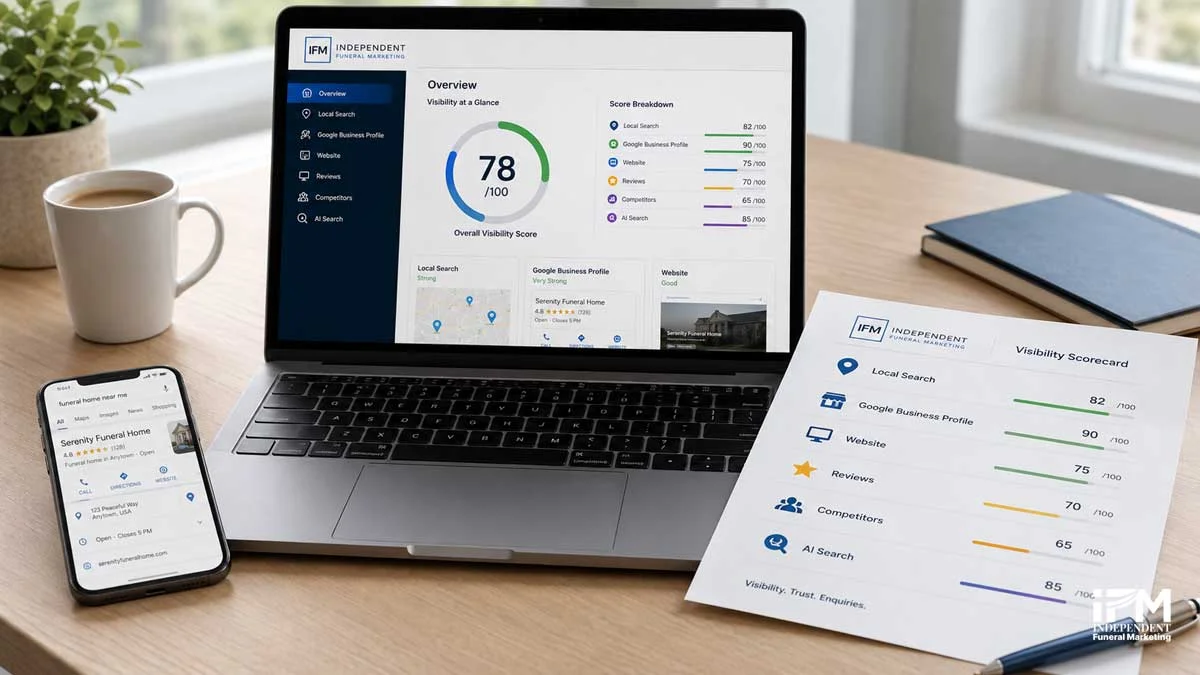
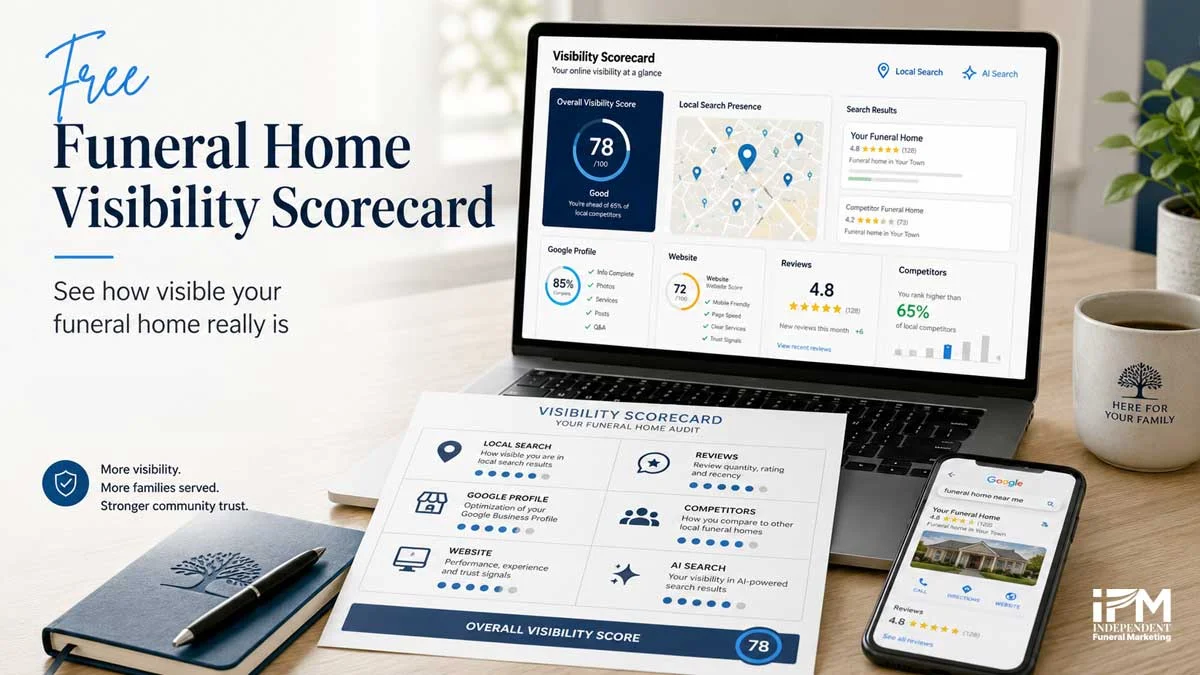
The IFM Funeral Home Visibility Scorecard, a free 30-point assessment across all six dimensions of local search visibility.
You can attempt a partial manual review: search for your area’s key funeral director terms in an incognito browser window, check your GBP against competitors, count your reviews. But this approach has practical limits. Google’s personalisation means that searching from your own location and device returns results that reflect your browsing history, not a neutral local search. Pulling meaningful data from six separate systems and making sense of them together takes time most funeral home owners do not have.
The free funeral home visibility scorecard was built to solve this precisely. It uses live data sources to assess your funeral home across all six dimensions and returns a structured 30-point score broken down by category. The form takes three to five minutes to complete, and results appear on screen immediately, with no obligation and no sales call attached.
The scorecard is available exclusively to independent funeral homes. One assessment per territory, in keeping with IFM’s one-firm-per-town principle.
What to do once you have your score
Most funeral homes that complete the scorecard find clear strengths in one or two areas alongside significant gaps in others. A common pattern is a strong Google Business Profile combined with thin reviews and a website that underperforms on mobile. Another is reasonable organic rankings but little to no presence in the Map Pack.
The most effective approach is to address the highest-impact weakness first. Review signals tend to produce the fastest visible improvement because volume and recency are real-time inputs to Google’s local ranking algorithm. GBP optimisation takes a few weeks longer but compounds over time. Structural website improvements and AI search readiness take three to six months to affect rankings, but they are increasingly difficult for competitors to replicate once in place.
For funeral homes where the gap is wide across several dimensions, funeral home marketing consulting provides a way to turn your scorecard results into a prioritised plan with clear sequencing. For wider context on what is driving these visibility pressures across the industry, the post on funeral industry digital transformation covers the structural market shifts affecting independent funeral homes in 2026.
FAQ
How can I check if my funeral home is visible in local search?
The quickest way is to use the free IFM Funeral Home Visibility Scorecard at independentfuneralmarketing.com/visibility-scorecard/. It assesses all six dimensions of local search visibility using live data and returns a 30-point score in under five minutes. You can also do a partial manual check by searching your key local terms in an incognito browser window, which removes personalisation from results, but this will not give you data on GBP completeness, review comparison, or AI readiness.
Why is my funeral home not showing up in Google Maps?
The most common causes are an incomplete or unverified Google Business Profile, inconsistent business name and address information across online directories, too few or too old reviews compared to local competitors, and weak signals from your website. Google’s Map Pack algorithm weighs proximity, relevance, and prominence. Prominence, which includes reviews and citations, is the dimension most often under-addressed by independent funeral homes and the one that produces the fastest results when improved systematically.
How long does it take to improve funeral home local search visibility?
Review signals and GBP optimisation typically produce measurable improvement within 30 to 60 days of consistent effort. Organic search ranking changes take 90 to 180 days in most cases. AI search visibility, tied to structured data and content quality, can improve more quickly once the technical changes are in place. The starting point matters: a funeral home with ten reviews and an incomplete GBP will see faster initial gains than one already close to the local average.
What is the difference between local search visibility and SEO?
SEO refers to optimising your website content to rank in organic search results. Local search visibility is a broader concept that includes your Google Business Profile, online reviews, citation consistency across directories, and AI search readiness, in addition to your website’s SEO. These systems interact but they can also diverge. A funeral home with excellent website SEO can still rank poorly in the Map Pack if its GBP signals are weak. Both require attention, and both are assessed separately in the free visibility scorecard.
Does AI search affect funeral home visibility?
Yes, and its influence is growing. Research by Nectiv found that 59% of local-intent prompts in ChatGPT trigger a real-time web search, the highest rate of any category. Yext’s 2025 research found that 68% of consumers have already used ChatGPT to research local products or services. Funeral homes without structured data, clear service pages, and consistent online information are less likely to appear in AI-generated responses to local search queries. This is why AI search readiness is included as one of the six dimensions in the visibility scorecard.
References
[1] BrightLocal, Local Consumer Review Survey 2025, brightlocal.com/research/local-consumer-review-survey-2025/
[2] Competition and Markets Authority, Funerals Market Investigation Final Report, December 2020, gov.uk/cma-cases/funerals-market-study
[3] Google and Ipsos, How Google sources and uses information in Business Profiles, support.google.com/business/answer/2721884
[4] Nectiv, via Search Engine Land, ChatGPT performs a real-time web search in 59% of local-intent prompts, October 2025, searchengineland.com/chatgpt-search-prompts-data-463407
[5] Yext, 15 AI Search Stats Every Marketer Needs to Know Going Into 2026, December 2025, yext.com/blog/2025/12/15-ai-search-stats-every-marketer-needs-to-know-going-into-2026