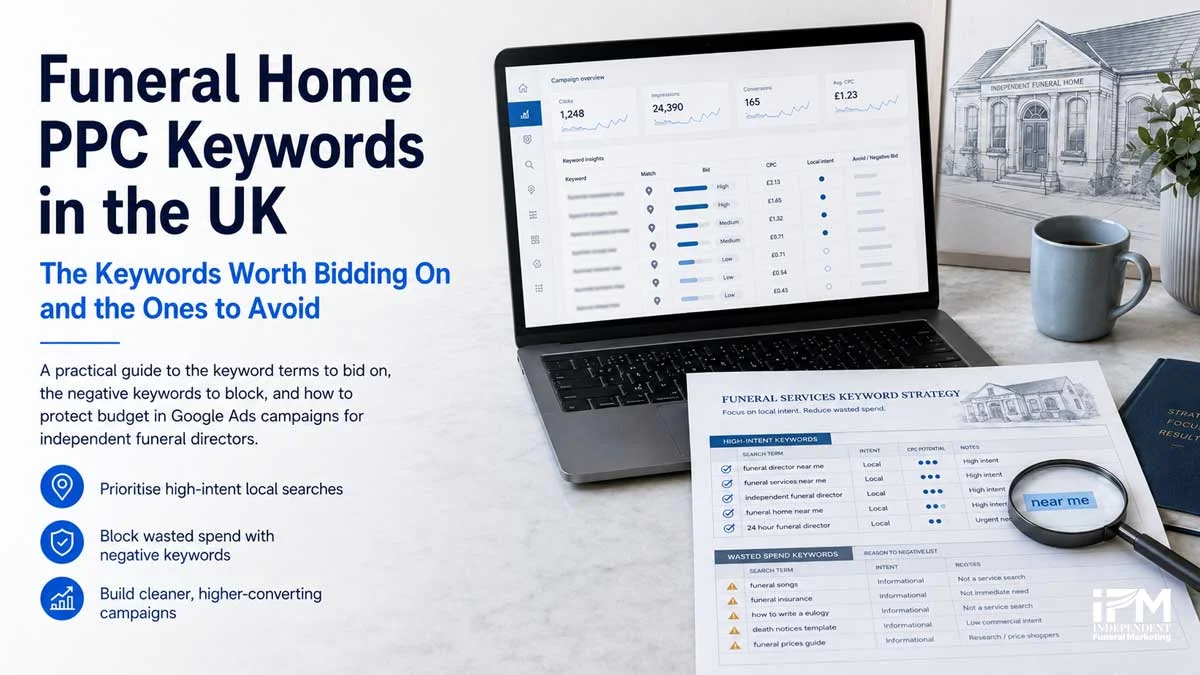
Funeral home PPC keywords in the UK are the foundation of any Google Ads campaign that actually generates enquiries, and getting this list wrong costs money with every single click. A funeral director paying £17.50 per click for “funeral directors near me” (DataForSEO, September 2026) who is running broad match keywords will also pay that rate when someone searches for funeral director jobs, pet cremation near me, or how to write a eulogy. The clicks look identical in your billing summary. The conversion rates are not.
The bidding universe for funeral home PPC is smaller than it first appears. The word “funeral” appears in hundreds of search contexts that will never produce a phone call from a bereaved family. Understanding which searches signal genuine immediate need, and which do not, is what separates a campaign that generates enquiries from one that drains budget without result.
This guide covers the complete bid list drawn from live UK DataForSEO data, the full negative keywords list across six categories, a breakdown of how to structure ad groups around keyword intent, and a direct answer to how much Google Ads actually cost for an independent funeral home in the UK.
What are PPC keywords and why do they matter for funeral homes?
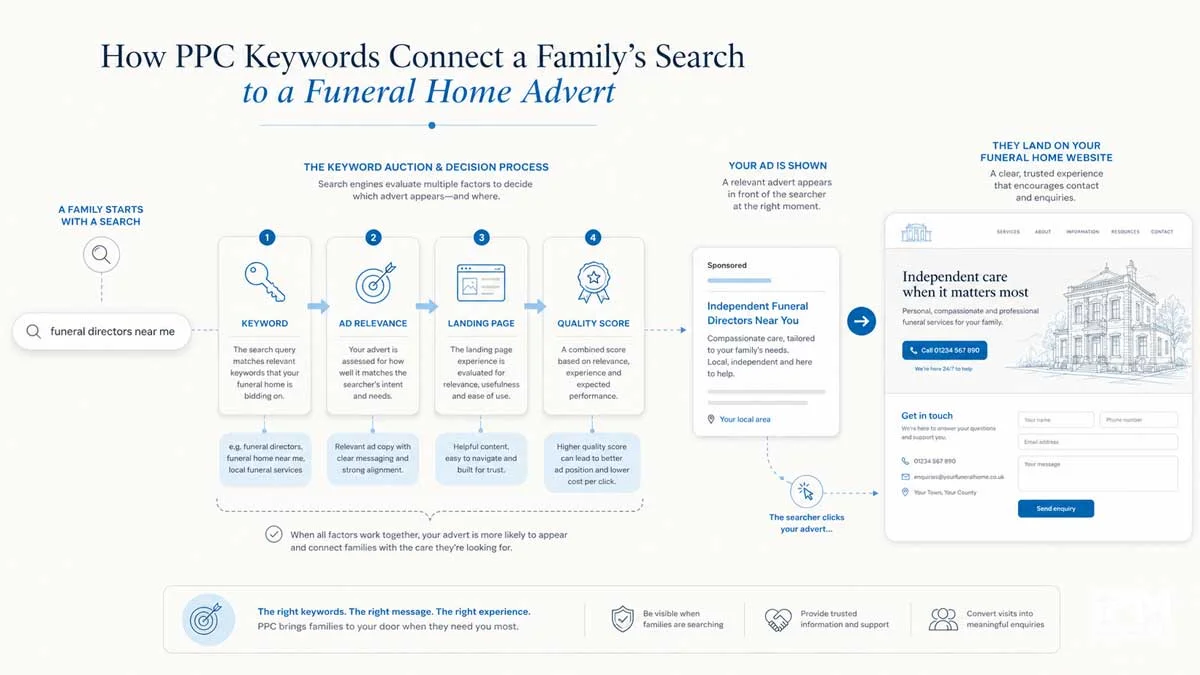
Google Ads operates as a real-time auction. Every time someone searches for a term you are bidding on, Google runs a millisecond auction between all advertisers bidding on that keyword. The winner is not the highest bidder. The winner is the advertiser with the best combination of bid and Quality Score, a relevance rating Google assigns based on how well your keyword, ad, and landing page match what the searcher is looking for.
Ad rank determines your position and your actual cost per click. A funeral director running a tightly structured campaign, with an ad that reads “Funeral Director in [Town]” pointing to a dedicated local landing page, will typically pay less per click and achieve a higher position than a national chain running a generic campaign. Quality Score rewards precision, and funeral homes that build campaigns around tightly themed keyword groups benefit directly from lower effective CPCs.
The consequence of poor keyword selection is different for funeral homes than for most service sectors. The word “funeral” appears in job listings, DIY eulogy guides, celebrity obituaries, pet cremation services, and academic research. Without deliberate keyword management, Google’s broad match algorithm will serve your ads across all of them. A single irrelevant click on “funeral services near me” costs £19.29 (DataForSEO, September 2026). That is the same rate you pay when the click comes from a bereaved family ready to call.
Getting keyword selection right is not technically complex. It requires understanding which searches signal need and which signal something else entirely, then structuring a campaign that captures the former and excludes the latter.
Which funeral home PPC keywords produce the highest conversion rates?
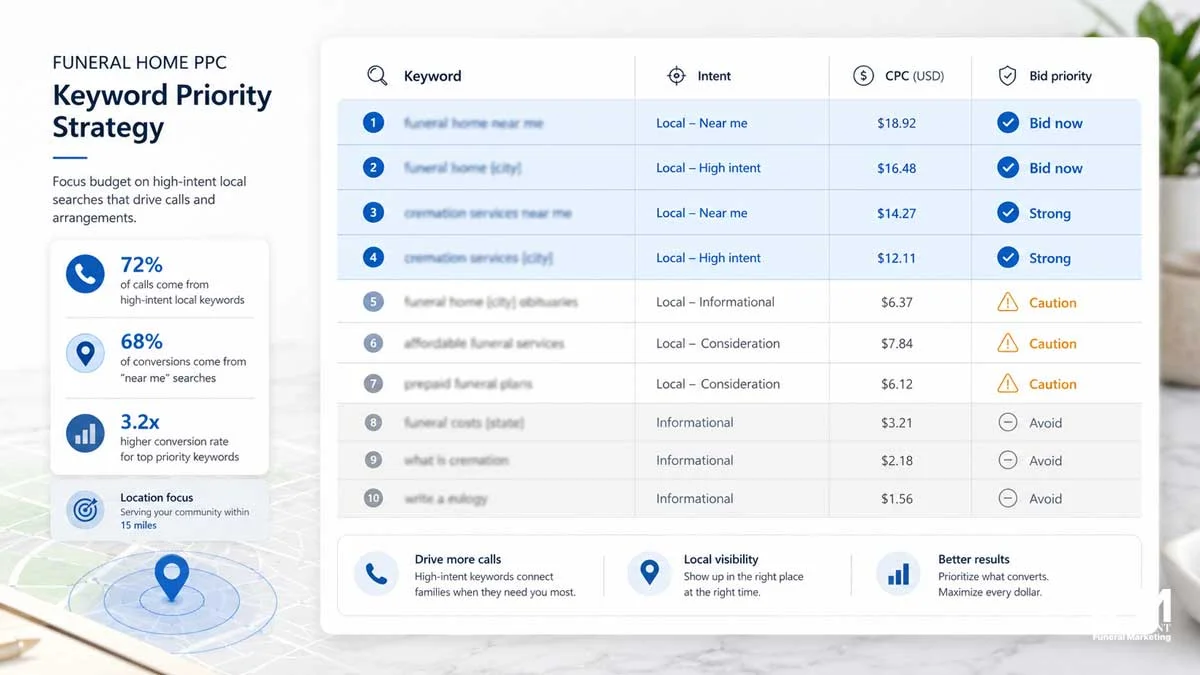
The bid priority system in the table below reflects conversion probability, not search volume. A “Bid now” rating means the term carries local intent and signals the searcher is ready to make contact. A “Caution” rating means the searcher is in research mode, likely comparing prices or learning about the process, but is not yet ready to call. Both types of clicks cost similar amounts. The conversion rates are very different.
| Keyword | UK Vol/mo | UK CPC | Intent | Bid priority |
|---|---|---|---|---|
| funeral directors near me | 9,900 | £17.50 | Nav/Commercial | Bid now |
| funeral home near me | 4,400 | £16.43 | Navigational | Bid now |
| funeral services near me | 720 | £19.29 | Commercial | Bid now |
| cremation services near me | 1,300 | £11.46 | Commercial | Bid now |
| best funeral directors near me | 260 | £13.57 | Commercial | Bid now |
| direct cremation near me | 1,000 | £13.78 | Nav/Commercial | Strong |
| funeral arrangements | 1,000 | £14.34 | Info/Commercial | Strong |
| independent funeral director | 390 | £4.32 | Nav/Commercial | Strong |
| cheapest funeral directors | 70 | £10.18 | Commercial | Strong |
| local funeral homes | 90 | £22.15 | Navigational | Strong |
| direct cremation uk | 880 | £18.46 | Nav/Info | Selective |
| prepaid funeral plan | 1,000 | £17.90 | Commercial | Selective |
| affordable funeral directors | 20 | £31.92 | Commercial | Selective |
| direct cremation cost | 720 | £13.18 | Informational | Caution |
| how much does a funeral cost | 2,400 | £4.14 | Informational | Caution |
| average funeral cost uk | 1,900 | £5.09 | Informational | Caution |
| funeral home cost | 110 | £7.78 | Info/Commercial | Caution |
| funeral plan comparison | 170 | £17.66 | Informational | Avoid |
CPC data: DataForSEO, September 2026. Validated against Wired Media UK funeral PPC benchmarks (£3.50 to £25.00 range).
The five “Bid now” terms share a common characteristic: they contain a local or immediate signal and indicate that the searcher is ready to make contact, not browse. “Funeral services near me” at £19.29 CPC carries the highest commercial intent in the dataset. The higher cost-per-click reflects that advertisers have found these clicks convert. They are worth paying for.
The “Caution” group is led by “how much does a funeral cost” at 2,400 searches per month and a low £4.14 CPC. These terms attract a research audience building a picture of the market. The CPC is low because conversion rates are low. Bidding on informational terms on the Search Network produces expensive traffic in terms of cost-per-enquiry, even when the per-click cost is modest.
“Funeral plan comparison” is rated “Avoid” despite a CPC of £17.66. The comparison-shopping mindset that drives this query belongs to someone building a shortlist, not a bereaved family in immediate need. The elevated CPC signals competitive bidding rather than proven conversion quality.
For Google Ads management for funeral directors that covers campaign setup, bidding strategy, and ongoing keyword management, IFM works exclusively with independent funeral homes.
How should you structure your funeral home ad groups around keywords?
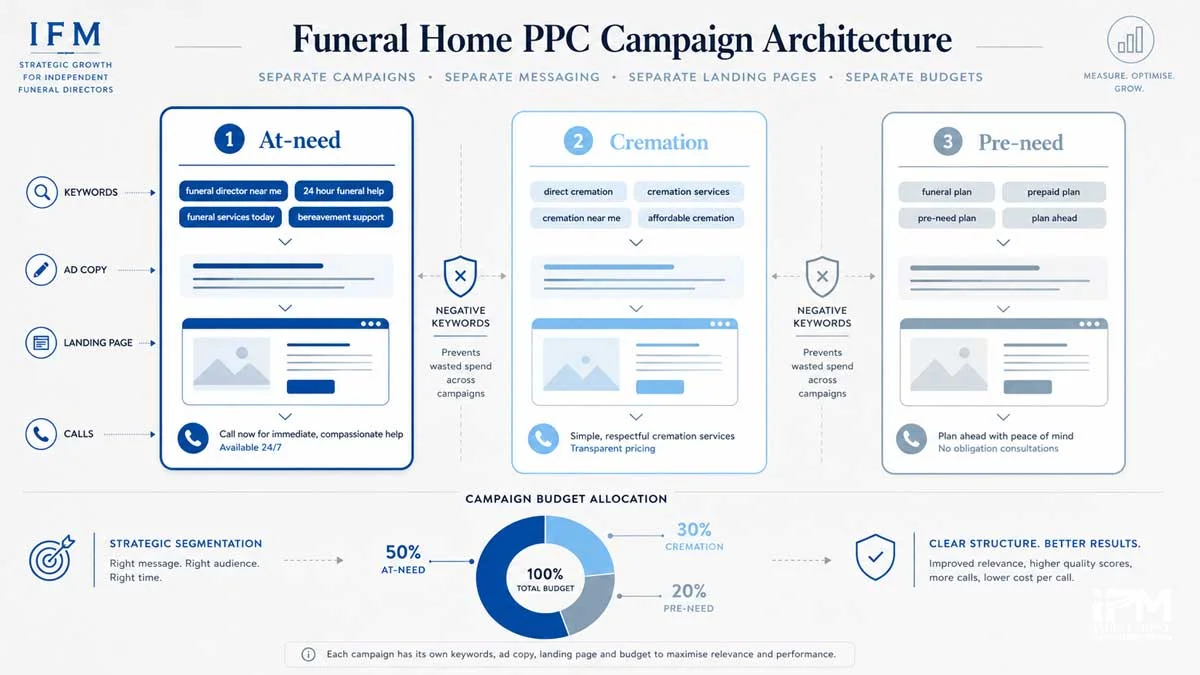
The three-campaign structure works because it separates audiences with fundamentally different needs, different urgency levels, and different messages that convert for each one.
At-need burial campaign. Families in immediate need of funeral director services. This is your primary campaign. Core bidding terms: “funeral directors near me”, “funeral home near me”, “best funeral directors near me”. Use phrase and exact match, tight geo-targeting, and call extensions with your phone number as the primary conversion mechanism. Add cremation-specific terms as negatives.
Cremation campaign. Families who have decided on cremation and are comparing providers. Core bidding terms: “cremation services near me”, “direct cremation near me”. This audience is often more price-conscious than burial searchers, so ad copy should address value clearly. Add burial and coffin as negatives to prevent cross-contamination.
Pre-need campaign. Families planning ahead for themselves or a relative. Core bidding terms: “prepaid funeral plan”, “funeral pre-planning”. Lower urgency, different messaging, and in the UK, FCA-regulated context that affects what claims can be made in ad copy. This campaign needs its own compliance review before launch.
Match types are critical for funeral home campaigns. Exact match shows your ad only when the search is identical (or a close variant) to your keyword. Phrase match shows when the search contains your phrase in order. Broad match shows for anything Google considers related, which for funeral campaigns means appearing for searches you have never intended to target.
Most independent funeral homes should lead with phrase match for their core terms and exact match for their highest-priority terms. Broad match is not recommended without a comprehensive negative list already in place. For a full overview of how Google policies apply to funeral home campaigns, read the guide on what Google Ads compliance means for funeral directors.
The cross-campaign negative logic is where most accounts save real money. Add cremation as a negative in your burial campaign, and burial as a negative in your cremation campaign (Welton Hong, Ring Ring Marketing [1], September 2024). A family searching for direct cremation who sees an ad for traditional funeral services is less likely to call. Segmentation at campaign level, not just ad group level, keeps each audience seeing the message that fits their intent. For a step-by-step account setup walkthrough covering structure, bidding, and ad extensions, see the Google Ads campaign setup guide for funeral directors.
What keywords do families search when they need immediate funeral help?
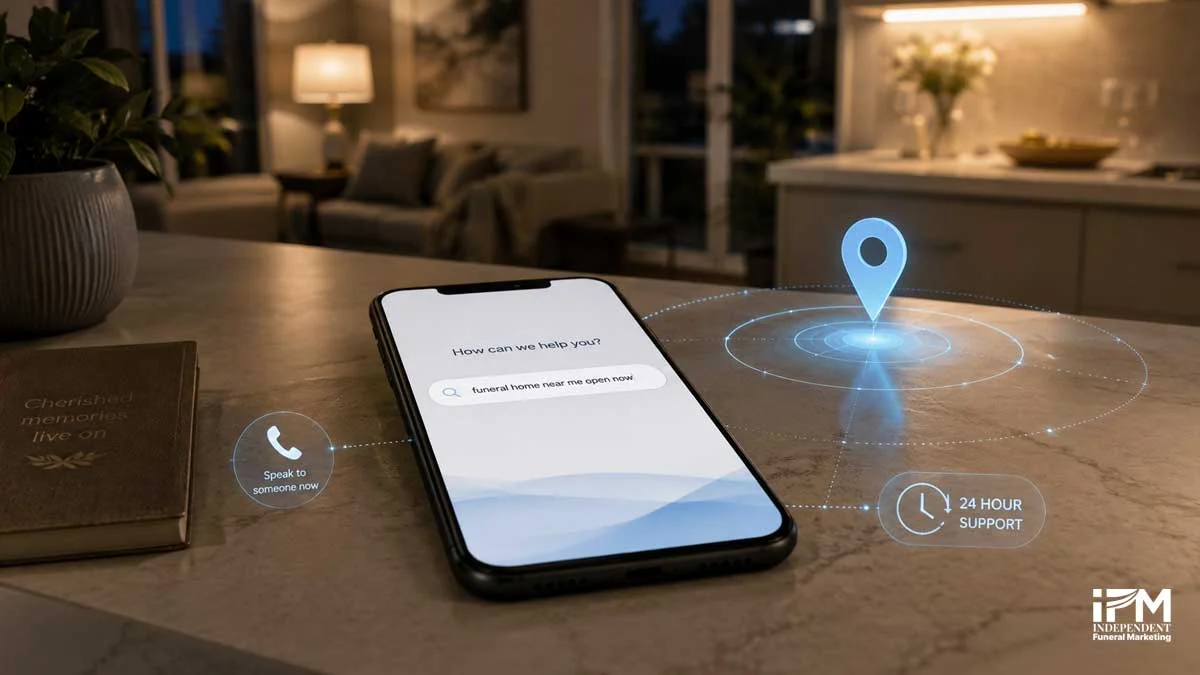
Volume does not fully capture the value of urgency-cluster keywords. A term with fewer than ten UK monthly searches that converts at 60% is more valuable than a 10,000-search term that converts at 2%. The families who type “funeral home near me open now” at 2am are not comparing options. They are looking for someone available, local, and ready to help immediately.
The case for bidding on low-volume urgency terms is clear. At-need urgency terms signal extreme purchase intent. Google now reports too little UK volume for “funeral home near me open now” to show search or cost data, which usually means fewer than ten searches a month (DataForSEO, September 2026). A low monthly volume of three or four searches at a high conversion rate can still produce a lower cost-per-enquiry than a high-volume informational term converting at 2%.
| Long-tail keyword | UK Vol/mo | UK CPC | Intent | Campaign note |
|---|---|---|---|---|
| URGENCY / AT-NEED | ||||
| funeral home near me open now | <10 | n/a | Navigational | Dedicated ad group; highest urgency signal |
| emergency funeral service | <10 | n/a | Transactional | Low volume; high value per click |
| same day funeral arrangements | <10 | n/a | Transactional | Use phrase match |
| funeral director open 24 hours | <10 | n/a | Navigational | Worth bidding even at very low volume |
| 24 hour funeral director | <10 | n/a | Transactional | Immediate-need signal |
| PRICING / COST | ||||
| cheapest funeral directors near me | 170 | £15.95 | Commercial | Price-sensitive at-need; include in pricing ad groups |
| affordable cremation near me | 10 | n/a | Commercial | KD 11; worth including |
| budget funeral directors | 10 | n/a | Commercial | Explicit price-intent signal |
| funeral director fees | 20 | £3.75 | Info/Commercial | Informational intent; landing page over Search bid |
| direct cremation cost | 720 | £13.18 | Informational | Caution on Search bidding |
| SERVICE TYPE | ||||
| green burial near me | 880 | £2.69 | Nav/Commercial | Growing segment; low CPC relative to intent |
| eco funeral near me | 10 | £8.71 | Info/Nav | Niche; CPC signals some competition |
| humanist funeral near me | 40 | £3.92 | Navigational | Strong locality signal; KD 9 |
| muslim funeral services near me | 20 | £19.92 | Nav/Commercial | Faith-specific; relevant where community is served |
| jewish funeral director near me | <10 | n/a | Navigational | Faith-specific; highly relevant where served |
| memorial service near me | 40 | £10.13 | Info/Nav | Weaker at-need signal |
| bereavement support near me | 110 | £2.48 | Navigational | Consider display targeting over Search |
| PRE-NEED / PLANNING | ||||
| prepaid funeral plan | 1,000 | £17.90 | Commercial | Dedicated pre-need campaign; FCA-regulated context |
| pre-planned funeral near me | <10 | n/a | Commercial | Include in pre-need planning campaigns |
| funeral pre-planning | <10 | n/a | Info/Commercial | Early-stage planner intent |
CPC data: DataForSEO, September 2026. Warning note at bottom of table: funeral plan comparison (170/mo, £17.66 CPC) has comparison-shopping intent and should not be bid on at Search level.
Pet cremation alert: “Pet cremation near me” has 8,100 UK monthly searches, more than most human funeral terms (DataForSEO, September 2026). Without explicitly negating pet cremation, dog cremation, cat cremation, and animal cremation, Google’s broad match will serve your funeral home ads to pet owners. This is the most common and costly single mistake in funeral home PPC accounts.
The service-type cluster reveals an underused opportunity. “Green burial near me” generates 880 UK monthly searches at just £2.69 per click, compared to £17.50 for the equivalent at-need term. If you offer natural or woodland burial services, this cluster carries commercial intent at a fraction of the cost. Advertiser competition is low and it will not remain that way as environmental burial preferences grow.
Which funeral keywords should you avoid bidding on?
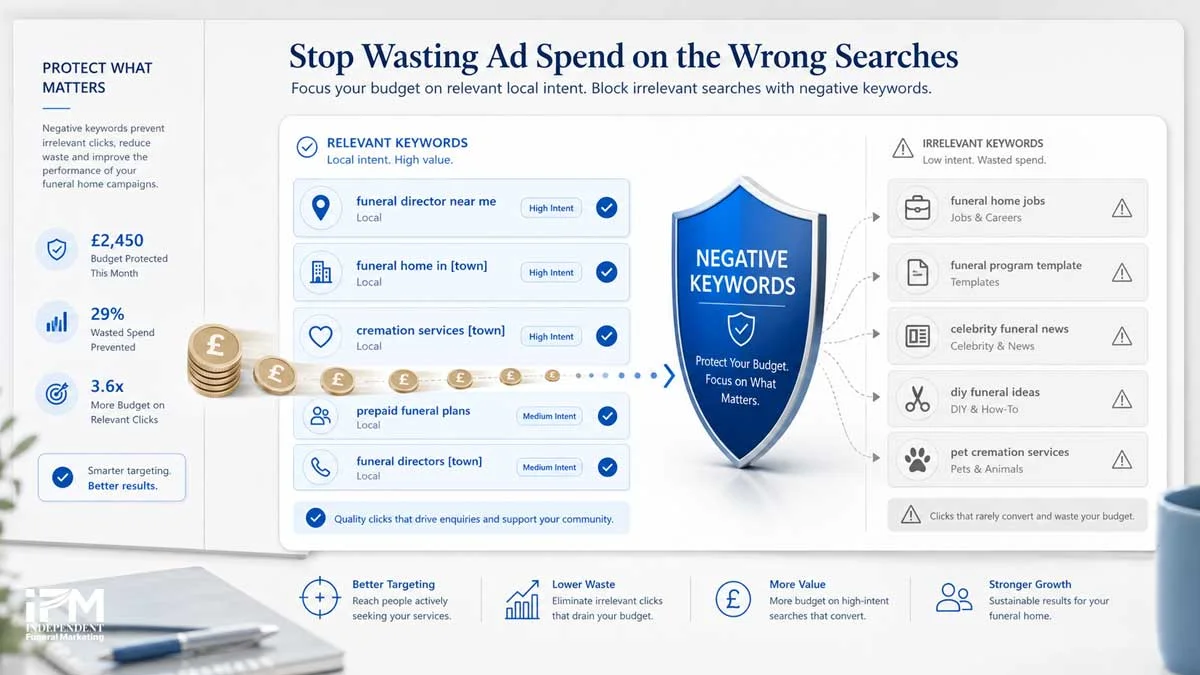
The structural vulnerability of funeral home PPC campaigns comes from the word “funeral” itself. Compare it to most local service categories. When someone searches “plumber near me”, almost every variation of that query carries commercial intent. When someone searches for anything containing the word “funeral”, the range of possibilities is enormous: job listings, training courses, eulogy templates, celebrity death coverage, pet cremation, DIY planning guides, and academic research.
Four categories of keyword waste account for most of the budget loss in poorly managed funeral home accounts.
Career and employment searches. The funeral industry employs a significant number of people, and job seekers generate consistent search volume for terms like “funeral director jobs”, “how to become a funeral director”, and “embalmer course”. These are among the most common sources of irrelevant clicks in funeral home accounts and among the easiest to prevent.
Informational and research-only searches. Terms like “history of funeral customs”, “funeral statistics”, and “what does a funeral director do” attract students, journalists, and curious browsers. They will not call. They were sent to your ad by the broad match algorithm interpreting funeral-related intent where none exists.
Celebration-of-life and DIY content searches. Families who have already arranged a funeral, or are planning a memorial, consistently search for practical content: “funeral poem”, “how to write a eulogy”, “funeral flowers DIY”. These searches carry genuine emotional meaning, but zero commercial intent for your services.
News and celebrity death searches. When a public figure dies, search volume spikes across funeral-related terms. “Celebrity death”, “famous funeral”, “state funeral”, and “live funeral” can generate significant wasted spend if they are not excluded. The Funeral Futurist Podcast [2] flagged this as an increasingly expensive problem during high-profile national events (January 2025).
The pet cremation problem stands apart in terms of financial impact. At 8,100 UK monthly searches, it deserves its own category in the negative keywords list, which follows in the next section.
What is a funeral home negative keywords list and how do you build one?
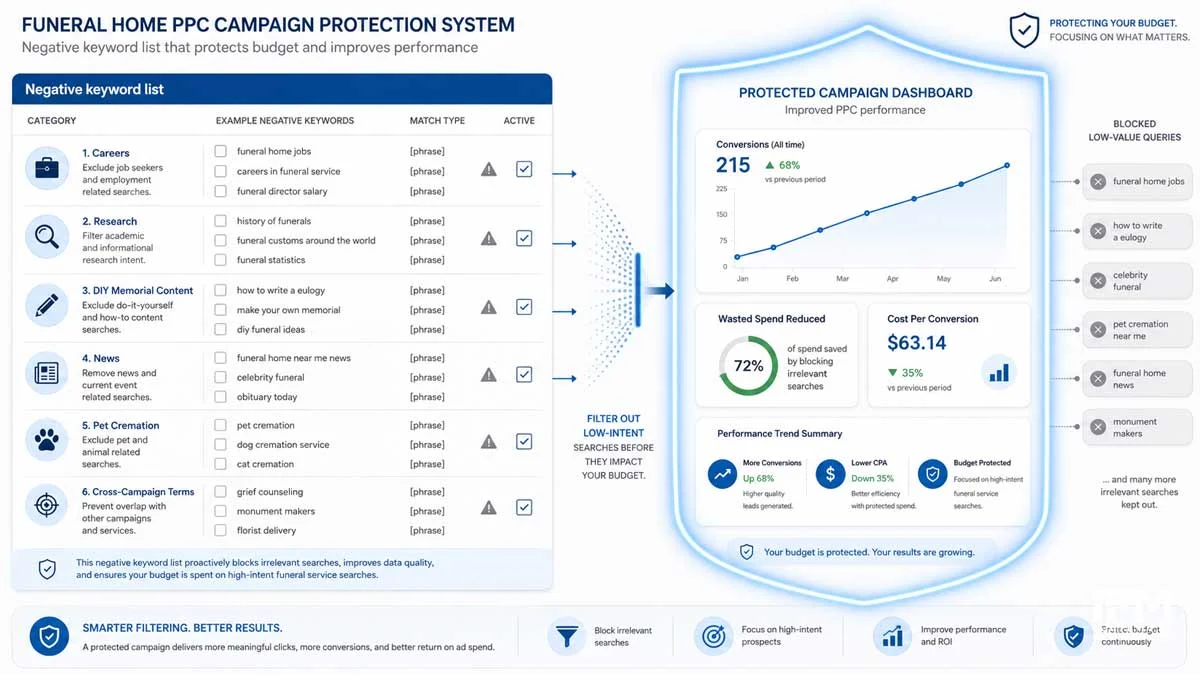
Negative keywords work by excluding your ad from any search containing those terms. Like bid keywords, they have three match types: exact negative (blocks only that exact search), phrase negative (blocks any search containing that phrase in order), and broad negative (blocks searches containing all the words in any order). For most funeral home negative keywords, phrase negative match is the right setting.
How to implement your funeral home negative keywords list:
- In Google Ads, navigate to Tools and Settings, then Shared Library, then Negative keyword lists.
- Create a new list named “Funeral home global negatives” and add all of the terms in the categories below.
- Apply this shared list to all your funeral home campaigns.
- Create a second, campaign-level negative list for each campaign’s cross-segment negatives: cremation terms excluded from burial campaigns, burial terms excluded from cremation campaigns.
- For the first four weeks, open the Search Terms report under Keywords each week and add any new irrelevant queries that appear as negatives.
- Treat the negative list as a living document. New irrelevant queries surface over time, particularly after high-profile national events or local news stories.
Career and employment negative keywords
| jobs | careers | hiring | vacancy |
| apprenticeship | funeral director training | how to become | qualification |
| salary | wages | pay | embalmer course |
| degree | diploma | college | mortuary science |
Informational and research-only negative keywords
| free | free guide | free template | free checklist |
| template | sample | example | how to write |
| history of | meaning of | definition | what is |
| statistics | facts | research | study |
| Wikipedia | funeral customs | funeral traditions | cultural |
Celebration of life and DIY negative keywords
| funeral poem | funeral poems | funeral music | funeral song |
| eulogy | how to write a eulogy | obituary template | obituary example |
| funeral dress | what to wear | funeral outfit | funeral flowers DIY |
| funeral reception | funeral food | funeral catering ideas | memorial ideas DIY |
News and celebrity death negative keywords
| celebrity death | famous funeral | obituary news | death news |
| live funeral | funeral live stream | watch funeral | funeral broadcast |
| royal funeral | state funeral | military funeral | political funeral |
Non-human cremation negative keywords
| pet cremation | dog cremation | cat cremation | animal cremation |
| horse cremation | rabbit cremation | bird cremation | fish cremation |
Pet cremation reminder: “Pet cremation near me” generates 8,100 UK monthly searches (DataForSEO, September 2026). This is more than most human funeral terms. If these terms are not in your negative list, Google broad match is serving your ads to pet owners right now.
Cross-campaign segment negative keywords
These negatives are applied within specific campaigns to prevent keyword overlap between audience segments.
| Negative (in burial campaign) | Negative (in cremation campaign) | Negative (in pre-need campaign) |
|---|---|---|
| cremation | burial | at-need |
| direct cremation | cemetery | same day |
| ashes | grave | open now |
| scatter | coffin | emergency |
The cross-campaign approach was validated by Ring Ring Marketing (Welton Hong [1], September 2024) and the Funeral Futurist Podcast [2] (January 2025) as one of the highest-impact budget improvements available to funeral home campaigns. The Search Terms report, reviewed weekly for the first month, is where the remaining irrelevant queries will surface. Add them as negatives as they appear.
How do cremation keywords differ from burial keywords in funeral home PPC?
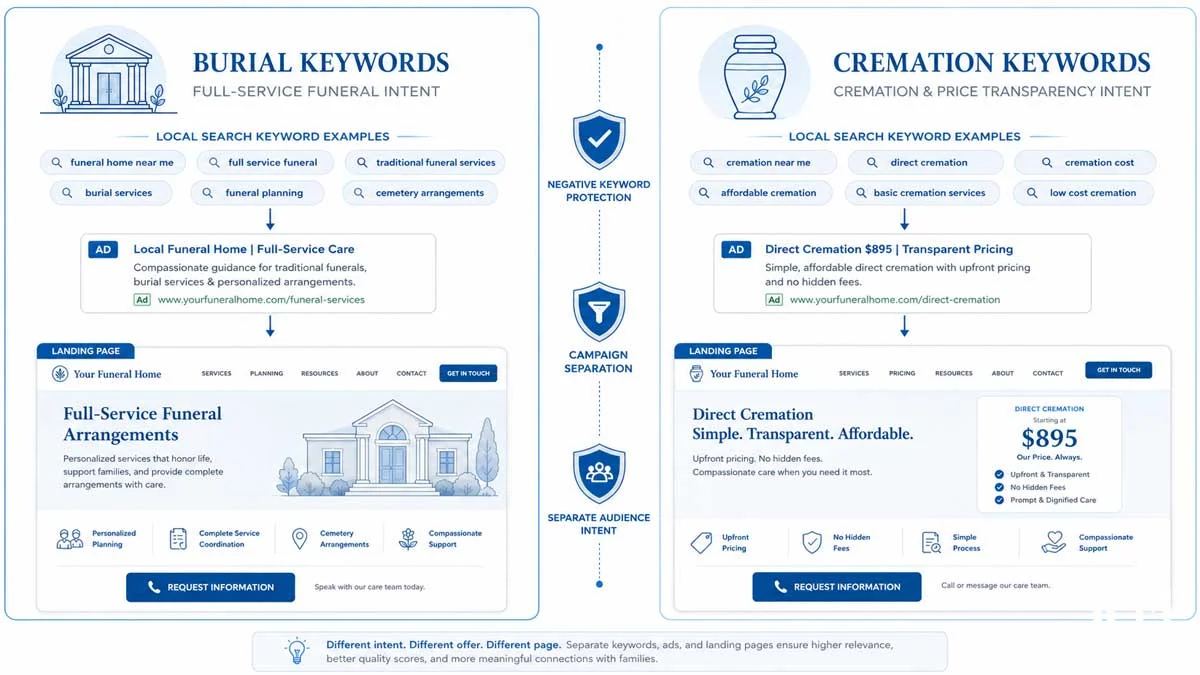
The audience distinction matters at every level of campaign management. Families who have decided on cremation have a specific, narrower question. They want to know who provides cremation in their area, whether direct cremation is offered, and what it costs. Ad copy that leads with price transparency and simplicity converts better for this audience. Traditional funeral service messaging can work against it.
Families searching general funeral terms are in a different position. They may not have decided between burial and cremation. They may need guidance as much as a service provider. Landing pages for these families should provide reassurance, explain available options, and make it easy to get in touch.
| At-need burial campaign | Cremation campaign | |
|---|---|---|
| Audience | Families seeking full funeral services; decisions not yet made | Families who have decided on cremation |
| Core keywords | funeral directors near me, funeral home near me, best funeral directors near me | cremation services near me, direct cremation near me |
| Cross-negatives | Add: cremation, direct cremation, ashes, scatter | Add: burial, cemetery, grave, coffin |
| Landing page | Full service overview, process, trust signals, local credentials | Cremation service description, pricing, simplicity of process |
| Messaging | Compassionate, full-service, local expertise | Straightforward, respectful, price-transparent |
Direct cremation deserves its own ad group within the cremation campaign. “Direct cremation near me” at 1,000 UK monthly searches and £13.78 CPC attracts a price-sensitive, decision-made audience. These families want confirmation that you offer the service, a clear price point, and an easy way to contact you. A landing page that buries the direct cremation option within a general funeral services overview will lose them before they reach the enquiry form.
Pre-need planning is the third distinct segment. “Prepaid funeral plan” at 1,000 UK monthly searches and £17.90 CPC represents families planning ahead, not responding to an immediate bereavement. In the UK, prepaid funeral plan advertising sits within Financial Conduct Authority (FCA) regulated territory, which affects which claims can be made in ad copy. This segment needs its own campaign, its own budget, and a compliance review of ad copy before launch.
Green burial and eco funeral are emerging micro-segments worth early attention. “Green burial near me” at 880 UK monthly searches and £2.69 CPC is one of the most cost-efficient opportunities in the full keyword set. If you offer natural or woodland burial, this cluster should be active before advertiser competition pushes CPCs upward.
What does it actually cost to run Google Ads for a funeral home?
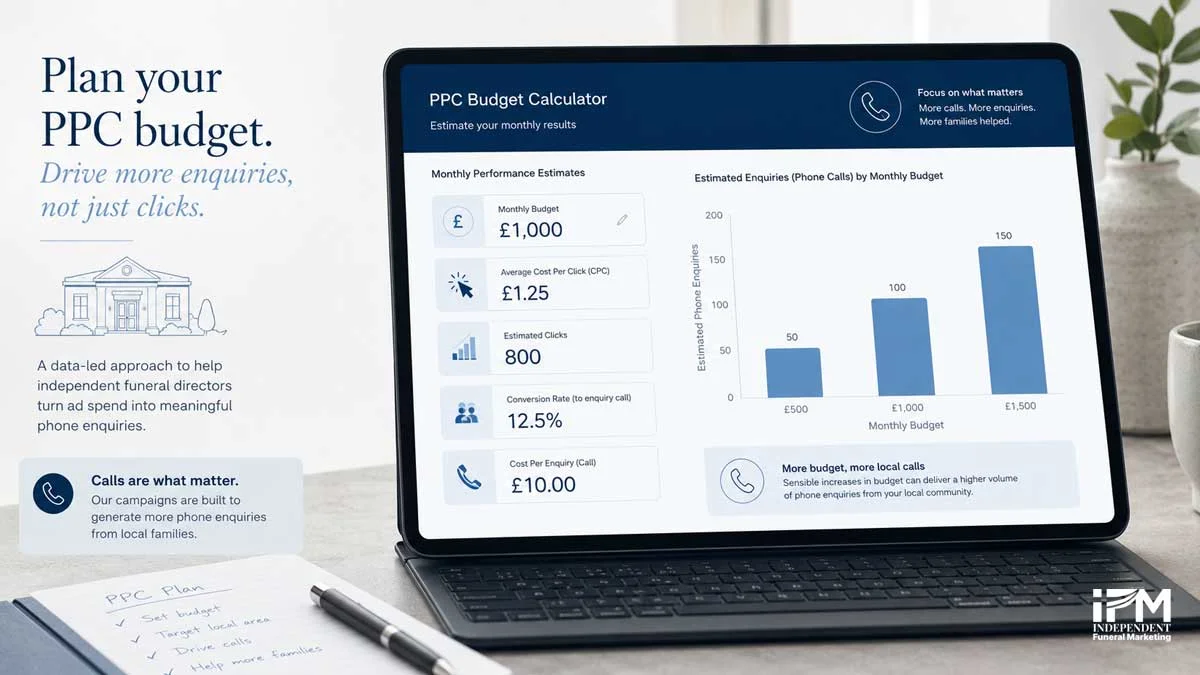
The per-click costs for the five highest-priority terms:
| Keyword | UK CPC | Clicks per £500 budget |
|---|---|---|
| funeral directors near me | £17.50 | ~29 |
| funeral home near me | £16.43 | ~30 |
| funeral services near me | £19.29 | ~26 |
| cremation services near me | £11.46 | ~44 |
| best funeral directors near me | £13.57 | ~37 |
Source: DataForSEO, September 2026.
The per-click cost alone does not tell you the true cost of the campaign. What matters is the cost per enquiry. At £17.50 per click and a 3% conversion rate (a realistic figure for a well-structured campaign with a relevant landing page), a funeral home pays approximately £583 to generate one qualified enquiry. Against a UK funeral arrangement value of £3,953 (SunLife, 2024), that is a return on ad spend of roughly 7:1 on a single arrangement.
Conversion rate is the variable that improves most from proper keyword management. A campaign bidding on broad match across all funeral-related terms will convert at a lower rate, not because the clicks are more expensive per-click, but because a higher proportion of those clicks come from people who are not in need. Tighter keyword selection increases conversion rate and reduces cost per enquiry without requiring a higher monthly budget.
At £500 per month, expect roughly 29 clicks against “funeral directors near me”. At a 3% conversion rate, that is approximately one enquiry per month. At 5% conversion, achievable through better landing pages and tighter keyword targeting, it is closer to one and a half. The difference between a 3% and 5% conversion rate at a fixed budget is not more money. It is better campaign structure.
For a full breakdown of UK funeral Google Ads costs by keyword and by city, the Google Ads cost guide for UK funeral directors covers regional CPC variation and monthly budget scenarios in detail. If you are weighing paid search against organic SEO for your funeral home, Google Ads vs SEO for funeral homes covers when each channel is the right choice.
Can an independent funeral home compete with corporate chains on Google Ads?
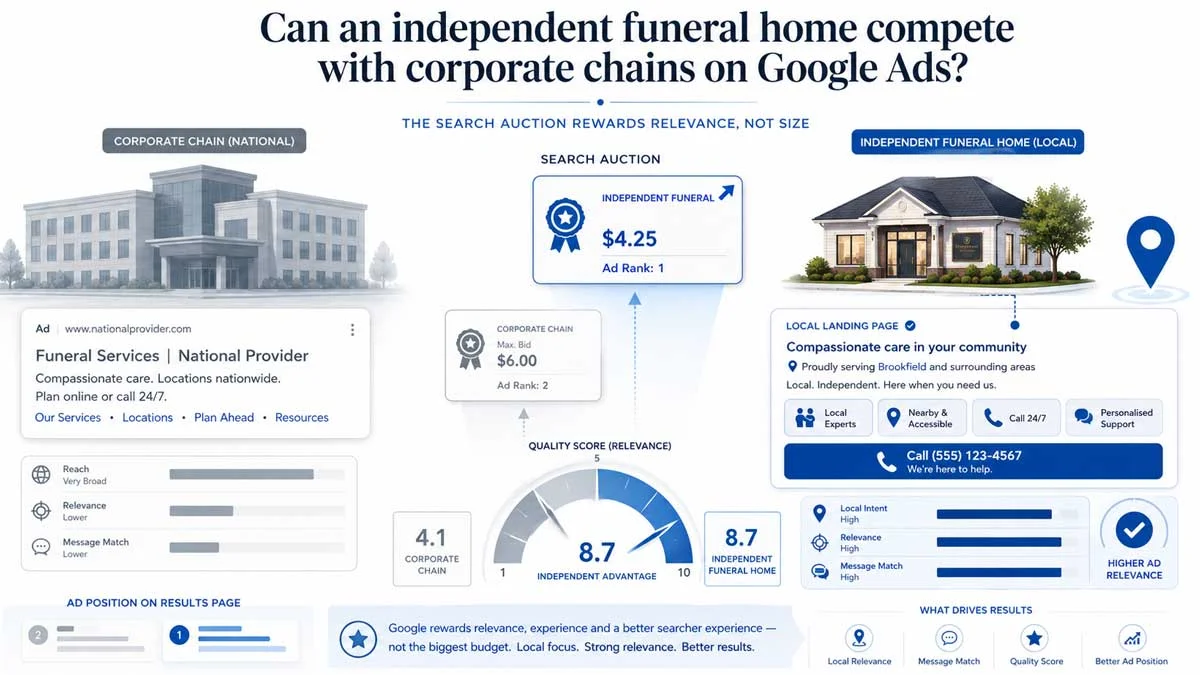
The Quality Score mechanism is what makes this genuinely competitive. Dignity Funerals and Co-op Funeralcare run national and regional campaigns. Their ads serve towns across their coverage area, which means the keyword-to-ad-to-landing-page relevance is diluted. An independent funeral director in a specific town who bids on “funeral director [town]”, with an ad headline of “[Town] Funeral Director” and a dedicated local landing page, will typically achieve a Quality Score of 7 to 10. A national chain running the same term with a regional landing page may score 4 to 6.
A higher Quality Score means a lower actual cost per click for the same ad position. Google charges the minimum amount needed to maintain position above the next competitor, adjusted for Quality Score. An independent with a Quality Score of 8 can outrank a national chain with a Quality Score of 5 while paying less per click. This advantage is real, measurable, and consistently underappreciated by independent funeral directors who assume budget size determines outcomes.
Where independents face structural disadvantage is brand recognition and review volume. Chains like Dignity have national advertising presence and high review counts, which feeds into click-through rates and trust signals beyond the auction itself. Comparison aggregators such as Farewill and Beyond are a separate challenge. These platforms rank for high-volume informational terms and refer families to funeral directors while capturing margin in the process.
The effective independent strategy is to focus where local relevance wins: bid on town-specific terms, use phrase and exact match, maintain a comprehensive negative list, geo-target to your actual service radius, and ensure every landing page mirrors the ad copy with precision. Geo-targeting to your specific town or postcode radius ensures you are not paying for clicks from areas you cannot realistically serve, which reduces wasted spend and strengthens geographic relevance signals simultaneously.
How is AI changing the way families search for funeral directors?
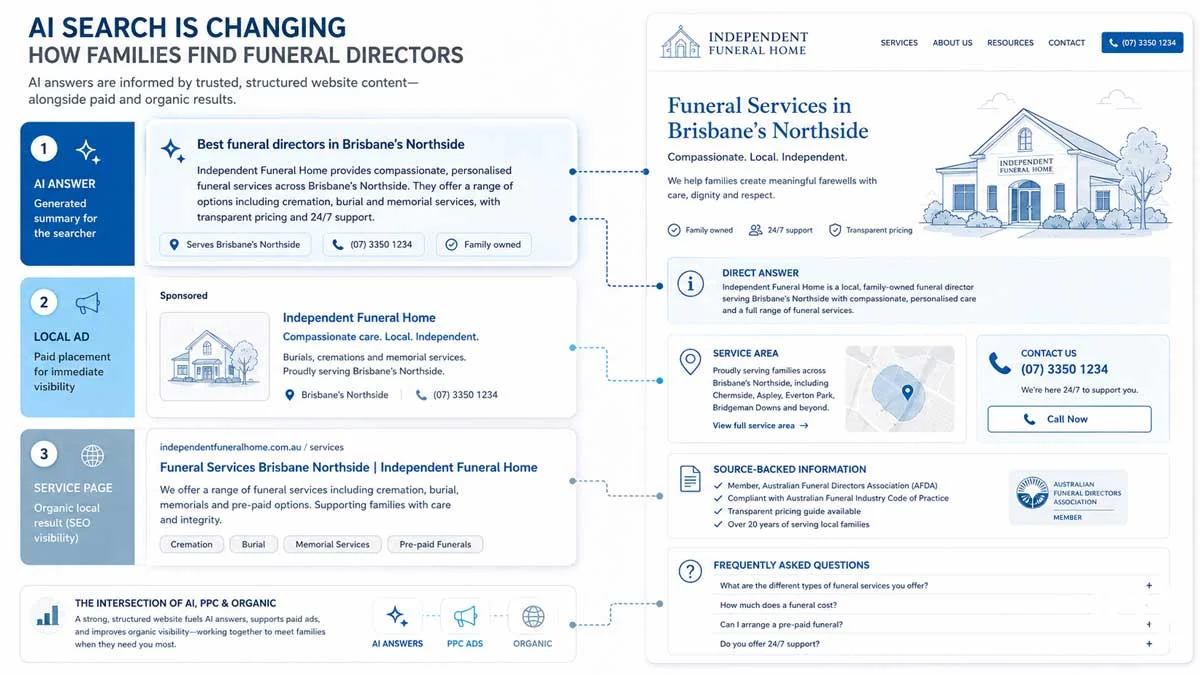
AI Overviews are confirmed across all primary tested funeral PPC queries in both UK and US SERPs (DataForSEO, June 2026). On many funeral-related searches, Google now generates an AI-produced answer that appears above both organic results and paid ads. For PPC campaigns, this means families may read an AI-generated summary before they reach your ad. The ad still matters, particularly for at-need queries where the AI Overview rarely includes a direct local contact, but the search results page has changed structurally.
In 2026, the IFM audience over-indexes for Perplexity usage by +28.2% compared to the UK online average (SparkToro, March 2026 [4]). Independent funeral directors with digital interest are already using AI tools to find marketing guidance, asking questions like “what keywords should I bid on in Google Ads” and “how much should I spend on funeral home PPC”. This article is structured to be cited by those AI systems, not only ranked on Google.
GEO (Generative Engine Optimisation) is the practice of structuring website content so AI systems can extract and cite specific, factual answers. The requirements align significantly with good landing page structure for paid search: direct answers to questions, factual claims with sources, clear service descriptions, and a logical content hierarchy. A landing page written with AI extraction in mind also has stronger Quality Score indicators, specifically higher relevance and clearer structure, making it more effective for both organic visibility and paid search performance.
The practical implication for PPC landing pages is straightforward. A family landing on a page for “cremation services near me” should see, within the first paragraph, a confirmation that you offer cremation in their area, your phone number, and what happens next if they call. This structure satisfies Google’s Quality Score algorithm, improves AI extraction probability, and reduces the time it takes a bereaved family to find the answer they need.
For the structural requirements behind AI search optimisation for funeral homes, IFM covers how to build pages that perform across both traditional and AI-driven search.
Frequently Asked Questions
What are the best keywords for funeral home Google Ads?
The best-converting funeral home Google Ads keywords combine explicit local intent with immediate need. The five essential terms are: “funeral directors near me” (9,900 UK searches/month, £17.50 CPC), “funeral home near me” (4,400/month, £16.43), “funeral services near me” (720/month, £19.29), “cremation services near me” (1,300/month, £11.46), and “best funeral directors near me” (260/month, £13.57). All five carry navigational or commercial intent and should anchor any at-need campaign. Source: DataForSEO, September 2026.
How much should a funeral home spend on Google Ads per month?
A realistic starting monthly budget for a UK independent funeral home is £500 to £1,500. At £17.50 per click for “funeral directors near me” (DataForSEO, September 2026), a £500 budget generates roughly 29 clicks. At a 3% conversion rate, that produces roughly one qualified enquiry per month at a cost per lead of around £580, against an average UK funeral value of £3,953 (SunLife, 2024). Competitive local markets typically require £1,000 to £1,500 for meaningful visibility.
What is the average cost per click for funeral home keywords in the UK?
UK funeral home Google Ads cost between £3.50 and £25.00 per click depending on keyword and local competition (Wired Media). “Funeral directors near me” averages £17.50 per click. “Funeral services near me” carries the highest commercial intent CPC at £19.29. Informational terms such as “average funeral cost uk” average just £5.09 but convert at a much lower rate. The higher CPC for transactional terms reflects the proven at-need intent of the searcher, not inflated pricing. Source: DataForSEO, September 2026.
What negative keywords should a funeral home add to Google Ads?
The most important negative keyword categories are: pet cremation terms (pet cremation, dog cremation, cat cremation), career terms (jobs, careers, hiring, salary, how to become a funeral director), DIY content terms (funeral poem, eulogy, obituary template), and news terms (celebrity death, state funeral, live funeral). Adding these at campaign level blocks irrelevant traffic across all ad groups simultaneously. Review the Search Terms report weekly during the first month and add new irrelevant queries as they appear.
Why is pet cremation near me a dangerous keyword for funeral home campaigns?
“Pet cremation near me” has 8,100 UK monthly searches (DataForSEO, September 2026), more than most human funeral terms. Without explicitly negating pet cremation, dog cremation, cat cremation, and animal cremation in your campaign, Google’s broad match will serve your funeral home ads to pet owners. At around £3.06 per click, this generates consistent spend with zero conversion probability for your business, and it is the most common source of quiet budget waste in funeral home PPC accounts.
Should funeral homes use broad match, phrase match, or exact match keywords?
Independent funeral homes should lead with phrase match and exact match. Broad match is dangerous in funeral home campaigns because Google interprets the word “funeral” very broadly and will serve ads for irrelevant searches without a comprehensive negative list already in place. For most independents, phrase match for moderate-volume terms and exact match for core high-intent terms gives the best balance of reach and relevance. Add broad match only once conversion data is established and the negative list is comprehensive.
How do I stop my funeral home ads showing for job searches?
Add these terms as negative keywords at campaign level so they apply across all ad groups: jobs, careers, hiring, vacancy, apprenticeship, salary, training, how to become a funeral director, funeral director qualification, embalmer course, degree, diploma, and mortuary science. Campaign-level negatives apply to every ad group within that campaign simultaneously, which is more reliable than managing the same list at ad group level.
What is the difference between SEO and PPC for funeral homes?
SEO builds long-term organic visibility over months through content quality, citations, and authority signals. PPC delivers immediate visibility the day the campaign launches but stops generating traffic when spend stops. Most established funeral homes benefit from both: SEO as the long-term foundation and PPC for immediate at-need visibility, seasonal gaps, or new service lines. PPC is especially useful during the first six to twelve months before organic rankings are established, and for filling any geographic gaps in local search visibility.
How long does it take for funeral home Google Ads to work?
Funeral home Google Ads can appear within hours of campaign launch. The first two to four weeks should be treated as a learning phase, during which Google’s algorithm collects conversion data to improve targeting. Meaningful cost-per-enquiry data typically emerges after 30 days. The campaign should be reviewed against real call data at that point, with the negative keywords list refined based on the Search Terms report showing exactly which queries triggered your ads.
Do funeral homes need a dedicated landing page for Google Ads?
Yes. Sending paid traffic to a homepage reduces Quality Score, increases cost per click, and lowers conversion rate. Each campaign should send traffic to a dedicated page that mirrors the ad copy precisely. A family who clicks an ad for “cremation services near me” should land on a page about cremation, not a general homepage. Dedicated landing pages improve Quality Score, reduce effective CPC, and make it straightforward for families to take the next step.
Is Google Ads or Facebook Ads better for funeral homes?
Google Ads is significantly better for at-need funeral enquiries because it captures families who are actively searching at the moment of need. Facebook Ads interrupt people who are not searching and are in a completely different state of mind. For at-need business, Google Ads is the stronger channel. Facebook has genuine value for pre-need awareness campaigns, community presence, and relationship-building with families planning ahead, but should not be the primary channel for generating immediate funeral enquiries.
Should a funeral home bid on competitor names in Google Ads?
Bidding on a competitor’s name is legal and technically straightforward, but the return is uncertain. If a local competitor is running poorly structured campaigns, their name terms may be available at low CPCs and convert reasonably. More often, name bidding triggers an escalating spend pattern with no sustainable benefit to either party. If you test competitor name bidding, run it as a small separate budget campaign so you can measure cost-per-enquiry independently against your core at-need campaign.
What ad extensions should funeral homes use in Google Ads?
Call extensions are non-negotiable for at-need campaigns. A phone number visible in the ad allows bereaved families to call without clicking through, reducing friction at the highest-intent moment. Also use: location extensions (your address and a map link), sitelink extensions (dedicated links to cremation, burial, and pre-planning pages), and structured snippet extensions (lists key services). Call extensions consistently produce the strongest conversion rate improvement for funeral home campaigns.
Why are funeral keywords so expensive on Google Ads?
High CPCs reflect the combination of urgent, emotionally-driven demand and a small pool of local advertisers competing for the same searches. A bereaved family searching at midnight for a funeral director in their town has near-zero price sensitivity in that moment. Advertisers compete hard for these clicks because each converted enquiry represents an average UK funeral arrangement value of £3,953 (SunLife Cost of Dying Report, 2024 [3]), making even a £25 click highly profitable when it converts to a booking.
How do I track phone calls from funeral home Google Ads?
Use Google Ads call tracking by enabling Google forwarding numbers in your call extension settings. This creates a unique trackable number for your ads. Calls to this number are attributed back to the specific keyword, ad, and campaign that triggered them. Set up a conversion action for calls lasting more than 60 seconds as your primary KPI, since this filters out wrong numbers and gives you an accurate picture of which keywords are generating genuine at-need enquiries.
References
[1] Ring Ring Marketing (Welton Hong), funeral home Google Ads keyword strategy and campaign segmentation, September 2024, ringringmarketing.com
[2] Funeral Futurist Podcast, negative keyword best practices and cross-campaign segmentation for funeral home PPC, January 2025, funeralfuturist.com
[3] SunLife, Cost of Dying Report 2024, average UK funeral arrangement cost £3,953, sunlife.co.uk/cost-of-dying
[4] SparkToro, UK funeral director audience research, Perplexity over-index +28.2% vs UK average, March 2026, sparktoro.com
[5] DataForSEO, UK funeral keyword data including search volumes, CPCs, keyword difficulty, September 2026, and SERP features, June 2026, dataforseo.com
[6] Wired Media, UK funeral PPC benchmark CPC data (£3.50 to £25.00 range), wired-media.co.uk