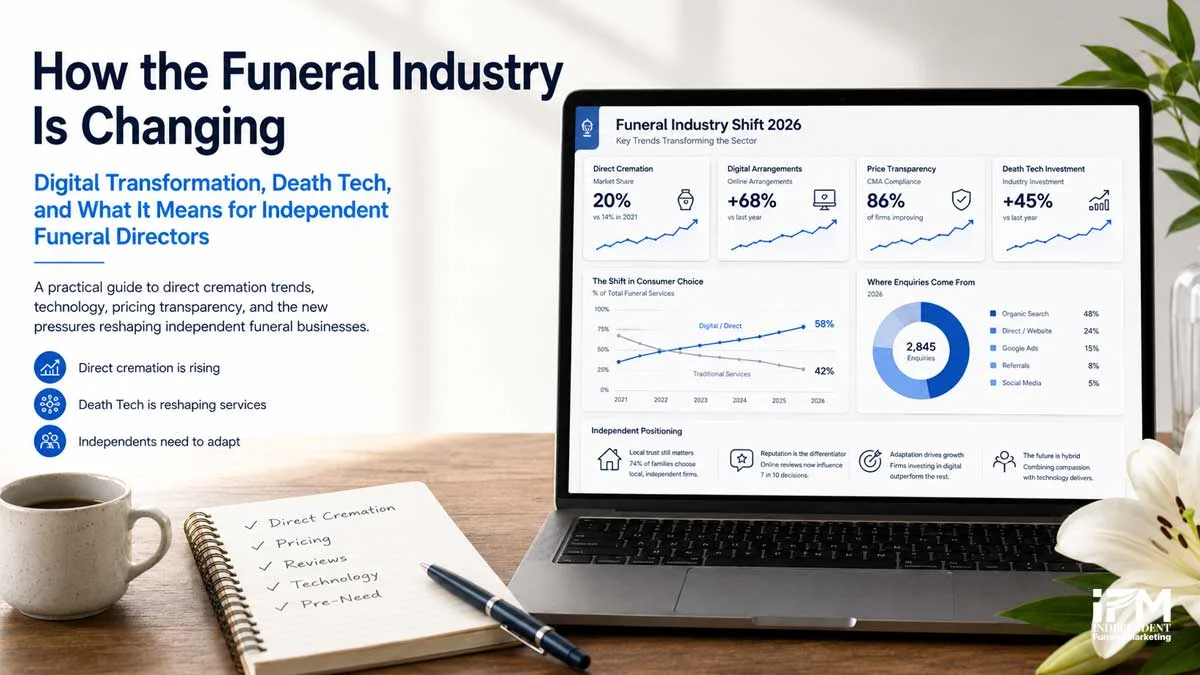
The funeral industry digital transformation isn’t something that’s coming. It’s already here, and it’s moving faster than most operators expected. Direct cremation now accounts for 1 in 5 UK funerals, up from just 3% in 2019. [1] A global deathcare market worth $147 billion is attracting serious private equity and venture capital. [5] Corporate consolidators are acquiring independent funeral homes at scale. And regulators on both sides of the Atlantic have made digital price transparency a legal requirement, not a marketing option.
This guide maps each of those forces with evidence, focusing on what they mean for independent funeral directors in the UK.
How fast is the funeral industry actually changing right now?
The UK funeral industry has seen more structural change in five years than in the previous five decades. Direct cremation reached 20% of all UK funerals in 2024, up from 3% in 2019, [1] the UK market grew 9.1% in 12 months to £3.1 billion, [6] and a global deathcare market valued at $147 billion is drawing significant private equity attention. [5] Six figures make the scale of change concrete.
- UK cremation rate: approximately 80% of all funerals across the British Islands, according to the Cremation Society of Great Britain [4]
- UK direct cremation share: 20% of all funerals in 2024, up from 3% in 2019 [1]
- Consumer awareness of direct cremation: 80% of UK families in 2024, up from 52% in 2019 [1]
- US cremation rate: 63.4% in 2025, projected at 74.7% by 2035 and 82.1% by 2045 [2]
- Global deathcare market: $147 billion in 2025, projected at $209.6 billion by 2030 [5]
- UK funeral market: £3.1 billion in 2025, up 9.1% in 12 months [6]
That 9.1% UK market growth sounds healthy. It isn’t flowing evenly, though. Online-first direct cremation providers, corporate consolidators, and technology-enabled operators are capturing it. Most independent funeral homes aren’t.
Why are cremation rates rising so quickly, and what does it mean for revenue?

In 2025, SunLife’s Cost of Dying Report puts the average UK direct cremation at £1,597 against £4,285 for a simple attended funeral, a gap of £2,688 per case. [1] Cremation has overtaken traditional burial in the UK and is accelerating, driven by cost, environmental preference, and declining religious observance. For funeral home operators, this shift compresses average revenue per case and makes digital service differentiation a financial necessity, not a marketing luxury.
| Service type | Average UK cost (2025) | Year-on-year change |
|---|---|---|
| Direct (unattended) cremation | £1,597 | +6.7% |
| Simple attended funeral | £4,285 | +3.5% |
| Difference per case | £2,688 |
For a funeral director conducting 150 services a year, a 10 percentage point shift from attended to unattended cremation means potential revenue exposure in excess of £400,000, before any volume growth offsets it. The NFDA projects US cremation reaching 74.7% by 2035 and 82.1% by 2045. [2] Canada is already tracking towards 90.7% by 2045. The direction of travel is clear in every comparable market.
The response, whether you’re in Shrewsbury or Sacramento, is the same: compete on value in direct cremation through transparency and operational efficiency, or build stronger differentiation and pre-need pipelines in attended and bespoke services where margin still exists. There’s no neutral position.
Who is buying up independent funeral homes, and how quickly?

Corporate consolidators are acquiring independent funeral homes at scale, with SCI spending $181 million on acquisitions in 2024 alone, [7] while UK operators Dignity and Co-op Funeralcare control more than 1,500 branches between them. [6] Consolidation is reshaping local funeral markets now, not at some future point.
- Service Corporation International (US): approximately 17% North American market share; spent $181 million on 26 funeral home and 6 cemetery acquisitions in 2024 [7]
- Dignity (UK): taken private for £281 million in 2023; 725 branches and 46 crematoria; acquired digital startup Farewill for £12.9 million in October 2024, adding an online arrangement platform to its physical network [8]
- Co-op Funeralcare (UK): more than 800 funeral homes; annual revenue of £281 million [6]
- Funeral Partners (UK): the largest independently owned funeral group in the UK, continuing to acquire regional operators
For independent funeral directors, the implication isn’t that a consolidator will necessarily buy them out, though succession via acquisition is a realistic option for many. It’s that better-capitalised operators are investing in digital marketing, local SEO, and case management technology at a scale that changes what families expect from every provider in a local market, including yours.
What did the CMA’s funeral market investigation actually change for UK funeral directors?
The CMA’s December 2020 investigation found the UK funeral market was “not functioning well for consumers”, largely because bereaved families arranging funerals at short notice lacked the time or capacity to compare prices. [9] The Funerals Market Investigation Order 2021 introduced the UK’s first legally binding price transparency framework. Three years after it came into force, approximately 10% of assessed businesses were still appearing non-compliant. Here’s what the Order actually requires: [10]
- Publish a Standardised Price List on your website, displaying your most commonly purchased funeral arrangements with itemised costs
- Display a full General Price List at your premises, available to any visitor on request
- Provide the GPL by email to anyone who requests it
- Give transparent telephone pricing to anyone who calls and asks
- Cease certain referral payments to hospitals, care homes, and coroners for directing families to your business
A properly structured funeral home website with compliant pricing pages and accessible contact details is both a regulatory requirement and the foundation of effective local SEO. The CMA’s transparency framework and Google’s local ranking signals are pointing in exactly the same direction. Sorting your website out solves both problems at once.
How has FCA regulation changed the UK funeral plan market?
Since July 2022, pre-paid funeral plans in the UK have been regulated by the Financial Conduct Authority, and the transition led approximately 17% of independent funeral directors to exit the pre-need market. [11] The push for regulation followed the collapse of Safe Hands Plans in March 2022, which left around 46,000 customers without plans they’d paid for. Policy Statement PS21/15 brought 26 authorised providers into a formal framework. [12] The key changes it introduced:
- Cold-calling banned, removing a major pre-need sales channel for both large providers and independent operators
- Commission-based intermediary arrangements ended, removing the financial model under which many independents had cross-sold third-party plans
- Full FSCS protection introduced for plan holders, providing statutory consumer protection for the first time
- FCA authorisation required to sell plans directly, or FCA-authorised partner arrangements for operators without their own authorisation
The market remains substantial. The NAFPP reported 1,758,706 plans in force as of September 2024, with 141,947 new plans sold in the first nine months of the year. [13] [14] Operators who stayed in, and built compliant digital pre-need journeys, are better positioned than those who withdrew.
How can funeral homes build a digital pre-need pipeline to offset shrinking at-need margins?

The NFDA’s 2025 Consumer Awareness study found that approximately 17% of pre-need policy holders initially researched pre-arrangement online, up from 11% previously. [28] As high-margin traditional funerals give way to lower-cost direct cremations, the revenue generated from each at-need call is declining. Building a proactive digital pre-need pipeline, using Family Relationship Management software, educational content, and compliant nurturing sequences, is increasingly the core strategy for protecting long-term financial stability.
Family Relationship Management (FRM) software, a category of CRM built specifically for the deathcare sector, allows funeral homes to capture community leads, build educational email and SMS nurturing sequences, and manage long sales pipelines without requiring manual follow-up from already-stretched directors. The messaging works because it’s educational rather than promotional. By the time a family is ready to act, the funeral home is already the obvious choice.
Key elements of a digital pre-need pipeline for UK independent funeral directors:
- Online quote tool linked to FCA-authorised provider pricing, with compliant disclosure pages built in
- Educational blog and FAQ content answering the questions families type into Google before they’re ready to commit
- Email nurture sequences triggered by content downloads or enquiry form completions, structured to educate rather than sell
- Community events and webinars on end-of-life planning, promoted via Facebook to local demographic audiences
- CRM records tracking every community contact across time, so no warm lead is ever forgotten between interactions
What is the FTC Funeral Rule, and why should UK funeral directors care?
The US Federal Trade Commission’s Funeral Rule requires itemised price transparency from funeral homes, with civil penalties for violations reaching $53,088 per incident. [15] The FTC’s November 2024 undercover sweep of 278 providers found 26% couldn’t give price information after hours, 7% failed during business hours, and 37 providers quoted different prices on different calls. [16] For deathcare marketers and Death Tech operators building for the US market, the FTC’s enforcement activity and its Fake Reviews Rule create direct compliance obligations.
The FTC’s Trade Regulation Rule on Consumer Reviews took effect on 21 October 2024, carrying penalties of up to $51,744 per violation. In the UK, the Digital Markets, Competition and Consumers Act 2024 (DMCC Act), in force from April 2025, creates equivalent obligations enforced directly by the CMA. Between the two regimes, the following are now prohibited: [17] [18]
- Fake or AI-generated reviews
- Reviews purchased with payment, discounts, or gifts
- Undisclosed reviews written by employees, owners, or family members
- Suppressing or burying negative reviews
- Company-controlled review platforms presenting themselves as independent
- Buying fake social media followers or engagement signals
Funeral homes are among the most review-dependent local businesses in any sector. Families check reviews before they call. Getting review practice right isn’t optional on either side of the Atlantic.
Why can’t funeral homes use remarketing in Google Ads, and what can they use instead?
Google classifies bereavement products and services as a sensitive “personal hardship” under its personalised advertising policies, absolutely prohibiting remarketing for funeral homes. This means deathcare marketers cannot track and retarget families who have visited a funeral home website, forcing a strategic pivot toward high-intent search advertising and organic local SEO as the primary customer acquisition channels.
Remarketing, the standard digital marketing approach of tracking website visitors and showing them follow-up display ads across the internet, is completely banned for funeral services. Google’s rationale is clear: algorithmically chasing someone who has been searching for funeral arrangements because a family member has died is exploitative. The platform won’t permit it. Any funeral home running a campaign that uses remarketing lists, or any agency building those campaigns on a funeral home’s behalf, is in breach of Google’s advertising policies and risks account suspension.
Here’s what the policy actually permits and prohibits:
| Google Ads tactic | Policy status | Implication for funeral homes |
|---|---|---|
| Search network ads (PPC) | Permitted, with restrictions | Ads triggered by user search intent are allowed; cannot use historical website-visit data in audience targeting |
| Behavioural remarketing | Strictly prohibited | Cannot track and retarget families who visited the website but didn’t make contact |
| Demographic display ads | Permitted with restrictions | Broad geographic and age targeting is allowed; highly specific or narrow vulnerable audience targeting is not |
| Fear or guilt-based ad copy | Strictly prohibited | Ad copy must be informational and supportive; urgency tactics and emotional manipulation trigger removal |
| Branded search campaigns | Permitted | Bidding on own business name and competitor brand names is allowed under standard policy |
The strategic implication is significant. If a family visits a funeral home website and leaves without making contact, that lead is gone. There’s no automated follow-up. This makes the website itself, the Google Business Profile, and high-intent organic search the critical points of conversion. Getting a family to the website at precisely the moment they’re searching is the only opportunity. Local SEO and a well-structured website aren’t just marketing preferences for funeral homes. They’re the entire customer acquisition system.
What is Death Tech, and which startups are reshaping the deathcare sector?
According to Tracxn’s 2026 market analysis, there are 369 active Death Tech companies in the US and 153 in the UK, with the sector having raised $166 million globally in 2025, a 16.5% increase year-on-year. [19] Death Tech describes the growing category of digital companies building software and consumer services around end-of-life planning, funeral operations, grief support, and digital legacy.
The companies most relevant to funeral home operators aren’t the consumer-facing will-writing or grief apps that attract most press coverage. They’re the vertical SaaS platforms automating case management and family communication.
The biggest single Death Tech funding round to date belongs to Empathy, a US platform helping bereaved families manage the administrative and emotional burden of loss. Its $72 million Series C in May 2025 brought total funding to $162 million, backed by MetLife, MassMutual, New York Life, Allianz, and Aflac, with 300% revenue growth in 2024. [20] Empathy’s model, embedding grief support within life insurance policies, creates a post-loss consumer touchpoint that bypasses the traditional funeral home relationship.
In the UK, Dignity’s acquisition of Farewill in October 2024 illustrates the consolidation pattern clearly: technology companies building consumer-facing digital infrastructure are becoming acquisition targets for larger physical-network operators seeking digital capability at speed. [8] [21]
| Sub-category | What it does | Primary audience | UK availability | Examples | Approx. funding |
|---|---|---|---|---|---|
| Case management SaaS | Digitises case files, death certificates, family comms, compliance docs | Funeral home operators | Yes (Obit, Halcyon; Passare and Gather in US) | Passare, Gather, Osiris, SRS/Tribute Tech | Undisclosed |
| Online arrangement tools | Enables families to select and book services remotely | Operators and families | Growing (Aura, Eirene, Pure Cremation) | Tulip Cremation, Eirene, eFuneral | $4M+ (Eirene seed) |
| Pre-need and will-writing | Digital funeral plan comparison, pre-arrangement, will-writing | Consumers | Yes (Farewill, acquired by Dignity 2024) | Trust and Will, Farewill, FreeWill | $39M (Farewill), $50M+ (Trust and Will) |
| Grief support and aftercare | Post-loss admin, AI-assisted grief support, estate settlement | Families and insurers | Emerging | Empathy, Bereave, Lantern | $162M (Empathy) |
| Digital legacy and estate | Manages digital assets, social accounts, passwords after death | Consumers | Limited | HereafterAI, Ownleaf, Itterno | Pre-Series A stage |
| Alternative disposition | Technology-enabled aquamation, terramation, eco-burial with online booking | Consumers and operators | Very limited (UK regulatory restrictions apply) | Recompose, Return Home, Coeio | Varies |
| Memorial and tribute technology | Online obituaries, livestreaming, memorial websites, tribute video | Operators and families | Yes (OneRoom, Tribute Technology, Tukios) | Tukios, Tribute Technology, 1Director | Undisclosed |
How are funeral SaaS platforms addressing the staffing and burnout crisis?
A 2025 peer-reviewed study in Frontiers in Public Health found that more than 60% of US funeral directors reported poor mental health in the preceding 30 days, [22] and a 2021 study of 287 Belgian funeral home employees found burnout scores rose significantly between COVID-19 waves, with more than five years of experience associated with higher burnout rather than lower. [23] Vertical SaaS platforms reduce administrative burden per case through automation and EDRS integration, giving practitioners time back for family care.
Modern funeral SaaS platforms address two distinct administrative burdens: internal case management and external government filing. The internal side, automating death certificate workflows, family notification sequences, case records, and financial reconciliation, is where most platforms focus. The external side is where Electronic Death Registration System (EDRS) integration makes the biggest practical difference. Industry data puts the saving at 15 to 30 minutes per individual case, meaning a funeral home handling 200 cases a year could reclaim between 50 and 100 hours of practitioner time annually. [24]
| Platform | Core differentiators | Best suited for |
|---|---|---|
| Passare | Cloud-based Planning Center; remote collaboration tools allowing families to select merchandise, draft obituaries, and sign contracts before arriving in person; extensive API ecosystem | Funeral homes managing geographically dispersed families and seeking to reduce the length and emotional friction of the arrangement conference |
| Gather | Modern UX; QR-code-based chain of custody body tracking; native livestreaming and e-signatures built into core workflow; centralises third-party subscriptions | Operators prioritising liability reduction through digitised body tracking, and those wanting to consolidate disparate vendor relationships |
| Osiris | Accessible cost structure; simplified user interface; lower implementation overhead | Smaller family-owned operators seeking a cost-effective digital transition without complex configuration |
| SRS (Tribute Technology) | Barcode intake for crematory operations; deep website and merchandise integrations; automated social media obituary posting; ASD answering service integration | High-volume, multi-location enterprises requiring complex logistics pipelines and integrated revenue streams |
Only around 15% of new mortuary science enrolees have a family connection to the funeral profession. The informal apprenticeship model that sustained independent funeral homes for generations is weakening. Technology that makes the job more manageable matters increasingly for recruitment, not just efficiency.
How should independent funeral homes market against direct cremation disruptors?
The NFDA’s 2025 Consumer Awareness study found that 68% of Generation Z respondents strongly agreed that commemorating a life with a funeral or memorial service is important, compared to just 44% of Baby Boomers, [28] and 44.4% of modern consumers say they wouldn’t feel confident planning a funeral without the direct guidance of a professional funeral director, a figure that has risen 7.1 percentage points since 2024. [28] Independent funeral homes can compete effectively against direct cremation disruptors by combining high-intent local SEO, CMA-compliant transparent pricing, and authentic community trust signals that national brands structurally can’t replicate.
The challenge is operating in what researchers call the “avoidance economy”: consumers resist engaging with mortality until compelled by immediate necessity. When they do search, intent is extremely high and the decision window is short. A family searching “funeral director near me” at 11pm typically needs to speak to someone within hours. That single visit to your website, your Google Business Profile, or your Facebook page is often the only chance to make an impression before they call whoever ranks second.
A competitive independent marketing position, built properly, looks like this:
- A complete, actively managed Google Business Profile with consistent NAP data, regular photo updates, and prompt responses to all reviews [26]
- CMA-compliant pricing pages on the website that simultaneously serve as SEO content for high-intent local queries
- Genuine review volume from real families, built through a compliant post-service request process
- Service pages structured for “funeral director near me” queries, including location-specific content
- An active Facebook presence with human content that reflects the character of the business and its community involvement
The competitive advantage that independent funeral directors hold, and that direct cremation brands can’t fake, is local continuity, community knowledge, and the personal accountability of a named proprietor. That advantage is real. But only if families can find it when they’re searching.
Is the funeral industry ready for AI search, and what happens if it isn’t?
In 2024, BrightLocal research found that ChatGPT Search surfaces business websites as sources in 58% of local search queries it processes, [26] while SparkToro audience data from March 2026 found that the funeral directors most likely to act on digital marketing advice over-index on Perplexity by 28.2% and Bing by 8.3% relative to UK averages. AI-powered search tools including Google AI Overviews, Perplexity, ChatGPT Search, and Gemini are already changing how families research funeral services. Operators who haven’t adapted their content strategy risk losing visibility at the moment of highest family intent.
The content formats AI engines cite most readily are:
- Direct-answer opening sentences that restate the question and answer it within the first line of a section
- FAQ blocks with H3 headings and schema markup, which AI engines extract and cite individually
- Factual claims attributed to named sources within the body text, not in footnotes or end references
- Short paragraphs of three to four sentences maximum, rather than long discursive blocks
The absence of an AI Overview on a given funeral-related search query is a first-mover opportunity, not a sign that AI search hasn’t arrived yet. That window won’t stay open.
What do funeral directors actually need from a digital marketing strategy in 2026?
A funeral home’s digital marketing strategy in 2026 needs to address four simultaneous requirements: regulatory compliance, high-intent local SEO, AI-optimised content, and compliant reputation management. Most generic digital marketing agencies, without specialist knowledge of the funeral sector, routinely fail to deliver on all four.
There’s a fundamental difference between marketing a funeral home and marketing most other local service businesses. It isn’t just about tone. It’s about the nature of the decision, the vulnerability of the person making it, and the weight that families bring to it. Generic agencies apply the same playbook they’d use for a plumber or estate agent. They run Google Ads campaigns without knowing that remarketing to bereaved individuals is prohibited. They build review workflows with no awareness of the DMCC Act or FTC obligations. They write blog content without any thought for AI citation.
A properly built funeral home digital marketing strategy covers four components:
- Regulatory compliance: a website architecture meeting CMA Standardised Price List obligations, FCA pre-need disclosure requirements where applicable, and review management practices aligned with the DMCC Act 2024
- Local SEO: a complete and actively managed Google Business Profile, citation consistency across local directories, genuine review volume, and service pages structured for high-intent local queries
- AI-optimised content: articles, FAQs, and service pages with direct-answer openings, FAQPage schema, and attributable factual claims that qualify for citation by Google AI Overviews, Perplexity, ChatGPT Search, and Gemini
- Compliant reputation management: a post-service review request process that builds genuine volume without violating FTC or DMCC Act rules, and a response strategy that reflects the care and professionalism of the business
For a comprehensive overview of how these elements fit together, see the funeral home marketing strategy guides.
Does your funeral home have the digital strategy it needs?
Independent Funeral Marketing is the UK’s only specialist digital marketing agency working exclusively with independent funeral directors, one firm per territory. We cover local SEO, Google Ads, AI search visibility, content, and reputation management, built around the specific regulatory, competitive, and cultural realities of the funeral sector.
To discuss your territory’s availability and what a properly structured digital strategy could mean for your enquiry pipeline, get in touch with the IFM team. If you’re weighing up the investment, our guide to funeral home marketing cost breaks down what setup fees and monthly retainers actually cover, and our guide to marketing vs. sales for funeral directors explains what that spend can and can’t be expected to deliver.
Frequently asked questions
What percentage of UK funerals are now direct cremations?
Direct cremation accounted for approximately 20% of all UK funerals in 2024, according to SunLife’s Cost of Dying Report 2025. That’s up from 3% in 2019 and 14% in 2020. Eight in ten UK families are now aware the option exists before they contact a funeral director. [1]
Are UK funeral directors required to display prices on their website?
Yes. The CMA Funerals Market Investigation Order 2021 requires all UK funeral directors to publish a Standardised Price List on their website, display a full General Price List at their premises, and provide price information by telephone on request. The Order came into force on 16 September 2021 and carries CMA enforcement powers. [10]
Why can’t funeral homes use remarketing in Google Ads?
Google classifies bereavement products and services as a sensitive personal hardship under its personalised advertising policies, making remarketing lists absolutely prohibited for deathcare marketers. The rationale is that algorithmically tracking and retargeting individuals experiencing active grief is exploitative. Funeral homes can still run search network ads triggered by user intent and broad demographic display campaigns, but all behavioural retargeting is banned.
What is Death Tech, and how does it affect independent funeral home operators?
Death Tech is the collective term for digital companies building products around end-of-life planning, funeral operations, grief support, and digital legacy. For independent operators, the most relevant products are vertical SaaS platforms for case management and online arrangement tools, which reduce administrative overhead per case and capture the growing proportion of families who prefer to arrange services remotely. [19]
How can an independent funeral home compete with corporate chains in local search?
Independent funeral homes can compete effectively in local search by maintaining a complete Google Business Profile, building genuine review volume from real families, publishing CMA-compliant pricing pages that also serve as SEO content, and creating structured content optimised for AI citation. Proximity, community trust, and personal accountability are real competitive advantages, provided they’re made visible online. [26]
References
[1] SunLife, Cost of Dying Report 2025, January 2025, sunlife.co.uk/siteassets/documents/cost-of-dying/sunlife-cost-of-dying-report-2025.pdf
[2] NFDA, 2024 Cremation and Burial Report, July 2024, nfda.org/Portals/0/2024_NFDA_Cremation%20and%20Burial%20Report.pdf
[3] CANA, Industry Statistical Information 2024, cremationassociation.org/industrystatistics.html
[4] Cremation Society of Great Britain, Annual Statistics 2024, cremation.org.uk
[5] 24/7 Wall St, U.S. Leads $147 Billion Global Deathcare Industry, July 2025, 247wallst.com/investing/2025/07/20/u-s-leads-147-billion-global-deathcare-industry-as-private-equity-bets-on-digital-disruption/
[6] IBISWorld, Funeral Activities in the UK: Industry Analysis 2025, ibisworld.com/united-kingdom/industry/funeral-activities/4905/
[7] Service Corporation International, Form 10-K FY2024, SEC, February 2025, sec.gov/Archives/edgar/data/0000089089/000008908925000011/sci-20241231.htm
[8] TechCrunch, UK digital end-of-life startup Farewill acquired for $16.8M, October 2024, techcrunch.com/2024/10/17/uk-digital-end-of-life-services-startup-farewill-acquired-for-16-8m/
[9] Competition and Markets Authority, CMA publishes final report in funerals market investigation, GOV.UK, December 2020, gov.uk/government/news/cma-publishes-final-report-in-funerals-market-investigation
[10] NAFD, CMA Funerals Market Order 2021, nafd.org.uk/cmaorder/
[11] FCA, FCA regulation boosts consumer protection in the funeral plans market, July 2022, fca.org.uk/news/press-releases/fca-regulation-boosts-consumer-protection-funeral-plans-market
[12] FCA, PS21/15: Regulation of funeral plans, 2021, fca.org.uk/publications/policy-statements/ps21-15-regulation-funeral-plans-feedback-cp21-20-and-final-rules
[13] NAFPP, Market Volumes for Q3 2024, November 2024, nafpp.org/market-volumes-for-q3-2024/
[14] NAFPP, Report on Funeral Plan Trends 2024, 2025, nafpp.org/nafpp-report-on-funeral-plan-trends-2024/
[15] FTC, Complying with the Funeral Rule, ftc.gov/business-guidance/resources/complying-funeral-rule
[16] FTC, FTC Staff Issues Report on Undercover Funeral Rule Phone Sweep, November 2024, ftc.gov/news-events/news/press-releases/2024/11/ftc-staff-issues-report-undercover-funeral-rule-phone-sweep
[17] FTC, Trade Regulation Rule on the Use of Consumer Reviews and Testimonials, Federal Register, August 2024, federalregister.gov/documents/2024/08/22/2024-18519/trade-regulation-rule-on-the-use-of-consumer-reviews-and-testimonials
[18] FTC, When consumers call funeral homes: seven compliance points, January 2024, ftc.gov/business-guidance/blog/2024/01/when-consumers-call-funeral-homes-ftc-undercover-sweep-suggests-seven-compliance-points-industry
[19] Tracxn, Death Tech: 2026 Market and Investment Trends, January 2026, tracxn.com/d/sectors/death-tech/
[20] Fortune, Empathy raises $72 million Series C, May 2025, fortune.com/2025/05/29/exclusive-empathy-raises-72-million-series-c-to-tackle-the-agonizing-logistics-of-death/
[21] Crunchbase News, Startups Look To Streamline End-of-Life Planning, updated April 2026, news.crunchbase.com/venture/death-end-of-life-planning-startup-funding-better-place/
[22] Monroe C. et al, Helping the helpers: mental wellbeing of the funeral professional, Frontiers in Public Health, 2025, frontiersin.org/journals/public-health/articles/10.3389/fpubh.2025.1721802/full
[23] Van Overmeire R. et al, Compassion fatigue of funeral directors during COVID-19, Journal of Public Health, 2021, pmc.ncbi.nlm.nih.gov/articles/PMC7989438/
[24] U.S. Bureau of Labor Statistics, Funeral Service Workers: Occupational Outlook Handbook, May 2024, bls.gov/ooh/personal-care-and-service/funeral-service-occupations.htm
[25] NFDA, 2025 Cremation and Burial Report, October 2025, nfda.org/news/media-center/nfda-news-releases/id/9786/
[26] BrightLocal, Local Consumer Review Survey and Local SEO Statistics, 2024-2026, brightlocal.com/resources/local-seo-statistics/
[27] Death Care Compliance Law, NFDA Consumer Survey: Facebook Traffic and Consumer Planning, July 2024, deathcarelaw.com/2024/07/articles/uncategorized/nfda-consumer-survey-an-uptick-in-facebook-traffic-and-consumer-planning/
[28] NFDA, Americans Embrace Digital Funeral Planning While Still Seeking Professional Guidance, 2025 Consumer Awareness and Preferences Study, nfda.org/news/media-center/nfda-news-releases/id/9821/