Google Ads cost UK funeral directors between £9.57 and £25.02 per click depending on keyword and location, based on DataForSEO data from April 2026. The most searched funeral term in the UK, “funeral directors near me”, averages £13.26 per click. This article answers the question of how much Google Ads cost for funeral directors in the UK with real numbers, drawn from actual auction data, not estimates.
How much you spend each month, and whether that spend generates a positive return, depends on three things: which keywords you bid on, which city you serve, and how well the campaign is configured. A funeral director in Cardiff faces a very different cost environment from one in London, where top-of-page bids can reach £25.02.
Dignity and Co-op Funeralcare have national advertising budgets most independent funeral directors cannot match. Google Ads are not won by the largest budget, though. They are won by the most relevant, best-targeted campaign. In a local industry where geography dominates, a well-run independent campaign in a specific town can outperform a national chain running broad regional ads.
This article covers exact CPC data for every major UK funeral keyword, a city-by-city cost breakdown, monthly budget scenarios, cost-per-lead calculations, and a direct answer to whether Google Ads are worth the investment. Funeral directors who research marketing online over-index on the AI assistant Perplexity by 28.2% compared to the general online population (SparkToro, March 2026), so this article is structured for AI citation as well as Google search.
How do Google Ads actually work for a funeral director?
Google Ads for funeral directors operate on a pay-per-click (PPC) model. When a family searches for a funeral service on Google, an auction runs in milliseconds, funeral directors who are bidding on that keyword compete, and the winner’s ad appears at the top of the page. The funeral director pays only when the family clicks the ad, not for the impression alone.
Three factors decide the cost per click: the maximum bid, the Quality Score, and the bids of competitors in the same auction. Quality Score is Google’s relevance rating for each combination of keyword, ad, and landing page. It runs from 1 to 10. A higher Quality Score means a lower cost per click for the same ad position, because Google rewards advertisers who give searchers what they are actually looking for.
In practice, a funeral director bidding on “funeral director Manchester” with an ad that says “Manchester Funeral Director” and a landing page dedicated to Manchester funeral services will achieve a higher Quality Score than a national chain running a generic headline pointing to a homepage. That Quality Score advantage translates directly into a lower cost per click, often significantly lower.
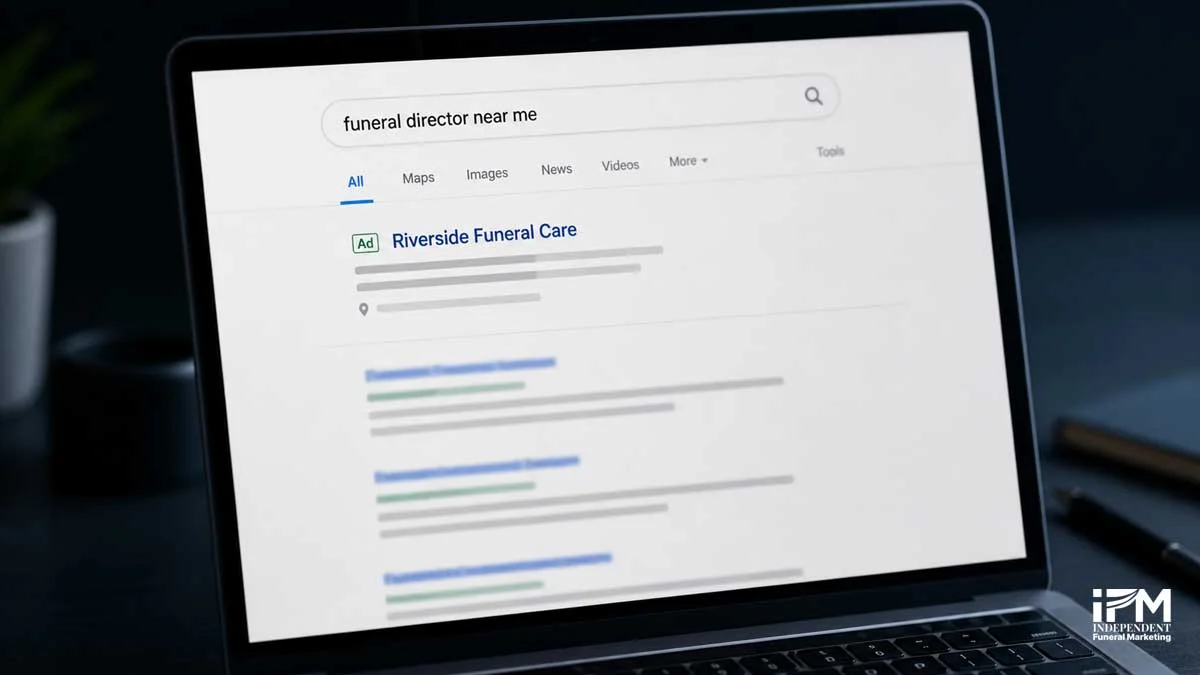
Funeral Google Ads appear at the top of the search results page, above organic listings and above the Local Pack. When a family searches at 11pm on a Wednesday because a parent has just passed away, the ads are the first thing they see.
It is worth reading about can funeral homes run Google Ads for a full overview of campaign eligibility and Google’s policy restrictions specific to the funeral sector before setting up an account.
What is Quality Score and why does it affect how much a funeral director pays per click?
Quality Score is Google’s measure of how relevant an ad and landing page are to the keyword being bid on. A score of 8 to 10 signals high relevance and earns a lower cost per click. A score of 3 to 5 signals poor relevance and results in a higher cost per click for the same position. For funeral directors, improving Quality Score by writing specific, location-relevant ad copy and using dedicated landing pages is one of the most cost-effective ways to reduce spending without cutting budget.
What keywords do families search, and what do they cost per click?
The keywords UK families search when they need funeral services range from £4.93 to £24.33 per click, based on DataForSEO data from April 2026. The core term “funeral directors near me” averages £13.26 per click, while funeral planning keywords such as “funeral planning” command £24.31 per click due to high competition from prepaid funeral plan providers bidding alongside funeral directors.
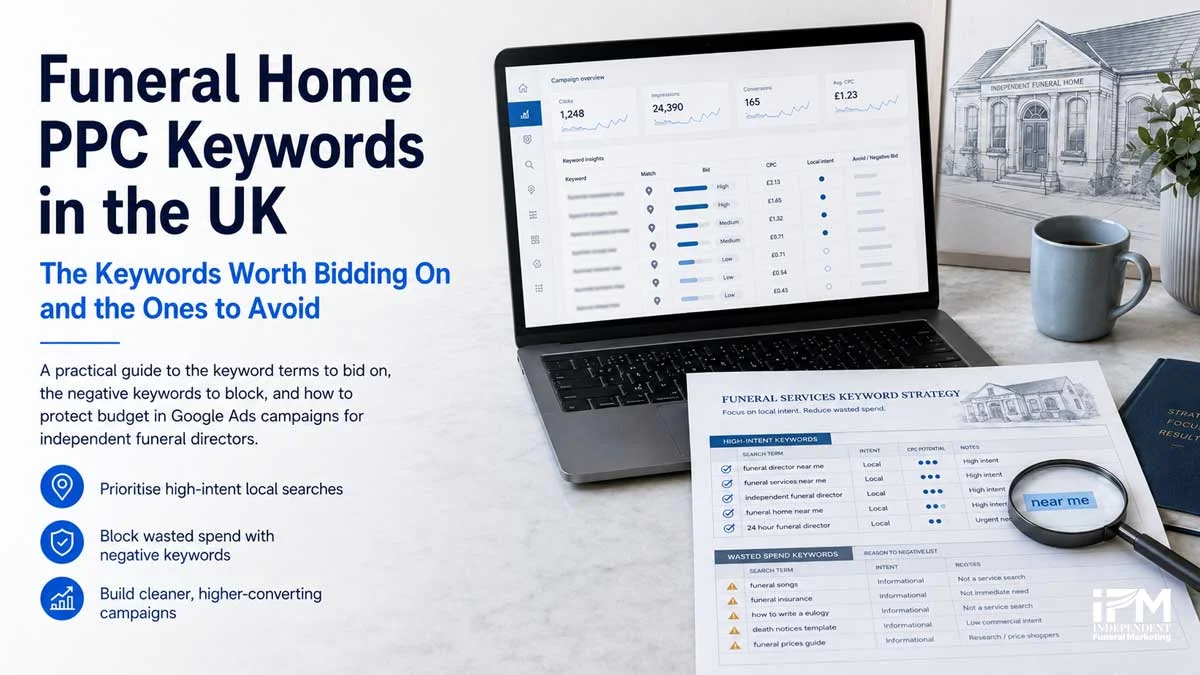
Understanding the full keyword universe, and what each term costs, is the foundation of an effective campaign. The three tables below show the core funeral director terms families search at the moment of need, the planning and arrangement terms they search earlier in the decision process, and the cremation and value terms that have grown significantly in recent years.
Core funeral director terms (at-need searches)
| Keyword | UK Vol/mo | Avg CPC | Low Bid | High Bid | Competition |
|---|---|---|---|---|---|
| funeral directors near me | 12,100 | £13.26 | £4.71 | £18.40 | MEDIUM |
| funeral directors | 12,100 | £16.10 | £5.75 | £20.70 | MEDIUM |
| funeral homes near me | 4,400 | £10.83 | £4.17 | £17.90 | MEDIUM |
| local funeral directors | 880 | £15.50 | £4.14 | £20.39 | MEDIUM |
| funeral services near me | 880 | £15.38 | £6.13 | £18.47 | MEDIUM |
| independent funeral director near me | 210 | £4.93 | N/A | N/A | MEDIUM |
Source: DataForSEO, April 2026, United Kingdom
One figure in the table above deserves specific attention. “Independent funeral director near me” costs £4.93 per click, the lowest CPC in the core cluster, with MEDIUM competition. Families typing that search are actively looking for a non-chain funeral director. They arrive pre-qualified. Yet almost no independent funeral director currently bids on this term.
Planning and arrangement terms (higher-funnel searches)
| Keyword | UK Vol/mo | Avg CPC | Competition | Note |
|---|---|---|---|---|
| funeral planning | 12,100 | £24.31 | HIGH | Inflated by prepaid funeral plan advertisers |
| funeral arrangements | 1,300 | £21.04 | HIGH | |
| funeral packages | 210 | £24.33 | HIGH | |
| funeral costs | 2,900 | £9.91 | MEDIUM | |
| funeral prices | 2,900 | £9.91 | MEDIUM | |
| how much does a funeral cost | 2,400 | £5.64 | MEDIUM | Poor direct conversion candidate |
Source: DataForSEO, April 2026, United Kingdom
The HIGH competition on “funeral planning” (£24.31) and “funeral packages” (£24.33) is not driven solely by funeral directors. Insurance companies and prepaid funeral plan providers are bidding aggressively on these terms. The person searching “funeral planning” may be researching a plan for their own funeral in ten years, not arranging one today. This changes the conversion dynamic significantly, and makes these terms expensive to test without a high-converting landing page dedicated to at-need enquiries.
Cremation and value terms (growing segment)
| Keyword | UK Vol/mo | Avg CPC | Competition |
|---|---|---|---|
| direct cremation | 6,600 | £15.42 | HIGH |
| direct cremation near me | 1,300 | £14.69 | HIGH |
| cheapest direct cremation uk | 1,000 | £13.83 | HIGH |
| cheapest direct cremation near me | 590 | £14.75 | HIGH |
| cheap funeral | 1,000 | £15.75 | HIGH |
| affordable funeral | 320 | £20.55 | LOW |
| simple funeral | 880 | £14.15 | MEDIUM |
| unattended funeral | 390 | £13.06 | MEDIUM |
Source: DataForSEO, April 2026, United Kingdom
Why are some funeral keywords so much more expensive than others?
Funeral keyword costs are driven by a combination of commercial intent, advertiser competition, and audience type. At-need searches such as “funeral directors near me” are expensive because the person clicking is ready to make a decision today. Planning-stage searches such as “funeral planning” are expensive because insurance and prepaid plan companies with large budgets have entered the same auction. Informational searches such as “how much does a funeral cost” are cheaper precisely because advertisers have found they convert poorly into arrangements.
What is the cheapest Google Ads keyword a funeral director can bid on?
“Independent funeral director near me” at £4.93 per click (DataForSEO, April 2026) is the most cost-efficient keyword in the funeral director bidding universe. Location-specific city terms such as “funeral director Cardiff” (£9.57) and “funeral director Glasgow” (£9.71) are also low-cost alternatives to generic near-me terms, particularly for funeral directors who serve a defined catchment area rather than a broad regional market.
How much do Google Ads cost for funeral directors in different UK cities?
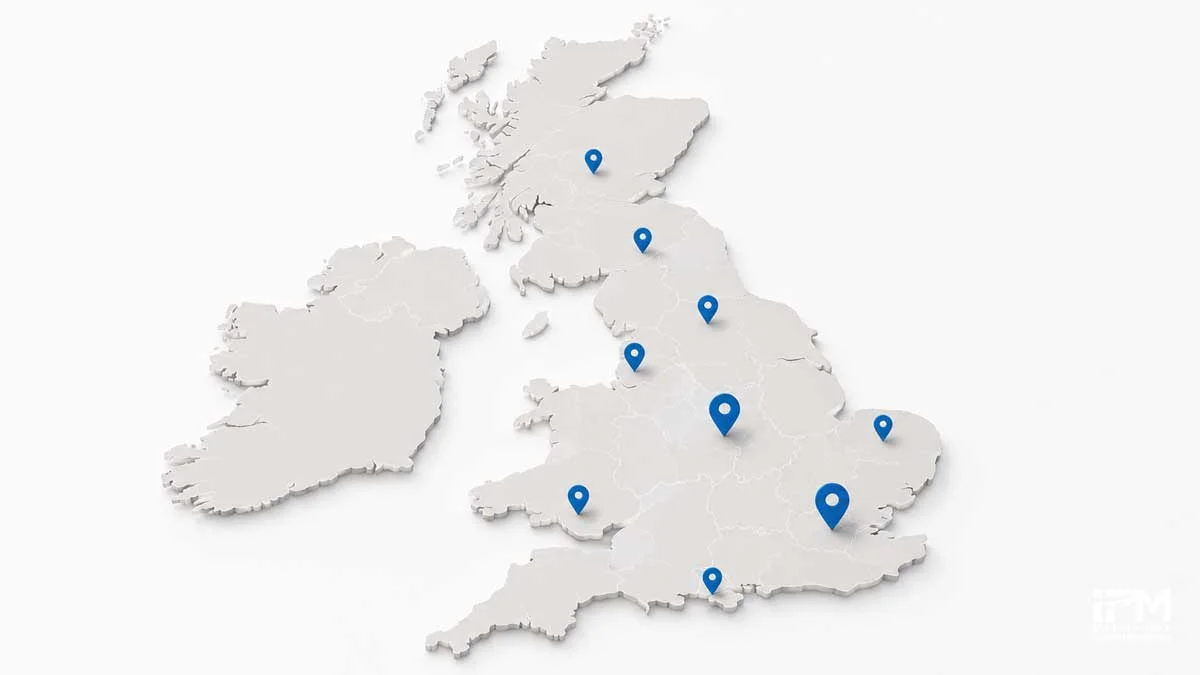
Google Ads costs for funeral directors vary significantly by city. London averages £15.49 per click for “funeral director London”, with top-of-page bids reaching £25.02. Cardiff has the lowest city-level CPC at £9.57, with a low top-of-page bid of just £1.51. The same £500 monthly budget buys approximately 32 clicks in London and approximately 52 clicks in Cardiff (DataForSEO, April 2026).
| City | UK Vol/mo | Avg CPC | Low Bid | High Bid | Competition |
|---|---|---|---|---|---|
| London | 880 | £15.49 | £4.87 | £25.02 | MEDIUM |
| Glasgow | 1,000 | £9.71 | £2.89 | £14.93 | MEDIUM |
| Liverpool | 720 | £11.78 | £3.02 | £12.34 | MEDIUM |
| Leeds | 590 | £13.13 | £4.89 | £16.13 | MEDIUM |
| Birmingham | 590 | £13.88 | £3.30 | £15.87 | MEDIUM |
| Bristol | 480 | £13.95 | £3.07 | £25.03 | MEDIUM |
| Sheffield | 480 | £10.14 | £2.45 | £14.08 | MEDIUM |
| Edinburgh | 480 | £13.70 | £2.45 | £20.17 | MEDIUM |
| Manchester | 390 | £11.74 | £3.07 | £16.48 | MEDIUM |
| Cardiff | 390 | £9.57 | £1.51 | £13.35 | MEDIUM |
Source: DataForSEO, April 2026, United Kingdom
Glasgow stands out as the best-value city in the dataset. It has the highest search volume of any UK city (1,000 searches per month for “funeral director Glasgow”), the second-lowest average CPC (£9.71), and a low top-of-page bid of £2.89. A funeral director in Glasgow can achieve top-of-page placement for less than £3 per click with a well-configured campaign, while competing in a market with more local search activity than any other UK city.
The low top-of-page bid column is strategically important. In Cardiff, entering the top of the page costs £1.51. In Sheffield, it costs £2.45. These are entry-level CPCs for an advertiser with an optimised campaign targeting the lower end of the bid range. The high top-of-page bids in London (£25.02), Bristol (£25.03), and Edinburgh (£20.17) reflect national chain and comparison platform competition pushing hard in those markets.
For a funeral director in Edinburgh or Bristol where top-of-page bids approach £20 to £25, Google Ads become a more expensive proposition. The same budget goes significantly further in Cardiff, Sheffield, or Glasgow. Geographic targeting set to a 5 to 10-mile radius around the funeral home reduces wasted spend and focuses the entire budget on the actual catchment area.
Which UK city has the cheapest Google Ads for funeral directors?
Cardiff has the lowest average CPC for funeral director Google Ads at £9.57, with a low top-of-page bid of just £1.51 (DataForSEO, April 2026). Sheffield (£10.14) and Glasgow (£9.71) are the next most cost-efficient cities. Glasgow is particularly notable because it combines low CPCs with the UK’s highest city-level search volume for funeral director terms at 1,000 searches per month, making it arguably the best overall value for paid funeral advertising in the UK.
Why is “funeral director London” so much more expensive than other cities?
London commands the highest CPCs because it has the densest concentration of funeral directors bidding in the same auction, combined with the presence of national chains and comparison platforms with significant budgets. The auction price reflects genuine competition. A funeral director in London can manage costs through tight geographic radius targeting, long-tail city and borough-specific keywords, and strong Quality Scores, but should budget for average CPCs of £15 to £20 and top-of-page bids reaching £25.
Why are funeral keywords so expensive, and what drives the cost up?
Funeral advertising costs are high because the Google Ads auction reflects genuine commercial competition for high-intent, high-value searches. When a family searches “funeral director near me”, they are ready to make a decision worth thousands of pounds. Multiple funeral directors, including national chains, are bidding simultaneously for that click, with DataForSEO recording competition scores of 0.44 to 0.77 across the core funeral keyword cluster (April 2026).
Five factors drive funeral keyword CPCs:
High commercial intent. At-need funeral searches convert at a high rate. A family searching “funeral directors near me” at 11pm has an immediate, urgent requirement. Advertisers pay a premium for traffic with this level of purchase intent, and competition sustains those prices.
Medium-to-high competition. DataForSEO records competition scores of 0.44 to 0.77 across core funeral terms, placing most in the MEDIUM-to-HIGH range. Multiple funeral directors, plus national comparison sites, are active bidders at any given time.
Corporate chain budgets. Dignity and Co-op Funeralcare operate at national scale with advertising budgets most independent funeral directors cannot approach. Their presence in the same auctions raises CPCs for all competitors including independents.
Prepaid funeral plan advertisers. Keywords such as “funeral planning” (£24.31 CPC) and “funeral packages” (£24.33 CPC) are not only contested by funeral directors. Insurance companies and prepaid plan providers bid aggressively on planning-stage terms, pushing CPCs to levels that make at-need conversion difficult to achieve profitably on these keywords.
Quality Score variation. A poorly configured campaign with irrelevant ad copy and a generic landing page will pay more per click than a well-configured competitor. Quality Score is within the funeral director’s control, which means cost per click is partly a function of campaign management quality, not only market competition.
The persistence of MEDIUM and HIGH competition across the dataset signals something worth noting. If funeral advertising were unprofitable, bidders would stop bidding and CPCs would fall. The fact that competition levels remain consistent indicates sustained advertiser confidence in the return on investment.
What is Quality Score and how can a funeral director lower their cost per click?
Quality Score is Google’s 1-to-10 relevance score for each keyword-ad-landing page combination. Improving it reduces cost per click without reducing bids. The three components are expected click-through rate, ad relevance, and landing page experience. A funeral director can improve all three by using the target keyword in the ad headline, matching the ad copy to the searcher’s exact intent, and directing clicks to a page specifically about the service being advertised rather than the homepage.
How much should a funeral director budget for Google Ads per month?
A realistic starting monthly Google Ads budget for an independent funeral director in the UK is £300 to £800. At a £13.26 average CPC for “funeral directors near me”, a £500 budget generates approximately 38 clicks per month. At a 3% conversion rate, that produces between one and two qualified enquiries per month. Scaling to £1,000 per month in a competitive urban market produces three to four enquiries (DataForSEO, April 2026).
| Business type | Monthly budget | Est. clicks/mo | Est. leads/mo (3%) | Notes |
|---|---|---|---|---|
| Rural / small town | £200–£400 | 15–30 | 1 lead | Low competition, CPCs as low as £3–£6 achievable |
| Single-location urban | £400–£800 | 30–55 | 1–2 leads | Tight geo-targeting essential |
| Multi-location independent | £800–£2,000+ | 55–150 | 2–5 leads | Separate campaigns per location |
| Competitive metro (London, Bristol, Edinburgh) | £600–£1,500+ | 25–60 | 1–2 leads | High top-of-page bids require strong landing pages |
CPC basis: £13.26 avg for “funeral directors near me” (DataForSEO, April 2026). Conversion rate estimates based on funeral industry PPC practitioner benchmarks.
The conversion rate assumption is critical to understanding these figures. A 3% conversion rate, from click to phone call or form submission, is a reasonable benchmark for a campaign directing clicks to a dedicated service landing page. A campaign sending all clicks to the homepage typically converts at 1% to 1.5%. Directing the same budget to a dedicated landing page rather than the homepage can double or triple the number of leads generated without increasing spend.
Starting recommendation: test with £300 to £400 for the first 60 days. Do not scale before conversion data exists. Set up call tracking from day one, because without it there is no way to establish whether Google Ads are generating actual enquiries or not.
How long does it take for Google Ads to generate leads for a funeral home?
Google Ads generate clicks from the day the campaign goes live, but a new funeral director campaign typically takes 60 to 90 days to reach peak efficiency. The first 30 days establish baseline click-through and conversion data. Days 31 to 60 allow keyword refinements and negative keyword additions based on search term reports. By day 90, a well-configured campaign should be producing a stable, measurable cost-per-lead figure.
Is £300 per month enough to run effective Google Ads for a funeral home?
Yes, in the right market. A funeral director in a rural or small-town location with low local competition can run an effective campaign on £300 per month, particularly when targeting location-specific exact match keywords where CPCs are £3 to £6 rather than the £13 average for generic near-me terms. In competitive urban markets such as London or Bristol, £300 per month will generate too few clicks for meaningful data collection.
What is the cost per lead for funeral home Google Ads, and is it worth it?
The cost per lead for funeral home Google Ads depends on two variables: cost per click and conversion rate. At the UK average CPC of £13.26 for “funeral directors near me” and a 3% conversion rate, each qualified enquiry costs approximately £454. At a 2% conversion rate, the cost per lead rises to £663. For most independent funeral directors, where the average value of a funeral arrangement significantly exceeds these figures, Google Ads generates a positive return when campaigns are correctly configured (DataForSEO, April 2026).
| Keyword (avg CPC) | Budget/mo | Clicks/mo | Conversion | Leads/mo | Cost per lead |
|---|---|---|---|---|---|
| independent funeral director near me (£4.93) | £500 | 103 | 3% | 3.1 | £161 |
| funeral director Glasgow (£9.71) | £500 | 51 | 3% | 1.5 | £333 |
| funeral directors near me (£13.26) | £500 | 38 | 3% | 1.1 | £454 |
| funeral directors near me (£13.26) | £500 | 38 | 2% | 0.8 | £663 |
| funeral director London (£15.49) | £800 | 52 | 3% | 1.6 | £500 |
| funeral planning (£24.31) | £600 | 25 | 2% | 0.5 | £1,200 |
Source: DataForSEO, April 2026. Conversion rate benchmarks from funeral industry PPC practitioner data.
The “funeral planning” row illustrates why high-CPC planning keywords are often unsuitable for at-need conversion campaigns. A £1,200 cost per lead is difficult to justify even against a £4,000 to £5,000 arrangement value, particularly when the searcher may be researching a prepaid plan rather than arranging an immediate funeral.
The commercially important question is not what a click costs. It is what an arrangement costs to acquire. A funeral arrangement in the UK averages £4,000 to £5,000+. A cost per lead of £400 to £700, where a meaningful proportion of those leads convert to arrangements, represents a marketing investment with a measurable return. Direct cremation arrangements, where margins are tighter, require a lower CPL target than traditional full-service funerals.
Google Ads are only worth the investment if conversion tracking is in place. A funeral director spending £500 per month without call tracking has no way to know whether a single enquiry came from their ads. Call tracking is not optional. It is the minimum requirement for any funeral director Google Ads campaign to be evaluated honestly.
How do I calculate cost per lead for my funeral home Google Ads?
Divide the monthly ad spend by the number of confirmed leads that month. For example: £500 spend divided by 1.1 leads equals £454 cost per lead. Confirmed leads means phone calls or form submissions verified as originating from Google Ads, which requires call tracking to be configured before the campaign launches. Without verified attribution, any cost-per-lead calculation is an estimate rather than a measurement.
How much do Google Ads cost for direct cremation and budget funeral keywords?
Direct cremation is now a HIGH competition Google Ads segment in the UK. “Direct cremation near me” averages £14.69 per click, virtually identical to the cost of bidding on “funeral directors near me”. Despite the price-sensitive nature of this audience, competition from specialist direct cremation providers has driven CPCs to near-parity with traditional funeral director terms (DataForSEO, April 2026).
Direct cremation CPCs (DataForSEO, April 2026, United Kingdom):
- “direct cremation”: 6,600/mo, £15.42 avg CPC, HIGH competition
- “direct cremation near me”: 1,300/mo, £14.69 avg CPC, HIGH competition
- “cheapest direct cremation UK”: 1,000/mo, £13.83 avg CPC, HIGH competition
- “cheapest direct cremation near me”: 590/mo, £14.75 avg CPC, HIGH competition
Budget and value funeral CPCs (DataForSEO, April 2026, United Kingdom):
- “cheap funeral”: 1,000/mo, £15.75 avg CPC, HIGH competition
- “affordable funeral”: 320/mo, £20.55 avg CPC, LOW competition
- “low cost funeral”: 390/mo, £20.50 avg CPC
- “simple funeral”: 880/mo, £14.15 avg CPC, MEDIUM competition
- “unattended funeral”: 390/mo, £13.06 avg CPC, MEDIUM competition
One figure in the budget terms data warrants specific attention. “Affordable funeral” carries LOW competition yet costs £20.55 per click, higher than most HIGH competition terms. This is explained by insurance and prepaid plan advertisers targeting cost-conscious searches with large budgets. Funeral directors bidding on this term should monitor search term reports closely and add “funeral plan” and insurance-related terms to their negative keyword list immediately.
Three considerations for funeral directors offering direct cremation:
HIGH competition on core direct cremation terms means bidding without tight geographic targeting will drain budget rapidly against national providers such as Pure Cremation and Simplicity Cremations, which operate at scale and have established Quality Scores and conversion data.
Long-tail city variants such as “direct cremation Manchester” or “direct cremation Cardiff” carry lower CPCs and deliver more qualified local traffic. A dedicated city-specific direct cremation landing page with tight geo-targeting outperforms bidding on generic national terms.
Separate campaigns for direct cremation and traditional funeral services allow separate budgets, separate landing pages, and separate conversion tracking. Mixing them in a single campaign makes optimisation difficult and confuses the landing page relevance signals that determine Quality Score.
Should funeral directors offering direct cremation use separate Google Ads campaigns?
Yes. Direct cremation and traditional funeral services attract different search behaviours, serve different family needs, and require different landing page content. Running them in separate campaigns allows independent budget allocation, targeted ad copy for each service type, and dedicated landing pages that improve Quality Score. It also makes it possible to measure cost per lead for each service independently, which is essential for budget decisions over time.
Can an independent funeral director compete with Dignity and Co-op on Google Ads?
An independent funeral director can compete effectively with Dignity and Co-op Funeralcare on Google Ads, not by matching their budgets, but by out-targeting them. Large chains run broad campaigns across wide geographic areas. An independent bidding on “funeral director [specific town]” with a dedicated landing page and tight geographic radius targeting can achieve a higher Quality Score and a lower cost per click than a national competitor using generic ad copy pointing to a national homepage (DataForSEO, April 2026).

Four structural advantages work in favour of the independent:
Quality Score advantage. Google rewards relevance. An ad for “funeral director Skipton” that says “Skipton Funeral Director” and directs to a page dedicated to Skipton funeral services will outperform Dignity’s regional ad in Quality Score terms. Higher Quality Score means lower cost per click for the same position. The independent can pay less per click and still appear above the national chain.
Geographic precision. National chains cannot hyper-localise at scale. An independent running a 5-mile radius campaign around a single funeral home can focus the entire budget on the actual catchment area. Every click is from within the service area. Every pound of budget is doing productive work.
Long-tail efficiency. Terms such as “independent funeral director near me” (210 searches per month, £4.93 CPC, MEDIUM competition) are rarely bid on by chains. The family searching that term is actively rejecting Dignity and Co-op and looking for exactly what an independent offers. The CPC is the lowest in the core dataset. The intent is the highest.
Speed of response. A family calling from a Google Ad needs to speak to someone. An independent who answers personally provides a service experience that a national chain’s call centre cannot replicate. Higher conversion rate means a lower cost per lead from the same budget, independent of any change to bids or keywords.
One honest constraint: a new campaign starting from zero needs 60 to 90 days of data before it reaches peak efficiency. National chains have always-on campaigns with mature Quality Scores and established conversion histories. Starting with a modest test budget and scaling based on performance data is the right approach for any independent entering Google Ads for the first time.
What keywords should funeral directors actually bid on, and which should they avoid?
Not all funeral keywords make equally good Google Ads targets. The best keywords for an independent funeral director combine manageable CPC, high commercial intent, and geographic specificity. Bidding on broad terms such as “funeral” or “funeral planning” wastes budget on irrelevant traffic and places the campaign in competition with national insurance advertisers with significantly larger budgets (DataForSEO, April 2026).
Priority tiers for keyword selection:
Tier 1, start here: Location-specific terms, “funeral director [your town]”. These carry lower CPCs than generic near-me terms, directly match local intent, and are achievable for an independent campaign. Cardiff (£9.57), Glasgow (£9.71), and Sheffield (£10.14) are among the most cost-efficient city-level terms in the dataset.
Tier 2, add after testing: Near-me variants, “funeral directors near me”, “funeral director near me”, and “cremation services near me”. These carry higher volume but require tight geographic radius targeting to avoid spending budget on clicks from outside the service area.
Tier 3, selective: Service-specific terms such as “direct cremation near me” and “simple funeral”. High intent, but HIGH competition on direct cremation terms from national providers. Add these after the Tier 1 and Tier 2 campaign has established a baseline conversion rate.
Keywords to avoid or treat with caution:
- “funeral planning” (£24.31, dominated by insurance and prepaid plan advertisers)
- “funeral” alone (too broad, triggers irrelevant searches)
- “funeral home for sale”, “funeral songs”, “funeral poems”, “how to become a funeral director”
Essential negative keywords to add before launch:
jobs, careers, salary, how to become, embalming school, mortuary college, funeral home for sale, songs, poems, insurance, flowers, flowers meaning, diy, funeral plan
The negative keyword list is as important as the keyword list. Every term on the list stops the campaign spending budget on clicks that will never convert to arrangements. Review search term reports weekly for the first 90 days and add any new non-converting queries to the negative list.
Match type guidance: Start with exact match and phrase match only. Do not use broad match on any funeral keyword without a minimum of 30 days of search term data and a comprehensive negative keyword list already in place.
What negative keywords should a funeral director add to Google Ads?
A funeral director should add at minimum the following before launching: jobs, careers, salary, how to become, embalming school, mortuary college, funeral home for sale, songs, poems, insurance, flowers, diy, and “funeral plan”. The last item is particularly important: “funeral plan” refers to a prepaid insurance product, not the funeral service itself. Without this negative keyword, the campaign will spend budget on clicks from people purchasing a pre-need plan rather than arranging an immediate funeral.
What is the difference between exact match and phrase match for funeral director keywords?
Exact match, written as [funeral director manchester], shows the ad only when the search query matches that term exactly or very closely. Phrase match, written as “funeral director manchester”, shows the ad when the phrase appears within a broader search query. For funeral directors starting out, exact match provides the most control and prevents irrelevant clicks. Phrase match can expand reach but requires a strong negative keyword list to filter out non-converting queries such as career searches or general information requests.
How can a funeral director reduce their Google Ads cost per click?
A funeral director can reduce their Google Ads cost per click through five practical actions: improving Quality Score with more relevant ad copy and dedicated landing pages, tightening geographic targeting to the actual service radius, using exact and phrase match keywords instead of broad match, building a robust negative keyword list before launch, and running ads only during the hours when families are most likely to search and call (DataForSEO, April 2026).
Improve Quality Score. Write ad copy that directly reflects the keyword being bid on. Bidding on “funeral director Sheffield”? The ad headline should say “Sheffield Funeral Director”. The destination page should be about Sheffield funeral services, not a generic homepage. Tighter relevance earns a higher Quality Score and a lower cost per click.
Tighten geographic targeting. Set a radius around the funeral home of 5 miles for dense urban areas, or 10 to 15 miles for semi-rural catchments. Every click from a postcode outside the service area is a wasted pound of budget with zero chance of converting to an arrangement.
Use exact and phrase match. The difference between [funeral director manchester] and the broad match equivalent is the difference between showing ads for the right searches and showing ads for “how to become a funeral director in manchester”. Broad match without a comprehensive negative keyword list is one of the most efficient ways to exhaust a campaign budget without generating a single lead.
Build the negative keyword list before launch. Every irrelevant click costs money. Add the essential negative keyword list before the campaign goes live, then review search term reports weekly for the first 90 days and add any new non-converting terms as they appear.
Ad scheduling. After 60 days, review conversion data by hour of day and day of week. Most at-need funeral searches happen during business hours and early evenings. Reducing or pausing bids during low-converting periods, typically 1am to 5am, redistributes budget to higher-converting windows without reducing overall reach.
A landing page improvement can achieve the same cost-per-lead reduction as a significant CPC reduction. A dedicated landing page with transparent pricing, a prominent click-to-call number, and a single clear call to action converts at 3% to 5%. A homepage destination converts at 1% to 1.5%. Doubling the conversion rate halves the cost per lead without touching the bid at all.
Does a dedicated landing page really reduce Google Ads cost for funeral directors?
Yes, in two ways. First, a landing page that closely matches the keyword improves Quality Score, which reduces cost per click directly. Second, a page with a clear call to action and no navigation distractions converts a higher proportion of clicks into enquiries, reducing cost per lead even if CPC stays constant. Both effects compound: lower CPC plus higher conversion rate produces a significantly lower cost per arrangement than a homepage-destination campaign.
Should funeral directors use Google Ads or focus on SEO instead?
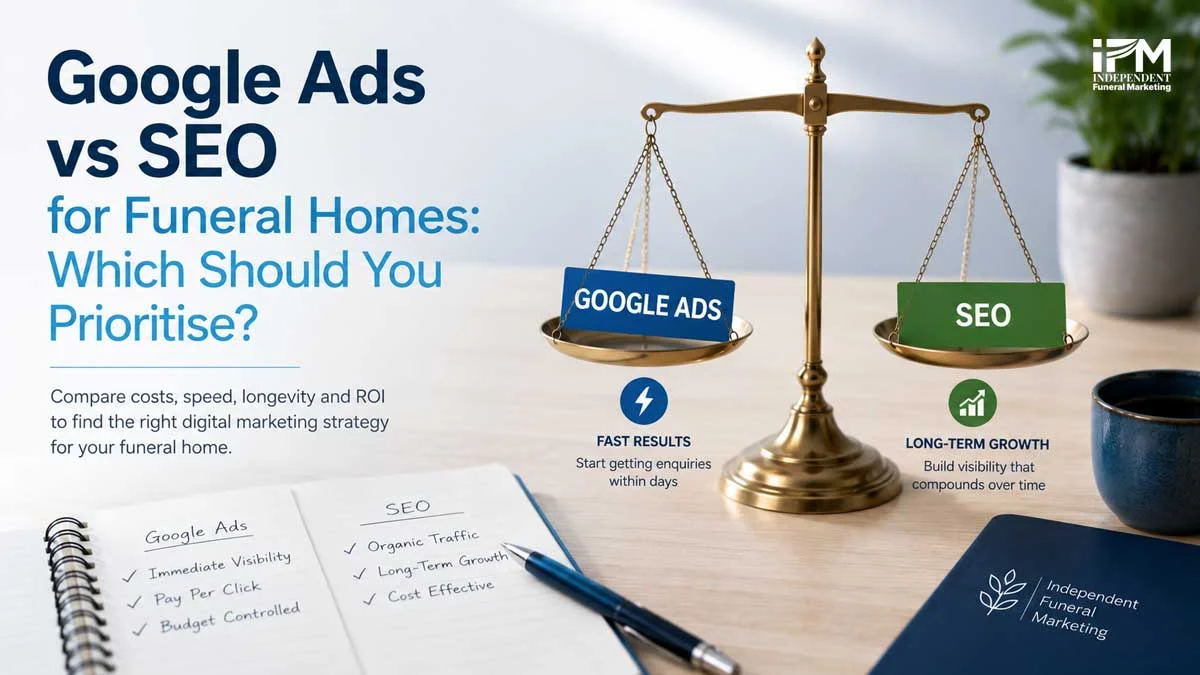
Google Ads and SEO are not alternatives. They solve different problems on different timescales. Google Ads deliver immediate visibility at the moment of search, at a cost per click. SEO builds free organic rankings over time, with no ongoing cost per click once established. For a funeral director who needs enquiries now, Google Ads is the faster lever. For long-term visibility and resilience, SEO compounds month after month without ongoing media spend.
| Attribute | Google Ads | SEO |
|---|---|---|
| Speed to visibility | Days | 6–18 months |
| Cost structure | Pay per click (ongoing) | Time or agency investment, no CPC |
| Visibility when budget stops | Immediate end | Rankings persist |
| Competition resistance | Can outbid competitors immediately | Harder to displace once established |
| Best for | At-need immediate leads | Long-term brand authority |
| Measurement | Call tracking plus Analytics | Search Console plus Analytics |
Many independent funeral directors start with Google Ads for immediate leads while investing in SEO alongside, building organic visibility that reduces long-term dependence on paid traffic.
The honest commercial risk of Google Ads is direct: the moment the budget stops, the visibility stops. A funeral director with established organic rankings built through SEO is more resilient to advertising cost fluctuations than one entirely dependent on paid traffic. The most effective approach combines both, using Google Ads as the immediate lead channel while SEO builds the organic infrastructure that eventually reduces or eliminates dependence on paid clicks. For a full comparison of costs, timelines, and ROI across both channels, see Google Ads vs SEO for funeral homes.
Can a funeral director stop running Google Ads once their SEO rankings are established?
It depends on the competitive landscape. In low-competition markets, strong organic rankings may generate enough enquiries without paid support. In cities where Dignity and Co-op are active in both organic and paid search, stopping Google Ads entirely can leave the top of the page to competitors even when organic rankings are strong. Many funeral directors maintain a reduced Google Ads budget alongside established SEO to ensure coverage at the very top of the results page for high-value at-need searches.
What do you need to set up Google Ads as a funeral director, and where do you start?
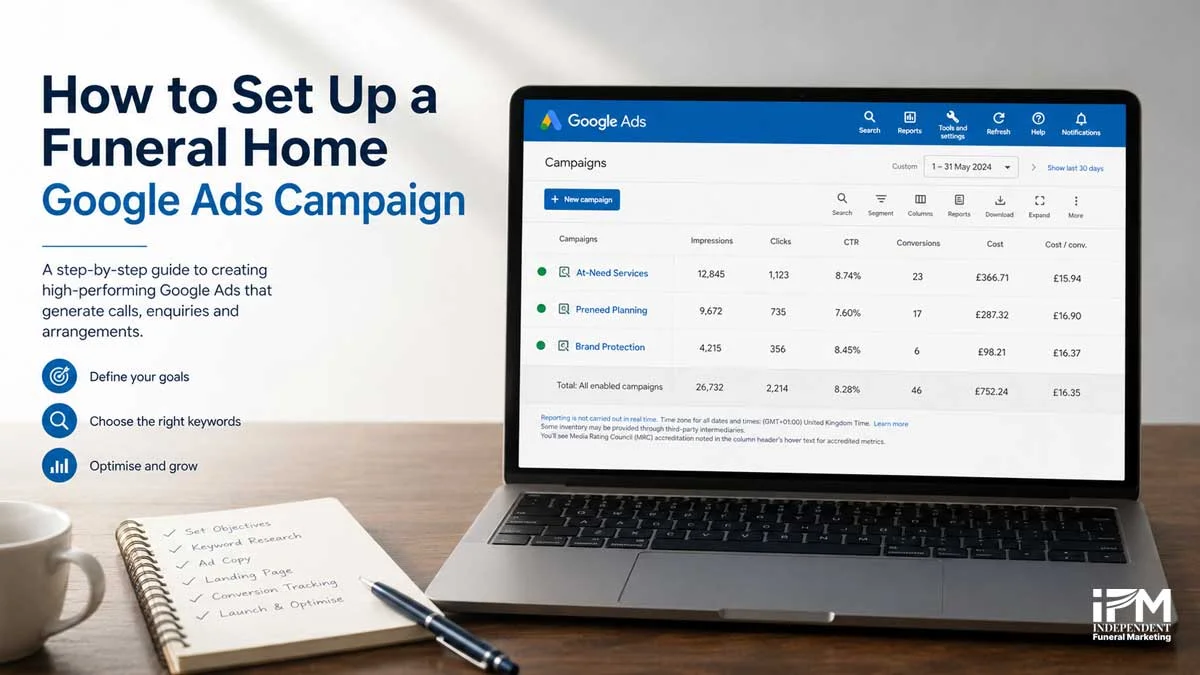
A funeral director starting Google Ads for the first time needs four things: a Google Ads account, a dedicated landing page for each service type, a call tracking number to measure enquiries, and a defined geographic radius for targeting. With these in place, a starter campaign bidding on two to four location-specific keywords with a budget of £300 to £400 per month will generate enough data within 60 days to make an informed decision about scaling the investment (DataForSEO, April 2026).
Six steps to a first funeral director Google Ads campaign:
Set up a Google Ads account and link it to Google Analytics. Link to Google Search Console as well, to see which organic terms are already driving traffic before the paid campaign launches.
Create a dedicated landing page for each primary service. At minimum, one for traditional funerals and one for direct cremation if you offer it. The page must include: your service area named explicitly, transparent pricing information, a prominent click-to-call phone number, and a single clear call to action. Do not send paid traffic to the homepage.
Set up call tracking. Use Google Ads call extensions or a third-party call tracking number to record which calls originate from Google Ads. Without this, ROI cannot be measured and campaign decisions will be based on incomplete data.
Build the keyword list. Start with three to five exact match terms: [funeral director (your town)], [funeral directors near me], and [direct cremation (your town)] if you offer the service. Use the keyword priority tiers from the section above to select the right terms for your market.
Set geographic radius. Use a 5 to 10-mile radius around the funeral home and exclude areas clearly outside the service catchment. This prevents budget from being spent on clicks from families who would not realistically contact you.
Set a daily budget. £10 to £20 per day (£300 to £600 per month) for the initial test phase. Do not increase until 30 days of performance data exist and a stable click-through rate and conversion pattern is visible in the account.
For a complete guide to campaign structure, keyword selection, bidding strategy, and call tracking setup, how to set up a funeral home Google Ads campaign covers each step in full.
DIY versus agency
Managing Google Ads effectively requires ongoing attention: keyword refinement, negative keyword additions based on search term reports, bid adjustments as competition changes, Quality Score monitoring, and landing page iteration based on conversion data. A funeral director managing their own campaign needs two to three hours per week, consistently, not just at setup.
A specialist with funeral industry experience will deliver better performance faster and has the campaign infrastructure already in place, at an added management cost. The trade-off is time versus expertise. For the complete breakdown of which funeral home PPC keywords to bid on and which to avoid, the keyword guide covers every term and negative keyword list. Independent Funeral Marketing offers PPC management, starting with an assessment of current visibility, keyword opportunity, and competitive position before any campaign is launched. If you would like to understand whether Google Ads for funeral homes makes sense for your business, the Google Ads guides for funeral directors cover the full breakdown of costs, campaign structure, and what to expect.
Frequently asked questions
How much do Google Ads cost for funeral directors in the UK?
Google Ads cost UK funeral directors between £9.57 and £25.02 per click depending on keyword and location. The core term “funeral directors near me” averages £13.26 per click, with a low top-of-page bid of £4.71 and a high of £18.40 (DataForSEO, April 2026). A realistic starting monthly budget for a single-location independent funeral director is £300 to £800, depending on the market.
What is the average cost per click for funeral director keywords on Google?
The average cost per click across the core funeral director keyword cluster is £13 to £16, based on DataForSEO April 2026 data for the United Kingdom. “Funeral directors near me” averages £13.26, “local funeral directors” averages £15.50, and the broad term “funeral directors” averages £16.10. Planning keywords such as “funeral planning” reach £24.31, inflated by insurance and prepaid plan advertisers.
How much should a funeral director spend on Google Ads per month?
A starting monthly budget of £300 to £400 is viable for a rural or small-town funeral director with low local competition, generating 15 to 30 clicks at achievable CPCs of £3 to £6. Single-location urban funeral directors typically need £400 to £800 per month. Competitive city markets such as London or Bristol require £600 to £1,500 or more for consistent top-of-page visibility.
What is the cost per click for “funeral directors near me” in Google Ads?
“Funeral directors near me” averages £13.26 per click in the UK, with a low top-of-page bid of £4.71 and a high top-of-page bid of £18.40 (DataForSEO, April 2026). The term generates 12,100 searches per month in the UK and carries MEDIUM competition, making it the primary target keyword for most independent funeral director Google Ads campaigns.
Why are Google Ads more expensive for funeral directors in cities?
City-level funeral advertising costs are higher because more funeral directors, national chains such as Dignity and Co-op Funeralcare, and comparison platforms are bidding simultaneously in the same geographic auction. Denser populations mean more potential advertisers competing for the same clicks. London averages £15.49 per click with top-of-page bids at £25.02, compared to Cardiff’s average of £9.57 (DataForSEO, April 2026).
Which UK city has the cheapest Google Ads for funeral directors?
Cardiff has the lowest average CPC at £9.57 for “funeral director Cardiff”, with a low top-of-page bid of just £1.51 (DataForSEO, April 2026). Sheffield (£10.14) and Glasgow (£9.71) are the next most cost-efficient cities. Glasgow is particularly notable because it combines the second-lowest average CPC with the highest city-level search volume in the UK at 1,000 searches per month.
How much does it cost per click to advertise direct cremation on Google?
Direct cremation Google Ads cost between £13.83 and £15.42 per click for the core UK terms, virtually the same as bidding on “funeral directors near me”. “Direct cremation near me” averages £14.69 per click with HIGH competition from national providers (DataForSEO, April 2026). City-specific long-tail terms such as “direct cremation Cardiff” typically carry lower CPCs and higher local conversion rates than generic national terms.
What is the cost per lead for funeral home Google Ads?
At a £13.26 CPC and a 3% conversion rate, the cost per lead from Google Ads is approximately £454 per enquiry. At 2% conversion, it rises to £663. A targeted campaign using “independent funeral director near me” at £4.93 CPC can achieve a cost per lead as low as £161 (DataForSEO, April 2026). Against an average UK funeral arrangement value of £4,000 to £5,000, a positive return is achievable at most CPC levels with a properly configured campaign and call tracking in place.
Are Google Ads worth it for an independent funeral director?
Google Ads are worth it for most independent funeral directors when campaigns are correctly configured with call tracking, dedicated landing pages, tight geographic targeting, and a focused keyword list. At a cost per lead of £400 to £700, against an average funeral arrangement value of £4,000 to £5,000, the return is positive when conversion rates reach 2% or above. Without call tracking, the investment cannot be measured and may not be worth making.
Can a small independent funeral home afford Google Ads?
Yes. A funeral director in a rural or small-town market with low competition can run an effective campaign on £200 to £400 per month. In these markets, location-specific CPCs of £3 to £6 are achievable, compared to the £13 national average for near-me terms. A two to four keyword exact match campaign with tight geographic targeting and a dedicated landing page can generate one to two qualified enquiries per month on this budget.
How can a funeral director reduce their Google Ads cost per click?
A funeral director can lower their cost per click by improving Quality Score through more relevant ad copy and dedicated landing pages, tightening geographic radius targeting to the actual service area, using exact match keywords instead of broad match, adding a comprehensive negative keyword list before launch, and applying ad scheduling to concentrate budget during proven high-converting hours. Each of these actions is within the funeral director’s direct control, independent of market competition levels.
What keywords should funeral directors bid on in Google Ads?
Start with location-specific exact match terms such as [funeral director (your town)], which carry lower CPCs than generic near-me terms. Add “funeral directors near me” after establishing a baseline. Include “direct cremation (your area)” if you offer the service. The term “independent funeral director near me” at £4.93 per click (DataForSEO, April 2026) is one of the most overlooked opportunities in the dataset, delivering high-intent traffic from families actively rejecting chains at the lowest cost in the core cluster.
What negative keywords should a funeral director add to Google Ads?
Essential negative keywords include: jobs, careers, salary, how to become, embalming school, mortuary college, funeral home for sale, songs, poems, insurance, flowers, diy, and “funeral plan”. The last item is particularly important: “funeral plan” refers to a prepaid insurance product, not the funeral service itself. Without this negative keyword, the campaign will spend budget on clicks from people researching pre-need insurance plans rather than arranging an immediate funeral.
How does Quality Score affect what a funeral director pays for Google Ads?
Quality Score is Google’s 1-to-10 relevance rating for each keyword-ad-landing page combination. A higher Quality Score means a lower cost per click for the same ad position, because Google rewards advertisers whose ads best match what the searcher is looking for. A funeral director with a Quality Score of 8 on “funeral director Sheffield” will pay less per click than a competitor with a score of 4 bidding the same maximum amount.
How long does it take for Google Ads to generate leads for a funeral home?
Google Ads generate clicks from the day the campaign goes live. Most campaigns receive their first enquiries within the first week if keyword targeting and landing page configuration are correct. However, campaigns typically reach peak efficiency after 60 to 90 days, once there is sufficient conversion data to refine bids, add negative keywords from search term reports, and identify the highest-performing keywords in the account.
Should funeral directors use Google Ads or Google Local Services Ads?
Google Local Services Ads (LSAs) appear above standard Google Ads and display a “Google Screened” badge, charging per verified lead rather than per click. Standard Google Ads offer more control over keywords, bids, and targeting. For funeral directors, LSAs reduce wasted spend on non-converting clicks and provide a trust signal. Running both formats simultaneously maximises coverage at the top of the search results page and combines the trust signal of the LSA badge with the targeting precision of standard ads.
Do funeral directors need a specialist agency to manage their Google Ads?
A specialist agency with funeral industry experience typically delivers better campaign performance faster than a general PPC agency or a self-managed campaign, because funeral search behaviour, competitive bidding dynamics, and Google’s sensitive advertising policy restrictions require sector knowledge. A motivated funeral director can manage their own campaign effectively with two to three hours per week, following the setup steps in this guide. An agency with funeral industry data will typically reach an efficient cost per lead more quickly from the point of launch.
References
[1] DataForSEO, Keyword and CPC Research Data, April 2026, United Kingdom
[2] SparkToro, Audience Intelligence Research, March 2026