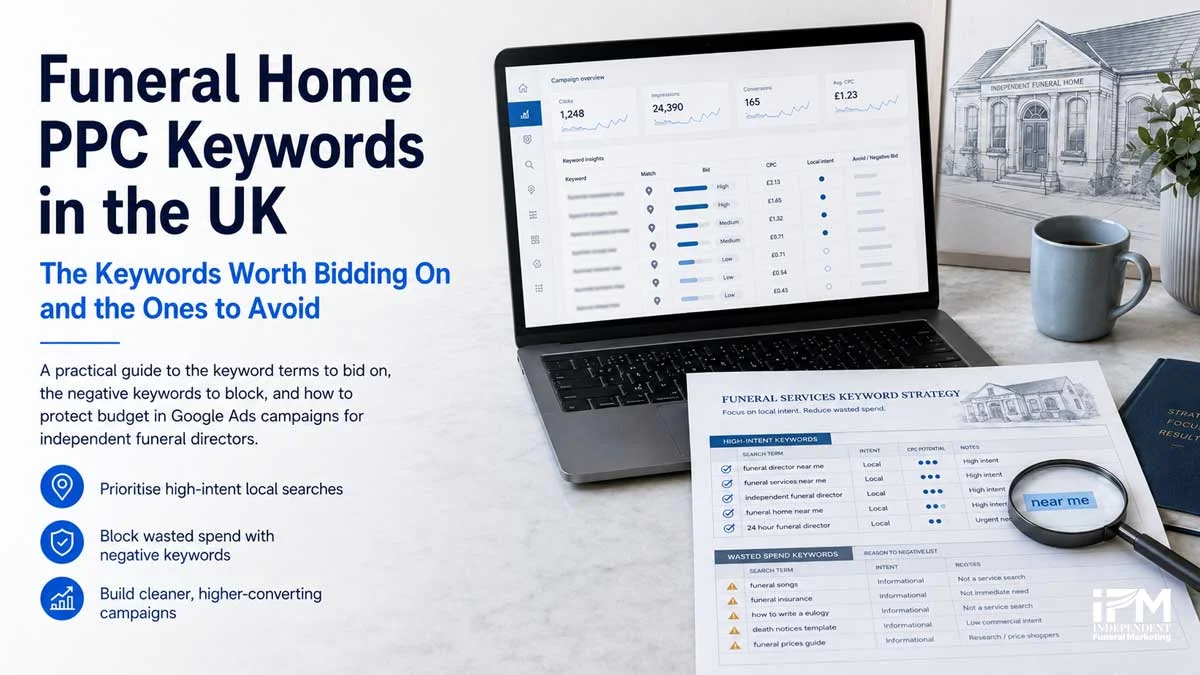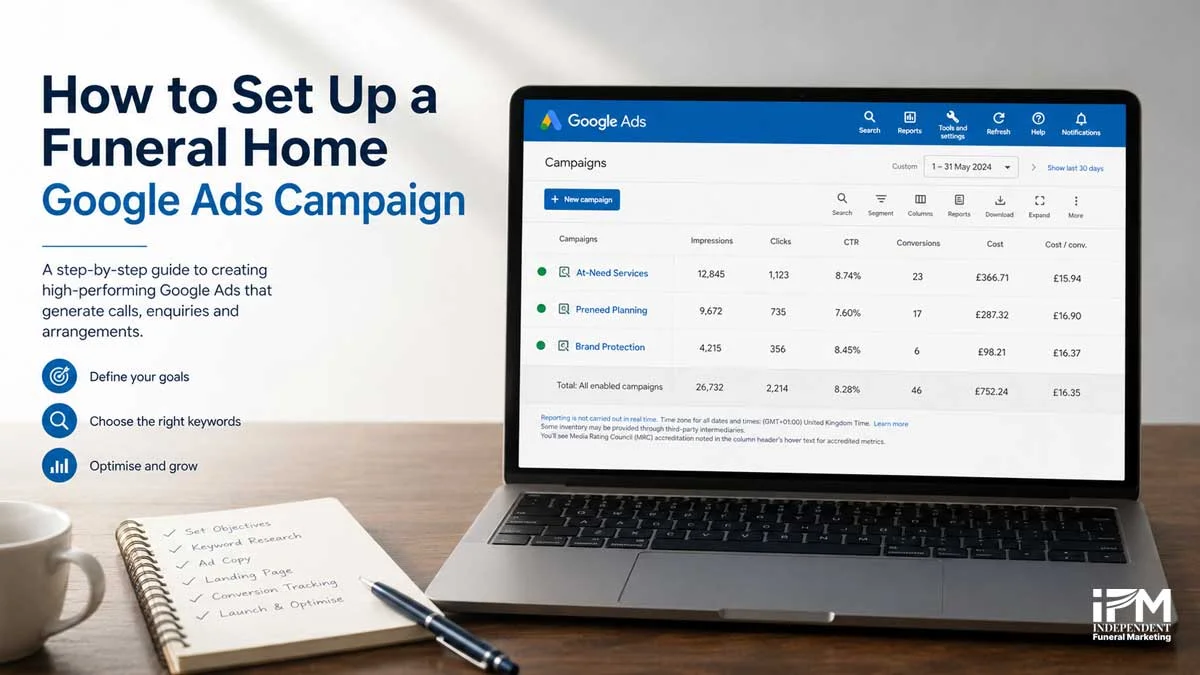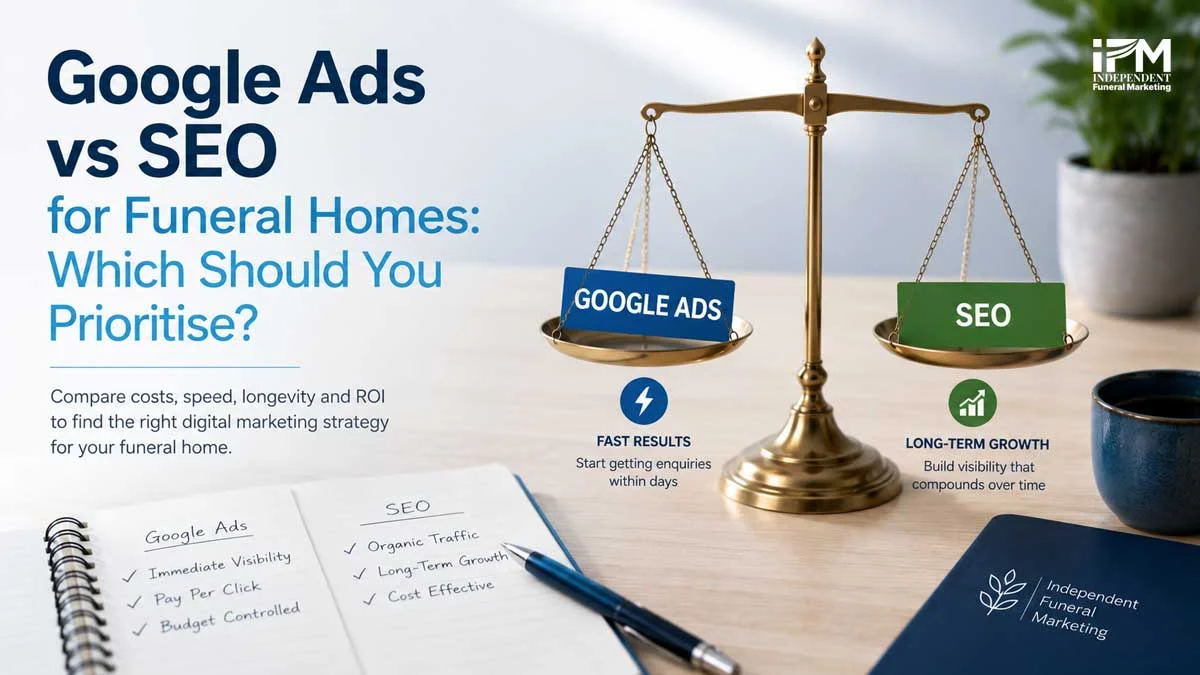
Google Ads vs SEO for funeral homes is one of the most important marketing decisions an independent funeral director will make, and getting it wrong costs both time and money. Not a lot of money at first, perhaps. But the wrong choice compounds quietly: months spent waiting for SEO to work when you needed enquiries last quarter, or years of ad spend with nothing to show once the budget stops.
Most funeral directors have a rough sense of what both channels do. What’s rarer is seeing an honest, research-backed comparison that’s specific to this industry rather than recycled from a generic marketing agency blog. That’s what this guide is.
Here’s the context worth having before the comparison begins. The NFDA’s 2025 Consumer Awareness and Preferences Study, the largest ongoing survey of funeral consumers in North America, found that over 70% of families visit a funeral home’s website before making contact [1]. That figure was 46% in 2016. The shift to digital-first research among bereaved families is not a future trend. It’s been the reality for some time, and it’s still accelerating.
The choice between Google Ads and SEO is essentially a choice between two different relationships with visibility: one you rent, one you build. This guide works through both: cost, speed, long-term return, and what actually fits where your funeral home is right now. It draws on DataForSEO keyword data from May 2026, NFDA research from 2025, BrightLocal consumer review data from 2026, and SparkToro audience intelligence from March 2026.
Both “funeral home” (the common global term) and “funeral director” (the primary UK term) are used throughout. Cost benchmarks are UK-first, with US figures for reference.
What is the difference between Google Ads and SEO for funeral homes?
Google Ads and SEO are two distinct digital marketing channels for funeral homes. Google Ads places your funeral home at the top of search results immediately through paid placement, you pay each time someone clicks your ad. SEO builds organic visibility over time by improving your website’s relevance and authority, so your funeral home appears in unpaid results without a per-click cost.
What is Google Ads (PPC) and how does it work for funeral homes?
When a family searches “funeral directors near me”, Google runs an auction in milliseconds. Every advertiser bidding on that keyword competes for the top positions. Your bid per click matters, but so does your Quality Score, a Google rating based on your ad’s relevance and the quality of your landing page. Win the auction and your ad appears above all organic results, labelled “Sponsored”. The family clicks. You pay. That click may become a call.
What is SEO and how does it work for funeral directors?
SEO earns positions in Google’s unpaid results by making your funeral home’s website more relevant and authoritative for searches in your area. It involves optimising your website’s content and structure, building your Google Business Profile, earning local citations, generating reviews, and publishing expert content. Rankings improve over months, not hours, but once established they generate clicks without any per-click cost.
How does each channel appear on a Google search results page?
A search for “funeral director in [town]” produces a results page with three distinct zones: sponsored ads at the top (Google Ads), the Map Pack below those (driven by Local SEO), and organic website listings below the Map Pack. Google Ads occupies the highest position. A well-executed SEO strategy can place a funeral home in both the Map Pack and the organic listings, covering two of the three zones without ongoing per-click spend.
The table below summarises the core differences:
| Factor | Google Ads | SEO |
|---|---|---|
| Visibility speed | Hours to days after launch | 3–12 months, depending on competition |
| Cost structure | Pay per click, ongoing spend required | Setup investment + ongoing, no cost per click once ranked |
| What happens when you stop? | Visibility disappears immediately | Rankings maintained (ongoing maintenance needed) |
| Placement on Google | Above Map Pack, top of page | Organic results + Map Pack (separate) |
| Click trust level | Lower, labelled “Sponsored” | Higher, organic results seen as more credible |
| Best for | New FDs / quick wins / competitive gaps | Established FDs / long-term growth / asset building |
| Measurability | High, every click and call trackable | Moderate, call tracking needed for accurate data |
| Sensitive category restrictions | Yes, funeral services have specific rules | No restrictions on organic content |
| 3-year cost trajectory | Ongoing monthly spend, cost never reduces | Initial investment, lower marginal cost over time |
| UK recommendation | Use as short-term foundation or tactical supplement | Use as primary long-term channel |
How do families find funeral directors online in 2026?
Most families searching for a funeral director online use Google Search, and they search in moments of acute stress, usually within hours of a bereavement. The NFDA’s 2025 Consumer Awareness and Preferences Study found that over 70% of families visit a funeral home’s website before making contact [1], and the majority of searches are local in nature: “funeral director near me”, “funeral director [town]”, or a direct cremation search with a postcode attached.
What search queries do at-need families use?
A family that has just lost a loved one doesn’t browse at leisure. They search with urgent, specific intent, usually on a mobile phone, often within the first few hours of a bereavement. “Funeral directors [town]”, “funeral home open now”, “direct cremation near me”. These aren’t consideration-phase queries. They’re ready-to-call queries. BrightLocal’s 2026 Local Consumer Review Survey found that 41% of consumers always read reviews when browsing for a local business before making contact, up from 29% the previous year [2]. The family finds you through search, then makes their judgement from your reviews.
Do families click on ads or organic results when searching for funeral directors?
The honest answer is: whichever is most visible and most trusted. Google Ads occupies the highest position on the page, which captures attention first. But research on local search shows the Map Pack, driven by Local SEO, receives 44% of all clicks on local-intent searches [3], with organic results and paid ads splitting the remainder. For bereaved families making a high-stakes decision under stress, reviews are also decisive: 83% of consumers use Google specifically to read reviews before choosing a local business (BrightLocal, 2025) [4]. Getting found is step one. What they find when they look decides whether they call.
What are the real advantages of Google Ads for funeral directors?
Google Ads gives funeral directors immediate visibility at the top of Google search results, within hours of launching a campaign. For a new funeral home, or one competing against well-established local funeral chains that have been building organic positions for a decade, that speed is the central advantage, not a secondary benefit.
Why is speed-to-results a major advantage of Google Ads for funeral homes?
Launch on Monday. Take a call on Tuesday. No other digital marketing channel closes the gap between zero visibility and first-page presence that quickly. For a funeral home that hasn’t yet established organic rankings, Google Ads isn’t a nice addition to the marketing mix, it’s the difference between appearing when a bereaved family searches and not appearing at all. At-need search intent, a family typing “funeral director near me” within hours of a bereavement, is arguably the highest-value enquiry moment in any service business. You’re either visible at that moment, or a competitor answers the phone instead.
How does geo-targeting help funeral directors reach the right local audience?
Google Ads allows precise geographic targeting: a specific radius around your funeral home, a defined set of postcodes, or a named town. A funeral home in a 12-mile service area can limit all ad spend to that exact catchment. This is a meaningful structural advantage over a corporate chain running national campaigns with looser geographic parameters. Your budget reaches the families you can actually serve.
What Google Ads formats work best for funeral directors?
Call-only ads are particularly effective for funeral homes because most at-need enquiries arrive by telephone. A call-only ad displays your phone number as the primary action, removing the step of navigating to a website. For families in immediate distress, removing friction converts. Standard search ads with call extensions also work well, displaying headline copy alongside a tap-to-call button on mobile.
Can Google Ads help a funeral home during periods of low enquiry volume?
Yes. Unlike organic rankings, which reflect historical authority rather than current urgency, Google Ads budget can be increased, decreased, or redirected within hours. A funeral home experiencing a quieter period can increase bids on specific high-intent terms. A funeral home launching a direct cremation service can allocate specific budget to those keywords immediately, without waiting for SEO rankings to develop.
What are the disadvantages and risks of Google Ads for funeral homes?
The primary disadvantage of Google Ads for funeral homes is that visibility stops the moment you stop paying. Unlike SEO, which builds lasting organic ranking, Google Ads generate no residual value. Pause the campaign and your funeral home disappears from the top of search results immediately. This makes ongoing cost a permanent requirement, not a one-time investment.
What happens to funeral home visibility when Google Ads are turned off?
Gone. The same day. There’s no wind-down, no residual effect, no carry-over authority. A funeral home that pauses its Google Ads on a Monday morning has dropped out of every sponsored position it held by Monday afternoon. Those positions are immediately filled by whichever competitor stays active. For funeral homes whose primary digital visibility comes from paid search, with no Map Pack position and no organic rankings to fall back on, this is a direct revenue interruption, not an abstract risk.
How much budget is wasted on Google Ads without proper management?
Without a comprehensive negative keyword list, funeral home ads can appear for queries with no purchase intent: job searches, property listings, educational queries, and informational browsing. These clicks cost money and produce no enquiries. Negative keywords, terms that prevent your ad from showing for irrelevant searches, are the single most important structural element of a funeral home Google Ads campaign. Adding them before launch is not optional.
Are there restrictions on advertising funeral services in Google Ads?
Yes. Google classifies bereavement as a sensitive personal hardship category under its personalised advertising policy [6]. Funeral homes cannot use remarketing lists, Customer Match audiences, or interest-based targeting when bereavement is the audience signal. Standard keyword search campaigns remain fully permitted. The restriction applies to targeting people because of their bereavement, not to advertising funeral services to people who actively search for them.
Why do high CPCs make Google Ads challenging for independent funeral directors?
US cost-per-click data from DataForSEO (May 2026) shows CPCs of $19.99 for “funeral home advertising” and $21.79 for “seo for funeral homes” in competitive US markets [7]. UK CPCs are generally lower, but in competitive areas the economics still require careful management. At £5 to £8 per click and a 10% conversion rate from click to call, a funeral home needs 10 clicks to generate one enquiry, meaning each enquiry costs £50 to £80 in ad spend alone. That is commercially viable against an arrangement fee of £3,000 to £5,000, but only with proper tracking to confirm the numbers.
How much does Google Ads cost for a funeral home?
Google Ads costs for funeral homes vary significantly by location and competition, but UK and US data confirms that average cost-per-click (CPC) for funeral director search terms ranges from approximately £3 to £8 in the UK and $13 to $22 in the US. Monthly budgets of £500 to £1,500 are typical for an independent funeral home targeting a single town or borough.
What is the average cost-per-click for funeral home Google Ads?
The table below uses DataForSEO data (May 2026) [7] for US benchmarks alongside estimated UK equivalents:
| Keyword | Est. CPC (UK) | Est. CPC (US) | Competition |
|---|---|---|---|
| funeral home advertising | £10–£14 | $19.99 | High |
| seo for funeral homes | £12–£16 | $21.79 | High |
| funeral home digital marketing | £8–£12 | $14.89 | Medium–High |
| funeral directors near me | £3–£6 | $8–$14 | Medium |
| direct cremation [town] | £2–£4 | $5–$10 | Lower |
| funeral home [town] | £4–£8 | $10–$18 | Medium–High |
UK CPCs are lower primarily because geographic markets are smaller and there are fewer competing advertisers outside major cities. London CPCs approach US levels for competitive terms.
How much should an independent funeral director budget for Google Ads monthly?
| Market type | Recommended monthly budget | Illustrative enquiry range (well-managed campaign) |
|---|---|---|
| Small town, low competition | £300–£500 | 3–8 enquiries per month |
| Medium town, moderate competition | £500–£1,000 | 8–18 enquiries per month |
| City or high-competition area | £1,000–£2,000+ | 15–30+ enquiries per month |
These are ad spend figures and the enquiry ranges are illustrative only, based on typical well-managed campaign performance. Actual results depend on local competition, landing page quality, and call tracking setup. Campaign management costs are additional. Below £300 per month in most UK markets, click volume is insufficient to generate reliable data or allow Google’s algorithm to optimise bid strategies. For a detailed breakdown of UK cost benchmarks by keyword and location, see how much Google Ads cost for funeral directors in the UK.
How do I calculate the return on investment from Google Ads for my funeral home?
The metric that matters is cost per enquiry: total monthly ad spend divided by the number of qualified phone calls or form submissions the campaign generates. If you spend £600 per month and generate 10 enquiries, your cost per enquiry is £60. Against an average arrangement fee of £3,500, that represents a 1.7% customer acquisition cost, which is commercially sound. The calculation only works when call tracking is in place. Without it, you are dividing spend by guesswork.
What factors affect the cost of Google Ads for funeral directors?
Location is the primary driver: CPCs in central London are significantly higher than in a rural market town. Competitive density matters too: an area with four funeral homes all running Google Ads will have higher CPCs than one where you are the only active advertiser. Quality Score, the rating Google gives your ad based on relevance and landing page quality, also affects CPC directly. A Quality Score of 7 to 10 means you pay less per click than a competitor with a score of 4 to 5, even if you bid the same amount.
What are the real advantages of SEO for funeral directors?
Organic ranking works differently to paid search in one important respect: it compounds. Every review earned, every citation added, every piece of relevant content published adds to the authority Google assigns to a funeral home’s website. That authority earns rankings, and those rankings stay in place once established. The work done in month three still produces clicks in month 18. Google Ads doesn’t work that way.
How does SEO build long-term visibility for funeral directors?
The signals Google uses to evaluate a funeral home are specific and measurable: content relevance, website speed and structure, Google Business Profile completeness, citation consistency, and the quality of backlinks from other trusted sites. None of these improve overnight. But none of them reset to zero either. Improve them consistently over 12 months and you end up with a digital presence that generates enquiries at no marginal cost per click, a structural advantage that compounds year on year rather than requiring the same spend to maintain the same result.
What is the Local Pack and why is it the most valuable SEO position for funeral homes?
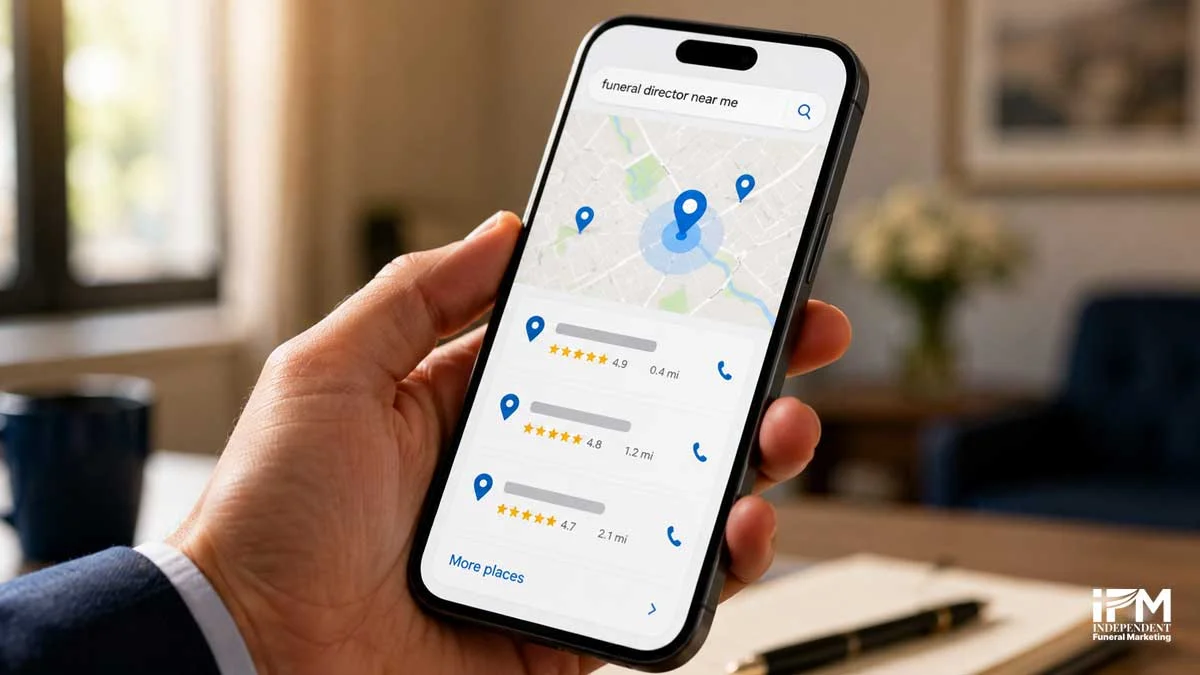
Most families searching for a funeral director on a mobile phone see the Map Pack before anything else, the three-business listing with a map that appears above organic results for local service searches. Research on local search behaviour shows the Map Pack receives 44% of all clicks on local-intent searches [3], more than any individual organic position. Families see your name, star rating, distance, and a click-to-call button before they ever reach the organic results below.
The ranking algorithm for the Map Pack is also different from standard organic ranking. It weights proximity, review recency, and Google Business Profile completeness heavily. These are factors where an active independent funeral home with genuine community roots regularly outperforms a corporate chain’s branch, regardless of the chain’s national domain authority. You don’t need to beat Co-op Funeralcare nationally. You just need to beat their local branch.
How does topical authority give independent funeral directors a competitive edge?
Topical authority is Google’s confidence that a website covers a subject thoroughly. A funeral home that publishes structured content, including direct cremation guides, bereavement support resources, and local service area pages, doesn’t just rank for one keyword. It earns positions across a wider range of relevant searches over time, including long-tail queries with high conversion intent that smaller funeral homes can win even before ranking for their primary terms.
For an independent funeral director competing in a single town or borough, this is a meaningful structural advantage. You don’t need authority across all of England. You need to be the most useful, authoritative resource in your catchment area. Targeted, locally-relevant content is the route to it.
Why is SEO more cost-effective than Google Ads over time?
The economics are simple: once a page ranks, every click from organic search costs nothing. The investment is front-loaded, covering setup, content, and ongoing optimisation, but the marginal cost per click reduces year on year. BrightLocal’s State of Local SEO research (2025) found that 45% of consumers have now used AI tools to help them find local businesses [5]. SEO content structured for AI extraction, with direct-answer openings, comparison tables, and FAQ schema, gets surfaced by Google AI Overviews and Perplexity alongside traditional search results. One well-written article earns traffic from multiple discovery channels simultaneously. SparkToro data from March 2026 shows that audiences researching funeral home marketing over-index for Perplexity by +28.2% versus the UK average [8], which makes that compounding value particularly relevant for funeral directors investing in content today.
What are the disadvantages and limitations of SEO for funeral homes?
The main limitation of SEO for funeral homes is time. Most funeral directors will not see significant organic ranking improvements for competitive local terms within the first three to six months of an SEO programme. This makes SEO a poor choice as the sole channel for a new funeral home needing immediate enquiries.
How long does SEO typically take to work for a funeral home?
Initial Map Pack improvements and long-tail keyword rankings typically appear within three to six months of consistent SEO work. Competitive terms, such as “funeral director [town]” in areas with established corporate chains, require six to eighteen months to reach the first page. The timeline depends on the current state of the website, the competitive intensity of the local market, and how consistently the SEO programme is executed. A funeral home with an established web presence and some existing rankings will see faster results than a brand-new domain.
Why is SEO not a “set and forget” strategy for funeral directors?
Google’s ranking algorithm updates regularly. Competitors publish new content, build new reviews, and earn new citations. A funeral home’s Map Pack position can slip if its Google Business Profile is not maintained, if review recency drops, or if a competitor increases its optimisation effort. SEO is an ongoing programme rather than a one-time project. The positive side of this is that a funeral home that maintains its SEO consistently builds a widening lead over competitors who treat it as a periodic task.
How does Local SEO differ from Google Ads for funeral directors?
Local SEO and Google Ads target the same local searchers but through different routes on the Google results page. Local SEO focuses on winning a position in the Google Map Pack, the three-business map results that appear above organic results for local service searches. Google Ads places text ads above even the Map Pack, making both channels complementary rather than competing.
What is the Google Map Pack and how do funeral directors win a position?
The Map Pack displays three funeral homes with their name, star rating, distance, and a click-to-call button. Winning a Map Pack position requires a well-optimised Google Business Profile, a consistent volume of recent reviews, accurate local citations, and a funeral home website that reinforces the same local signals. Proximity to the searcher also plays a role: a funeral home physically closer to the searcher has a natural advantage for “near me” searches.
Does Google Ads or Local SEO produce better results for “funeral director near me” searches?
They serve the same search differently. Google Ads can win the sponsored position at the very top of the page immediately, above the Map Pack. Local SEO earns a Map Pack position over time, which appears above the organic results but below any active Google Ads. Both positions capture high-intent at-need searchers. The critical difference is cost: Google Ads charges for every click to the Map Pack position, while Local SEO earns Map Pack clicks at zero marginal cost per click once established.
How can a funeral home use both Local SEO and Google Ads for maximum local visibility?
A funeral home with both an active Google Ads campaign and a Map Pack position can appear in two of the three most prominent zones on the first Google results page for local funeral searches. This dual presence is the strongest achievable local visibility: the sponsored position captures the highest-intent clicks at the very top, while the Map Pack position captures the trust-driven clicks from families who prefer organic over paid results. Combined, they cover more of the available search real estate than either channel alone.
Which is more cost-effective in the long run, Google Ads or SEO?
Over a three-year horizon, SEO consistently delivers a lower cost per funeral enquiry than Google Ads for most independent funeral homes. This is because SEO costs are front-loaded, the investment goes into building ranking authority, while Google Ads require ongoing spend to maintain visibility. A well-ranked organic page and Map Pack position generate enquiries at zero marginal cost per click.
What does “cost per enquiry” mean for a funeral home, and why does it matter?
Cost per enquiry is total marketing spend divided by the number of qualified enquiries generated. It is the only metric that connects marketing investment directly to business outcomes. A funeral home spending £800 per month on Google Ads and generating 12 enquiries has a cost per enquiry of £67. The same funeral home spending £800 per month on SEO in month 18 of its programme and generating 20 enquiries has a cost per enquiry of £40. The comparison is not meaningful at month one but becomes decisive by month 18 to 24.
The wider direction of travel matters here. WordStream’s 2025 Google Ads benchmark research puts the cross-industry average cost-per-lead at $70.11, a 5.1% increase year on year from $66.69 in 2024 [10]. These are US cross-industry figures, not funeral-specific, but the underlying dynamic is consistent across markets: paid search CPLs tend to rise as auction competition increases. SEO CPLs, in contrast, reduce over time as established rankings generate clicks at no marginal cost. The longer the SEO programme runs, the wider that gap becomes.
How do SEO and Google Ads compare over 1, 2 and 3 years?
The table below uses illustrative figures based on realistic scenarios for a single-location independent UK funeral home. These are not guaranteed results, they are illustrative of the structural difference between the two channels over time.
| Metric | Google Ads Yr 1 | Google Ads Yr 3 cumulative | SEO Yr 1 | SEO Yr 3 cumulative |
|---|---|---|---|---|
| Monthly investment | £500–£800 | £500–£800/mo | £500–£800 | Reducing marginal cost |
| Estimated enquiries per month | 2–5 (at ~£10 CPC) | 2–5 (while active) | 0–2 (building) | 4–10+ (compounding) |
| Asset value at year end | £0 (rented visibility) | £0 | Growing domain authority | Established organic rank |
| Cost if paused for one month | £0 spend, £0 visibility | £0 spend, £0 visibility | £0 spend, rank maintained | £0 spend, rank maintained |
| Long-term cost per enquiry trend | Flat or rising as CPCs increase | Flat or rising | High in year 1 | Reducing year on year |
When does Google Ads have a better ROI than SEO for funeral directors?
Three scenarios favour Google Ads: a new funeral home with no organic ranking history; a competitive area where organic positions are held by well-funded corporate chains with multi-year SEO investment; and specific short-term situations such as a new service launch or a campaign for a particular seasonal offering. In each case, Google Ads provides immediate commercial return that SEO cannot match in the same timeframe.
How should an independent funeral director allocate their marketing budget?
A funeral home with £1,000 per month available for digital marketing might reasonably allocate £400 to £500 to Google Ads for immediate at-need coverage and £500 to £600 to SEO and content for long-term compounding returns. This split prevents the vulnerability of relying entirely on paid spend while ensuring the long-term organic asset is being built consistently.
How does the UK funeral market affect your choice between Google Ads and SEO?
The UK funeral market has specific characteristics that affect how digital marketing channels perform for independent funeral directors. CMA pricing transparency rules require funeral homes to publish prices online, which influences the SEO value of service pages. UK consumers also show a statistically significant preference for AI search tools: independent funeral directors’ audiences over-index for Perplexity by +28.2% versus the UK average [8] (SparkToro, March 2026).
How do CMA pricing transparency rules affect funeral home SEO in the UK?
The Competition and Markets Authority (CMA) Funerals Market Study 2021 requires UK funeral homes to publish price lists on their website [9]. This creates a mandatory SEO asset: pricing pages are required by regulation and also rank for commercial-intent searches such as “funeral cost [town]” and “direct cremation price [town]”. Funeral homes that invest in well-structured, keyword-optimised pricing pages gain both CMA compliance and organic traffic from families researching costs before choosing a funeral director.
Do UK families search for funeral directors differently than US families?
UK families predominantly use the term “funeral director” rather than “funeral home”. This distinction matters directly for Google Ads keyword targeting and SEO metadata. UK campaigns should use “funeral director” as the primary keyword in ad copy, H1 headings, and meta descriptions, with “funeral home” as a secondary variant for dual-market content. NAFD and SAIF membership are credible trust signals in UK ad copy and on-page content.
Why do UK funeral directors’ audiences over-index for AI search tools like Perplexity?
SparkToro data from March 2026 shows that the UK audience most likely to be researching funeral home marketing over-indexes for Perplexity by +28.2% and for Bing by +8.3% versus the UK average (SparkToro [8]). AI search tools pull answers directly from well-structured web content: articles with direct-answer openings, FAQ sections in structured schema, and comparison tables are prioritised. This means SEO content built for AI extraction, with clear factual opening statements and FAQPage schema, delivers disproportionate visibility to exactly the audience most likely to influence funeral home marketing decisions.
Does NAFD or SAIF membership help with Google Ads or SEO for UK funeral directors?
NAFD and SAIF membership improves performance in both channels, indirectly but meaningfully. In Google Ads, membership accreditations in ad copy and landing pages function as trust signals that improve click-through rate and conversion rate. In SEO and the Map Pack, they appear as trust signals on the Google Business Profile and website that influence families’ decisions after clicking. Neither is a direct ranking factor, but both contribute to the conversion of clicks into calls.
Can independent funeral directors compete with corporate chains using Google Ads or SEO?
Independent funeral directors can compete effectively against corporate funeral chains using both Google Ads and SEO, and in many cases have a structural advantage. Corporate chains like Co-op Funeralcare and Dignity compete at national scale. An independent funeral director competes in a single town or borough, where hyper-local targeting and genuine community presence deliver conversion rates that national brands struggle to match.
Why does local targeting give independent funeral directors an advantage in Google Ads?
A corporate chain running national Google Ads campaigns targets broadly by county or region. An independent funeral home can target a 5 to 10 mile radius around its premises with town-specific keywords and ad copy that names the local area. This precision typically produces a higher Quality Score, meaning a lower CPC for local searches than a national competitor targeting the same region less precisely. Hyper-local ad copy also resonates more with families who are searching specifically for a funeral director they can reach quickly.
Can SEO help an independent funeral home outrank corporate chains locally?
Yes, particularly in the Map Pack. Google’s local ranking algorithm weights review recency, proximity, and Google Business Profile completeness heavily. An independent funeral home with 80 recent reviews, an active Google Business Profile, and locally-relevant content will regularly outrank a Dignity or Co-op Funeralcare branch in the Map Pack, even if the corporate chain’s national domain authority is higher. Keyword difficulty data from DataForSEO (May 2026) shows KD scores of 4 to 24 across the funeral marketing keyword cluster [7], confirming these positions are genuinely winnable for independently-operated funeral homes.
What is the first-mover advantage for independent funeral directors in digital marketing?
IFM’s keyword research confirms zero coverage by UK competitors on key SEO and Google Ads comparison topics for funeral directors. Publishing structured, AI-optimised content on these subjects first means owning both the SERP position and the AI Overview citation for these queries before any competitor does. First-mover advantage in content is temporary but significant: an article that ranks for 12 to 18 months before a competitor publishes a competing piece accumulates authority, reviews, and backlinks that are difficult to displace quickly.
Should a new funeral home start with SEO or Google Ads?
A new funeral home with no organic search history should start with Google Ads to generate initial enquiries while SEO is built in parallel. This combined approach prevents the “dead period” of waiting 6 to 12 months for SEO to produce results, while ensuring the long-term compounding value of organic ranking is not sacrificed for short-term visibility.
Why does a new funeral home need Google Ads before SEO produces results?
A brand-new domain has no ranking history with Google. No domain authority, no local citations, no reviews, no Map Pack presence. SEO begins building these from zero, and the first measurable organic results typically appear at month three to six at the earliest, with competitive positions taking twelve months or longer. During this period, Google Ads is the only way to ensure the funeral home appears at the top of Google for at-need local searches. Without it, the funeral home is effectively invisible digitally.
What is the recommended timeline for transitioning from Google Ads to SEO dominance?
- Months 1 to 3: Google Ads live immediately. Google Business Profile set up and optimised. Website technical foundations in place. No significant organic traffic yet.
- Months 3 to 9: SEO content programme begins. Early long-tail keyword rankings appear. Map Pack position starts to develop. Google Ads continue to fill the enquiry gap.
- Months 9 to 18: Organic Map Pack positions strengthen. Long-tail enquiries increase. Google Ads budget can hold steady or begin to reduce as organic takes share.
- Month 18 onwards: Established organic presence generating consistent enquiries. Google Ads maintained for highest-competition terms or reallocated to new service areas.
For an established funeral home with five or more years of web history and an existing Google Business Profile, phases one and two are significantly compressed. The starting position determines the timeline.

Should a funeral home use Google Ads and SEO at the same time?
Most independent funeral homes benefit from running Google Ads and SEO simultaneously, particularly in the first 12 to 18 months of a digital marketing programme. The two channels are not competitors. They occupy different positions on the search results page and serve different stages of the marketing timeline: Ads deliver immediate enquiries, SEO builds the long-term foundation.
What are the benefits of running Google Ads and SEO together for funeral directors?
Running both channels simultaneously creates a multi-position presence on the first Google results page. Google Ads occupies the sponsored position at the top. Local SEO earns a Map Pack position in the middle. Organic SEO produces a website listing below the Map Pack. A funeral home that achieves all three covers the top, middle, and lower sections of the results page for its core local terms. No competitor running only one channel can match that coverage.
How should a funeral home split its marketing budget between Google Ads and SEO?
There is no universal allocation, but a reasonable starting framework is:
- £1,000/month budget: £400–500 Google Ads + £500–600 SEO and content
- £1,500/month budget: £600–700 Google Ads + £800–900 SEO and content
- £2,000/month budget: £800–1,000 Google Ads + £1,000–1,200 SEO and content
The split can adjust as results develop. If Google Ads are generating strong returns at current spend, maintain or increase. If organic rankings are producing enough enquiries to reduce ad dependency, reallocate. The important principle is that neither channel is stopped entirely until the other is producing consistent results.
When can a funeral home reduce Google Ads spend as SEO matures?
The signal to reduce Google Ads dependence is when organic sources, Map Pack calls and organic website traffic combined, are generating enough enquiries to maintain target volumes without paid support. This typically occurs between month 12 and 18 for a funeral home with a well-executed SEO programme. Google Ads should not be stopped entirely at this point but rather scaled back to a maintenance level covering competitive keywords where the organic position is not yet strong. For a deeper look at whether Google Ads is the right next step before starting SEO, can funeral homes run Google Ads covers the setup and policy specifics in detail.
Which digital marketing channel gets funeral homes more enquiries?
The channel that generates more funeral home enquiries depends on the stage of the business, the local competitive landscape, and the quality of execution. However, data consistently shows that local SEO, specifically Map Pack visibility and high organic rankings, delivers a lower cost per enquiry over 12 or more months than Google Ads alone, because each organic click costs nothing once the ranking is earned.
Does Google Ads or SEO produce more phone calls for funeral directors?
In months one to six, Google Ads will typically generate more calls for a funeral home with no existing organic presence. From month 12 onwards in a well-executed combined programme, organic sources begin to match or exceed paid call volume at a lower cost per enquiry. The crossover point depends on the competitive intensity of the local market. In a small town with low organic competition, SEO may overtake paid volume by month nine. In a city with multiple well-established competitors, the crossover may not occur until month 18 or later.
What is the average conversion rate for funeral home Google Ads vs organic traffic?
Conversion rates differ by channel and by traffic intent. Google Ads targeting high-intent local terms such as “funeral director [town]” typically convert at 8 to 15% from click to enquiry, when properly tracked with call tracking in place. Organic traffic from long-tail informational queries converts at a lower rate but at zero cost per click. Map Pack traffic, the highest-intent organic traffic type for funeral homes, converts comparably to paid search. The variable that determines conversion across both channels is landing page and website quality, not just the channel itself.
How do funeral homes measure marketing performance accurately?
The measurement framework that works for funeral homes is built around three numbers: enquiries, cost per enquiry, and channel attribution.
| Metric | What it measures | Tool required |
|---|---|---|
| Call volume by channel | How many calls each channel generates | Call tracking with unique numbers per channel |
| Cost per enquiry | Total spend divided by total enquiries | Google Ads dashboard + call tracking data |
| Map Pack position | Local SEO visibility for primary terms | Google Business Profile Insights |
| Organic keyword ranking | SEO progress for target search terms | Google Search Console |
| Conversion rate | Percentage of clicks that become enquiries | Call tracking + website analytics |
Without call tracking, none of the above can be attributed accurately. Funeral homes that do not track calls cannot determine which channel is generating enquiries, which means they cannot make informed decisions about where to invest their marketing budget.
What is the best digital marketing strategy for an independent funeral director?
The best digital marketing strategy for an independent funeral director combines local SEO as the long-term foundation with Google Ads as the short-term enquiry engine, with both optimised for the single outcome that matters: more families choosing your funeral home. The right balance between the two channels depends on budget, local competition, and how long the funeral home has been online.
What is the recommended digital marketing framework for a new independent funeral home?
- Month 1: Launch Google Ads targeting at-need local terms. Set up Google Business Profile fully. Install call tracking.
- Month 2 to 3: Begin SEO technical foundations. Publish first batch of locally-relevant content. Start citation-building programme.
- Month 3 to 9: SEO content programme active monthly. Google Ads continue. Early Map Pack appearances begin.
- Month 9 to 18: Organic rankings strengthen. Google Ads spend holds or begins to reduce. Map Pack position established.
- Month 18 onwards: SEO and Local SEO generating consistent organic enquiries. Google Ads maintained tactically for competitive terms.
What is the recommended digital marketing framework for an established independent funeral home?
An established funeral home with five or more years online, an existing Google Business Profile, and some organic rankings is in a different position. Its primary investment should be local SEO, with a focus on Map Pack optimisation, review velocity, and structured content. Google Ads should be run tactically for the highest-competition terms where organic positions are not yet strong, or as a defensive measure against corporate chains running aggressive local campaigns.
What are the three most important marketing priorities for any independent funeral director?
- Google Business Profile optimised and review-active. This is the single highest-return action for most funeral homes. A fully optimised GBP with consistent recent reviews is the foundation of Map Pack visibility and the first thing a family sees after searching.
- Website with local SEO basics in place. Fast, mobile-optimised, with CMA-compliant pricing pages, locally-relevant content, and clear click-to-call functionality. The website converts visibility into enquiries.
- Google Ads active for at-need terms where organic gaps exist. Run targeted, well-structured campaigns for the searches your funeral home is not yet ranking organically. Scale down as organic fills those gaps.
The funeral directors who invest in structured, AI-extractable content today will own the Perplexity answers and Google AI Overview citations for funeral marketing searches that their competitors have not yet written. The landscape is uncrowded. The opportunity to establish authority before competitors do is real, and it is closing as awareness of AI search grows.
For a complete picture of how Google Ads, SEO, and Local SEO fit together as an integrated system, the Google Ads guides for funeral directors covers the full channel strategy in detail.
Frequently asked questions: Google Ads vs SEO for funeral homes
Is Google Ads worth it for funeral directors?
Yes, Google Ads is worth it for most funeral directors, particularly those without strong organic rankings or Map Pack visibility. It generates at-need enquiries within 24 to 48 hours of launch and captures families actively searching for funeral services right now. The key qualifier is proper setup: campaigns without call tracking, dedicated landing pages, and negative keyword lists typically produce poor results regardless of budget.
How much does Google Ads cost for a funeral home?
Google Ads costs for funeral homes in the UK typically range from £300 to £1,500 per month in ad spend, depending on location and competition. Cost-per-click for high-intent terms such as “funeral directors near me” ranges from approximately £3 to £8 in most UK towns. US benchmarks show CPCs of $13 to $22 for core funeral service search terms (DataForSEO, May 2026). Budget alone does not determine results: campaign structure and call tracking are equally important.
What is the difference between SEO and Google Ads for funeral homes?
Google Ads places a funeral home at the top of search results immediately through paid placement, charging a fee for each click. SEO builds organic visibility over time by improving the website’s relevance and authority, so the funeral home appears in unpaid search results. Google Ads produces results within hours but stops when the budget stops. SEO takes three to twelve months to show results but continues generating enquiries without per-click cost once rankings are established.
Does Google Ads affect SEO ranking?
No. Running Google Ads does not improve a funeral home’s organic SEO ranking. Google keeps its paid and organic systems completely separate. Spending more on Google Ads will not increase a funeral home’s position in the organic results or the Map Pack. This is a common misconception and has no basis in how Google’s ranking algorithms work. SEO ranking is determined by website relevance, authority, and technical quality, not ad spend.
Which is better, SEO or Google Ads, for a funeral director?
Neither is universally better: they serve different purposes and perform best together. Google Ads delivers immediate at-need enquiries and is the right starting point for new funeral homes or those in competitive areas where organic rankings are dominated by corporate chains. SEO builds a long-term asset that generates enquiries without ongoing per-click cost, making it more cost-effective over a two to three year horizon. The optimal approach is to run both in parallel, with Ads providing coverage while SEO builds.
How long does SEO take to work for a funeral home?
Most funeral homes see early Map Pack and long-tail keyword improvements within three to six months of an active SEO programme. Competitive local terms typically require six to twelve months to reach the first page. A well-established funeral home with an existing web presence may see faster results. A brand-new domain with no history should expect twelve to eighteen months for competitive organic rankings.
What happens to my funeral home visibility when I turn off Google Ads?
When Google Ads are paused or stopped, paid search visibility disappears immediately. There is no residual benefit: the sponsored positions vacated the same day the campaign is paused. This is the fundamental difference from SEO, where organic rankings remain in place when investment pauses. For funeral homes dependent primarily on Google Ads for enquiries, any budget interruption directly reduces the volume of at-need calls received.
Should a funeral home use SEO and Google Ads at the same time?
Yes. Most independent funeral homes benefit from running both simultaneously, particularly in the first 12 to 18 months of a digital marketing programme. Google Ads occupies the sponsored position at the top of the page while SEO works toward the Map Pack and organic positions below. Running both channels means a funeral home can appear in up to three positions on the first page of Google for its key local terms, significantly increasing the likelihood of capturing at-need enquiries.
How do families find funeral directors online in the UK?
Most families in the UK search for funeral directors using Google, typically within hours of a bereavement. The NFDA’s 2025 Consumer Awareness and Preferences Study found that over 70% of families visit a funeral home’s website before making contact [1]. The dominant search query type is local, using terms such as “funeral directors near me” or “funeral director [town]”. BrightLocal’s 2026 research found that 41% of consumers always read reviews before choosing a local business [2], making both search visibility and review volume critical to winning the enquiry.
What keywords should funeral homes use in Google Ads?
The highest-value keywords are transactional and location-specific: “funeral directors [town]”, “funeral home near me”, “cremation services [town]”, “direct cremation [town]”, and “funeral home open now”. Negative keywords are equally critical: employment searches, property listings, educational queries, and informational terms must be excluded before launch to prevent budget waste on traffic with no purchase intent.
Can SEO help a funeral home compete with Co-op Funeralcare or Dignity?
Yes. SEO can help an independent funeral home outrank Co-op Funeralcare and Dignity in local results, particularly in the Google Map Pack. The Map Pack ranking algorithm heavily weights proximity, review recency, and Google Business Profile completeness, all areas where an active independent funeral home with genuine community presence can outperform a corporate chain’s branch. Keyword difficulty data (DataForSEO, May 2026) shows KD scores of 4 to 24 across the funeral marketing cluster, confirming these positions are genuinely winnable.
Should a new funeral home start with SEO or Google Ads?
A new funeral home should start with Google Ads to generate immediate enquiries while SEO is built in parallel. A new domain has no organic ranking history, so SEO alone would leave the business without search visibility for six to twelve months. Google Ads fills that gap from day one. The recommended approach is to launch Google Ads and Google Business Profile simultaneously, begin an SEO content programme within the first three months, and reduce ad dependency as organic positions develop.
What is a realistic monthly Google Ads budget for a funeral home?
A realistic monthly Google Ads budget for a UK funeral home is £300 to £500 for a small town with low competition, £500 to £1,000 for a medium-sized town, and £1,000 to £2,000 or more for London and high-competition cities. These are ad spend figures, not total campaign management costs. Below £300 per month in most UK markets, click volume is insufficient to generate reliable enquiry data or allow Google’s algorithm to optimise bid strategies effectively.
How do I measure the success of SEO or Google Ads for my funeral home?
The primary metric for both channels is cost per enquiry: total monthly spend divided by the number of qualified phone calls or form submissions generated. For Google Ads, this requires call tracking via a Google forwarding number with a 60-second minimum duration threshold. For SEO, call tracking with a unique organic traffic number isolates organic enquiries from other sources. Secondary metrics include Map Pack position, keyword ranking movement, and website conversion rate.
Are there restrictions on advertising funeral services in Google Ads?
Yes. Google classifies bereavement as a sensitive personal hardship category under its personalised advertising policy. Funeral homes cannot use remarketing lists, Customer Match audiences, or interest-based targeting when bereavement is the audience signal. Standard keyword search campaigns are fully permitted and unrestricted. The restriction applies to targeting people because of their bereavement status, not to advertising funeral services to people who actively search for them.
Working with a specialist makes the difference
Google Ads and SEO each require specialist knowledge to perform in the funeral sector. The keyword costs, audience behaviour, and local competitive dynamics that determine success are specific to this industry, and managing both channels effectively takes time that most funeral directors do not have. Independent Funeral Marketing works exclusively with established independent funeral directors, managing PPC for funeral directors, SEO, and content as an integrated system focused on one outcome: more enquiries.
See how IFM supports independent funeral directors to discuss your local market.
References
[1] National Funeral Directors Association, 2025 Consumer Awareness and Preferences Study, nfda.org
[2] BrightLocal, Local Consumer Review Survey 2026, brightlocal.com
[3] Red Local Agency, Google Local Pack Statistics, redlocalagency.com
[4] BrightLocal, Local Consumer Review Survey 2025, brightlocal.com
[5] BrightLocal, State of Local SEO 2025, brightlocal.com
[6] Google, Personalised advertising policy, sensitive events and hardship categories, support.google.com
[7] DataForSEO, Keyword Research: Funeral Home Advertising, May 2026, dataforseo.com
[8] SparkToro, Audience Intelligence Report: Independent Funeral Directors UK, March 2026, sparktoro.com
[9] Competition and Markets Authority, Funerals Market Study Final Report, 2021, gov.uk
[10] WordStream, Google Ads Benchmarks 2025, wordstream.com