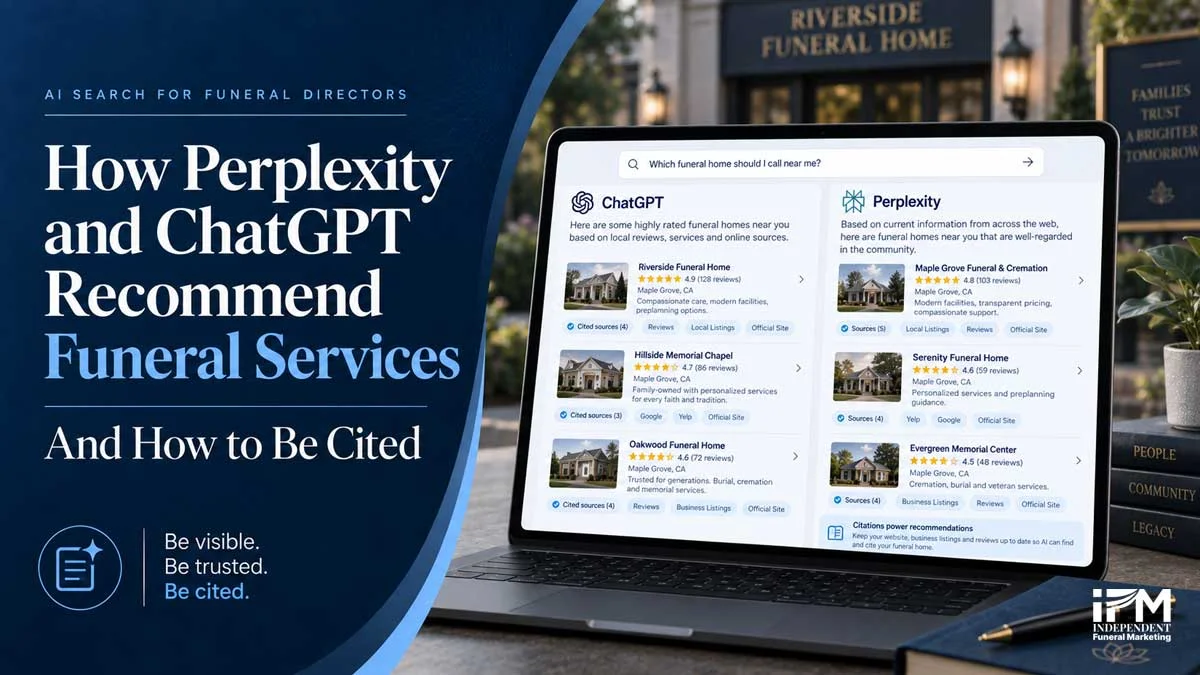
How Perplexity and ChatGPT recommend funeral services comes down to two different sets of mechanics, not one shared algorithm. A family, hours after a death, increasingly does not open a directory first. They open ChatGPT, or Perplexity, and ask who to call. Somewhere behind that question, one platform is checking a licensed data feed, the other is running its own live retrieval across the open web, and each is deciding, separately, whether to name a funeral home at all.
This article goes one level deeper than what GEO is and how to check where a funeral home currently stands. It assumes both, and exists to answer one specific question: what is actually happening inside ChatGPT and Perplexity when they choose who to recommend, and what a funeral home’s own website can do about it.
How do ChatGPT and Perplexity actually decide which businesses to recommend?
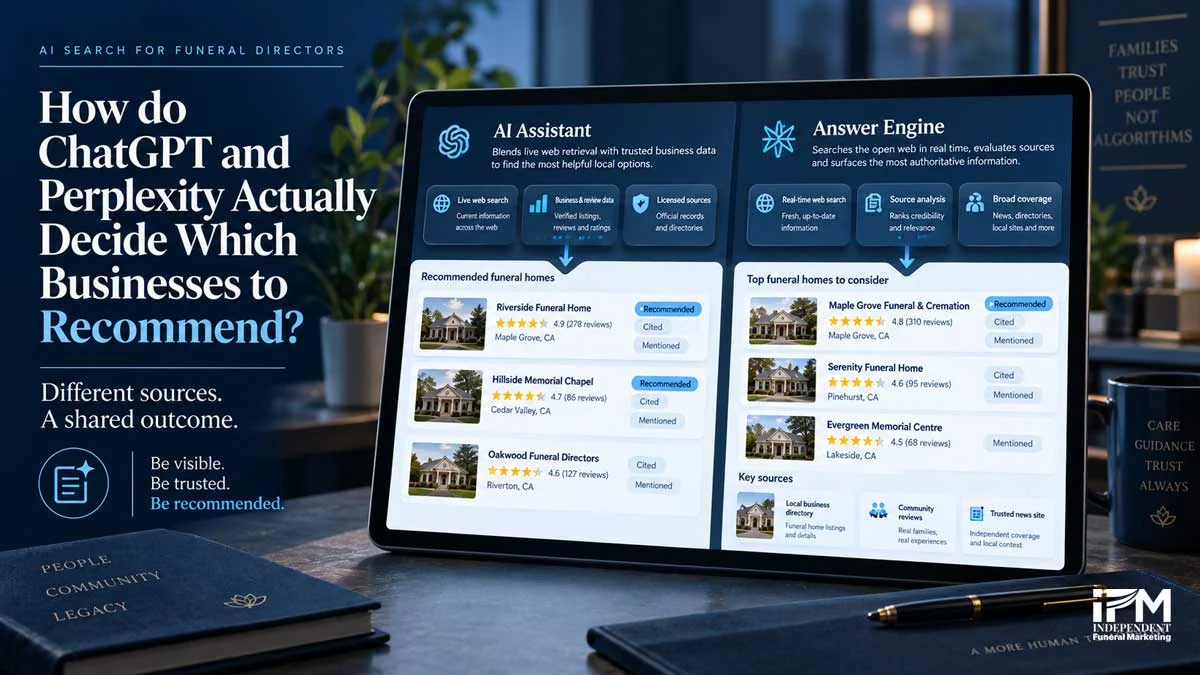
Most AI assistants build their answers using retrieval-augmented generation, pulling in live web content and synthesising it into a response rather than relying only on what a model learned during training. What Is GEO for Funeral Homes? covers that mechanism in full, this article assumes it and focuses on what is specific to ChatGPT and Perplexity when the question is a local, “who do I call” business query.
The two platforms are converging on a similar goal, a trustworthy, specific answer, by different routes. ChatGPT increasingly blends its own live web retrieval with licensed third-party data partnerships, the clearest current example being a 2026 data-licensing agreement with Yelp. Perplexity is built end to end around real-time retrieval and a source-ranking pipeline of its own, without an equivalent licensed local-business dataset behind it.
Once either platform has gathered its candidate information, it makes a separate decision about how to use a business’s name in its answer. IFM uses a three-tier way of describing this, mentioned, cited, and recommended, set out in full in our guide to checking if your funeral home appears in AI search. This article assumes that distinction and spends its word count on the mechanics behind each tier instead.
| ChatGPT | Perplexity | |
|---|---|---|
| Core mechanism | Live web retrieval blended with licensed data partnerships | Real-time web retrieval and its own source-ranking pipeline |
| Local business data | Licensed Yelp data (330 million reviews, 8 million-plus listings) since 2026 | No equivalent licensed local-business dataset |
| What it favours | Complete, actively reviewed Yelp profiles among other signals | Direct answers, entity clarity, crawlable first-party facts, corroboration |
| Domain trust signal | Not publicly documented | Source labels (Government, Academic, Trusted) on reviewed domains |
| Citation style | Names a business, links to Yelp and other sources | Numbered citations linking to specific pages |
Click a factor to see why it matters
ChatGPT
Perplexity
Illustrative summary of documented platform behaviour, not a screenshot of either product.
What role does the Yelp-OpenAI partnership play in ChatGPT’s funeral home recommendations?
The relationship became public in three stages over six months:
- 12 February 2026, Yelp discloses a data-licensing relationship with OpenAI in its quarterly earnings release.
- 23 July 2026, Axios reports the full detail, a non-exclusive deal giving ChatGPT access to 330 million cumulative user-generated reviews and more than 8 million business listings, with Yelp branding and links retained in ChatGPT’s answers and financial terms undisclosed [1].
- 10 August 2026, Yelp’s own official blog confirms a further step, bringing Yelp Reservations and Waitlist directly into ChatGPT, in a post authored by Chad Richard, Yelp’s SVP of Business and Corporate Development [2].
For a funeral home, the practical implication is specific. Profile completeness, review volume and review recency on Yelp are now a live grounding input to ChatGPT’s local answers, in a way that is structurally distinct from Perplexity’s open-web approach, a contrast the next section develops.
What is not confirmed matters just as much as what is. OpenAI has not published how it weights or ranks the Yelp data it receives, and the deal is explicitly non-exclusive, which says nothing about how ChatGPT treats a business with a thin or absent Yelp presence. Treat an accurate, complete, actively-reviewed Yelp profile as a plausible, evidenced lever for ChatGPT visibility specifically, not a guaranteed mechanism.
Independent SEO practitioners describe seeing the same shift in their own client advice. Andy Chadwick, interviewed by James Dooley on advanced answer engine optimization (AEO) strategies in 2026, describes now telling clients to prioritise Yelp reviews specifically because the Yelp API is being called on for large language model visibility, distinct from Google ranking. Treat this as one practitioner’s anecdotal experience, not a study, sitting alongside the verified Yelp and Axios facts above rather than replacing them.
How does Perplexity choose which sources to cite for a funeral home query?
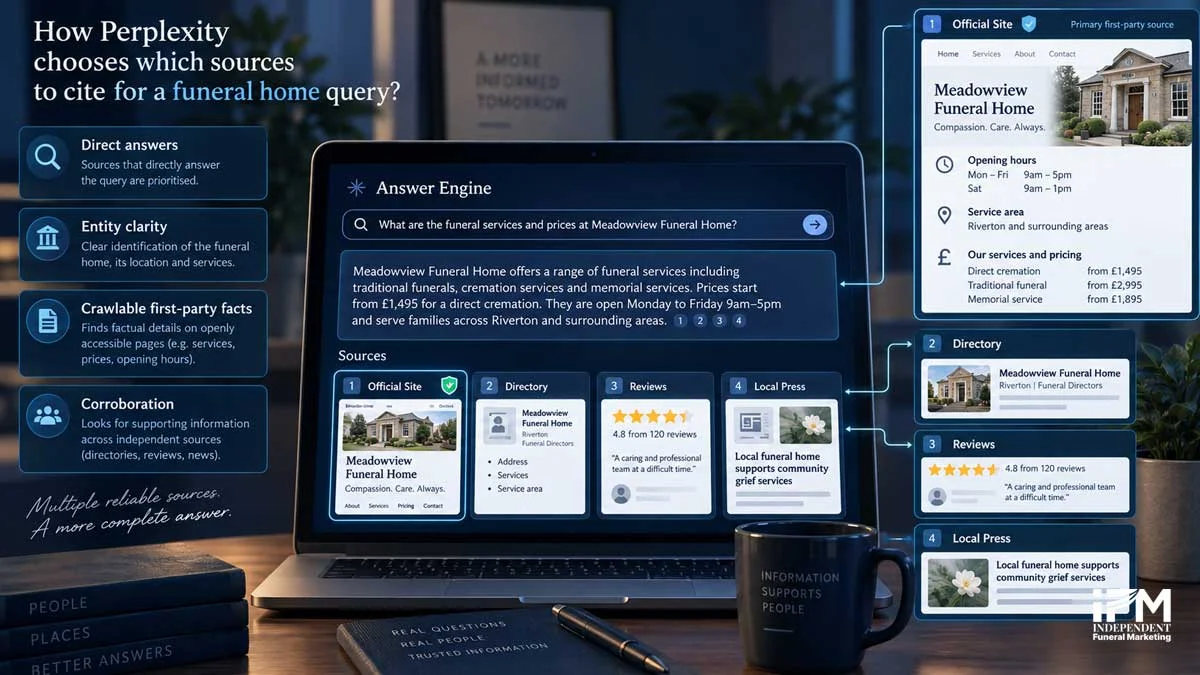
Perplexity describes itself as an answer engine, using live web retrieval to gather sources before synthesising a response with numbered citations [3]. The factors that determine which pages it favours, drawn from Perplexity’s own documented behaviour, cluster around a handful of themes most relevant to a funeral home:
- Direct answers, does the page state the fact a family is actually asking for, rather than requiring inference.
- Entity clarity, is the business identifiable as a single, unambiguous real-world entity, not one of several similarly named listings.
- Crawlable first-party facts, are hours, service areas and pricing stated in plain HTML text rather than buried in images, PDFs, or scripts.
- Corroboration, is the same information repeated across independent sources elsewhere on the web, not stated once and nowhere else.
Perplexity also documents a source-labelling system for evaluating domain trustworthiness. Some citations carry a small shield icon marking a domain that Perplexity has reviewed and rated Government, Academic or Trusted, applied to the whole domain rather than any single page, with most domains carrying no label at all [4]. Separately, Perplexity’s Search API supports a domain filter of up to twenty allowed or blocked domains, one illustration of how source-domain eligibility can be controlled at the platform level even outside the consumer product [5].
Translated for a funeral home, a dedicated “who to call” page and clearly written service pages are exactly the kind of self-contained, factual, first-party content Perplexity favours, distinct from a generic homepage or a directory listing on its own. Directories are not competitors to a funeral home’s own site for this purpose, they are corroboration. The official site should be the best source for first-party facts, other sites for reviews and independent recommendation.
Does ChatGPT’s local data come from Foursquare or Yelp?
One widely repeated industry claim holds that Foursquare’s Places API supplies somewhere between 60 and 70 percent of ChatGPT’s local business results. That figure traces back to a small early study covering only a handful of cities, and it continues to circulate across SEO commentary as settled fact. A larger 2026 measurement study, built on thousands of test prompts with a published methodology, found the opposite, Foursquare’s actual citation share statistically indistinguishable from zero, with Yelp appearing in the overwhelming majority of business-card groundings tested.
Neither claim comes from OpenAI itself, and neither is independent, peer-reviewed research. This section exists to show that popular claim checked and found unsupported, which is itself a useful trust-building habit for a research-minded reader. The practical conclusion holds regardless of which side of the dispute turns out to be right: given the independently confirmed Yelp-OpenAI licensing deal, a complete, accurate Yelp profile is the better-evidenced investment of the two, not chasing Foursquare specifically.
How much do reviews and star ratings influence whether a funeral home gets recommended?
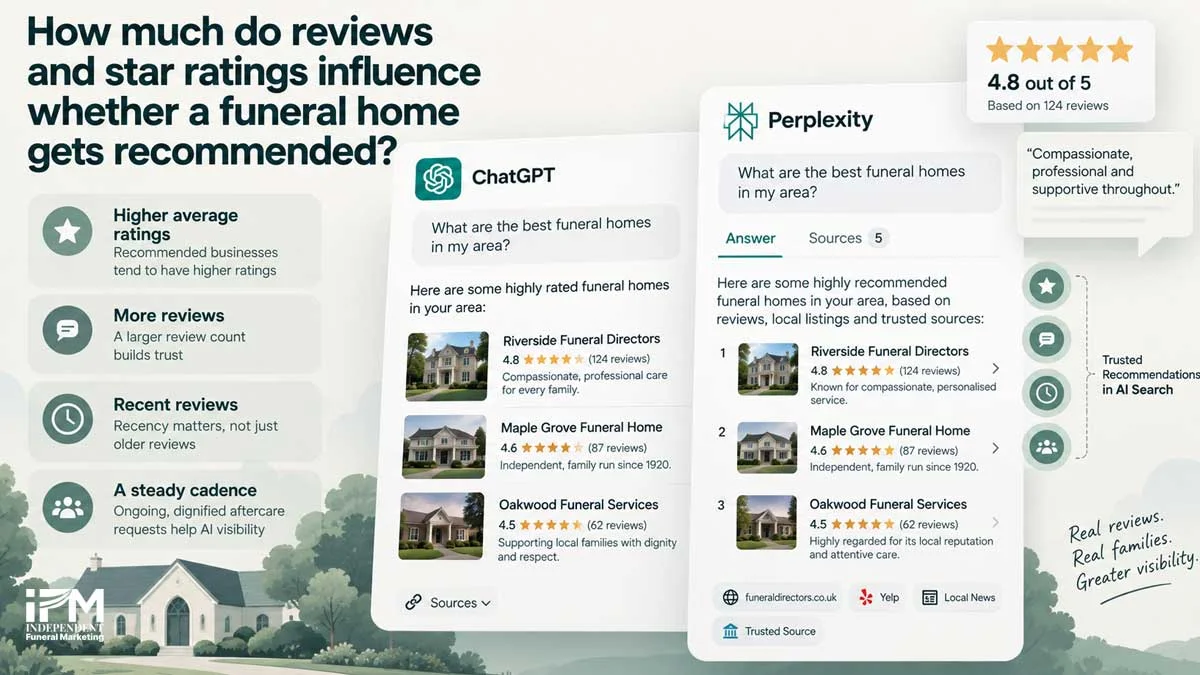
Neither platform publishes a ranking formula built on star ratings alone. What is consistent across the available evidence is a directional pattern, businesses that ChatGPT and Perplexity actively recommend tend to sit above the general pool on both average rating and review count, treated as a trust signal alongside the other factors already covered rather than a score in its own right.
This is a different lever from the general “how to get more reviews” guidance already covered elsewhere in IFM’s local SEO content, review recency and volume specifically feed AI trust judgments, not just star-rating averages on a directory page. Review acquisition timing is inherently sensitive in the funeral sector, so tie this back to aftercare communication rather than generic review-request tactics, a steady, respectful cadence of requests once a family has had time, rather than a single push immediately after a service.
Can an independent funeral home compete with a corporate chain for AI citations?
What Is GEO for Funeral Homes? already sets out the general “winner takes most” and independent-versus-corporate-chain dynamic in AI search. This section goes one level further into the mechanism, AI systems reward narrow, well-corroborated specificity over broad brand scale.
The contrast is worth making concrete. A page describing “funeral services in your town” in general terms gives an AI system little to grab onto beyond a location. A page describing a specific specialism, direct cremation with a named team of directors, service areas listed by name rather than “the local community,” and a genuine, verifiable tie to that community, gives the same system a specific, corroborated fact pattern to cite. Backed by a consistent Yelp profile, accurate directory listings and local press mentions, that specificity is often a more compelling citation than a corporate chain’s generic, templated location page serving many towns at once.
The honest limit is worth stating plainly. A corporate chain with equally strong structured data and active review management remains competitive, this is a genuine opportunity for independent funeral homes, not a guarantee.
Who gets cited when a funeral home’s information lives on other websites?
The analysis used DataForSEO LLM Mentions data for Google AI Overviews and AI Mode in the United States, with a partial match on the phrase “funeral home website”, retrieved on 23 September 2026 [9]. This is US data. Equivalent UK citation data was not available in the dataset.
Much of what these queries touch on, notices, obituaries, service times and details about the person who has died, is content funeral directors create. When that content is published only on a platform, the platform becomes the source that AI systems name.
This is not a case against notice and obituary platforms. They reach people who search there, and many families expect to look for notices on them. The practical answer is to publish in both places:
- On the funeral home’s own website, so the business is an original source that search engines and AI systems can cite.
- On the platforms families already use, so the notice reaches the people who look there first.
- With the same details in each place, so names, dates, times and venues match wherever an AI system reads them.
Why does the FTC Funeral Rule matter for AI citation, not just legal compliance?
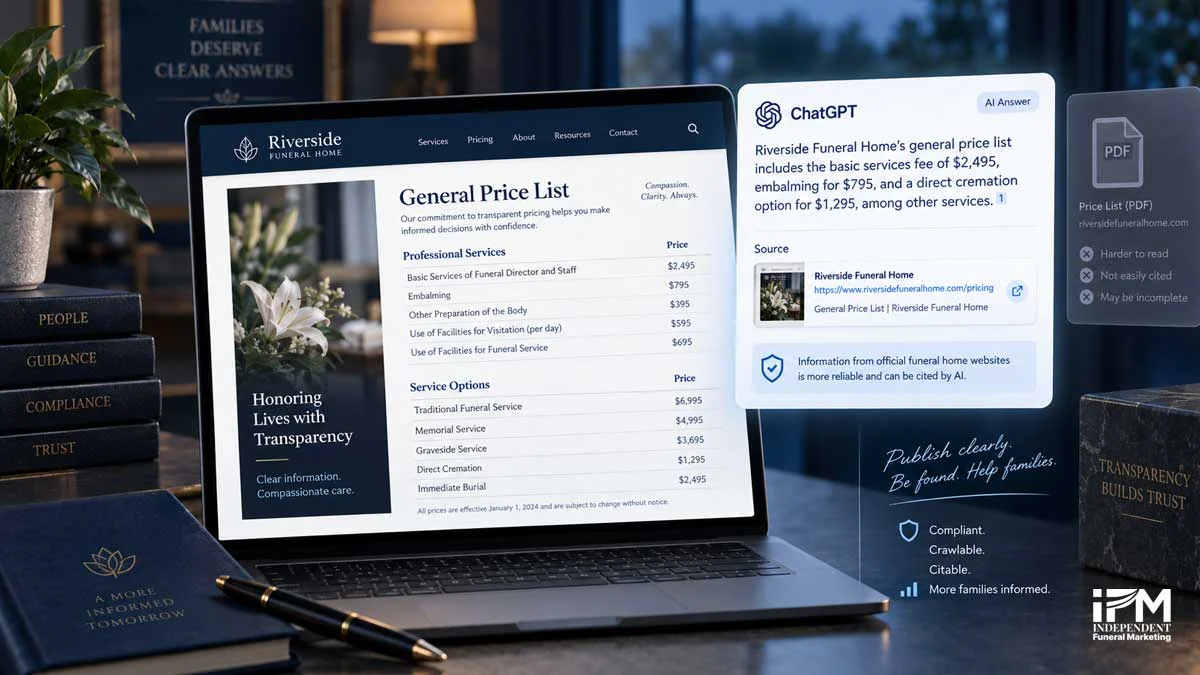
This is the article’s most distinctively funeral-specific point, and no general local-business content makes it. In the United States, the FTC Funeral Rule requires funeral providers to disclose itemised pricing through a General Price List, a Casket Price List and an Outer Burial Container Price List [6], alongside consumer-facing guidance on shopping and comparing funeral costs [7]. That kind of mandatory itemised disclosure is exactly the extractable, verifiable, first-party fact that Perplexity’s source-selection process favours, and that any retrieval-based system generally favours over vague marketing copy.
The practical instruction is direct. Publish General Price List, Casket Price List and Outer Burial Container Price List pricing as structured, crawlable on-page HTML content, not a PDF-only or gated document, consistent with the site-structure guidance below.
One caveat matters for IFM’s UK-primary audience. The FTC Funeral Rule is US regulation, and UK funeral homes operate under different disclosure rules, the CMA’s Funerals Market Investigation Order, already referenced in IFM’s GEO guide. Read the FTC Rule here as the illustrative US example of a pattern, publish itemised pricing as structured page content, not as a rule that applies directly outside the US.
How should a funeral home structure its website so ChatGPT and Perplexity can cite it correctly?
This is the article’s practical payoff. Based on the platform mechanics already covered, a funeral home’s website should be structured around a small number of concrete pieces. Tick each one off against a real site while reading:
Try it now
Open an incognito window, run each question through the platform you're checking, and tick it off as you log the result.
0 of 6 tested
Schema markup and crawler-access checks, robots.txt, OAI-SearchBot and PerplexityBot among them, are already covered in full in our guide to checking if your funeral home appears in AI search, this section deliberately focuses on content structure and information architecture rather than repeating that technical detail. For the wider question of what a funeral home website is for now that AI answers families, including the UK CMA price list position, see our separate guide.
Working through all of this, alongside the Yelp profile, review cadence and pricing-page work already covered, is exactly the kind of ongoing structural work IFM’s AI search optimisation service is built to handle for a funeral home that would rather not manage it alone.
How reliable are ChatGPT and Perplexity when they recommend a funeral home?
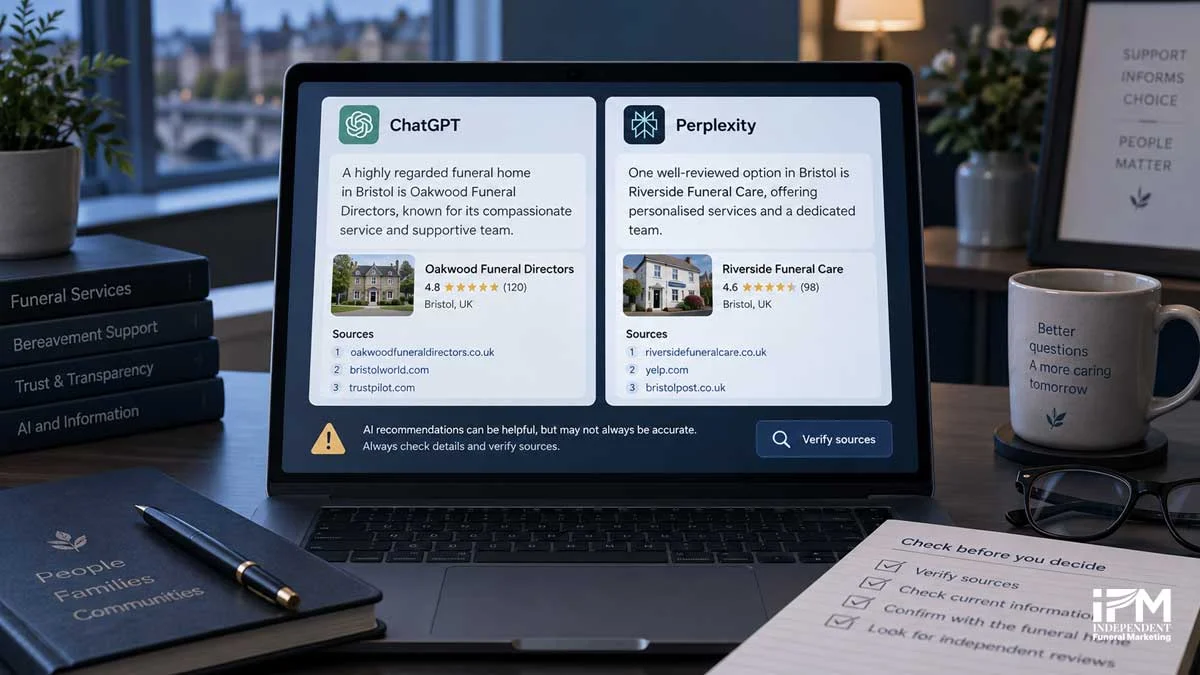
A 2025 Columbia Journalism Review and Tow Center for Digital Journalism study tested eight AI search tools, including ChatGPT Search and Perplexity, on their ability to cite news content accurately. Perplexity had the lowest citation-error rate of the eight tools tested, at 37 percent, while ChatGPT Search was wrong 67 percent of the time [8].
This matters for a reason beyond curiosity. The point of this section is not to alarm a bereaved family, it is written for the funeral director, not the family reading an AI answer at a kitchen table. The practical takeaway is to periodically verify what ChatGPT and Perplexity actually say about a funeral home, using the testing walkthrough in our guide to checking if your funeral home appears in AI search, and to treat a citation as evidence of visibility, not an endorsement of accuracy.
Both tools are imperfect but improving, and a funeral home that has done the structural work covered above, an accurate Yelp profile, clean and specific pages, itemised pricing, is making both the recommendation and the accuracy of that recommendation more likely.
Frequently asked questions
How does ChatGPT recommend businesses?
ChatGPT recommends businesses by combining its own live web retrieval with licensed third-party data, most notably a 2026 data-licensing deal with Yelp, then deciding separately whether to mention, cite or actively recommend a business in its answer. The mechanics behind this are covered in full above.
How do you get AI to recommend your business?
You get AI to recommend your business by making the facts it needs, who you are, where you serve, what you do and how to contact you, unambiguous, consistent and easy to extract from plain HTML text. The full structural blueprint is covered above.
Is Perplexity a reliable source of information?
Perplexity is more reliable than most AI search tools tested, but not fully reliable. A 2025 Columbia Journalism Review study found Perplexity had the lowest citation-error rate of eight AI search tools tested, at 37 percent, meaning it still got roughly a third of citations wrong.
Where does Perplexity source data?
Perplexity sources data through its own real-time web retrieval and ranking pipeline, favouring pages that answer a query directly, state facts clearly, are easy to crawl, and are corroborated by other independent sources, rather than drawing on one licensed database.
Does Google Business Profile information influence what ChatGPT and Perplexity say about a funeral home?
Indirectly. Google Business Profile feeds Google’s own AI features directly, but for ChatGPT and Perplexity it functions as one more piece of corroborating information rather than a direct data feed into either platform.
Can a small independent funeral home compete with a national chain for AI citations?
Yes. AI systems tend to reward narrow, well-corroborated specificity over brand scale, so a clearly described independent funeral home can be recommended ahead of a corporate chain whose profile is broad but generic. A chain with equally strong structured data and review management remains competitive, so this is an opportunity, not a guarantee.
Does schema markup guarantee a citation?
No, and this is covered in full in our guide to checking if your funeral home appears in AI search. Schema is supporting infrastructure, not a guarantee of citation on its own.
How often should a funeral home check its AI search visibility?
Monthly, using the same fixed list of buyer-intent questions each time, as set out in our guide to checking if your funeral home appears in AI search.
What this means for a funeral home right now
Understanding what GEO is, checking where a funeral home currently stands, and now the platform-specific mechanics behind ChatGPT and Perplexity and the structural fix that follows from them, together cover the ground a funeral director needs to act with confidence rather than guesswork. No funeral-sector competitor currently explains ChatGPT and Perplexity’s mechanics at this level of specificity.
If working through the Yelp profile, review cadence, pricing pages and site structure covered above feels like more than there is time for, get in touch and IFM will walk through where a funeral home currently stands and what a structured plan looks like.
References
- [1] Axios, Yelp partners with OpenAI to surface reviews in ChatGPT, axios.com/2026/07/23/yelp-reviews-chatgpt-geo-partnership, 23 July 2026
- [2] Yelp Official Blog, Yelp Brings Reservations and Waitlist to ChatGPT, blog.yelp.com/news/yelp-chatgpt-integration, 10 August 2026
- [3] Perplexity Help Center, How does Perplexity work?, perplexity.ai/help-center/en/articles/10352895-how-does-perplexity-work
- [4] Perplexity Help Center, Understanding source labels, perplexity.ai/help-center/en/articles/20260806-understanding-source-labels
- [5] Perplexity, Search Domain Filter documentation, docs.perplexity.ai/docs/search/filters/domain-filter
- [6] Federal Trade Commission, Complying with the Funeral Rule, ftc.gov/business-guidance/resources/complying-funeral-rule
- [7] FTC Consumer Advice, Funeral Costs and Pricing Checklist, consumer.ftc.gov/articles/funeral-costs-pricing-checklist
- [8] Jaźwińska, K. and Chandrasekar, A., AI Search Has a Citation Problem, Columbia Journalism Review / Tow Center for Digital Journalism, cjr.org/tow_center/we-compared-eight-ai-search-engines-theyre-all-bad-at-citing-news.php, 6 March 2025
- [9] IFM analysis of DataForSEO LLM Mentions data, Google AI Overviews and AI Mode, United States, partial match on “funeral home website”, retrieved 23 September 2026, dataforseo.com