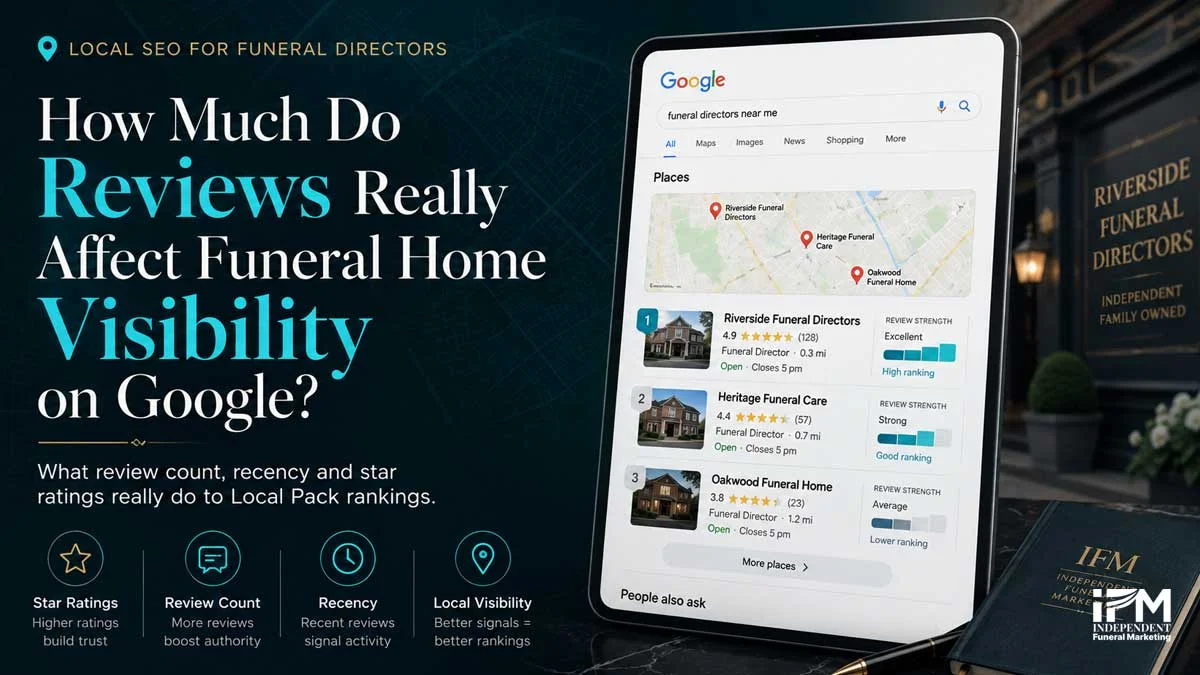
How much do reviews affect funeral home visibility on Google? Enough to decide which of two funeral homes on the same street a grieving family calls first tonight. Both are well run and both are trusted locally, and the family comparing them on a phone screen right now is weighing the number under each name, how recent it looks, and the star rating next to it. Not opinion, not a marketer’s rule of thumb, the actual sourced data on what Google reviews do to a funeral home’s Google visibility and what they do not.
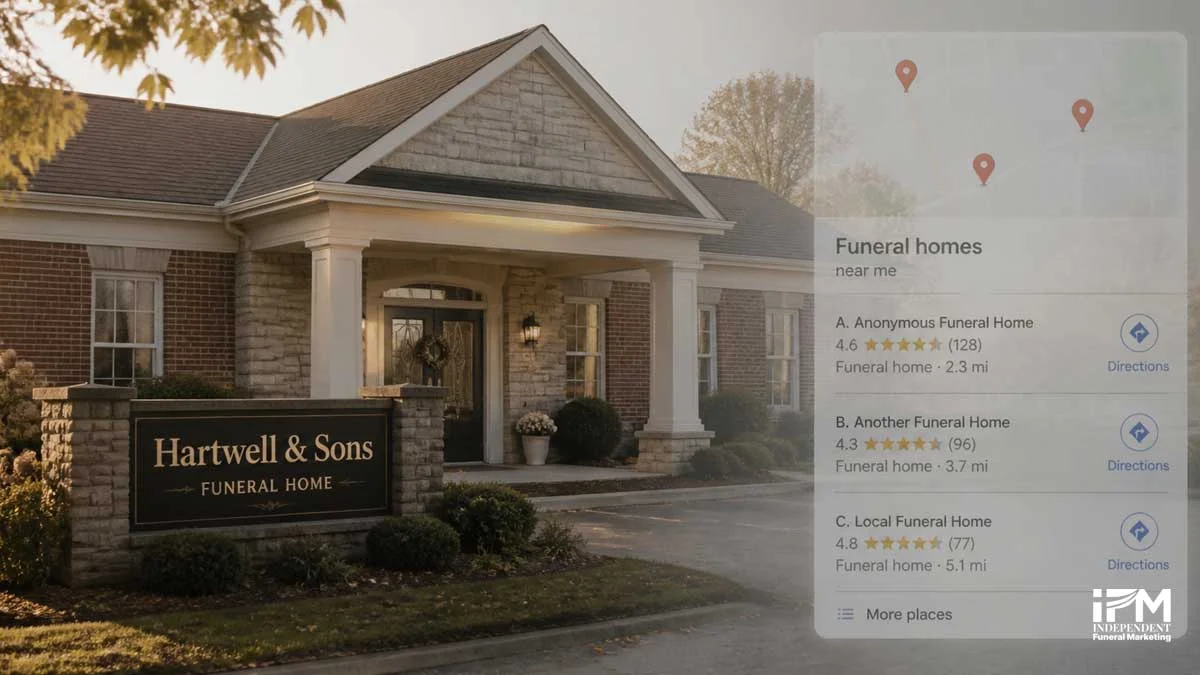
This piece exists because that question, and its broader version, how much do reviews affect local search ranking generally, already has an answer on IFM’s site, in general terms. What it has not had, until now, is the sourced, numbered version. Google’s own documentation confirms reviews sit inside its ranking model [1], and Whitespark’s 2026 survey of 47 local search experts scores exactly where review signals sit among 187 individual local ranking factors [2]. That is the data this article works from, cited inline, factor by factor, with nothing rounded or estimated.
What Does Google Actually Say About Reviews and Local Ranking?
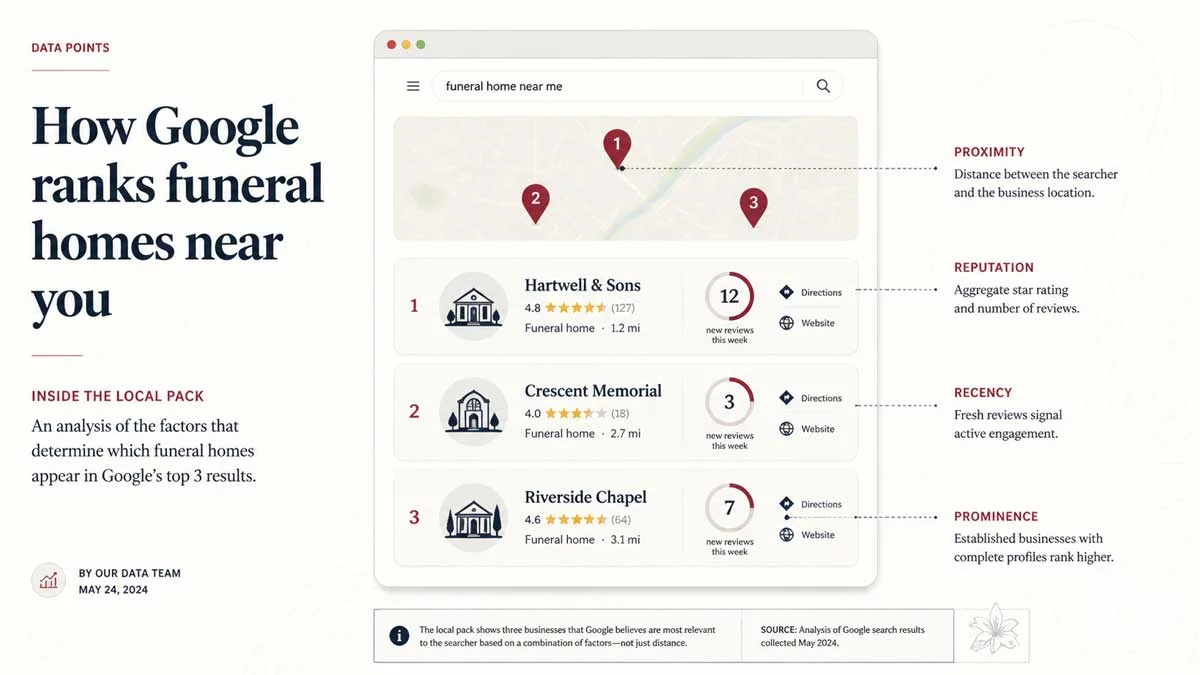
Are Google reviews a ranking factor? Yes, but as one input inside prominence rather than a category scored on its own, which is why the individual factor ranks later in this article matter more than any single review-related percentage. That framework matters more than it looks. Relevance is about matching a search to what your Google Business Profile says you do. Distance is straightforward, how close your listing is to the searcher or the area they searched. Prominence is the one factor a funeral home can meaningfully move month to month, and it is built from more than reviews alone, review count, review recency, star rating, how complete and accurate your profile is, and off-site signals like press mentions and links all feed into it.
Google’s own documentation does not publish a percentage breakdown of how much each individual signal contributes to prominence. Any figure claiming to state that reviews are worth an exact percentage of local ranking weight is not something Google itself has published, a distinction covered directly in the next section. For funeral homes simply asking whether Google reviews affect SEO at all, Google’s own documentation already answers yes, the sections below quantify exactly how much. What Google confirms in its own words is enough on its own, review count and rating carry real, direct weight inside the one ranking factor a funeral home has the most day-to-day control over, and the full guide to ranking your funeral home on Google covers how prominence works alongside relevance and distance in practice.
How Do Reviews Rank Against Other Local SEO Ranking Factors?
This is the clearest sourced evidence that Google reviews help ranking, not as a rule of thumb, but as one of the top ten most influential factors out of 187 scored by a panel of working local search experts. Whitespark’s report is the primary annual source for this data, an industry survey rather than a Google-published figure, but one built from the working judgement of 47 practising local search experts rather than a single agency’s opinion. It is worth being precise about what a “score” is here. Each of the 187 factors is rated by the panel and given a weighted score, the higher the score, the more the panel judged that factor to influence local pack and Maps ranking. The four review-related factors below are shown relative to each other, scaled against the highest-scoring one in this set.
Where review signals rank among 187 local ranking factors
Bars scaled relative to the highest-scoring review signal in this set (181). Source: Whitespark, Local Search Ranking Factors 2026, published 6 November 2025, based on a survey of 47 local search experts scoring 187 local pack and Maps ranking factors.
Whitespark’s own analysis of the 2026 edition notes that review signals and behavioural signals both increased in importance since the prior edition, while on-page and link signals dropped slightly [2]. That answers a live question directly: is review count still a top local ranking factor in 2026? Yes, its influence grew rather than faded. For an independent funeral home with limited time to spend on local SEO, that shift is a useful piece of prioritisation, review signals are not a secondary task sitting behind technical work, they are moving in the direction of mattering more, not less.
One figure deliberately does not appear anywhere in this article, an answer to what percentage of local pack ranking is reviews as a category. That figure circulates widely across SEO blogs, quoted inconsistently as 16%, 19%, 20%, and “16 to 20%”, sometimes citing the same Whitespark edition for different numbers. It does not appear anywhere on Whitespark’s own published report. The individual factor scores above are the sourced, verifiable version of the same underlying claim, and they are more precise for exactly that reason.
Does Review Recency Matter More Than Review Count?
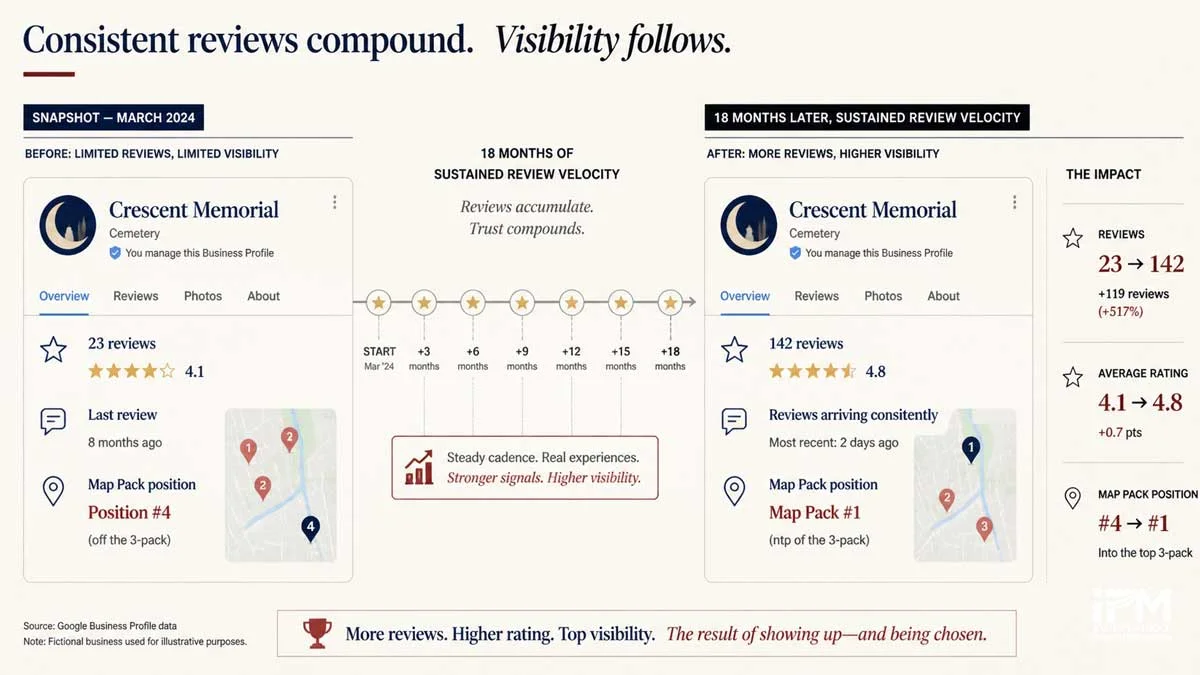
This distinction is easy to miss if review count is the only figure a funeral home tracks. A profile can carry a healthy total review count built up over several years and still be losing ground on recency specifically, if the last review landed eighteen months ago, the recency signal has gone quiet even while the count on the page still looks respectable. Whitespark’s separate scoring of “Sustained Influx of Reviews Over Time” as its own factor, distinct from recency and distinct from raw count, is effectively a measurement of consistency, whether new reviews keep arriving steadily rather than in a single burst followed by silence.
For an independent funeral home, that has a practical reading. A one-off push to gather twenty reviews in a month, then nothing for a year, satisfies the count metric and does very little for recency or sustained influx. A slower, steady flow, timed to when families are naturally ready to leave one, satisfies all three review signals at once, a structural reason to build review requests into an ongoing aftercare system rather than a one-time campaign.
How Many Google Reviews Does a Funeral Home Actually Need?
A specific figure for the funeral sector, thirty to fifty reviews at an average above 4.7 stars, circulates on some funeral marketing content. This research pass could not trace that figure to Whitespark, BrightLocal, or Google’s own documentation, so it is not repeated here. Presenting an unsourced number as a target risks two failure modes, undershooting it in a market where competitors are stronger, or treating it as a finish line in a market where competitors are weaker and less effort would have been competitive.
The more defensible approach, and the one this data actually supports, is a direct competitive audit against the businesses ranking above you.
| What to check | Where to look | What it tells you |
|---|---|---|
| Review count | Competitor’s Google Business Profile | Whether the volume gap is large or marginal |
| Date of most recent review | Competitor’s individual reviews, sorted by newest | Whether their recency signal is active or stale |
| Review frequency over the last 12 months | Competitor’s review timestamps | Whether they run a consistent system or relied on a one-off push |
| Average rating | Competitor’s profile summary | Whether rating, not just volume, is part of the gap |
Run that check against the two or three funeral directors currently outranking you locally, and the target becomes specific to your market rather than borrowed from a generic figure. If a competitor has forty reviews, most from the last year, and your profile has twelve, several years old, the gap is real and closing it is the priority. If a competitor’s profile looks thin and dated too, chasing volume for its own sake is a lower priority than other local SEO work, on-page content, citations, and profile completeness among them.
Whether the question is phrased how many Google reviews is good, how many Google reviews should you have, or how many reviews does a funeral home need to rank on Google Maps, the sourced answer stays the same, there is no fixed figure, only your standing against the competitors currently outranking you locally.
A related but different question is how many reviews it takes to increase your Google rating, since a single five-star review moves a small total noticeably and a large one barely at all. That affects your displayed star rating specifically, not your Map Pack position directly, though a rising average and a growing review count tend to move together over time for a funeral home running a consistent request system.
How Much Do Reviews Influence a Family’s Decision, Separate From Ranking?

That falling trust figure is worth sitting with rather than reading as bad news. It does not mean reviews matter less, BrightLocal’s own 2025 survey shows reading behaviour staying high even as blind trust falls [4]. It means families are reading more carefully, weighing specific detail in a review’s text over the star rating alone. For a funeral home, this is where ranking impact and conversion impact genuinely separate. Whitespark’s ranking data explains why your profile appears where it does in the Local Pack. This consumer data explains what happens once a grieving family actually clicks through and starts reading, and a thin, generic, or oddly worded set of reviews can undercut a strong ranking position at exactly that point.
Is This Different for Funeral Homes Than for Other Local Businesses?
A funeral director does not benefit from the same forgiving browsing pattern a family might apply to choosing a restaurant, comparing five options over a leisurely evening, reading through a dozen reviews each, coming back to it the next day. A death in the family compresses that entire process, often into a single evening, often under acute distress. The bereaved family reading your profile is not casually researching, they are trying to make a decision they cannot easily undo and do not want to get wrong.
That context changes what “good” reviews look like for a funeral home specifically. A generic five-star rating with no detail reassures less than a smaller number of specific, human reviews describing what the family actually experienced, how a director handled a difficult request, how a service was arranged at short notice, whether staff were patient with an uncertain family. The consumer trust data in the previous section, families reading review detail rather than deferring to a star rating, applies with particular force in a sector where the decision itself is this weighted.
None of this changes the ranking mechanics covered earlier in this article. It changes the argument for treating your review profile as more than a Local Pack input, it is very often the first piece of evidence a bereaved family sees about who you are, ahead of your website, ahead of a phone call, ahead of anything else.
Does Responding to Reviews Affect Ranking, or Just Trust?

This is a deliberately narrow section, because it sits between two claims that are easy to blur together and should not be. Reviews existing on your profile affect ranking, that is the sourced data covered above. Responding to a review is a different action entirely, and the case for doing it well rests on trust and reputation, not on a confirmed ranking mechanism. Conflating the two risks either overstating what a reply does for your Map Pack position, or underrating why it matters at all.
The mechanics of writing a good response, what to say to a glowing review, how to respond professionally to criticism, and how to handle a review that looks fake or malicious, are covered in full in how to respond to funeral home Google reviews. That article is the place for the how, this one stays with the sourced data on why reviews move visibility in the first place.
Frequently Asked Questions
Do Google reviews impact SEO?
Yes, in a specific, limited way. Reviews are one component of prominence, one of the three published local ranking factors Google confirms it uses, alongside relevance and distance. They do not sit outside Google’s ranking system as a separate, unrelated signal.
Do Google reviews help you rank higher?
Yes. In Whitespark’s 2026 survey of 47 local search experts, High Numerical Google Ratings ranks 6th of 187 local ranking factors and Quantity of Native Google Reviews ranks 9th, placing both inside the top 10 factors local search practitioners consider most influential.
How many Google reviews do I need to rank higher?
There is no fixed number. The useful benchmark is relative, the review count and recency of the funeral directors currently outranking you in your local Map Pack, since Google’s local ranking model responds to your standing against nearby competitors, not a universal threshold.
Does replying to Google reviews affect SEO ranking?
Google does not list owner responses as a confirmed ranking factor, so its effect on ranking is indirect at best. Its confirmed effect is on trust, a considered public response shapes how the next family reads your profile far more reliably than it shapes your Map Pack position.
How to increase reviews for a funeral home?
By building a consistent, compliant request into your aftercare process rather than asking occasionally or only when a family seems especially satisfied. Reviews are only one part of a complete profile, and optimising your Google Business Profile is the foundation any review-generation effort sits on top of.
Is review recency more important than review count?
Whitespark’s 2026 data scores them as separate, independent factors, Recency of Reviews ranks 11th of 187 and Sustained Influx of Reviews Over Time ranks 14th. Whitespark founder Darren Shaw has said recency, ranked only 20th in the 2023 edition, now sits in his personal top 5 most important local ranking factors, a sharper rise than review count itself has shown.
The honest answer to how much reviews affect funeral home visibility on Google is that they matter, provably, inside a specific part of Google’s ranking model, and they matter separately, at a larger scale, to the family reading your profile before they have decided to call anyone at all. Chasing an unsourced number solves neither problem. Understanding where review count, recency, and rating actually sit, and building a system that keeps all three moving, solves both.
The number under your name is data to Google and evidence to a grieving family. Both readings deserve the same discipline.
Turning sourced ranking-factor data like this into a working local SEO system, alongside your Google Business Profile, citations, and on-page content, is exactly what IFM’s local SEO service for funeral directors is built to do. Get in touch to talk through where your review profile currently stands against the competitors ranking near you.
References
[1] Google Business Profile Help, Tips to improve your local ranking on Google, support.google.com/business/answer/7091
[2] Whitespark, Local Search Ranking Factors 2026, published 6 November 2025, whitespark.ca/local-search-ranking-factors
[3] Whitespark, Review Recency is the Most Underrated Local Ranking Factor, whitespark.ca/blog
[4] BrightLocal, Local Consumer Review Survey 2025, published 29 January 2025, brightlocal.com/research
[5] Memorial Business Journal, coverage of NFDA’s 2024 Consumer Awareness and Preferences Survey, deathcarelaw.com