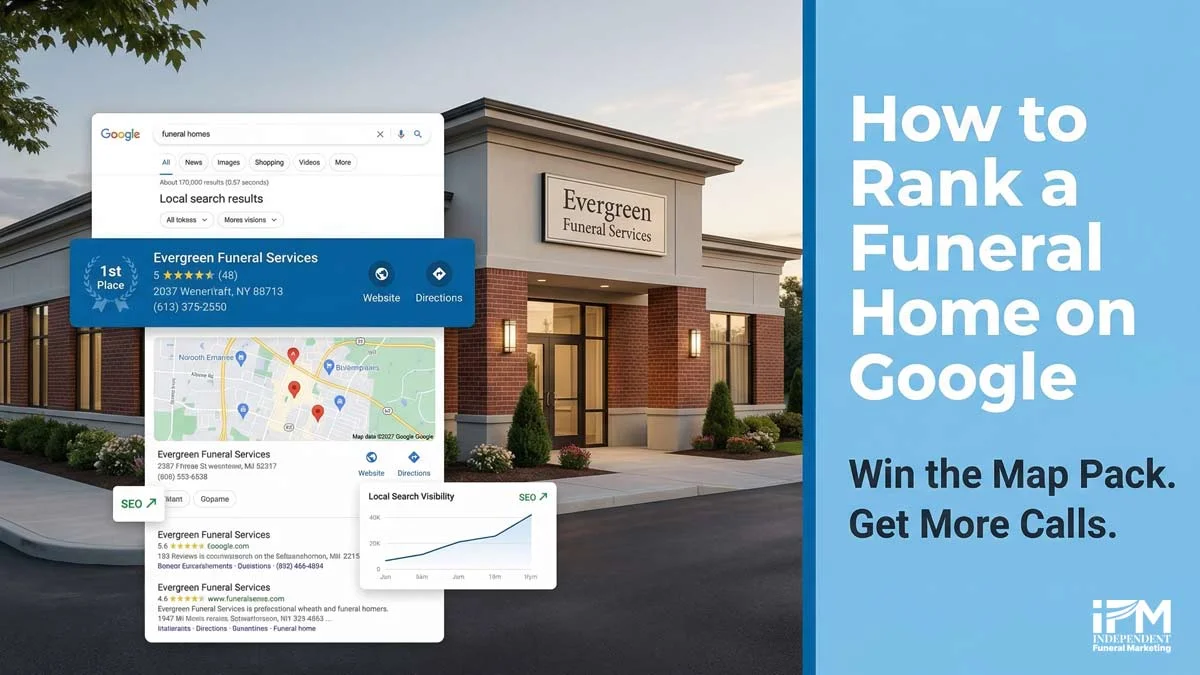
When a family needs a funeral home, they don’t ask a friend first. They open Google.
“Funeral home near me.” “Funeral director in [town].” “Cremation services [city].” Every day, thousands of people search for funeral services this way, and the funeral homes at the top of those local search results get most of the calls. The ones that don’t appear, don’t.
SEO for funeral homes matters in a way it doesn’t for most industries. The search happens at one of the most stressful moments in a family’s life. They’re not browsing. They’re deciding. A well-optimized Google Business Profile and a properly structured website ensure your funeral home appears at the moment that matters most.
This guide covers everything an independent funeral director needs to rank on Google in 2026: Google Business Profile, Map Pack visibility, organic SEO, reviews, citations, content, video, and AI search.
Why Google Rankings Matter for Funeral Homes
“Funeral home near me” generates an estimated 246,000 searches per month globally. When people search for funeral home services, it’s usually the first thing they do, before calling anyone, before asking a friend. According to BrightLocal’s annual Local Consumer Review Survey [1], 98% of people used the internet to find local business information in 2023. Google dominated by a wide margin.
For local businesses including funeral homes, the difference between showing up in local search rankings and not showing up is the entire difference between getting the call and being invisible.
Strong SEO ensures your funeral home appears when families are actively looking. The SEO strategies that work best for independent funeral homes aren’t complex, but they do require consistent execution. A strong SEO foundation can boost your funeral home’s visibility and let a single-location independent outrank national chains in its own service area. Corporate groups have larger budgets. What they don’t have is your local authority, your community roots, or the ability to optimise for one specific town.
How Google Ranks Funeral Homes: The Three Core Factors
Before changing anything, understand exactly how search engines decide who appears where. For local queries, Google uses three signals.
Relevance is whether your profile clearly communicates what you do and where. Google needs to match your listing to what someone typed. A vague profile, wrong categories, or blank sections means Google can’t make that match confidently. Filling everything in helps Google understand your business and surface it for the right search queries.
Distance is how close you are to the person searching. You can’t move the building, but you can make sure your service area settings reflect the full geography you serve, not just your street address.
Prominence is the one most within your control. It’s shaped by your reviews, how consistently your name, address, and phone number appear across the web, how authoritative your website looks to Google, and your overall online presence.
| Factor | What it means | What you can control |
|---|---|---|
| Relevance | Does your profile clearly match what the searcher typed? | GBP categories, description, service listings, website content |
| Distance | How close are you to the person searching? | Service area settings in GBP (the building’s location cannot change) |
| Prominence | How trusted is your business in Google’s assessment? | Reviews, citations, backlinks, GBP activity, website domain authority |
All three are improvable without significant spend. For a detailed breakdown of each in practice, the local SEO guide for funeral homes covers the full picture.
Your Google Business Profile: The Foundation of Local Rankings
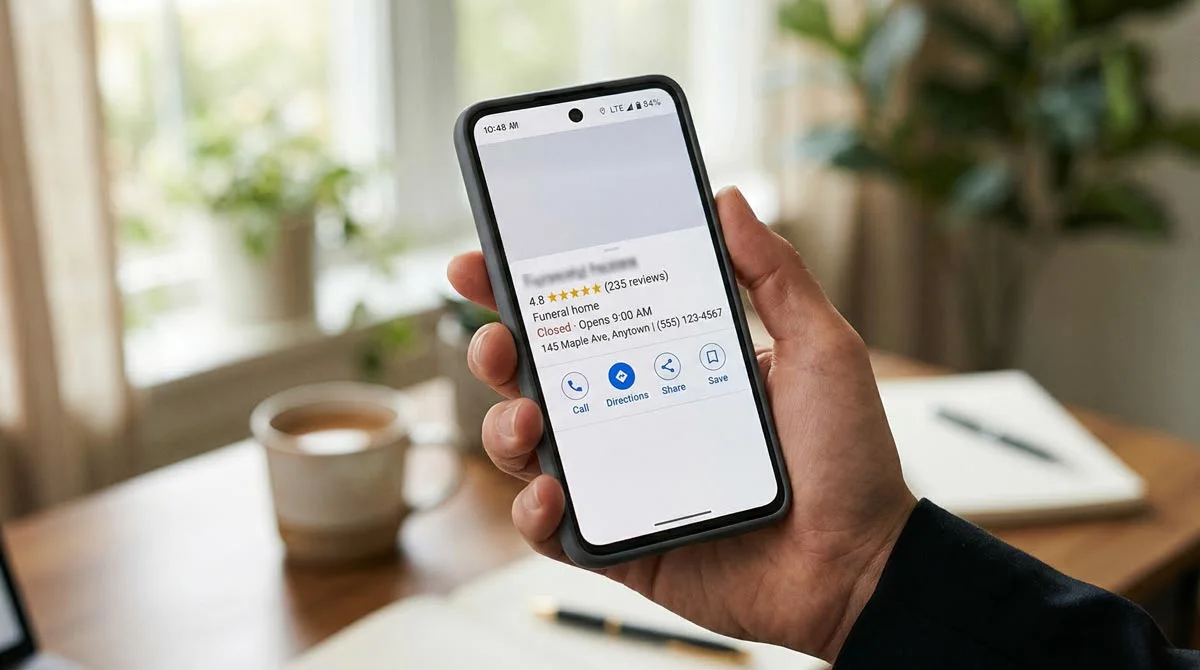
Optimizing your Google Business Profile, also known as Google My Business, is where every funeral home should start. A well-optimized Google Business Profile is the foundation everything else builds on. For a dedicated deep-dive into every element, the GBP optimisation guide for funeral directors covers categories, descriptions, photos, posts, and reviews in full.
What a complete profile needs:
| Profile element | Requirement | Notes |
|---|---|---|
| Business name | Exact match to your registered trading name | No keyword stuffing in the name field |
| Address and phone | Identical to your website and every directory listing | NAP consistency, see the citations section below |
| Primary category | Funeral Home | Set this first before adding secondary categories |
| Secondary categories | Cremation Service, Funeral Director, Memorial Service | Add only what applies to your business |
| Description | Up to 750 characters | Lead with your location and service, include “independent funeral director” |
| Service listings | Individual entry per service type | Include descriptions and pricing where appropriate |
| Opening hours | Current, including bank holidays | Update immediately when hours change |
| Reviews | Aim for ten or more, with a consistent incoming rate | See the reviews section below |
| Google Posts | At minimum once a week | Announcement or informational tone |
| Photos | At minimum ten, refreshed monthly | Exterior, interior, arrangement room, staff |
| Crucial for funeral homes: an incomplete profile is a suppressed profile. Completeness is a ranking signal in itself. |
Categories and Attributes
Category selection is one of the most underused levers in local search. Set “Funeral Home” as your primary. Add “Cremation Service,” “Funeral Director,” and “Funeral Director Supplies” where they apply. Don’t pad with unrelated ones. Google cares about precision.
Google offers attributes covering appointment availability, accessibility options, and ownership type. Fill in every relevant one. These are filterable signals that help make your profile surface in more specific search queries, including searches like “funeral home near me with parking” or “cremation service near me,” which are the kinds of terms families use when looking for funeral services in your area.
Keeping Your Profile Active
Google treats an active, maintained profile as a sign of a trustworthy, operating business. Post weekly. Update photos monthly. Respond to every review within 24 to 48 hours. Check for Google-suggested edits regularly, which can silently override your information if you don’t reject them. I’ve seen funeral homes lose their correct phone number this way without realising for weeks.
Consistent maintenance over six to twelve months is one of the most reliable things in local SEO.
Reviews: The Ranking Signal You Can’t Ignore
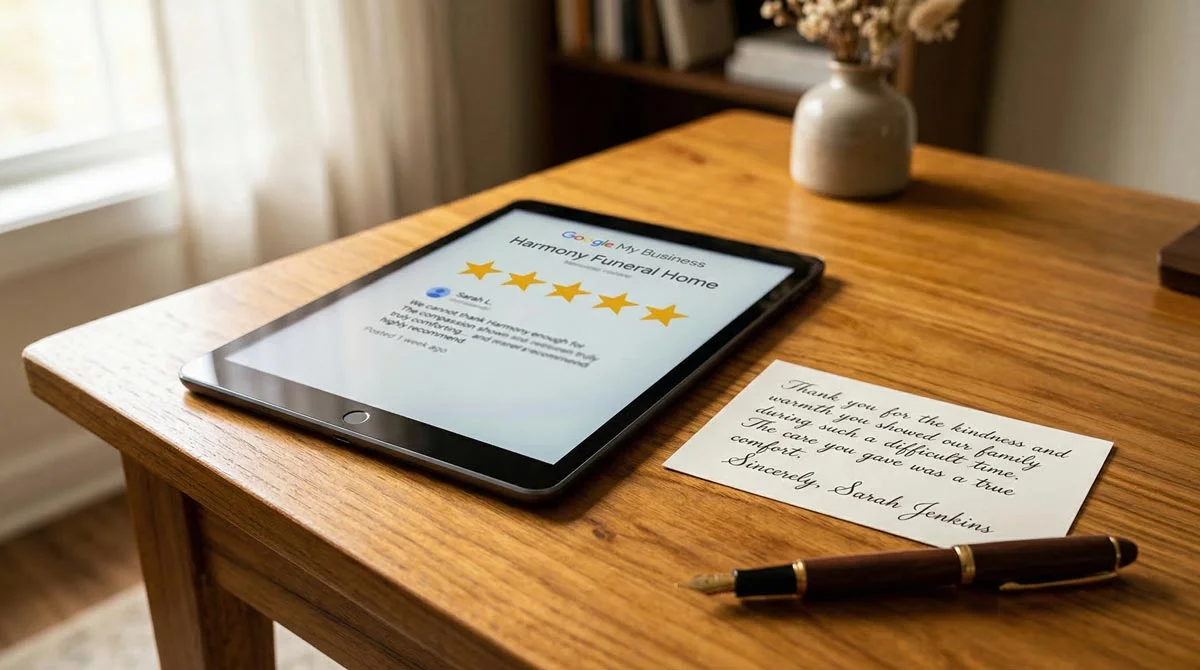
Most funeral directors either don’t ask for reviews at all, or ask in a way that doesn’t work. Reviews play a crucial role in both local search rankings and in converting visitors into callers.
BrightLocal research [1] consistently shows that consumers trust online reviews as much as personal recommendations. For funeral services, where families are making decisions under stress, that credibility factor is enormous. A funeral home with 45 reviews at 4.8 stars doesn’t just rank higher. It converts better.
Ask at the right moment. Several days after the service, once the family has had space. A handwritten note or brief personal message lands very differently to an automated email fired off an hour after the funeral. One feels compassionate. The other doesn’t.
Make it easy. Send a direct link to your Google review page. One extra step loses most people.
Respond to reviews. A genuine reply to a positive review helps build trust with everyone else reading the listing. A thoughtful response to a negative review often does more for credibility than a row of five-stars with no replies underneath.
The Competition and Markets Authority [3] is clear: no incentivising reviews, no fake reviews, no selectively removing negative ones. Encourage reviews ethically by asking families who had a good experience to share it.
The gap between a funeral home with 8 reviews and one with 45 is typically six to twelve months of consistent asking.
NAP Consistency and Citation Building

NAP. Name, address, phone number. It sounds simple. It’s one of the most common reasons independent funeral homes underperform in local search results, and one of the easiest to fix.
Search engine crawlers cross-reference your business information across the web to verify you’re a legitimate, established business. Inconsistencies undermine that confidence. Your funeral home’s name must be identical everywhere: “Birkett & Sons Funeral Directors” and “Birkett and Sons Funeral Directors” are different strings to a crawler. “High Street” and “High St” are different. A phone number you stopped using three years ago, still sitting on Yell, is a live conflict.
The most important citation sources for UK funeral homes:
| Directory | Priority | Why it matters |
|---|---|---|
| Google Business Profile | Essential | Primary local ranking signal, feeds Google Maps |
| Bing Places | High | Second search engine, also feeds Apple Maps on iPhone |
| Apple Maps | High | Default maps app on iOS, significant mobile traffic |
| Yell.com | High | Major UK directory, strong domain authority |
| Thomson Local | High | Established UK directory, widely crawled |
| FuneralGuide.co.uk | High | Industry-specific, high topical relevance for funeral searches |
| NAFD member directory | High | Industry association listing, authoritative topical signal |
| SAIF member directory | High | Industry association listing, authoritative topical signal |
| Yelp UK | Medium | Consumer reviews platform, citation value |
| 192.com | Medium | UK people and business directory |
| Local council directory | Medium | Local authority signal, strong geographic relevance |
Audit every source. Correct anything inconsistent. Build new listings on directories where you’re not yet present. This directly helps Google understand your funeral home as a real, established local entity and improve your local search rankings.
Organic SEO: Your Website’s Long-Term Authority

Your Google Business Profile and your website work together. A strong GBP drives calls. A strong website builds long-term authority, captures informational search queries, and reinforces your Map Pack position.
SEO ensures your funeral home appears in search results and improves your visibility for informational queries, not just Map Pack searches. For the full picture on organic SEO strategies for independent funeral homes, the funeral director SEO service covers it properly.
On-Page SEO Essentials
Every page on your funeral home’s website needs a structure that search engine crawlers can read and rank. The core elements:
- Title tag: Include your primary keyword and location. “Funeral Home in [Town] | [Business Name]” works well.
- H1: One per page, matching the intent of the page’s primary search term.
- Meta description: 150 to 160 characters. Include the keyword naturally and give someone a reason to click.
- URL structure: Lowercase, hyphen-separated, descriptive.
- First paragraph: Your primary keyword should appear naturally in the first 100 words.
This applies to every service page: funerals, cremation, pre-need planning, memorial service. Each needs its own dedicated page. A single “Services” page listing everything doesn’t give search engines enough signal to rank your funeral home’s website for any one term.
Ensure your funeral home’s website follows these on-page best practices across every page, not just the homepage. To find the exact phrases families use when looking for funeral services in your area, tools like Google Keyword Planner give you data on search volume directly. Don’t guess at what people are searching for.
Technical SEO Foundations

Ensure your funeral home’s website is mobile-friendly and loads fast. These are prerequisites, not optional extras.
- Page speed: Check with Google’s PageSpeed Insights. I’ve seen funeral homes with excellent Google Business Profiles get beaten in the Map Pack by a competitor with a faster website, not because of reviews, but because their pages took eight seconds to load on a phone.
- Mobile-first: Most funeral home searches happen on a mobile device. If your funeral home’s website is mobile-friendly, Google treats it more favourably in local search results.
- HTTPS: Unsecured HTTP sites are treated as untrustworthy by search engines.
- Core Web Vitals: Google’s LCP, CLS, and INP metrics assess real user experience on your pages.
- XML sitemap: Submit one to Google Search Console so that search engines can crawl and index all your pages correctly.
- Structured data (JSON-LD): At minimum, LocalBusiness schema with your address, phone, opening hours, and coordinates. Use
additionalType: "Funeral_home"in the markup. This helps Google understand your business type with precision.
Following these best practices for technical SEO is the foundation everything else sits on.
Track Your Local SEO Performance
Use Google Search Console and Google Analytics together to track your local SEO performance. Tools like Google Analytics show where visitors come from, how long they stay, and which pages lead to contact. Search Console shows which search queries drive impressions and clicks, and gives you data on search volume for the terms you’re targeting.
Tracking your local SEO performance monthly means you can identify what’s working and adjust quickly. Local SEO efforts don’t compound if you’re not measuring them.
Local Landing Pages for Multiple Locations
Serving more than one town? You need a dedicated page for each.
A page targeting “funeral home in [Town A]” and a separate page targeting “funeral home in [Town B]” will consistently outperform a single page that mentions both towns in passing. Each location page needs a unique H1, genuinely specific content, an embedded Google map, and locally relevant context. Don’t just swap the town name on a duplicated template. Duplicate content suppresses both pages.
How Independents Can Outperform Corporate Funeral Groups
People assume the corporate chains will always rank above them. The evidence says otherwise.
Corporate funeral groups have national domain authority and professional teams running search engine optimization at scale. On paper, they look hard to beat in local search results. In practice, independents routinely outrank them in specific towns.
Here’s why. Local search is hyperlocal. A national chain’s domain authority helps them rank for broad terms nationally. It doesn’t translate into ranking in your specific town. Google’s local algorithm weights local signals heavily: your proximity to the searcher, your local reviews, your locally specific content, your community citations.
A corporate chain’s GBP for a branch in your town is managed remotely, often by someone who’s never visited. Reviews accumulate slowly. Content is generic. Local citations are often inconsistent. You can enhance your funeral home’s presence in every local signal that matters, and they can’t easily replicate that at branch level.
With a well-maintained GBP, 40 to 50 local reviews, a fast mobile website, and consistent citations, an independent can and does outrank a national chain in its own service area. We see it with the funeral homes we work with.
Website Conversion: Rankings Without Calls is Wasted Traffic
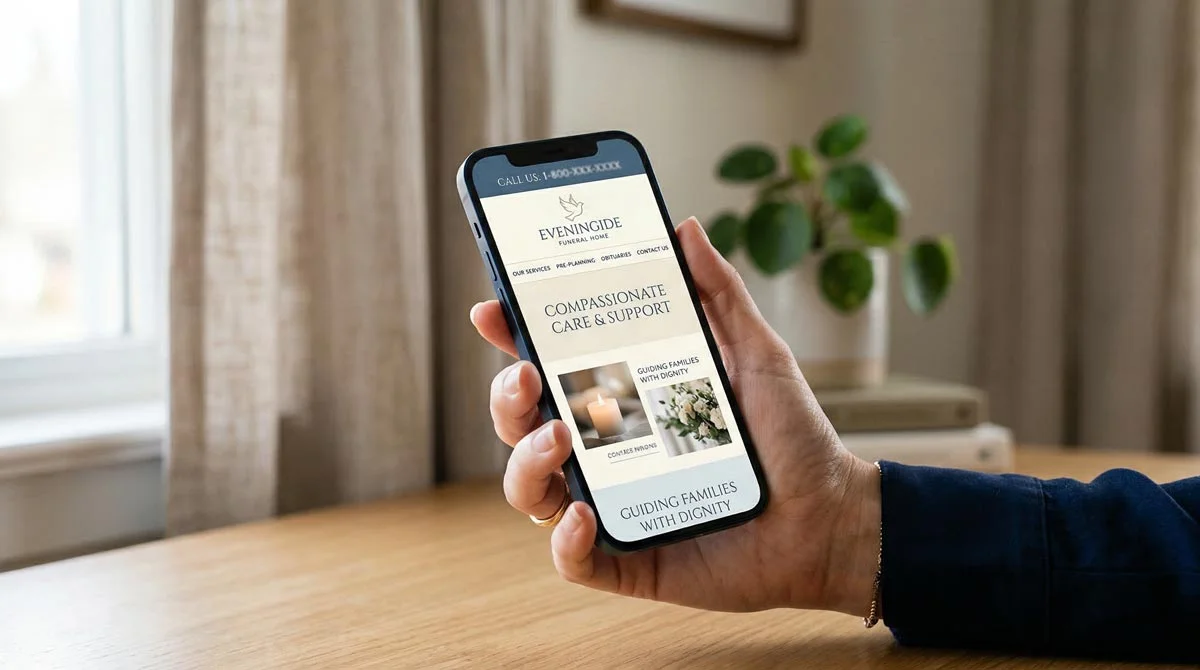
Getting to the top of Google brings visitors to your site. Your funeral home’s website then has to turn those visitors into callers.
The most common conversion failures:
- Phone number not in the header on mobile. The family found you. If the number requires scrolling, most won’t. They’ll call the next result.
- No sense of who you are. Independent funeral homes have a real credibility advantage over corporate chains as a funeral service provider. That advantage disappears if your About page reads like a corporate brochure. Help families understand they’re dealing with a real person who knows their community.
- No reviews on the website. Reviews build trust on the page before a family has even thought about calling. Embed them.
- Slow loading on mobile. Pages that take more than three seconds to load on 4G lose a significant share of visitors before they see anything. Page speed is a user experience issue before it’s an SEO issue.
- Copy that ignores the emotional reality. Families searching for a funeral home are under stress. Copy that feels direct, compassionate, and written for a real person outperforms corporate language every time. Write for local families, not for search engines.
A fast, clear website helps potential clients feel confident before they call, and converts more visitors than a slow, unclear one regardless of how well it ranks.
Local SEO and website optimisation work together as a complete funeral home marketing system. Rankings without the conversion infrastructure is only half the job.
Content Marketing: Earning Authority Over Time

The funeral industry is underserved by useful online content. Most funeral home websites have five pages. Few publish anything informative.
That gap is a real opening. A funeral home that builds a content library consistently earns long-term organic authority, ranks for additional search terms, and earns trust from local families before they ever need a funeral home.
Effective content types for funeral home SEO include:
- Informational guides: “What to do when someone dies,” “How to plan a funeral on a budget,” “Burial versus cremation, what are the differences.” These are the questions people search for when looking for funeral services before they’ve chosen a funeral home.
- Local obituaries and memorial content: Builds local relevance signals and gives the community a reason to visit your website regularly.
- Grief and bereavement resources: Positions you as a community resource, not just a transaction. Attracts links from local charities, hospices, and community organisations.
- Pre-need planning content: Families researching pre-arranged funerals search months or years before they need a funeral home. Content that helps families choose the right option builds early relationships.
- AI-friendly content: Structured content that directly answers specific search queries improves visibility in AI-generated responses.
For a full content strategy, the funeral home content marketing service covers how this is structured and executed.
Video Marketing: The Underused Advantage for Funeral Homes
Video is the most underused channel in funeral home marketing, and one of the highest-return ones available to an independent.
YouTube is the second-largest search engine in the world. It is owned by Google, which means YouTube videos surface in standard Google search results, not just within YouTube itself. Audience research from SparkToro confirms that YouTube is the number one social platform for independent funeral home owners as a professional demographic. That same audience, your potential clients, is spending significant time there. The content they are searching for on YouTube is not abstract. It is practical and local: “what happens at a cremation,” “how to plan a funeral,” “funeral home in [town].”
But the bigger reason video matters for funeral homes is not the algorithm. It is trust.
Families choosing a funeral home are making a decision under time pressure and emotional stress. A two-minute video showing your premises, your team, and how you approach your work answers questions that a page of text cannot. It shows people who you are before they call. That matters enormously in a service where the decision comes down to whether a family trusts the person on the other end of the phone.
The SEO Case for Video
YouTube videos appear in Google’s standard search results, in the video panel and increasingly in AI Overviews. A funeral home with a YouTube channel that publishes consistent, well-titled video content has the opportunity to occupy additional SERP positions beyond its GBP listing and organic website results. That is three separate placements from one piece of content.
Google Business Profile also treats video as an active signal. Profiles with video content are treated as more complete and more engaged, which contributes positively to local ranking signals. Adding video to your GBP is one of the simplest actions available and takes less than ten minutes once the video exists.
What to Film
Facility tours. Families want to know where they are going before they arrive. A short walk-through of your chapel, reception area, and arrangement room removes uncertainty before it becomes a barrier. Keep it calm, natural, and unscripted.
Staff introductions. A 90-second piece to camera from the funeral director builds more trust than a full biography page. It does not need to be polished. It needs to feel human and unhurried.
“What to expect” videos. Explaining the process in plain language: what happens when you call, what the first meeting looks like, what arranging a funeral actually involves. Families searching online often don’t know what to expect. This content meets them where they are.
Memorial tribute examples. Showing the care that goes into your services, rather than describing it. A short reel of a candlelit chapel prepared for a service communicates something that copy cannot.
Pre-need and planning guides. Short videos answering common questions about funeral costs, pre-payment plans, and what to do when someone dies. These rank on YouTube for informational queries and build a content library over time.
| Video type | Recommended length | Where to publish | Purpose |
|---|---|---|---|
| Facility tour | 2 to 3 minutes | Website, YouTube, GBP, Facebook | Reduce pre-visit anxiety, build familiarity |
| Staff introduction | 60 to 90 seconds | Website, YouTube, GBP | Build personal trust before the call |
| What to expect | 2 to 3 minutes | Website, YouTube | Reduce process uncertainty for families |
| Memorial tribute examples | 60 to 90 seconds | Website, YouTube, Facebook | Demonstrate care, not just describe it |
| Pre-need planning guide | 3 to 5 minutes | YouTube, Website | Capture families planning ahead |
Practical Logistics
You do not need a production company to start. A modern smartphone and a well-lit room produce video of sufficient quality for YouTube and GBP. The first videos to film are a facility tour and a direct-to-camera introduction. Both can be done in an afternoon.
Each video then distributes across your website, your YouTube channel, your Google Business Profile, and your Facebook page. One filming session. Ongoing visibility.
For independent funeral homes with limited time, quarterly filming, four short videos per year, is enough to build a meaningful presence on YouTube and GBP while staying ahead of most local competitors who have no video content at all.
The funeral home video marketing service covers the full production and distribution approach for independent funeral directors.
Google Ads as a Complement to SEO
Organic SEO and local rankings compound over time. In the early months, before that compounding takes effect, Google Ads fills the gap.
A well-structured campaign captures at-need searches from families who need a funeral home right now. UK data on funeral-related search terms shows cost-per-click rates ranging from £4.00 to £9.50, depending on keyword and area. A Yell Business case study on RSJ Funeral Directors in Liverpool reported over 230 leads per month on average, with a cost per lead of £17.69 in January 2025, against an average case value of approximately £3,000.
The role of funeral home Google Ads is to capture urgent demand while organic rankings build. Complementary, not alternatives.
AI Search: What’s Changing and Why Funeral Homes Need to Pay Attention
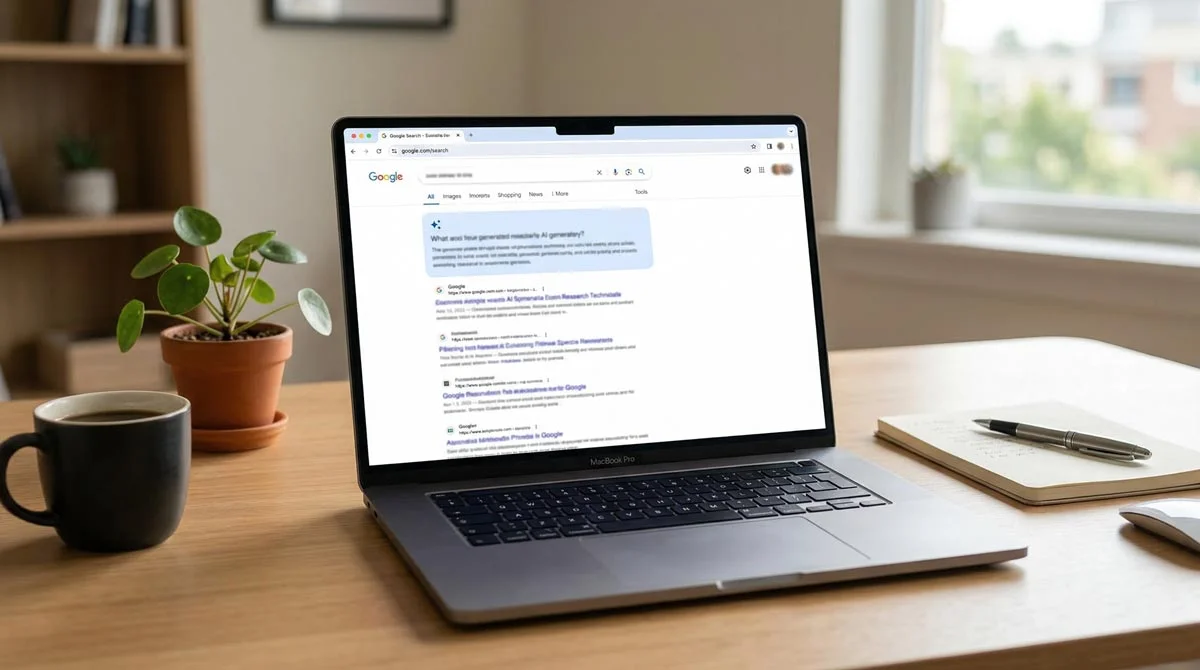
AI search is not a future trend. It is a current reality affecting where funeral homes appear when families search online.
Google’s AI Overview now appears above standard organic results for a growing range of queries. Searches like “funeral home marketing” and “digital marketing for funeral homes” already trigger AI Overviews in Google’s results. The AI summarises answers from a shortlist of websites it judges to be authoritative. If your website is not on that shortlist, you are not in the summary.
ChatGPT has over 100 million daily active users. Perplexity, the AI search engine built specifically for research-style queries, is growing fast. Audience data from SparkToro shows that independent funeral home owners over-index for Perplexity relative to the UK average. Your potential clients are using these tools to research marketing decisions and suppliers, including decisions about which funeral marketing agency to work with. The same pattern applies to families researching funeral homes. They are asking AI tools, not just Google.
The question for independent funeral homes is not whether AI search matters. It is whether your business will be cited when it does.
How AI Search Systems Decide What to Cite
AI platforms extract answers from content that meets specific structural criteria. Understanding these criteria directly informs how you should create and organise your website content.
Entity-first content. AI systems identify and retrieve named entities: Google Business Profile, Core Web Vitals, NAP consistency, LocalBusiness schema. Content built around clearly defined entities is retrieved more reliably than vague prose. Use the correct terminology for your services and location. Define things clearly before discussing them.
Direct-answer opening paragraphs. Every section of your website content should open with a single, complete, factually correct sentence that stands alone. “The Google Map Pack is the block of three local business listings that appears above organic results for location-based searches.” That sentence can be extracted and cited by an AI system without any surrounding context. Content that buries the key point three paragraphs in does not get cited. Content that leads with the answer does.
Structured Q&A content. FAQ sections are the primary mechanism through which AI systems extract citations for informational queries. AI tools are specifically built to match questions to answers. A well-structured FAQ section on your funeral home website, covering the questions families actually search for, significantly increases the likelihood of your content being surfaced in AI responses. This applies to Perplexity, ChatGPT, Google AI Overviews, and Claude.
Cited statistics from named sources. AI systems preferentially cite content that includes attributable data points. A claim supported by a named source carries more citation weight than the same claim made without one. For funeral homes, this means referencing local data, CMA statistics, or industry research where relevant, with clear attribution.
The Brand Entity Dimension
AI tools do not just read individual web pages. They build an understanding of whether a business is a credible, real-world entity by cross-referencing signals across the web.
A funeral home that appears consistently in Google Maps, has a complete and active GBP, has consistent NAP information across directories, has genuine reviews on multiple platforms, and is mentioned in local news or community publications carries a stronger entity signal than one that exists only as a website. AI systems treat that kind of consistent, multi-source presence as evidence that the business is legitimate and relevant.
This means the work of building local citations, earning reviews, and maintaining a complete GBP is not separate from AI search strategy. It is the same work. Every citation you build and every review you earn contributes to the entity signal that AI systems use to decide whether to cite you.
What This Means Practically for Independent Funeral Homes
You do not need a separate AI-content strategy. But you do need to apply the principles above deliberately.
- Ensure every key page on your website opens with a direct, factual statement that answers the page’s main question in a single sentence.
- Build a comprehensive FAQ section covering the questions local families actually ask: costs, process, what to expect, who to contact.
- Cite statistics and reference named sources. A BrightLocal survey cited with a link is more useful to AI systems than an uncredited claim.
- Maintain complete, consistent information across your GBP, your website, and your key directory listings.
- Publish content regularly. AI systems treat recency as a freshness signal. A funeral home website that was last updated three years ago is treated as a less reliable source than one updated in the last six months.
The independent funeral homes that invest in structured, well-cited, locally authoritative content now will earn AI citations as these tools become the primary search interface for more of the population.
The AI search optimisation service for funeral homes covers the full approach, including schema implementation, entity-building, and content structure for independent funeral directors.
How Long Does Funeral Home SEO Take to Show Results?

SEO is not a switch. It is a compounding investment. The timeline below reflects realistic expectations for independent funeral homes starting from a low base of online visibility.
| Action | Expected timeline | What you will see |
|---|---|---|
| Claim and complete your GBP fully | 2 to 4 weeks | Improved Map Pack positions for your primary town |
| On-page SEO updates to key pages | 4 to 8 weeks | Google re-crawls and begins adjusting rankings |
| Citation audit and correction | 2 to 3 months | Stronger local authority, NAP conflicts resolved |
| Review velocity building | 3 to 6 months | Competitive review count relative to local competitors |
| Content and topical authority | 6 to 12 months | Organic traffic from informational search queries |
| Link building | 3 to 6 months per campaign | Domain authority uplift, broader geographic reach |
| Overall visibility step-change | 12 months of consistent activity | Stable Map Pack positions, organic traffic growing month on month |
Measurement matters throughout. Google Search Console (free) shows which queries drive impressions and clicks. GBP Insights shows calls, direction requests, and website clicks directly from your map listing. Track both from day one so you can see what is moving and what is not.
Frequently Asked Questions
How long does it take for a funeral home to rank on Google?
Ranking your funeral home on Google takes different amounts of time depending on what you’re targeting. For Map Pack rankings, meaningful improvement is often visible within 60 to 90 days of completing your profile, building reviews, and correcting citation inconsistencies. Organic website rankings typically take 6 to 12 months for competitive terms.
Why is my funeral home not showing up on Google Maps?
The most common reasons a funeral home isn’t showing up on Google Maps are an unclaimed or incomplete Google Business Profile, a primary category that doesn’t match what families search for when looking for funeral services in your area, fewer reviews than nearby competitors, NAP inconsistencies, and a website that lacks location-specific signals.
How many Google reviews does a funeral home need?
In most UK towns, a funeral home with 30 to 50 reviews and an average above 4.7 stars is competitive for Map Pack positions. The more important metric is whether you’re accumulating reviews consistently. A stagnant count is a negative signal to Google.
Does the funeral home website affect Google Maps rankings?
Yes, the funeral home’s website directly affects Google Maps rankings. Google uses it as a corroborating source for your GBP information. A funeral home’s website with consistent NAP information, location-specific content, and structured data strengthens Map Pack rankings. A slow or poorly optimised one suppresses them.
What is the most important thing a funeral home can do for local SEO?
The most important thing is to optimise your Google Business Profile. The process of optimizing your Google Business Profile fully, from categories and description through to reviews and regular posts, moves the needle more than anything else in the first 90 days. Make your profile as complete as possible from day one.
Should a funeral home use Google Ads or SEO?
Both, in sequence and in parallel. Google Ads captures urgent at-need enquiries immediately. SEO builds long-term organic and local search visibility. Most independent funeral homes get the best results by running a focused Google Ads campaign on their highest-value search terms while building organic rankings in parallel.
How do corporate funeral chains rank so highly?
National chains benefit from domain authority built over years of search engine optimization at scale. But local Map Pack rankings are driven by local signals: proximity, local reviews, locally specific content. An independent funeral home with a well-maintained GBP, strong local reviews, and consistent citations can outrank a corporate chain in its own town.
What is NAP consistency and why does it matter?
NAP stands for name, address, and phone number. Search engine crawlers cross-reference your business information across the web. If your funeral home’s name, address, or phone number appears differently across listings, Google’s confidence is reduced, suppressing your rankings in local search results. Audit and correct every listing where your information appears.
Do funeral homes need a blog?
Not immediately, but content is the primary mechanism for building organic search authority over time. A funeral home that publishes guides on funeral planning, grief support resources, and pre-need information builds links, ranks for additional search terms, and earns trust from local families before they need a funeral home.
How do online reviews affect funeral home SEO?
Reviews play a significant role in Map Pack rankings. They also improve click-through rates and increase on-site conversion when embedded on the website. A funeral home with a strong review profile above 4.7 will rank above competitors with fewer or lower-rated reviews. Reviews build the trust your services need to turn a website visit into a phone call.
What is the difference between local SEO and organic SEO for funeral homes?
Local SEO refers specifically to Google Business Profile and Map Pack optimisation. Organic SEO refers to ranking your website pages in standard Google search results. Both matter. Local SEO captures at-need searches from families in your area. Organic SEO builds long-term authority and captures search queries from families in earlier stages of decision-making.
Can a funeral home rank in multiple towns?
Yes, with a deliberate approach. Service area settings in your GBP extend coverage, but dedicated location pages are the most effective way to rank for searches in specific towns. Each location page needs unique, locally relevant content, not a template with the town name swapped. Duplicate content harms both pages.
What is Google’s Map Pack for funeral homes?
Google’s Map Pack is the block of three business listings that appears above organic results for location-based queries. For searches like “funeral home near me” or “funeral director in [town],” the Map Pack is the most visible and most clicked part of the page. Appearing in it for your primary service area is the highest-priority outcome of local SEO.
How does social media affect funeral home Google rankings?
Social media doesn’t directly influence search rankings, but social profiles function as citations reinforcing NAP consistency, and social content drives traffic to your site. Research from the NFDA [2] found that 40% of consumers used the services of a funeral home they discovered on Facebook in 2024, up from 21% in 2023. That’s a substantial lead generation channel independent of its effect on search engines.
How do I get my funeral home to appear in AI search results?
AI search systems, including Google AI Overviews, Perplexity, and ChatGPT, cite content that is clearly structured, well-cited, and factually authoritative. The most effective steps are: open every page section with a direct, standalone answer to the question it addresses; build a comprehensive FAQ section covering the questions families ask; cite statistics with named sources; maintain consistent NAP information across your GBP and directories; and publish content regularly. A complete, active Google Business Profile also strengthens the entity signal that AI systems use to verify your funeral home is a credible, real-world business.
What structured data should a funeral home use?
At minimum, LocalBusiness schema with your business name, address, telephone, opening hours, and coordinates. Use additionalType: "Funeral_home" to be specific. For service pages, add Service schema. For FAQ sections, add FAQPage schema to target featured snippet positions. For blog content, add BlogPosting schema. Implement as JSON-LD in the page head. Structured data helps search engines understand your content and can improve how your listing appears in results.
References
[1] BrightLocal Local Consumer Review Survey 2024, brightlocal.com/research/local-consumer-review-survey/
[2] National Funeral Directors Association Consumer Awareness and Preferences Study, nfda.org/news/statistics
[3] Competition and Markets Authority: Funerals Market Study, gov.uk/cma-cases/funerals-market-study
A Note on Exclusivity
IFM partners with one independent funeral home per town. Once a partnership is active in your area, that location is protected for the duration of the engagement.
If you’re considering whether your area is still available, the right time to find out is now. Search visibility takes time to build. Every month without a structured approach is a month of compounding disadvantage relative to competitors who are building it.
If you’re ready to discuss how this applies to your funeral home, reach out to the IFM team to check availability in your area.