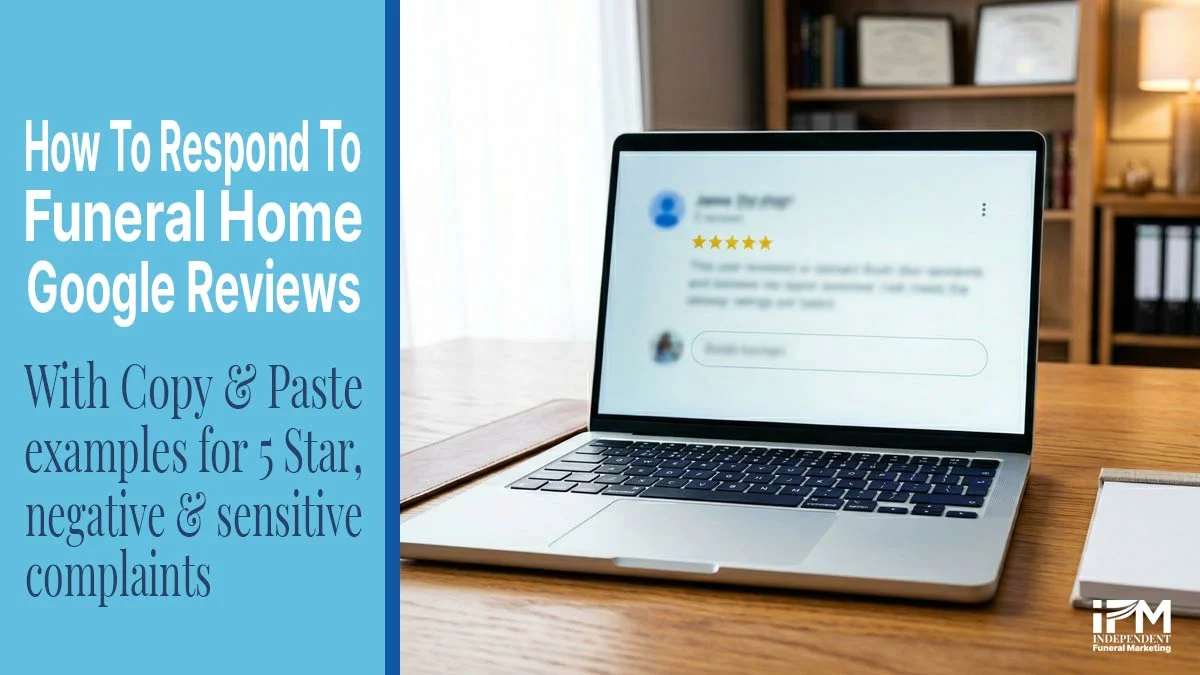
How to respond to funeral home Google reviews is one of the most consequential decisions an independent funeral director makes online. When a family in your town searches for a funeral director, they are not just reading your list of services. They are reading how you treat people at the worst moment of their lives. Your review responses are visible, permanent, and public. They form a first impression before a family ever contacts you.
According to the NFDA 2024 Consumer Awareness Survey, 66.7% of families visit a funeral home’s website before making contact [1]. Reviews, and how you respond to them, are embedded in that decision process. The stakes are higher here than in almost any other sector.
There are two reasons to respond well. The first is trust. A calm, considered response to a difficult review tells the next family reading it that you are professional and willing to listen. The second is ranking. Google treats owner responses as a local search signal. An active, responded-to profile outperforms a dormant one. Responding to reviews is not admin. It is both marketing and SEO.
This guide covers how to respond to positive and negative funeral home Google reviews, including copy-paste examples, the GDPR considerations specific to this sector, and how to handle the scenarios that no generic marketing guide addresses.
Why Do Google Reviews Matter So Much for Funeral Homes?

Google reviews matter for funeral homes because they directly influence both local search ranking and the decision-making of at-need families. Review signals, including quantity, recency, average rating, and whether the owner responds, are confirmed local ranking factors. A Google Business Profile with consistent, recent reviews and active responses outperforms a dormant profile in the Local Pack.
Google local map results receive approximately 44% of all clicks in local searches (Funeral Marketing Hub). That figure is worth pausing on. Nearly half of everyone searching for a funeral director locally clicks on one of the three Map Pack listings before they ever scroll to the organic results. Your review profile is front and centre at that moment, before a family reads a word of your website.
For independent funeral homes, reviews carry additional strategic weight. Corporate funeral chains respond to reviews with templated, centralised copy. You can respond as a real person, with genuine warmth and professional authority. Families notice the difference, and so does Google. An active, personalised response pattern signals a genuinely managed profile, which is both a trust signal to families and a prominence signal to Google’s local ranking algorithm.
The families reading your reviews are not neutral observers. They are often making this decision within the first 24 to 48 hours after a death. What they see in your responses, your tone, your attentiveness, your willingness to engage, shapes whether they pick up the phone.
For a full picture of how reviews sit within your local search strategy, why funeral homes need local SEO in 2026 covers the broader context. For the technical detail on managing your Google Business Profile for funeral directors, that guide covers every element of the profile in full.
Do Funeral Homes Really Get Negative Google Reviews?
Yes, funeral homes receive negative Google reviews, and more frequently than many funeral directors expect. Grief is not a predictable emotion. Families sometimes post reviews during the rawest period of loss, and even exceptional service delivered with genuine care can attract criticism when a family is overwhelmed by bereavement.
The most common categories of negative funeral home reviews fall into five types:
- Communication failures, families who felt kept in the dark during the arrangement process or the period between death and the service
- Pricing surprises, unexpected costs or a sense that the final bill did not match expectations set at the arrangement meeting
- Perceived lack of empathy, a specific interaction with a member of staff that felt cold, rushed, or impersonal
- Logistical errors, timing issues, a wrong flower delivery, a missed detail in the service order
- Competitor-driven fake reviews, a known problem in the sector, covered in a dedicated section below
The important framing here is this: every unresponded review is a missed opportunity. Families reading your reviews are not just reading the complaint. They are watching how you react to it. A well-crafted, measured response to a negative review is visible marketing to every family who reads it. The absence of a response is also a signal, and not a reassuring one.
If you suspect a review is fraudulent or posted by someone who was not a client, the correct approach is to respond publicly and flag it for removal in parallel. Both actions matter.
How Do You Access and Reply to Google Reviews on Your Profile?

To reply to Google reviews on your funeral home’s Google Business Profile, follow these steps:
- Sign into business.google.com or search for your business name directly in Google while signed into your Google account
- Navigate to the Reviews tab in the left-hand menu
- Find the review you want to respond to and click Reply
- Write your response and click Post reply
On mobile, you can access your reviews via the Google Maps app or by searching your business name in Google Search. The reply function works the same way. For busy funeral directors managing enquiries throughout the day, replying directly from a phone is practical and accessible.
Timing: aim to respond within 24 to 48 hours of a review being posted. For negative reviews, treat this window as urgent. A prompt response to a difficult review demonstrates attentiveness at the moment it matters most.
Your response is public and permanent in its original form. It can be edited after posting, but the original may be cached by AI tools and search engines. Write it carefully before posting.
A consistent response pattern, including for 5-star reviews, signals to Google that your profile is actively managed. This is a ranking behaviour, not just courteous housekeeping.
What if I can’t see the reply button?
If the reply button is not visible, common causes include: not being verified as the business owner, being logged into the wrong Google account, or the review having been flagged and temporarily hidden. Verify your ownership status at business.google.com/add. If you are the verified owner and still cannot reply, contact Google Business Support through the GBP dashboard.
How Should a Funeral Home Respond to a Positive Google Review?
A funeral home should respond to a positive Google review by acknowledging the trust the family placed in you, reflecting the specific sentiment they mentioned, and closing with a professional sign-off. Keep it warm and genuine. Avoid the generic response that reads as careless in a bereavement context.
The framework for a positive review response:
- Thank and acknowledge trust, open with genuine gratitude for the family taking the time to write during what was undoubtedly a difficult period
- Reflect the specific sentiment, reference what they mentioned without using names or identifying details
- Reference your team or approach, a quiet opportunity to reinforce your values publicly
- Close with your name and role, this adds authenticity and accountability
What never to include: the name of the deceased, details of the funeral arrangement, or any identifying information about the family. This is both a GDPR consideration and a standard of basic dignity. The response is public and visible to everyone.
The phrase “Thank you for your review!” on its own reads as careless in a bereavement context. Families who have just buried a loved one notice when a response feels automated. The examples below show how to do it properly.
Example 1, Simple 5-star acknowledgement (review contains no specific details):
“Thank you so much for taking the time to share your experience. It means a great deal to us and to our whole team that we were able to support your family during such a difficult time. We are honoured to have been trusted with the care of your loved one.”
[Signed: Name, role]
Example 2, Detailed 5-star acknowledgement (reviewer mentions a specific team member or element of the service):
“Thank you for your kind words about our team. It is exactly what we hope every family experiences, and it genuinely means a great deal to hear that it made a difference at such a hard time. We will make sure this is shared with everyone who was involved in supporting you.”
[Signed: Name, role]
Example 3, Rating-only response (5-star rating, no review text):
“Thank you for your kind rating. We hope we were able to support you and your family as you deserved.”
[Signed: Name, role]
How Should a Funeral Home Respond to a Negative Google Review?

A funeral home should respond to a negative Google review using the four-step framework below. The goal is not to win the argument. It is to demonstrate to every other family reading that review, the ones who have not yet chosen you, that you are professional, measured, and willing to listen.
The four-step framework:
- Acknowledge, validate the experience as they described it, without confirming fault or liability
- Empathise, use genuine language, not PR language. “We are deeply sorry your experience felt this way” is stronger than “We are sorry you felt…”, which reads as deflection
- Redirect offline, invite the family to contact you directly by phone or email to discuss further
- Close professionally, sign with your name and title
Hard rules for negative review responses:
- Never include the name of the deceased
- Never include details of the funeral arrangement
- Never include pricing information or cost comparisons
- Never respond when emotionally reactive
- Never copy-paste the same response to multiple negative reviews
Important, GDPR notice: Never include the name of the deceased, the date of the service, pricing details, or any other identifying information in a public review response. Doing so may constitute a GDPR violation under UK data protection law. Always direct case-specific conversations to a private channel, by phone or email.
CMA note for UK funeral homes: if the review relates to pricing, your public response must not include specific figures or cost comparisons. The Competition and Markets Authority requires transparency in funeral pricing, and a public response is not the appropriate place for pricing discussions. Acknowledge the concern and direct the family to a private conversation.
What if the review is factually wrong?
Resist the urge to correct the record publicly. A factual rebuttal reads as combative to every other family observing the exchange. Instead, acknowledge the experience as they perceived it, note that this does not reflect your usual standard, and invite direct contact. This demonstrates accountability without validating any inaccuracy.
What if the reviewer is not a client?
This is common in the funeral sector. Competitors, disgruntled former employees, and individuals with no connection to your business occasionally post reviews. Do not speculate publicly about who posted it. Respond as if the review is genuine. If you believe it is fraudulent, initiate the flagging process in parallel with your public response. The next section covers that process in full.
Example 1, Complaint about communication:
“Thank you for taking the time to share your experience. We are truly sorry that communication during this period did not meet the standard you, and we, would have expected. We take this seriously, and we would genuinely welcome the opportunity to speak with you directly. Please do contact us by phone or email at your convenience.”
[Signed: Name, role, contact details]
Example 2, Complaint about cost or pricing:
“We are sorry to read that your experience raised concerns about cost. We understand that the financial aspects of arranging a funeral can feel overwhelming, and we always aim to be clear and transparent from the outset. We would welcome the chance to speak with you privately, and we will do everything we can to address your concerns.”
[Signed: Name, role, contact details]
Example 3, Complaint about a specific member of staff:
“We are sorry that your experience with our team fell short of what you deserved at such a difficult time. This is not the standard we hold ourselves to, and we take all feedback of this nature seriously. Please do contact us directly, and we will make sure this is properly addressed.”
[Signed: Name, role, contact details]
Example 4, 1-star rating with no review text:
“We are sorry to see this rating. If we have fallen short in any way, we would genuinely welcome the opportunity to speak with you. Please do contact us directly.”
[Signed: Name, role, contact details]
Review management is part of the broader picture of Local Pack visibility for funeral directors. How consistently and professionally you respond feeds directly into how Google scores your profile’s engagement signals.
What Should a Funeral Home Never Say in a Google Review Response?
A funeral home should never include identifying information about the deceased or the family, pricing details, or defensive language in a review response. Here is the complete list of what to avoid, with the reasoning behind each:
- The name of the deceased or any identifying family details, a public response is indexed and visible to anyone online. Including the deceased’s name is a privacy violation and a potential GDPR breach under UK data protection law
- Specific pricing information or cost comparisons, pricing discussions in a public forum carry CMA compliance risk. Direct all pricing conversations to a private channel
- Defensive, aggressive, or sarcastic language, even when a review is unfair, the tone of your response is read by future families. A defensive reply is more damaging than the original complaint
- Medical, legal, or cause-of-death references, these details belong in private correspondence only
- Accusations that the reviewer is lying or acting in bad faith, even if justified, this reads badly to every other observer. Let your professional response speak for itself
- Internal business information, staff names, internal policies, supplier relationships, and similar details have no place in a public review response
- Copy-pasted template responses, families in a bereavement context notice when a response feels automated or generic. Personalisation is not optional in this sector
Every restriction in this list is, in practice, guidance toward better responses. Brevity, empathy, and privacy protection are professional virtues in this context, not limitations.
How Do You Handle Sensitive Review Scenarios Unique to Funeral Homes?
Funeral homes face review scenarios that no generic reputation management guide addresses. This section is what separates a funeral-specific response strategy from the generic advice that fills the top of the SERP for review response queries.
Grieving families posting in acute emotional distress
The most common sensitive scenario is a family posting during the sharpest period of grief, sometimes within days of the death. The review may be factually inaccurate, may reflect the experience of loss rather than any specific service failure, or may carry a tone of genuine distress that would be inappropriate to challenge.
Do not correct the factual record publicly. Do not challenge the emotional framing. Use language that validates the experience without appearing to confirm fault: “We are deeply sorry your experience felt this way” is more appropriate than “We apologise that you felt…” The latter signals deflection to anyone reading carefully. Invite a private conversation. Do not pressure a response from the family.
Reviews about pricing
Pricing complaints require particular care for UK funeral directors. The Competition and Markets Authority has specific requirements around funeral pricing transparency, and any public response that includes figures, comparisons, or justifications risks CMA scrutiny. Acknowledge the concern about value in general terms. Direct the family to a private channel, by phone or email, where the conversation can be handled properly.
Reviews from non-clients
Competitor-driven fake reviews, reviews from former employees, and reviews from individuals with no connection to your business are a known problem in the funeral sector. Respond publicly as if the review is genuine. Do not speculate about motives. If you have no record of the reviewer as a client, it is professionally acceptable to note this calmly in your response, then initiate the flagging process. A measured public response to a potentially fake review actually signals credibility, showing that you take all feedback seriously.
Should you respond differently to pre-need vs at-need reviews?
At-need reviews, from families who arranged a funeral through acute loss, carry the highest emotional weight and require the warmest, most personal response tone. Pre-need reviews, from families in the planning stages, tend to be more measured and may be responded to with a slightly more consultative register. The core rules remain constant across both: no identifying details, genuine empathy, professional close.
What Do You Do About Fake or Unfair Google Reviews?
Funeral homes should take a two-track approach to fake or unfair reviews: post a professional public response and initiate the flagging process in parallel. Waiting for the flagging outcome before responding leaves your profile unprotected in the meantime.
How to flag a review for removal:
- Go to your Google Business Profile
- Find the review
- Click the three-dot menu next to the review
- Select Report review
- Choose the policy violation that applies, spam, conflict of interest, fake content, and offensive language are the most relevant categories for funeral homes
- Submit the report
Google does not guarantee removal. The timeline is unpredictable. Do not wait for the outcome before responding publicly.
What Google will remove: spam, off-topic reviews, fake reviews, reviews with a clear conflict of interest, and content that violates Google’s policies.
What Google will not remove: negative reviews from genuine clients, even if the feedback is harsh or you believe it to be unfair.
Public response while flagging is in progress: if you have no record of the reviewer as a client, it is acceptable to state this professionally: “We have searched our records and are unable to find a record of the service you describe. We take all feedback seriously and would welcome direct contact from anyone with a genuine concern.” Do not accuse the reviewer of lying. State the factual position calmly and invite direct contact.
How Can a Funeral Home Get More Google Reviews After a Service?
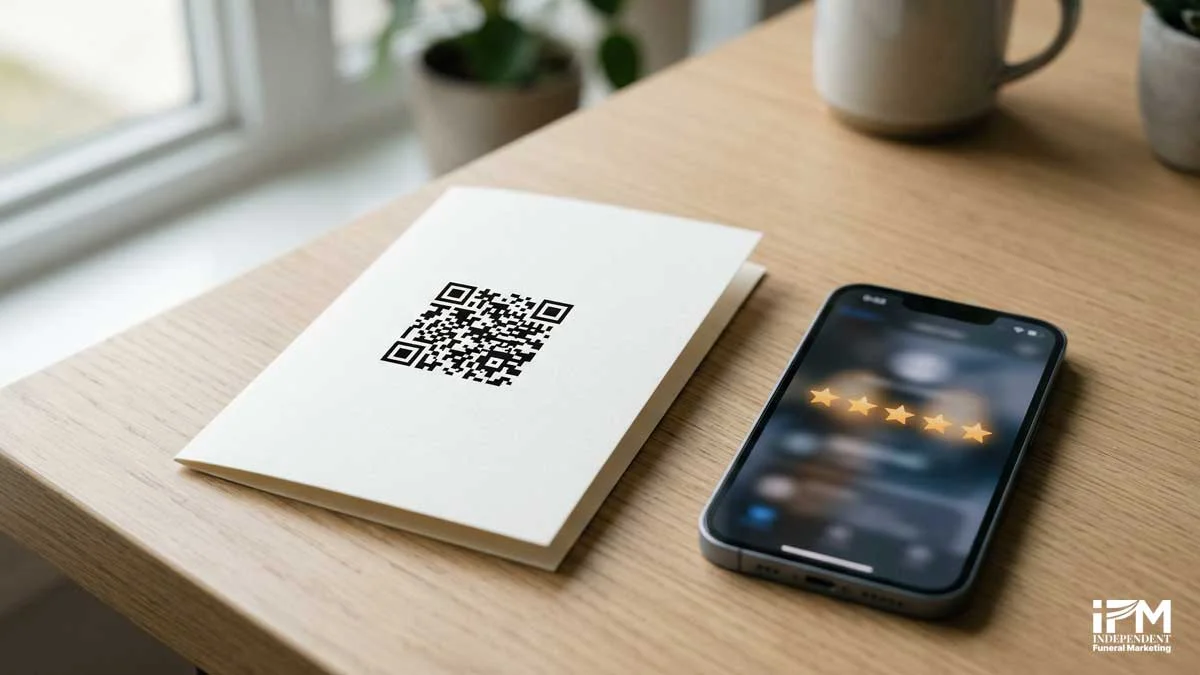
A funeral home can get more Google reviews by using a structured post-service review request, timed correctly and delivered through the right channel. Most funeral homes that respond well to reviews are not asking for them systematically. That gap is worth closing.
Timing: families are most receptive to a review request two to four weeks after the service. Too early, within days of the death, risks catching the family in acute grief and asking something of them they are not ready to give. Too late, months after the service, and the moment has passed and the impulse has gone.
Three practical methods:
- Email follow-up, a short, personal message with a direct Google review link. One paragraph. No sales language. The directness of the ask matters
- SMS or text, suitable for families where the relationship supports it. A direct link removes all friction
- Printed card with QR code, handed at the final collection or included with aftercare correspondence. Works well for families who are less comfortable with digital communication
According to Homesteaders Life research, funeral homes using structured review-generation systems earn an average of 16 five-star reviews in the first week of implementation. The gap between a systematic approach and ad hoc asking is substantial.
Managing the timing, the messaging, and the response workflow across every family engagement, consistently and without it falling through the cracks, is exactly what a structured system addresses. If you would prefer this handled professionally rather than managed reactively, funeral home marketing consulting covers the full framework.
Frequently Asked Questions
Should funeral homes respond to all Google reviews?
Yes. Responding to every review, positive and negative, signals active engagement to Google and improves local search ranking. It also shows prospective families that the funeral home is attentive and professional. Even a brief acknowledgement of a 5-star review contributes to a stronger, more credible online presence.
How should a funeral home respond to a negative Google review?
Respond calmly and professionally. Acknowledge the family’s experience without admitting liability or including any identifying details about the deceased or the service. Offer to continue the conversation offline by phone or email. The goal is to demonstrate to other families reading the review that you are professional and willing to listen, not to win the argument.
How do funeral home Google reviews affect local search ranking?
Google treats review signals, including quantity, recency, average rating, and owner responses, as local ranking factors. An active, responded-to Google Business Profile outperforms a dormant one in the Local Pack. Responding to reviews also increases profile engagement, which contributes to the prominence signals Google uses to determine local search positions.
What should a funeral home NOT say in a review response?
Never include the name of the deceased, details of the funeral arrangement, pricing information, or any identifying details about the family. Avoid defensive, dismissive, or sarcastic language. Do not speculate publicly about a review’s authenticity. Under UK data protection law, including identifiable information about the deceased in a public response may constitute a GDPR violation.
How long should a funeral home take to respond to a Google review?
Aim to respond within 24 to 48 hours of the review being posted. Prompt responses demonstrate attentiveness and are rewarded by Google’s engagement signals. Negative reviews warrant faster responses given their potential reputational impact. For positive reviews, consistency matters more than speed, but responding within 48 hours is a sound standard to work to.
Can a funeral home remove a fake or unfair Google review?
Funeral homes can flag a review for removal via the Google Business Profile dashboard if it violates Google’s policies, such as spam, fake content, conflict of interest, or offensive language. Removal is not guaranteed and the timeline is unpredictable. While the flagging request is in progress, posting a professional public response neutralises the reputational impact for families reading the review.
How can a funeral home get more Google reviews?
The most effective method is a structured post-service review request, sent by email, SMS, or printed card with a QR code, two to four weeks after the service. Families are most receptive during this window. According to Homesteaders Life research, funeral homes using structured review-generation systems earn an average of 16 five-star reviews in the first week of implementation.
What is the best format for a funeral home Google review response?
Open with a brief acknowledgement without repeating names. Address the specific sentiment raised. Close with a professional sign-off including your name or role. Keep positive review responses to two to four sentences. Negative responses may need four to six sentences. Avoid templated responses that feel generic, as personalisation matters more in the funeral sector than in most other industries.
Do Trustpilot and Yell.com reviews matter for funeral homes in the UK?
Yes, though Google Business Profile is the primary platform for local search impact. Trustpilot and Yell.com responses are visible to families conducting broader research and carry authority signals recognised by AI search tools including Perplexity. A consistent response approach across all platforms reinforces professional reputation and reaches families who may not find you through Google Maps alone.
Is there a GDPR risk when responding to funeral home reviews?
Yes. Publicly responding with any identifying information about the deceased or their family members is a potential GDPR violation under UK data protection law. Always respond in general terms, acknowledge sentiment, and direct the family to a private channel, by phone or email, for any case-specific discussion. This applies even when responding to negative or factually inaccurate reviews.
Every review response you post is a public demonstration of how your funeral home treats people. It is not administrative housekeeping. It is marketing, it is positioning, and it is visible to every family who searches for a funeral director in your town.
Most independent funeral homes do not have a structured system for requesting reviews, monitoring incoming feedback, and responding consistently within 48 hours. That is not a criticism. It reflects the reality of running a demanding, people-facing business. But the gap between structured and ad hoc is measurable in local search visibility and in the first impression your profile makes.
IFM’s approach to funeral home reputation management brings the full review cycle, requesting, monitoring, and responding, into a consistent system that protects your local presence and builds the kind of online profile that works for you. This type of disciplined attention to reputation is exactly what separates well-run independent firms from the corporate chain template.
References
[1] National Funeral Directors Association, Consumer Awareness and Prepayment Survey 2024, nfda.org/news/statistics