Setting up a funeral home Google Ads campaign correctly from the start is the difference between consistent at-need enquiries and wasted spend. Google Ads (formerly Google AdWords) delivers one thing that SEO cannot: immediate top-of-results visibility, from the moment a campaign launches, for the searches that matter most to a funeral home’s survival.
Most independent funeral homes are in one of two camps. Either they avoid Google Ads entirely, assuming it is too expensive or too complicated, or they have tried it once, watched the budget disappear, and written it off. Both responses are understandable. Neither is the right conclusion.
The real issue is structural. Poorly built campaigns waste money. Well-built campaigns generate measurable at-need calls from day one. This guide covers the complete campaign structure and strategy: how to organise your account, which keywords to target, how to write effective ad copy, what to bid, and how to track every call back to the pound spent.

What is Google Ads PPC and how does it work for funeral homes?
Google Ads is a paid search platform that places a funeral home’s advert at the top of Google’s search results when a local family searches for funeral services, and the funeral home pays only when someone clicks. This is PPC (pay per click), meaning every click costs money but every impression is free. The system is an ad auction run in real time, every time someone searches.
The auction determines who appears and where using Ad Rank, which is calculated by multiplying Quality Score by the maximum bid. Quality Score (scored from 1 to 10) reflects how relevant your keyword, ad copy, and landing page are to the searcher’s query. A funeral home with a Quality Score of 8/10 and a £5 maximum bid will often outrank a competitor with a Quality Score of 4/10 and a £9 bid. Structure and relevance are more powerful than raw spending power.
The core appeal for funeral homes is timing. A family in crisis searching for “funeral directors near me” or “cremation services [town]” has extremely high intent. They need a funeral director now. Google Ads puts your funeral home at the top of that result immediately, without waiting months for organic rankings to build.
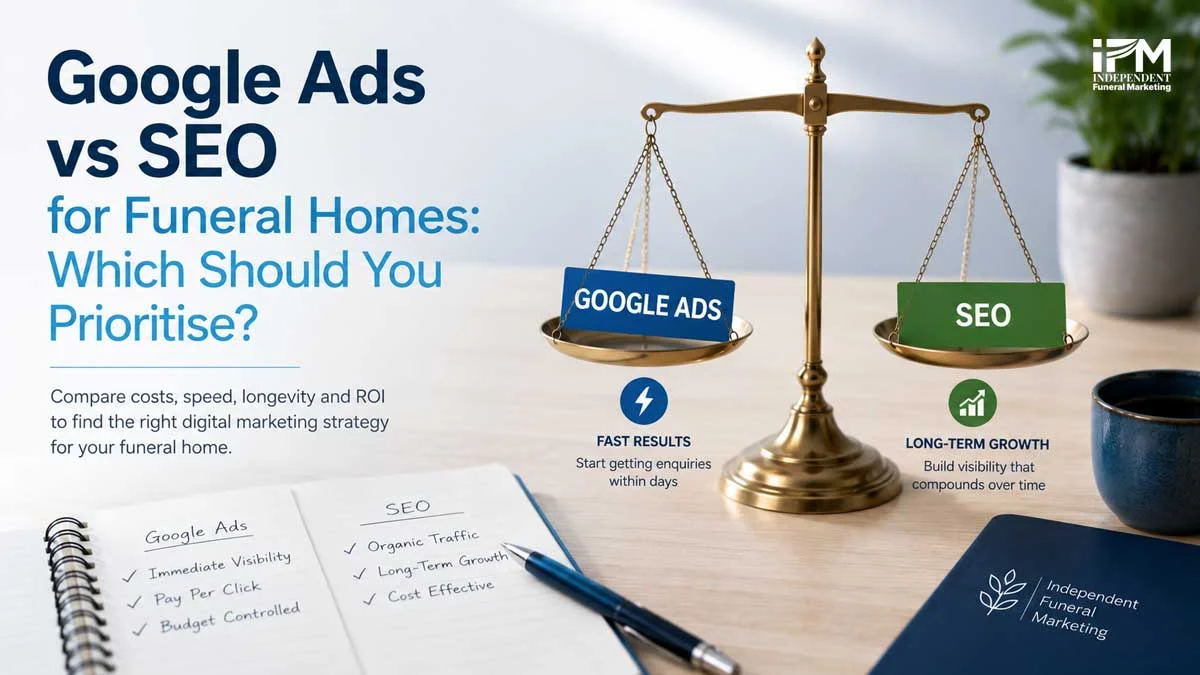
SEO and Google Ads are not alternatives. SEO compounds over 6 to 12 months and eventually delivers enquiries at a lower long-term cost. Google Ads delivers visibility now. Both have a role, and this distinction matters when planning where to invest. For a broader look at whether do Google Ads work for funeral directors is right for your business, that post covers the foundational case in detail.
Should a funeral director use Google Ads, and when does PPC actually make sense?
Google Ads is worth using for a funeral home when the business needs immediate visibility, has no established organic rankings, or wants to capture additional at-need calls in a competitive local market, but it requires correct setup and ongoing management to deliver return on investment. It is not a passive channel. A campaign left unmanaged for weeks will degrade.
There are three scenarios where Google Ads works particularly well for funeral homes. The first is a new or recently relaunched website with no established organic search presence. SEO takes time; Ads fills the gap immediately. The second is a competitive local market where corporate chains hold strong organic and Maps Pack positions, and gaining ground through SEO alone will take considerable time. The third is promoting a specific service, such as direct cremation or pre-arranged funeral packages, where a targeted campaign can reach families actively searching for that precise service.
The “we tried it before and it didn’t work” objection is worth addressing directly. Most Google Ads failures for funeral homes come from the same structural problems: broad match keywords with no negative keyword list, all traffic sent to a generic homepage, no call conversion tracking in place, and no ongoing management. The concept is sound. The execution is where most campaigns fail.
Small and rural funeral homes can benefit too, but with tighter geographic targeting and realistic budget expectations. A rural funeral home serving a catchment of three or four towns has lower competition, which typically means lower CPCs (cost per click) and a viable budget of £300 to £500 per month.
One honest caveat: if the funeral home website is slow, hard to navigate on mobile, or has no clear call-to-action, fix that first. Google Ads sends traffic. The website’s job is to convert it. Spending on Ads with a broken website accelerates losses, not enquiries.
A practical decision framework: use Google Ads if you need immediate enquiry generation or are launching in a new area. Prioritise SEO if you have an established website and can invest over a 12-month horizon. Use both if you are in a competitive market and want to build sustainable enquiry volume across immediate and long-term timeframes.
For a head-to-head analysis, Google Ads vs SEO for funeral homes covers the decision framework in full.
How do you structure a Google Ads campaign for a funeral home?
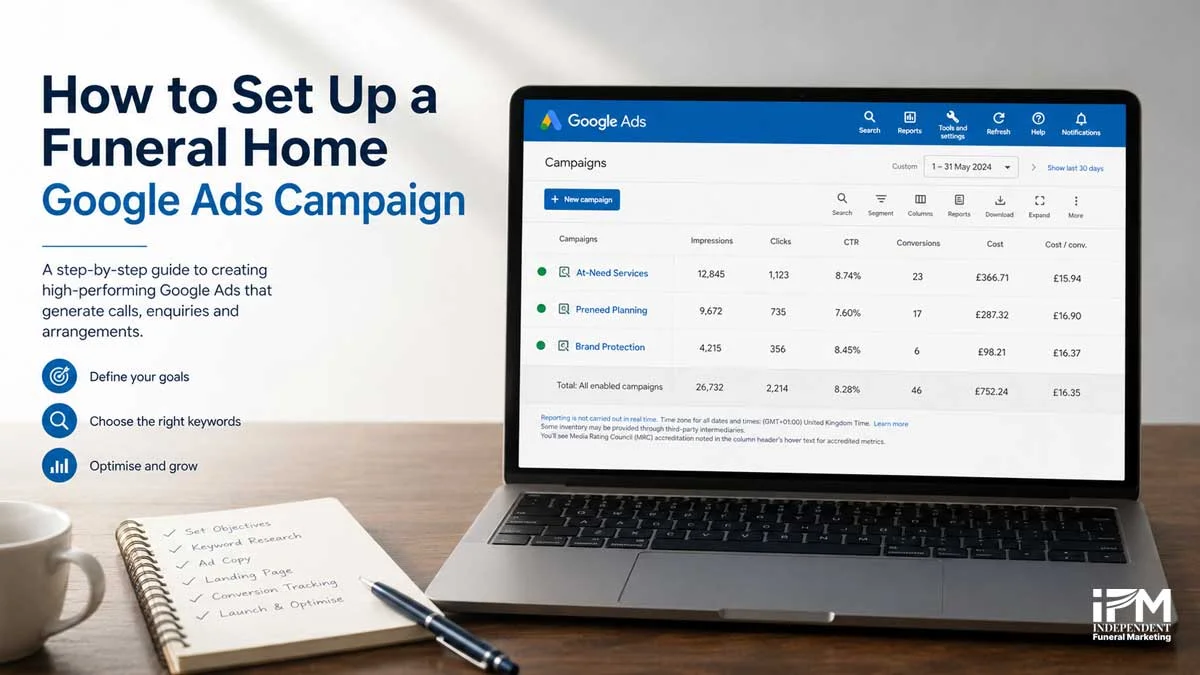
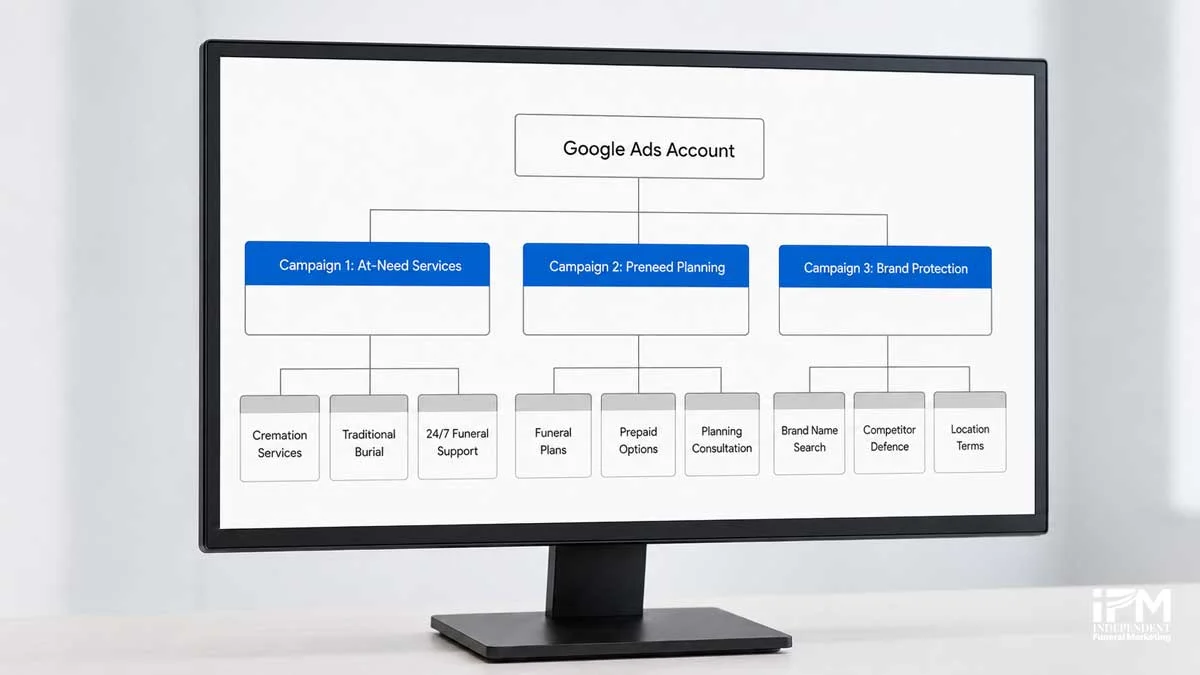
A well-structured funeral home Google Ads account uses three separate campaigns: at-need services, preneed planning, and brand protection, each with tightly themed ad groups built around specific service types and search intents. The account hierarchy flows from Account down to Campaigns, then Ad Groups, then Ads and Keywords at the base. Every level serves a purpose.
Campaign 1: At-Need / Immediate Services
This is the priority campaign. It targets families with immediate need: burial, cremation, direct cremation, 24/7 availability. Use exact match and phrase match keywords only. Set the highest budget allocation here. At-need search intent is the highest-converting traffic a funeral home will see.
Ad groups within this campaign should be tightly themed by service type. A separate ad group for “cremation services”, a separate group for “traditional burial”, a separate group for “direct cremation”, and so on. Each group should contain keywords that are genuine variants of the same core intent, with matching ad copy and a dedicated landing page.
Campaign 2: Preneed / Planning
This campaign targets families researching and planning ahead: pre-arranged funeral, funeral planning, funeral costs, packages, and pricing. The search intent is research-led rather than crisis-driven. These searchers have more time, and the campaign can tolerate lower ad positions. Budget allocation here is lower than at-need. The landing page for preneed should provide more information and reassurance, with a callback form rather than a call-first design.
Campaign 3: Brand Protection
This campaign bids on your own funeral home name and name plus location variants. CPCs are very low because your Quality Score for your own brand name will be near-perfect. The reason this campaign matters: without it, competitors can bid on your brand name and appear above your own organic result when someone searches directly for you.
Why this three-campaign structure matters technically: tight ad groups improve Quality Score. Higher Quality Score improves Ad Rank. Better Ad Rank means you pay less per click for the same or higher position. This is how independent funeral homes outbid corporate competitors without matching their national budgets. An independent with a well-structured account paying £5 per click regularly outranks a corporate chain paying £10.
One important note on campaign types: avoid Performance Max as the primary vehicle for at-need campaigns. Performance Max runs across all Google properties with limited control over which search terms trigger your ads. For at-need funeral services, that loss of control is costly. Search Network campaigns give the granular control funeral homes need to stay on-budget and on-target.
What keywords should a funeral director bid on in Google Ads?
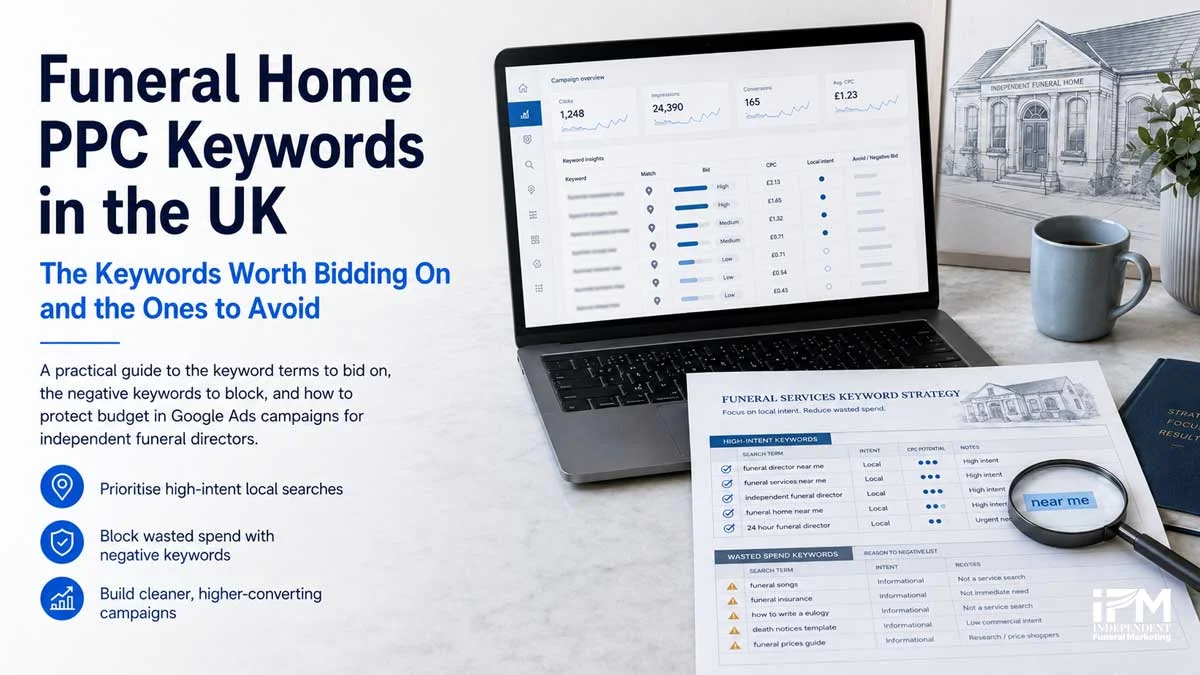
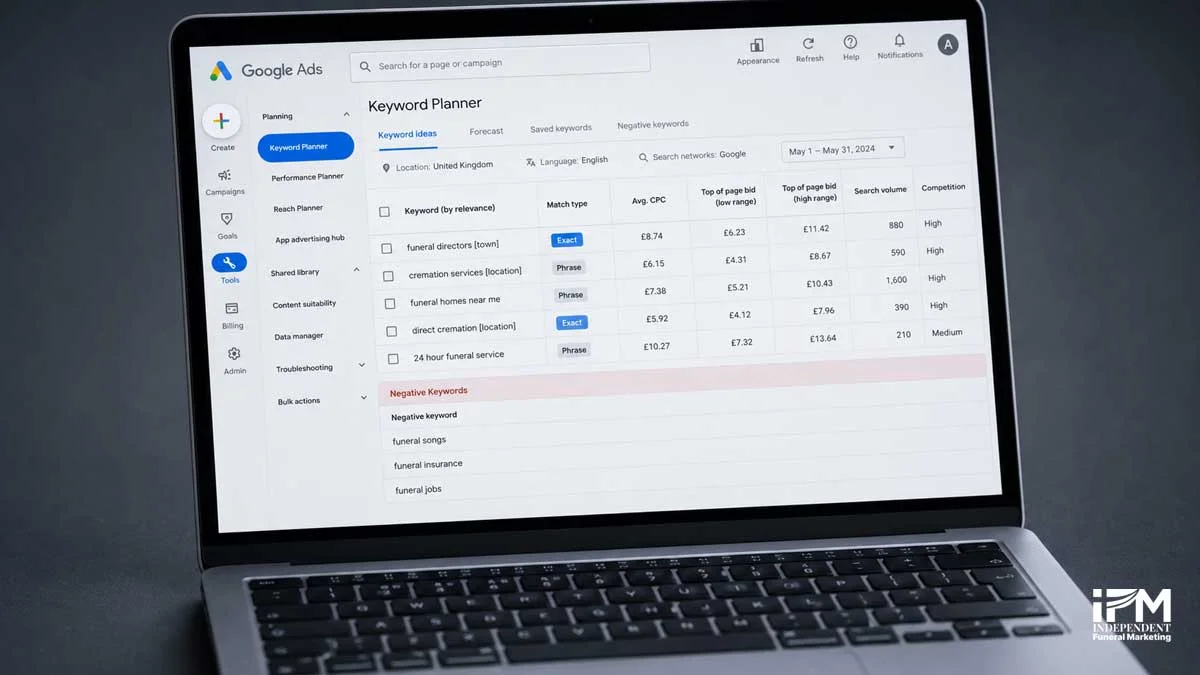
Funeral home Google Ads campaigns should focus primarily on high-intent, location-qualified keywords such as “funeral directors [town]”, “cremation services [city]”, and “funeral homes near me”, using exact match and phrase match only, never broad match. Match type discipline is what separates a campaign that generates enquiries from one that burns through budget on irrelevant searches.
High-intent at-need keywords (exact match)
These are the core of the campaign. Target:
- “funeral directors [town/city]”
- “funeral home [location]”
- “funeral homes near me”
- “cremation services [location]”
- “immediate cremation [location]”
- “direct cremation [location]”
- “24 hour funeral service [location]”
- “funeral directors near me”
Planning and preneed keywords (phrase match)
- “funeral planning [location]”
- “pre-planned funeral [location]”
- “funeral costs [location]”
- “cremation packages [location]”
- “direct cremation cost”
- “pre-arranged funeral [location]”
Brand terms (exact match)
Your funeral home name, your funeral home name plus location, and common misspellings of your name.
Match type guidance is non-negotiable: exact match for high-intent at-need terms, phrase match for planning terms, and never broad match. Broad match in a funeral home campaign will generate clicks on searches for funeral insurance, funeral songs, funeral jobs, and celebrity funerals. The waste is significant and immediate.
UK versus US phrasing matters here. UK families use “funeral director” more frequently than “funeral home”. Target both variants across your keyword sets, but weight your budget towards the UK-preferred terminology.
On CPCs: practitioner data from Wired Media (March 2025) [1] shows UK funeral-related CPCs ranging from £3.50 to £12.00. High-intent local terms such as “funeral directors near me” sit towards the upper end of that range. DataForSEO keyword research (May 2026) [5] indicates relatively low competition scores for most funeral-specific PPC terms, meaning a well-structured campaign can achieve strong positions without extreme bids.
What negative keywords does a funeral director need in Google Ads?
Negative keywords are search terms you instruct Google Ads to exclude from triggering your adverts, and for funeral homes they are essential to prevent budget waste on searches that have nothing to do with hiring a funeral director. Without a robust negative keyword list, a funeral home campaign will haemorrhage spend on irrelevant searches within its first days live.
The word “funeral” attracts an enormous volume of search queries that have nothing to do with hiring a funeral director. People search for funeral songs, funeral poems, what to wear to funerals, funeral insurance, and celebrity funerals. All of these will trigger a broad or phrase match keyword containing the word “funeral”.
Add the following as negative keywords before any campaign goes live:
Always exclude:
- funeral insurance
- funeral cover
- funeral plan insurance
- funeral insurance quotes
- prepaid funeral insurance
- funeral songs
- funeral readings
- funeral poems
- what to wear to a funeral
- funeral attire
- funeral dress code
- funeral jobs
- funeral director jobs
- funeral home jobs
- funeral home careers
- funeral home for sale
- how to open a funeral home
- funeral home business plan
- funeral home franchise
- how much does a funeral home owner make
- funny funeral
- funeral home meme
- celebrity funerals
- famous funerals
This list is a starting point, not a complete solution. Check the Search Terms report in Google Ads every week after launch, particularly in the first four weeks. The Search Terms report shows the actual queries that triggered your ads. Add any irrelevant terms as negatives immediately.
Campaign-level negatives apply to all ad groups within that campaign. Ad group-level negatives apply only to that group. Apply the core exclusion list at campaign level. Add more specific exclusions at ad group level when a particular service group attracts specific irrelevant traffic.
How do you write Google Ads that convert for a funeral director?
Effective funeral home Google Ads copy is calm, clear, and service-focused, it answers the searcher’s immediate need, establishes trust through specifics such as years of experience, local knowledge, and 24/7 availability, and ends with a clear action prompt. The families searching at the most difficult moment of their lives need clarity, not cleverness.
Google now uses Responsive Search Ads (RSAs) as the standard format. You write multiple headline variants (up to 15) and multiple description variants (up to 4), and Google tests combinations to find what performs best. Write each headline and description as if it might appear alone, because it sometimes will.
Headline principles:
- Lead with the service type and location: “Funeral Directors in [Town]”, “Cremation Services [City]”
- Follow with a key differentiator: “Family-Run Since [Year]”, “24/7 Support Available”, “Independent, Local, Caring”
- Include a trust signal: “NAFD Member”, “SAIF Registered”, “Serving [Town] for [X] Years”
Example headline combinations:
- “Funeral Directors [Town] | Family-Run | 24/7 Support”
- “Cremation Services [City] | NAFD Member | Call Now”
- “Independent Funeral Directors | [Town] | Est. [Year]”
Description principles:
Descriptions (up to 90 characters each) should be specific. Include a call-to-action, mention the independent and local nature of the business, and reference any relevant accreditations. Avoid generic phrases.
Tone matters enormously for funeral home advertising. Never use “cheap”, “deals”, or “discount” in at-need campaigns. These signal the wrong intent and can damage trust at a sensitive moment.
On pricing in ads: include pricing for preneed campaigns where it aids decision-making. For at-need campaigns, leave pricing to the landing page. A family in immediate need is not making a price comparison; they are looking for reassurance and availability.
Google Ads policy is clear on this: funeral services are not a restricted or sensitive advertising category. Your ads can include pricing, service descriptions, and direct calls-to-action without special certification. Ad copy must be factually accurate. That is the only hard policy requirement for this category.
NAFD (National Association of Funeral Directors) and SAIF (Society of Allied and Independent Funeral Directors) membership are genuine trust signals in ad copy. Families recognise these bodies. Including them in a headline or callout extension directly supports click-through rate.
What ad extensions should a funeral home use in Google Ads?
Funeral home Google Ads campaigns benefit most from call extensions (enabling direct calls from the ad), sitelink extensions (linking to specific service pages), location extensions (showing the funeral home’s address), and callout extensions (highlighting key trust signals). Google now refers to extensions as “Assets” in the interface, but the function is identical.
Extensions increase the physical size of your ad in search results and provide additional information without extra cost. A fully extended ad takes up significantly more screen space than a basic text ad, which directly improves visibility and click-through rate (CTR, meaning the percentage of people who see the ad and click it).
Priority order for funeral homes:
Call extension: Allows the ad to display a clickable phone number. On mobile, this means a family can call directly from the search result without visiting the website. Enable call reporting to track these calls as conversions. This is the single most important extension for at-need campaigns.
Sitelink extensions: Additional links below the main ad, pointing to specific service pages such as Cremation Services, Traditional Burial, Pre-Arranged Funerals, and Contact. Each sitelink has a headline and two description lines. Well-written sitelinks significantly increase CTR.
Location extension: Displays the funeral home’s address beneath the ad. Requires linking a verified Google Business Profile to the Google Ads account. Adds local credibility and is particularly important for “near me” searches.
Callout extensions: Short phrases of up to 25 characters each, displayed as additional text beneath the ad. Use for trust signals: “24/7 Service Available”, “NAFD Member”, “Family-Run Funeral Home”, “Serving [Town] Since [Year]”.
Structured snippet extensions: List your services in a structured format: “Services: Burial, Cremation, Pre-Planning, Memorial”. Helps searchers quickly confirm the funeral home offers what they need.
Call extensions can be scheduled to display only during your active hours if required, though for 24/7 at-need services, leaving them active around the clock is recommended. For preneed campaigns where enquiries are less time-sensitive, lead form extensions can capture enquiry details directly in the search result.
How much should a funeral director spend on Google Ads, and what is a realistic budget?
A realistic starting budget for a funeral home Google Ads campaign in the UK is £500 to £800 per month, enough to maintain consistent visibility for at-need searches in a defined local area, given CPCs of £3.50 to £12.00 depending on location and competition (Wired Media, March 2025) [1]. Budget requirements vary significantly based on geographic coverage, number of competing funeral homes, and which service types you are targeting.
A simple budget calculation helps set expectations: if an at-need keyword costs £9 per click and the landing page converts at 10%, the campaign needs ten clicks to generate one enquiry. That enquiry costs approximately £90. A £500 monthly budget at that rate generates roughly five to six at-need enquiries per month.
Is that worth it? The average UK funeral costs £4,285 (SunLife Cost of Dying Report 2025) [2]. The maths is clear when conversion tracking is in place. An enquiry cost of £90 against a service value of £4,285 represents a strong return, assuming reasonable conversion from enquiry to instruction.
Recommended starting budget allocation:
- At-need campaign: £400 to £600 per month (priority spend)
- Preneed campaign: £100 to £200 per month
- Brand campaign: £50 to £100 per month
The guiding principle is to start with a manageable budget, prove the model with conversion data, then scale. Do not commit significant budget before call conversion tracking is fully operational. Without tracking, there is no way to verify whether the spend is generating enquiries.
Geographic coverage is the main determinant of required budget. A funeral home covering one town needs far less than one covering an entire county. The tighter the targeting, the more efficiently the budget works.
One honest note for funeral homes on very limited budgets: if the available monthly budget is below £300, it may be more sustainable to invest in SEO foundations first. SEO builds over time but eventually delivers enquiries at a much lower marginal cost. For detailed UK CPC benchmarks and budget modelling, Google Ads costs for funeral directors covers this in full.
What bidding strategy works best for a funeral home Google Ads campaign?
For most funeral home Google Ads campaigns, Manual CPC bidding for new accounts with limited data, transitioning to “Maximise Conversions” or “Target CPA” smart bidding once 30 or more conversions have been recorded, is the recommended approach. The reason is simple: smart bidding needs data, and a new campaign has none.
The bidding spectrum runs from Manual CPC at one end through Enhanced CPC, Maximise Conversions, and Target CPA (cost per acquisition, the average cost to generate one conversion). Manual CPC gives full control over every keyword bid. Smart bidding strategies use machine learning to adjust bids automatically, but only perform well when trained on sufficient conversion history.
New campaigns (weeks 1 to 8): Use Manual CPC. Set bids based on estimated keyword CPCs and your budget. Review and adjust weekly based on impression share and conversion data. This stage is about gathering data, not maximising volume.
When to transition: Once the campaign has recorded 30 or more conversions in a 30-day period, test Maximise Conversions. Monitor cost per conversion closely during the transition. If efficiency holds or improves over two to four weeks, consider progressing to Target CPA with a realistic CPA target based on actual campaign data.
Bidding strategy differs between campaign types. At-need campaigns justify higher CPCs because the enquiry value is high and the timing is critical. Preneed campaigns can tolerate lower positions and lower CPCs because the searcher has time. Brand campaigns can run on low Manual CPC bids since Quality Score for your own name will be near-maximum.
Impression Share bidding is not recommended. It optimises for how often your ad appears, not whether those appearances lead to conversions. For funeral homes with limited budgets, efficient conversion spend matters far more than impression volume.
Bid adjustments add further control: increase bids for your immediate service area within the geographic radius, adjust for device (mobile over-indexes for at-need searches), and adjust by time of day if call data shows clear peak windows.
What should a funeral home landing page include for PPC traffic?
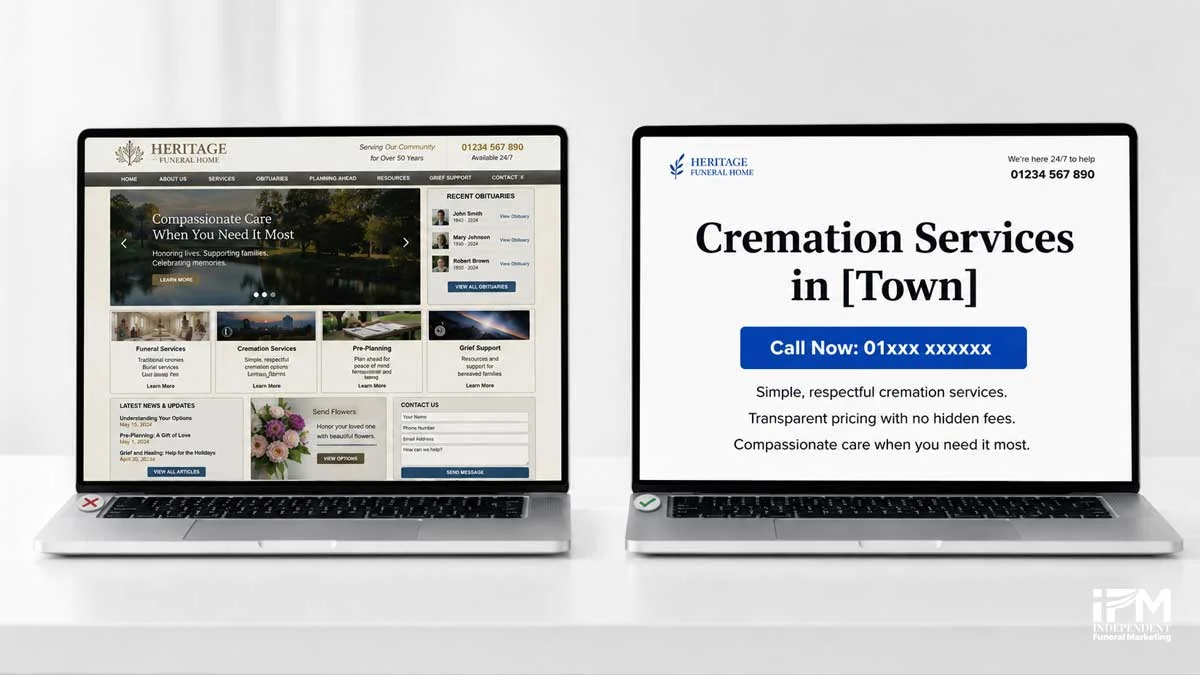
Funeral home Google Ads traffic should always be sent to a dedicated landing page, not the homepage, that matches the specific search intent of the ad, includes a prominent call-to-action, and loads in under three seconds on mobile. This is not optional. The correlation between message match (the alignment between ad copy and landing page headline) and conversion rate is direct and significant.
Sending “cremation services [town]” search traffic to a generic homepage wastes budget and damages Quality Score simultaneously. Google evaluates landing page relevance as part of Quality Score. A low-relevance landing page means lower Quality Score, higher CPCs, and worse ad positions.
Landing page checklist for at-need campaigns:
- Matching headline: The H1 on the landing page must echo the ad copy. If the ad says “Cremation Services in [Town]”, the page headline must say the same.
- Prominent click-to-call button above the fold: Visible before any scrolling. Large, mobile-optimised, clearly labelled.
- Brief reassuring service description: 50 to 100 words above the fold, covering what you offer, where you serve, and how to reach you.
- Trust signals: Years in business, NAFD or SAIF membership badge, real Google review score (with review count), and genuine photographs of the funeral home or team.
- Enquiry form: Maximum three fields for at-need pages. Name, phone number, and a brief message field. Fewer fields, higher completion rates.
- Address and service area: State clearly which towns and postcodes you cover.
- GDPR-compliant privacy notice: Required under UK GDPR. Include a brief statement of how data is handled and a link to the full privacy policy.
What to avoid: auto-playing video or audio, which is both disrespectful at a sensitive moment and detrimental to page load speed; excessive pop-ups; navigation links leading to irrelevant pages away from the conversion action.
Page speed is critical. A page that loads in over three seconds on mobile will see significant drop-off before the user even reads the headline. Poor page speed also directly damages Quality Score.
At-need and preneed landing pages need different designs. At-need pages should be call-first, minimal copy, with a single clear action. Preneed pages can carry more information, build trust over more content, and use a callback form rather than an immediate call prompt.
How do you track calls and measure ROI from a funeral director Google Ads campaign?
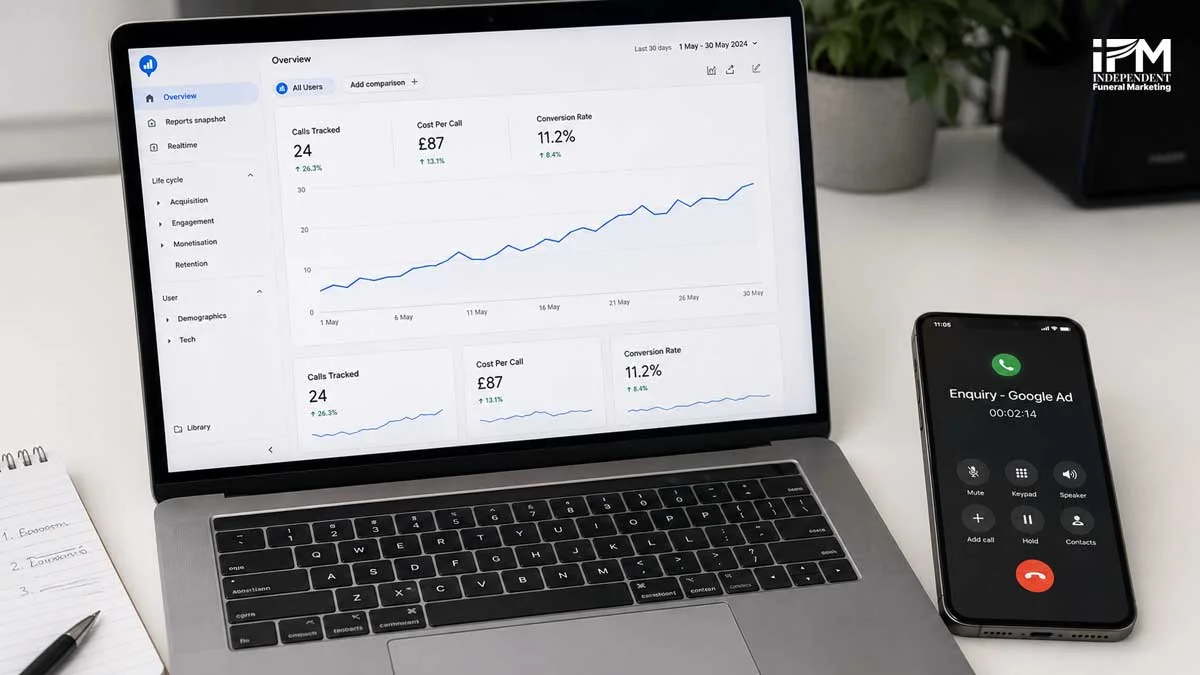
Funeral home Google Ads tracking must be set up before any campaign goes live, because without call conversion tracking there is no way to know whether Google Ads is generating enquiries or wasting budget. This is not a post-launch task. It is a pre-launch requirement.
Funeral homes convert primarily by phone call, not online form submission. A campaign generating significant traffic and zero tracked conversions almost always means call tracking is not set up, not that the campaign is generating no calls.
Set up two call conversion actions in Google Ads:
- Calls from ads: Tracks calls made by clicking the call extension directly from the search result. These are recorded in Google Ads automatically once the conversion action is enabled.
- Calls to a phone number on your website: Google inserts a dynamic forwarding number on your landing page, which rotates in for each visit from an ad click. Calls to that number are tracked back to the campaign, ad group, and keyword that generated the visit.
Link Google Analytics 4 (GA4) to your Google Ads account. This imports GA4 goals into Google Ads and provides a fuller picture of post-click behaviour. Use Google Tag Manager (GTM) to deploy Google Ads conversion tags on the landing page without editing website code directly.
Key metrics to review weekly:
- Impressions and clicks (volume check)
- CTR (click-through rate, target 5 to 10% on high-intent terms)
- Average CPC
- Conversions and conversion rate (target 8 to 15% on well-optimised landing pages)
- Cost per conversion (target £40 to £150 depending on competition level)
For deeper analytics, third-party call tracking tools such as CallRail provide call recording, keyword-level attribution, and caller journey data that Google’s native tracking cannot match.
Monthly ROI calculation is straightforward: multiply the number of confirmed at-need calls by the average funeral value, subtract the month’s Google Ads spend, and the result is gross return before other costs. One important attribution note: a family may click an ad, leave, and call 24 to 48 hours later. Multi-touch attribution provides a more accurate picture of ad-assisted conversions than last-click alone.
How do you optimise a funeral home Google Ads campaign after launch?
A funeral home Google Ads campaign should be reviewed and optimised at least weekly in the first month after launch, then fortnightly once stable, with the most impactful tasks being reviewing the Search Terms report for negative keywords and A/B testing ad copy headlines. The campaign will not optimise itself.
Weekly (first four weeks):
Review the Search Terms report and add any irrelevant queries as negative keywords immediately. Check conversion data: are calls being tracked? Are any ad groups generating zero conversions? Review Quality Scores for every keyword. Flag any keyword with a Quality Score below 6/10 for attention. Check budget pacing to confirm the daily budget is being spent as expected.
Monthly:
A/B test two to three headline variants per ad group. Change one variable at a time so results are attributable. Analyse geographic performance: are certain towns or postcodes over-performing or under-performing? Review device breakdown: if mobile is generating clicks but fewer conversions, investigate the mobile landing page experience. Check the auction insights report to see which competitors are bidding on the same terms.
Quality Score improvement is the single highest-leverage activity in ongoing optimisation. Improve keyword-to-ad-copy alignment. Ensure the landing page headline echoes the keyword and ad. Pause keywords with Quality Score 3 or below and either rewrite the supporting content or remove them from the campaign.
Signs a campaign needs urgent attention: CTR below 2% on high-intent terms indicates ad copy is not resonating; cost per enquiry consistently above £200 suggests structural problems with keywords, landing page, or both; high impressions with very few clicks indicates ad copy is poor or ad position is too low.
Quarterly, conduct a full account audit: review all keyword lists, update negative keywords, refresh ad copy, assess whether the campaign structure still reflects the funeral home’s current service priorities.
What are the most common Google Ads mistakes funeral directors make?
The most common and costly Google Ads mistake funeral homes make is using broad match keywords with no negative keyword list, directing budget towards irrelevant searches including funeral songs, funeral insurance, and celebrity funerals, consuming spend with zero conversion potential. Below are the ten most damaging mistakes, each with the fix.
Using broad match keywords with no negative keywords. Why it happens: it is the Google Ads default. What it costs: potentially half or more of the budget on irrelevant traffic. The fix: use exact match and phrase match only, and build a negative keyword list before the campaign goes live.
Sending all traffic to the homepage. Why it happens: it seems logical to start with the most prominent page. What it costs: poor message match damages Quality Score and reduces conversion rates. The fix: build dedicated landing pages for each service type.
Not setting up call conversion tracking before launch. Why it happens: it is technical and easy to defer. What it costs: no visibility on whether the campaign is generating calls. The fix: set up both call extension tracking and website call tracking before activating any campaign.
Setting and forgetting. Why it happens: time pressure. What it costs: accumulating waste as irrelevant searches build over time. The fix: schedule a weekly 30-minute campaign review as a non-negotiable calendar item.
Using Performance Max as the primary at-need campaign. Why it happens: Google recommends it. What it costs: loss of search term control. The fix: use Search Network campaigns for at-need targeting. Performance Max has a role, but not as the primary at-need vehicle.
Advertising nationally instead of targeting the local service area. Why it happens: it seems like more coverage. What it costs: budget wasted on locations the funeral home cannot serve. The fix: set geographic targeting to the specific towns and postcodes served, plus a radius around the main location.
Identical ads for cremation and burial. Why it happens: it saves time. What it costs: lower relevance scores, lower CTR, higher CPCs. The fix: separate ad groups with tailored copy for each service type.
Ignoring Quality Score. Why it happens: it is not prominently displayed. What it costs: higher CPCs for the same or lower position. The fix: review Quality Score for every keyword monthly and address anything below 6/10.
No brand campaign. Why it happens: it seems unnecessary. What it costs: competitor ads appearing above your organic result when someone searches for your funeral home by name. The fix: run a brand campaign at minimal budget. The CPCs are very low.
Giving up too soon. Why it happens: costs appear before conversions in the first few weeks. What it costs: writing off a working channel prematurely. The fix: commit to four to six weeks of data before drawing conclusions. The first weeks are a learning phase, not a performance phase.
Can an independent funeral home compete against Co-op and Dignity on Google Ads?
Yes, an independent funeral home can compete effectively against Co-op Funeralcare and Dignity Funerals on Google Ads, because Ad Rank is determined by Quality Score multiplied by bid, not bid alone, and a well-structured independent campaign with high Quality Scores can outrank a corporate competitor paying more per click. The formula is not budget versus budget. It is relevance versus relevance.
The Ad Rank formula works clearly in favour of the well-organised independent. A funeral home achieving a Quality Score of 8/10 with a maximum bid of £5 has an Ad Rank of 40. A corporate chain achieving a Quality Score of 4/10 with a maximum bid of £10 has an Ad Rank of 40. They are equal. Improve Quality Score to 9/10 and the independent wins at the lower bid. Structure beats budget.
Where independent funeral homes have a structural advantage on Quality Score: local relevance is genuine and demonstrable. A landing page for “funeral directors in [specific town]” from a funeral home that has served that town for decades is intrinsically more relevant than a national chain’s generic regional page. Local ad copy, local images, and genuine local knowledge all contribute to higher Quality Scores.
Authentic ad copy is another independent advantage. Headlines like “Family-Run Funeral Directors | [Town] | Est. [Year]” achieve higher CTR than generic corporate copy. Higher CTR is one of the key inputs into Quality Score. The independent’s story is a genuine performance differentiator.
Where Co-op Funeralcare and Dignity Funerals have an advantage: absolute budget scale means they can run 24/7 national coverage across all locations simultaneously. They also benefit from significant brand search volume.
The practical counter-strategy for independents: do not attempt to compete nationally. Outperform locally. Concentrate the full budget on the specific towns and postcodes served. Use the auction insights report to see where Co-op and Dignity are bidding and identify terms or locations where they are under-investing.
Is Google Ads better than SEO for a funeral home, or should you use both?
Google Ads and SEO serve different timescales for funeral homes: Google Ads delivers immediate visibility the day a campaign launches, while SEO compounds over 6 to 12 months to build a sustainable, lower cost-per-enquiry foundation, and most established independent funeral homes benefit from using both. The choice is not either/or. It is a sequencing and budget allocation question.
| Google Ads | SEO | |
|---|---|---|
| Time to first visibility | Same day | 6 to 12 months |
| Time to peak efficiency | 6 to 8 weeks | 12 to 24 months |
| Cost per enquiry (short term) | £40 to £150 | High (time and content investment) |
| Cost per enquiry (long term) | Constant or rising | Declining toward near-zero marginal cost |
| Stops working when | Budget stops | Rankings degrade only slowly |
| Control over positioning | High | Moderate |
UK CPC context makes this concrete. At roughly £9 per click and a 10% landing page conversion rate, each at-need enquiry from Google Ads costs approximately £90. An equivalent call from established organic search has a marginal cost close to zero. Over 24 months, the cumulative cost difference is significant.
When to prioritise Google Ads: new website with no organic rankings, entering a new geographic area, highly competitive local market where organic positions are dominated by corporate chains.
When to prioritise SEO: established website with existing content, medium to long-term investment horizon, market where organic and Maps Pack positions are achievable within 12 months.
The integrated approach is the most resilient model. Google Ads provides immediate coverage while SEO builds in the background. As organic rankings strengthen and the Maps Pack position improves, Ads dependency reduces naturally. Budget can be reallocated from Ads to other channels without losing visibility.
A third channel is growing in significance and should not be overlooked. AI search platforms including Google AI Overviews, Perplexity, ChatGPT, and Gemini are becoming discovery channels for funeral services. Proprietary audience research (SparkToro, March 2026) [3] shows that the independent funeral director audience over-indexes for Perplexity by +28.2% compared to the UK average. This is a meaningful signal. AI search optimisation is the emerging third channel alongside paid search and organic SEO, and forward-thinking independent funeral homes are already building for it.
In practice, the accounts that perform most sustainably are those where Google Ads and SEO run concurrently from launch, with Ads covering immediate at-need volume and SEO building the organic foundation that eventually reduces paid dependency.
Frequently Asked Questions About Setting Up a Funeral Home Google Ads Campaign
Is Google Ads worth it for a funeral home?
Yes, when set up correctly. Google Ads places your funeral home at the top of search results immediately, unlike SEO which takes months. The key is correct campaign structure: tight geographic targeting, exact match keywords, dedicated landing pages, and call conversion tracking. Incorrectly set-up campaigns waste budget; well-structured campaigns deliver measurable at-need enquiries from the day they launch.
How much should a funeral home spend on Google Ads per month?
A realistic starting budget for a UK funeral home is £500 to £800 per month. UK funeral-related CPCs range from £3.50 to £12.00 (Wired Media, March 2025) [1], with competitive local intent terms at the higher end of that range. At those rates and a 10% conversion rate, a £500 budget generates roughly five to six at-need enquiries per month, a strong return given that the average UK funeral costs £4,285 (SunLife Cost of Dying Report 2025) [2].
What type of Google Ads campaign works best for funeral homes?
Search Network campaigns work best for funeral homes, particularly for at-need search traffic. Search ads appear when families are actively searching for funeral services, the highest-intent moment. Avoid relying on Performance Max for at-need campaigns as it reduces control over search terms. A three-campaign structure (at-need, preneed, and brand) provides the most effective coverage.
What keywords should funeral homes bid on in Google Ads?
Bid on high-intent, location-qualified terms: “funeral directors [town]”, “cremation services [location]”, “funeral homes near me”, and “immediate cremation [location]”. Use exact match for at-need terms and phrase match for planning searches. Never use broad match, it generates irrelevant clicks. In UK campaigns, include “funeral director” variants as UK audiences use this term more than “funeral home”.
What are negative keywords and why does a funeral home need them?
Negative keywords are search terms you exclude from your campaign to prevent irrelevant clicks. Without them, a funeral home campaign will waste budget on searches like “funeral songs”, “funeral insurance”, “what to wear to a funeral”, and “funeral director jobs”. A well-built negative keyword list is essential to any funeral home Google Ads campaign and should be reviewed weekly via the Search Terms report.
Should cremation and burial services have separate Google Ads campaigns?
At minimum, they should have separate ad groups within the same campaign. Ideally, for a funeral home with meaningful monthly volume, separate campaigns allow independent budget allocation, separate bidding strategies, and cleaner performance data. The searcher intent for “cremation services” differs from “traditional burial”, they are different families with different decision timelines and should be addressed differently.
How long does it take for Google Ads to work for a funeral home?
Google Ads can generate enquiries within 24 to 48 hours of a campaign going live. Meaningful optimisation requires four to six weeks of conversion data. Smart bidding strategies that require 30 or more conversions per month may take six to eight weeks to activate. Set realistic expectations: the first month is learning; months two and three are when cost-per-enquiry efficiency improves significantly.
How do I track phone calls from Google Ads for my funeral home?
Set up call conversion tracking in Google Ads using two methods: “Calls from ads” (tracks calls made directly via call extensions) and “Calls to a phone number on your website” (uses a Google forwarding number inserted on the landing page). Link Google Analytics 4 (GA4) to the Google Ads account. Use Google Tag Manager to deploy tracking tags. Call tracking must be active before any campaign launches.
What ad extensions should a funeral home use in Google Ads?
Priority extensions for funeral homes: 1) Call extensions, allowing direct calling from the ad (essential for at-need campaigns). 2) Sitelink extensions, linking to specific service pages. 3) Location extensions, displaying the funeral home’s address. 4) Callout extensions, short trust phrases such as “24/7 Service”, “NAFD Member”, “Family-Run Funeral Home”. 5) Structured snippets, listing services: “Burial, Cremation, Pre-Planning”.
Can an independent funeral home compete against Co-op or Dignity on Google Ads?
Yes. Google Ads ranks ads using Ad Rank, which is Quality Score multiplied by bid, not bid alone. An independent funeral home with a Quality Score of 8/10 can outrank a corporate chain bidding more per click but achieving only 4/10 Quality Score. The key advantages for independents are local relevance, authentic ad copy, and tight geographic targeting, all factors that improve Quality Score.
Should funeral homes send PPC traffic to their homepage or a dedicated landing page?
Always send PPC traffic to a dedicated landing page, not the homepage. Landing pages should match the exact search term and service advertised in the ad (message match). Sending “cremation services” ad traffic to a general homepage wastes spend, damages Quality Score, and reduces conversion rates. A dedicated landing page with a clear click-to-call button and brief trust signals consistently outperforms a homepage.
Are there Google Ads restrictions for funeral services?
Funeral services are not a restricted or sensitive advertising category under Google’s current policies. Ads can include pricing, service descriptions, and calls-to-action without special certification. Ad copy must be factually accurate and not misleading. The primary compliance consideration is GDPR: ensure landing pages include a privacy notice. Google does prohibit personalised advertising targeting people based on bereavement status [4], but standard keyword search campaigns are fully permitted.
What bidding strategy works best for a new funeral home Google Ads campaign?
Start with Manual CPC bidding for the first four to eight weeks. This gives full control while conversion data is limited. Once the campaign has recorded 30 or more conversions in a 30-day period, test Maximise Conversions smart bidding. Manual CPC prevents the algorithm from making uninformed decisions in the early stages, smart bidding is only as good as the data it is trained on.
Why is my funeral home Google Ads campaign getting clicks but no calls?
The most common causes are: (1) traffic being sent to the homepage rather than a dedicated landing page; (2) a landing page without a prominent click-to-call button above the fold; (3) slow mobile page load speed; (4) broad match keywords attracting irrelevant traffic. Review your Search Terms report to confirm whether clicks are from genuinely relevant queries before assuming the landing page is the problem.
Should funeral homes advertise on Microsoft Bing Ads as well as Google?
Yes, and it is a stronger case than for most industries. The IFM audience (independent UK funeral home owners with a digital focus) over-indexes for Bing usage by +8.3% versus the UK average (SparkToro, March 2026) [3]. Bing Ads CPCs are typically 30 to 40% lower than Google equivalents. Microsoft Advertising campaigns can be imported directly from Google Ads, making setup straightforward once a Google campaign is running.
Google Ads works for funeral homes when the campaign structure is correct. The three-campaign model covering at-need services, preneed planning, and brand protection, combined with tight keyword targeting using exact and phrase match only, dedicated landing pages that match each ad’s intent, and call conversion tracking active before launch, are the four non-negotiables. Everything else is refinement.
The pattern for most independent funeral homes that succeed with Google Ads is consistent: they start with a modest, tightly targeted at-need campaign, prove the cost-per-enquiry model with four to six weeks of data, then expand. They do not try to outspend corporate chains nationally. They outperform them locally, using Quality Score, local relevance, and authentic copy.
Structured Google Ads investment alongside SEO and AI search optimisation is how independent funeral homes build durable enquiry pipelines that are not dependent on any single channel. Each channel serves a different timeframe. Paid search provides immediate coverage; organic SEO builds the long-term foundation; AI search optimisation positions the funeral home for the growing share of families who will discover services through conversational AI platforms.
If you would like specialist support setting up or auditing a funeral home Google Ads campaign, Start with the funeral home PPC keywords guide to confirm your keyword structure and negative keyword list before launch. Independent Funeral Marketing works exclusively with independent funeral directors across the UK. Google Ads management for funeral homes
References
[1] Wired Media, Funeral Home PPC CPC Expenses Explored, March 2025, https://www.wiredmedia.co.uk/2025/03/11/funeral-home-ppc-cpc-expenses-explored/
[2] SunLife Cost of Dying Report 2025, https://www.sunlife.co.uk/siteassets/documents/cost-of-dying/sunlife-cost-of-dying-report-2025.pdf
[3] SparkToro Audience Research Report, March 2026 (proprietary IFM research data)
[4] Google Ads Help, Personalised Advertising Policy, https://support.google.com/adspolicy/answer/143465
[5] DataForSEO Keyword Research, May 2026 (proprietary IFM research data)