Local citation building for funeral directors is one of the least visible, highest-impact elements of local SEO, and most independent firms have never given it deliberate attention.
A local citation is any online mention of your funeral home’s Name, Address, and Phone number. These mentions appear on directory sites, review platforms, map tools, and dozens of other places across the internet. Google uses them to verify that your business is real, local, and contactable.
The problem: most funeral directors have incorrect, incomplete, or mismatched versions of their business information scattered across the web, often without knowing it. That inconsistency quietly suppresses local search rankings.
This guide covers which directories genuinely affect local visibility for funeral directors, why accuracy matters more than volume, and exactly where to focus first. By the end, you’ll know which platforms to prioritise and how to make sure your listings are working in your favour.
What is a local citation, and why does it matter for funeral directors?
A local citation for a funeral home is any online mention of your business’s Name, Address, and Phone number (NAP), whether on a directory site, a review platform, a local news article, or a data aggregator network. Research confirms that 87% of people use Google to find local businesses [1], and Google cross-references your citation data from across the web to confirm your funeral home is credible, local, and worth ranking prominently.
Citations appear in three main forms. Structured citations are full NAP listings on directory platforms like Yell, Google Business Profile, or Bing Places, submitted directly or scraped from other sources. Partial mentions are brand references in content not designed to be a directory: a local newspaper piece naming your firm, a council website listing local services, or a community forum recommendation. Data aggregators are companies like Infogroup (Data Axle) and Neustar Localeze that distribute business information to hundreds of smaller directories automatically.
When a bereaved family searches “funeral director near me” or “funeral homes in [town]”, Google cross-references your citation data to confirm the business is real, is where you say it is, and can be contacted on the number you provide. Inconsistent or missing data creates doubt in Google’s algorithm, and that doubt costs you visibility at the moment when a family needs you most.
How do local citations affect your funeral home’s search rankings?
Local citations influence your funeral home’s search rankings primarily by affecting your prominence score, one of the three factors Google uses to determine local search position. Google local map results receive approximately 44% of all clicks in local searches [2], making citation signals directly tied to the enquiries your business receives.
Google’s local ranking algorithm uses three core factors:
- Proximity: how close your funeral home is to the searcher. You cannot control your physical location.
- Relevance: how well your Google Business Profile and website match what the searcher is looking for.
- Prominence: how well-known and trusted your business appears to be online. Citations are a direct input into this score.
When two funeral directors serve the same town, consistent and widespread citation data can be the decisive factor between appearing in the local three-pack and being invisible to at-need families. If your competitor has accurate listings across 50 platforms and yours has conflicting data on 20, Google’s confidence in their listing is higher than in yours.
Understanding how this fits into the broader picture of local search is covered in why funeral homes need local SEO. For a complete walkthrough of every ranking factor and how to improve your position, how to rank your funeral home on Google covers each element in detail.
What is NAP consistency, and why is it the foundation of citation building?
NAP consistency means your funeral home’s Name, Address, and Phone number appear in exactly the same format across every directory, listing, and online mention. Google compares these mentions to verify your identity. When they don’t match, Google reduces confidence in your listing, and your local rankings suffer.
The most common errors in long-established funeral firms look like this:
- Yell: “J. Smith & Sons Funeral Directors, 14 High Street, Grantham, NG31 6PZ, 01476 123456”
- Google Business Profile: “J Smith and Sons, High Street, Grantham, 01476123456”
- Thomson Local: “John Smith Funeral Services, 14 High St, Grantham”
These are three references to the same business. Google sees inconsistency and reduces confidence. The result: lower prominence scores and lower rankings, with no obvious cause to point to.
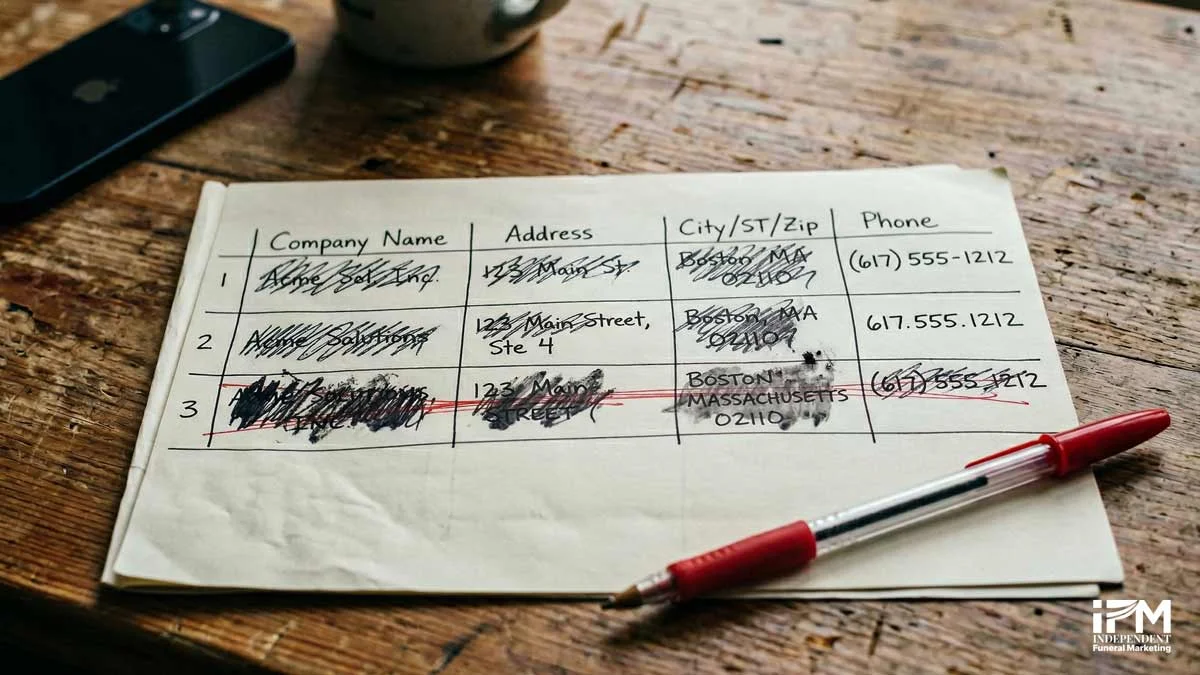
This problem is especially common in firms that have been trading for 10, 20, or 30 years, where phone numbers have changed, trading names have evolved, and old data is sitting uncorrected in directories from a decade ago. For a full audit methodology and step-by-step correction process, the NAP consistency guide for funeral homes covers every element in detail.
Which online directories actually matter for funeral directors in the UK?
For funeral directors in the UK, the directories that genuinely move the needle are Google Business Profile, Bing Places for Business, and Yell.com. After these, Thomson Local, Trustpilot, Apple Maps, and Facebook Business Page provide meaningful secondary signals. Everything else is incremental.
Tier 1: Non-negotiable
Google Business Profile The single most important citation for any funeral director. It feeds the local Map Pack directly and is the dominant signal for proximity-based searches. It must be fully claimed, verified, and maintained, not simply set up and left. For a complete guide to every element, see Google Business Profile for funeral directors.
Bing Places for Business Often overlooked, but directly relevant for independent funeral directors. SparkToro audience data for UK funeral home owners confirms a +28.2% Bing over-index compared to the UK average, meaning this audience uses Bing at a significantly higher rate than the national baseline. Bing Places feeds Microsoft search results and is particularly used by older demographics, a core segment for funeral services. Setup takes approximately 30 minutes and is free.
Yell.com Yell carries the highest audience affinity score of any UK directory in the SparkToro data for this market, 81/100 affinity. It has genuine domain authority and remains widely used by UK consumers searching for local services, including funeral directors. A free basic listing is available.
Tier 2: High value
Thomson Local A legacy UK directory with continued domain authority. Widely used in the funeral industry. Free basic listing available.
Trustpilot Crosses the boundary between citation and reputation tool. A Trustpilot presence signals credibility to both families and search engines. Particularly relevant for funeral homes building social proof alongside their citation footprint.
Apple Maps Critical for iPhone users and Siri voice search. Populated via Apple Business Connect. Free to set up and straightforward to maintain.
Facebook Business Page Functions as a structured citation as well as a social proof platform. Even if you are not actively posting, a complete, accurately filled Facebook Business Page provides a consistent citation signal. Research indicates that 92% of funeral service consumers use Facebook [3], making this a platform you cannot leave incomplete.
Tier 3: Worth including
- Foursquare: feeds data to dozens of other platforms via its aggregator network. One listing, many downstream signals.
- Checkatrade / Which? Trusted Traders: carries trust signal weight in the UK consumer market. Relevant for funeral directors positioning on quality and accountability.
- FreeIndex: UK-specific business directory. Modest authority but easy to complete and part of a comprehensive citation footprint.
- Nextdoor: hyperlocal platform increasingly used by older demographics for local service recommendations. Relevant for independent funeral homes with strong community presence.
Which directories matter most for funeral homes in the United States?
For US funeral homes, the starting point mirrors the UK: Google Business Profile, Bing Places for Business, and Apple Maps are non-negotiable. Beyond these, the US market has its own directory ecosystem with several additional platforms worth prioritising.
- Google Business Profile: identical priority to the UK. The foundation of every local SEO strategy.
- Bing Places for Business: Microsoft Bing is the second-largest US search engine. Free, and consistently underused by funeral homes.
- Yelp: significantly higher consumer adoption in the US than in the UK. A complete, well-maintained Yelp profile carries genuine local SEO weight in US markets.
- Yellow Pages (yellowpages.com): legacy authority in the US market. Free basic listings available.
- Apple Maps: same setup process via Apple Business Connect. Critical for iPhone penetration in the US market.
- Better Business Bureau (BBB): carries trust signal weight in the US, particularly relevant for family-owned businesses making credibility claims.
- Foursquare / Factual: functions as a US data aggregator. One listing feeds dozens of downstream directories automatically.
What is the difference between structured and unstructured citations?
Structured citations are formal, complete NAP listings submitted to or scraped by directory websites specifically designed to list businesses. Google Business Profile, Bing Places, Yell, Thomson Local, and Apple Maps are all structured citations. They follow a consistent format and are the primary citation type in any building strategy.
Unstructured citations are mentions of your funeral home’s name (and sometimes your address or phone number) in content not designed to be a directory. A local newspaper article about a charity event you supported, a council website listing local services, a community forum thread recommending local funeral directors. These carry trust signals even without a formal listing.
A complete citation strategy builds both types. Structured citations provide the foundation. Unstructured citations build the natural web of mentions that signals genuine local authority to Google.
For funeral directors, unstructured citations come naturally from community involvement: sponsoring a local event, being quoted in a local news piece, participating in council initiatives, or running bereavement support sessions. This is the type of presence that sets independent firms apart from corporate chains, both in their community and in local search results.
How many citations does a funeral director actually need?
There is no universal answer. In a rural area with one or two funeral directors serving the same postcode, 20 to 30 high-quality, accurate citations across the right platforms is often sufficient to establish a strong local prominence signal. In a competitive city market where several funeral directors are competing for the same Map Pack positions, a broader footprint of 50 to 80 or more directories may be needed.
The more useful measure is citation quality and consistency over volume. Ten perfectly consistent citations, where your NAP is identical on every platform, is worth more than 100 citations where your business name is spelled differently on half of them.
Start with Tier 1 (Google Business Profile, Bing Places, Yell, Apple Maps). When those are claimed, verified, and consistent, move to Tier 2. Tier 3 directories are incremental, worth doing as part of a comprehensive programme, but never at the cost of getting Tier 1 and Tier 2 right first.
How do you audit and fix incorrect funeral home directory listings?
Many funeral directors, particularly those who have been trading for ten years or more, have a trail of outdated, incorrect, or duplicated listings scattered across the web. Old phone numbers, previous addresses, trading name changes, and listings created by third parties without your knowledge all contribute to NAP inconsistency.
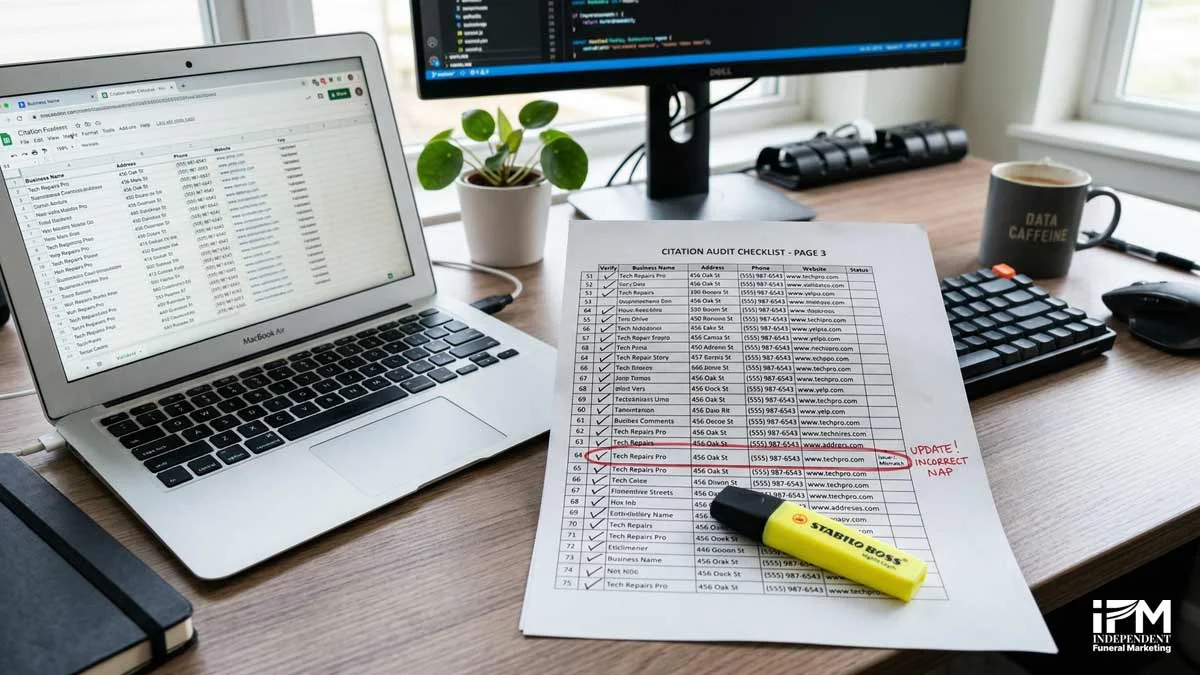
A systematic audit process works as follows:
- Search for your business name in Google, Bing, and DuckDuckGo. Review every listing that appears in the first two pages of results.
- Search for “[Your Business Name] + [Your Town]” and “[Your Phone Number]” separately to surface additional mentions.
- Use a dedicated audit tool. BrightLocal and Whitespark both offer citation audit features that surface listings across hundreds of directories automatically.
- Build a simple spreadsheet: list every directory where you appear, the NAP data shown, and whether it is correct.
- Prioritise corrections by directory authority. Start with Google Business Profile and work down through Tier 1 and Tier 2 platforms.
- For directories you cannot edit directly, contact the directory and request a correction. Most have a business owner claim process.
- Suppress or remove genuine duplicates. Multiple listings for the same business on the same directory confuse Google and dilute your authority signals.
This process takes several hours for an established business with a long history. If you’d prefer to have it handled as part of a structured plan, citation audit and cleanup is included in IFM’s local SEO service for funeral directors.
Does citation building still matter in 2026, or has Google moved on?
Citation building still matters in 2026, but the emphasis has shifted decisively from volume to accuracy and authority. In the early 2010s, submitting your funeral home to hundreds of directories regardless of their quality was a standard local SEO tactic. Google has since become considerably more sophisticated.
What has not changed: Google still needs to verify that your business exists, is where you say it is, and can be contacted on the number you provide. That verification process relies on consistent citation data. For funeral directors specifically, Google applies a higher trust threshold than it does for most local businesses. Bereaved families are making one of the most significant decisions of their lives based on your online presence, and Google reflects that.
What has changed: quality and context matter more than quantity. A single well-maintained listing on Yell (high domain authority, high funeral audience affinity) is worth considerably more than ten listings on generic, low-authority directories nobody uses.
Research from specialist agency audits confirms that between 80 and 90% of cremation services reviewed did not have their Google Business Profile set up correctly [4]. The gap between those who get the basics right and those who don’t remains wide.
Citation consistency also feeds directly into AI search visibility. The IFM audience over-indexes for Perplexity AI search by +8.3% above the UK average. If you want your funeral home to be cited by AI tools like Perplexity and Google AI Overviews, consistent citations are part of the foundation. AI search optimisation for funeral homes covers how to build that visibility systematically.
How long does it take for citation building to affect local rankings?
Citation building typically takes three to six months to produce measurable improvements in local search rankings. New or corrected citations usually begin feeding through to Google’s index within four to eight weeks, but the full effect on your Map Pack position takes longer to become visible, particularly for competitive local search terms.

The general timeline for an independent funeral director starting from scratch, or correcting existing listings:
- Months 1 to 2: citations submitted and verified across Tier 1 and Tier 2 platforms.
- Months 2 to 4: Google begins indexing the updated data. Minor ranking movement may be visible.
- Months 4 to 6: local ranking improvements become measurable. Map Pack position improvements more consistent.
This timeline assumes Google Business Profile is fully optimised and verified in parallel. Citation building alone will not produce results if your GBP is incomplete or unverified. The citations and the GBP profile need to work together.
Frequently asked questions: local citations for funeral directors
What is a local citation for a funeral home?
A local citation for a funeral home is any online mention of your business’s Name, Address, and Phone number. Citations appear on directory sites like Yell and Google Business Profile, on review platforms like Trustpilot, and on data aggregator networks that distribute your details automatically. Google uses citation data to verify your business is real, local, and contactable.
Which directories matter most for funeral directors in the UK?
The three non-negotiable directories for UK funeral directors are Google Business Profile, Bing Places for Business, and Yell.com. Audience data confirms Yell’s 81/100 affinity for UK funeral consumers, and a significant Bing over-index among this audience, making both platforms more relevant than generic local SEO guidance suggests. After Tier 1, Thomson Local, Trustpilot, Apple Maps, and Facebook Business Page provide meaningful secondary signals.
What happens if my funeral home has inconsistent NAP data across directories?
Inconsistent NAP data reduces Google’s confidence in your listing and suppresses your local search rankings. It also means families researching your funeral home may encounter conflicting contact details across platforms, which undermines trust. For established firms with long trading histories, NAP drift is the most common cause of unexpected ranking suppression, and correcting it is one of the highest-return fixes in local SEO.
How many directories should a funeral home be listed on?
There is no single target number. In a low-competition rural area, 20 to 30 quality citations across the right platforms is often sufficient. In a city with several competing funeral directors, 50 to 80 or more may be needed to match established competitors. The key principle is quality over quantity: ten perfectly consistent citations outperform 100 citations where your business name or address varies.
Do I need to pay for directory listings to rank locally?
No. The directories that produce the strongest local SEO signals are all free: Google Business Profile, Bing Places for Business, Apple Maps, Yell.com (free basic listing), Thomson Local (free basic listing), Facebook Business Page, and Foursquare. Paid listing upgrades may offer additional visibility features, but paying for a listing does not generate a stronger SEO signal than an accurate free listing on the same platform.
How long does citation building take to affect local rankings?
New or corrected citations typically begin feeding through to Google’s index within four to eight weeks. Measurable Map Pack ranking improvements generally take three to six months. This assumes Google Business Profile is fully optimised in parallel. Citations alone will not move rankings if your GBP is incomplete or unverified.
Where to start: a practical priority order for funeral directors
If you know your listings need attention, or you have simply never given this deliberate thought, the correct order of priority is:
- Google Business Profile: claim it, verify it, and complete every field. This is your single most important local SEO action.
- Bing Places for Business: takes approximately 30 minutes to set up and reaches an audience most funeral directors ignore entirely.
- Yell.com: claim or correct your listing. Check your NAP against your Google Business Profile exactly, character for character.
- Apple Maps: add your funeral home via Apple Business Connect. Essential for iPhone users and Siri search.
- Citation audit: search your business name and phone number across Google, Bing, and DuckDuckGo. Correct any outdated or conflicting data you find.
- Build outward: add Thomson Local, Trustpilot, and Facebook Business Page. Then work through Tier 3 directories systematically.
For context on what bereaved families actually want when they find you through local search, what at-need searchers are looking for when they type “funeral directors near me” explains the intent behind those searches and how to respond to it.
IFM’s Local SEO service for funeral directors includes citation audit and cleanup as part of a structured local visibility programme. If you’d prefer to have this handled systematically rather than doing it yourself, the service covers every element in this guide.
References
[1] Statista, Search Engine Market Statistics, statista.com/topics/1158/search-engine-market/
[2] BrightLocal, Local Consumer Review Survey, brightlocal.com/research/local-consumer-review-survey/
[3] National Funeral Directors Association, Consumer Awareness Statistics, nfda.org/news/statistics
[4] BrightLocal, Local Search Research, brightlocal.com/research/