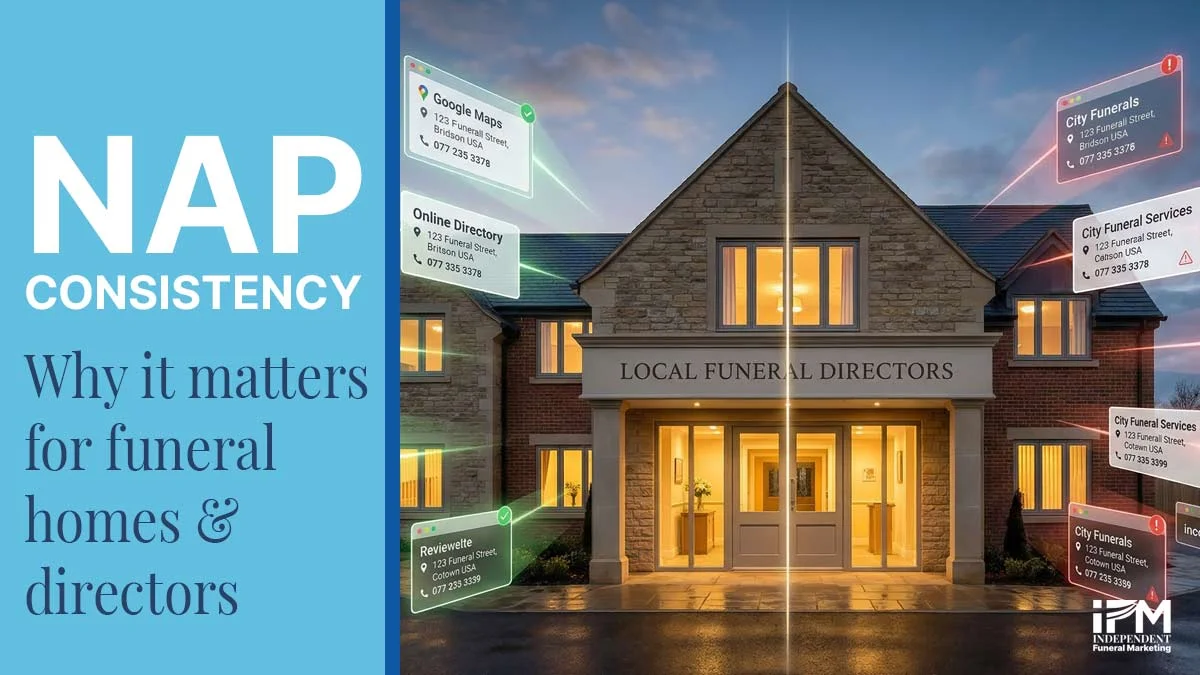
It’s 11pm. A bereaved family types “funeral directors near me” into Google. Your firm appears, but the phone number shown is wrong. They call the next result. You never know they searched for you.
This scenario is more common than most funeral directors realise. “Funeral director near me” generates up to 3,600 US searches per month (DataForSEO, March 2026). Who appears, and with what information, is determined in large part by NAP consistency.
NAP, your business Name, Address, and Phone Number, must appear identically across every online platform. Not approximately. Not close enough. Identically. A space in the phone number, a shortened street name, a trading name that does not match your Google Business Profile, any of these register as conflicting data to search engine crawlers and suppress your local visibility.
66.7% of consumers have visited a funeral home website before making contact [1]. The families who find you online need the right information the moment they look. Wrong details at that moment means a permanent loss, a call that will not be retried.
In this guide, we cover what NAP consistency means for funeral homes, why it directly affects your local search ranking, what the most common errors look like, and how to audit and fix your listings in six steps.
What is NAP Consistency in Local SEO?

NAP consistency is the practice of ensuring your business Name, Address, and Phone Number appear in exactly the same format across every online platform, from your Google Business Profile to directory listings, your website, and mentions in local news or blogs. Inconsistency in any of these three fields reduces search engines’ confidence in your business data and suppresses your local ranking.
The word “consistency” carries more weight than most people expect. “07800 123456” and “07800123456” are different data points to a search engine crawler. “Smith’s Funeral Home” and “Smiths Funeral Home” are treated as different entities. A formatting discrepancy is not a minor issue, it is a conflicting data signal.
Citations, the collective term for any online listing of your business details, fall into two types. Structured citations are entries in business directories with defined data fields for name, address, and phone number, such as Google Business Profile, Yell.com, or Thomson Local. Unstructured citations are brand mentions in articles, blog posts, or local news coverage where your details appear in running text rather than structured fields. Both contribute to Google’s understanding of your business, but structured citations carry more direct weight for local ranking purposes.
There is a third mechanism most funeral homes have never considered: data aggregators. Infogroup (also known as Data Axle) and Neustar Localeze are companies that collect and syndicate business information to hundreds of smaller directories automatically. If an aggregator holds incorrect NAP data for your funeral home, that error propagates silently to directories you have never visited and may not know exist. Updating your Google Business Profile alone does nothing to correct aggregator records.

Key takeaway: NAP consistency is not just about being listed, it is about being listed identically, everywhere, including platforms you did not know you were listed on.
Why NAP Consistency Affects Your Local Search Ranking
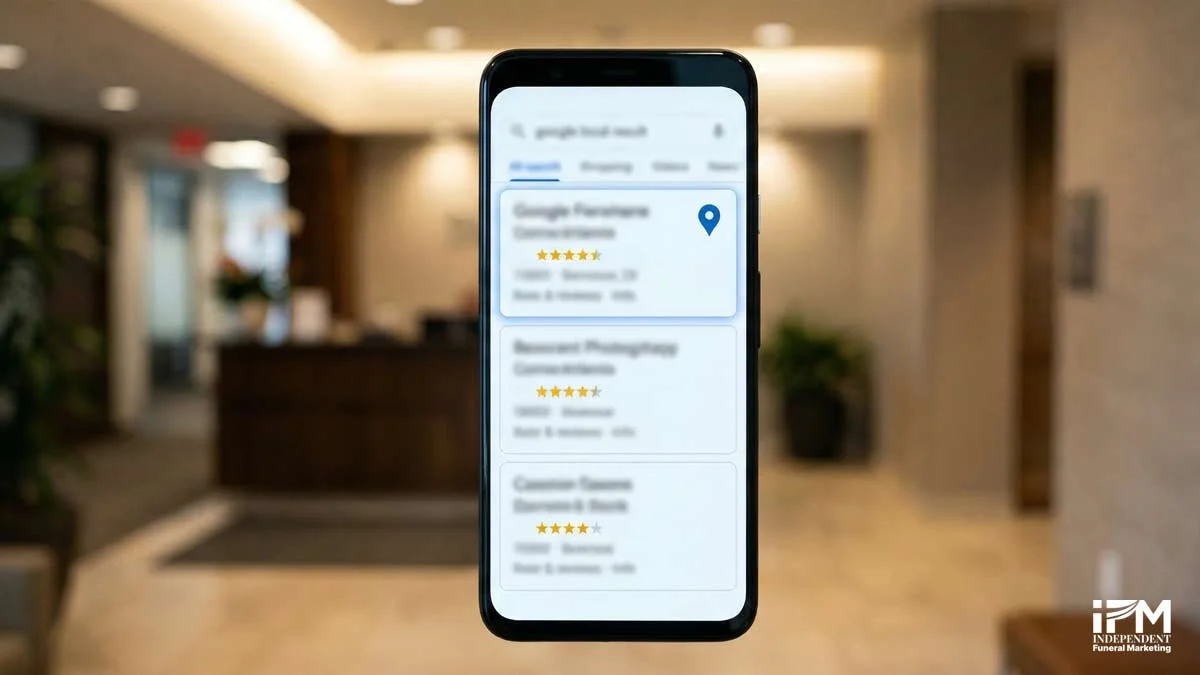
NAP consistency is a core input into Google’s Prominence signal, one of the three factors Google uses to rank businesses in local search. Inconsistent listings across the web reduce Prominence, suppress your Map Pack position, and hand ranking advantage to competitors who may be weaker on service quality but tighter on citation management.
Google evaluates local search results using three factors: Proximity (how close your funeral home is to the searcher), Relevance (how clearly your profile matches the search intent), and Prominence (how well-established and trusted your business appears online). Proximity is fixed by your physical address. Relevance is shaped by your Google Business Profile content and website. Prominence is where independent funeral homes most often lose ground, and where consistent citation management makes the fastest difference.
When multiple authoritative sources independently confirm the same name, address, and phone number, Google treats that confirmation as evidence of a real, established local business. When sources conflict, confidence drops and Map Pack positioning follows.
The Google Local Pack, the three-result map box that appears above all organic search results for local queries, captures approximately 44% of all clicks in local searches [2]. For funeral homes, this is the primary result format for at-need searches. When a bereaved family searches “funeral director near me”, they are most likely to click one of those three results. The firms shown are the ones Google trusts. NAP consistency is one of the core trust signals that earns inclusion.
Corporate chains including Co-op Funeralcare, Dignity, and Funeral Partners invest in managed citation programmes. Independent firms that allow citation drift hand those competitors a ranking advantage they did not earn through service quality. Tightening your NAP data is one of the few actions that closes that gap quickly, without a large budget.
87% of consumers use Google to evaluate local businesses [3]. Your funeral home’s presence in those results, and the accuracy of the information shown, is not incidental to your business. It is the front door.
Key takeaway: NAP consistency is one of the primary signals that determines whether your funeral home appears in Google’s Local Pack when families search for a funeral director near them.
The Six Most Common NAP Errors for Funeral Directors
Most NAP errors are invisible to the funeral home owner. You will not see them unless you look. Here are the six that appear most frequently across independent funeral home audits.
1. Phone number format inconsistency
The same number can appear as 01234 567890, 01234567890, and +441234567890 across different platforms. To a human, these are obviously the same. To a search engine crawler, they are three distinct data points. Choose one standard format and replicate it everywhere without exception.
2. Trading name versus registered name discrepancy
“Smith’s Funeral Home” and “Smith & Sons Funeral Directors Ltd.” are different entities in Google’s data model. Use your trading name as the standard NAP entry, not your Companies House registered name. The trading name is what families recognise and what you want associated with your location.
3. Stale address from a previous location
Data aggregators may retain an old address for months or years after you have updated your Google Business Profile. The fix must happen at the aggregator level, not just at GBP. Updating your GBP alone leaves aggregator records unchanged, and those records continue spreading the old address to secondary directories.
4. Multiple branches sharing one phone number
If your funeral home has more than one location, each branch needs its own distinct local geographic number. A shared head office number across multiple branches sends no individual local signal for any single location. Each branch listing must be independently identifiable.
5. 0800 or 0844 numbers used as the primary NAP number
National numbers are a red flag for Google’s local algorithm. A geographic number with a 01 or 02 prefix signals local presence. 0800 and 0844 numbers signal a national or call-centre operation, which works against local trust signals. Use a local geographic number as your primary NAP entry on every platform.
6. Duplicate listings
Duplicate listings are particularly common on Google Business Profile, created when previous owners, members of staff, or listing aggregation services have submitted independent entries for the same location. Duplicates divide your authority signals and create conflicting NAP data. Google cannot determine which listing is correct, so reduces confidence in both. Any duplicate you find needs to be claimed and removed through the platform’s business owner process.
A UK-specific note on Yell.com: Yell periodically refreshes its data from Companies House, which can silently reintroduce your registered address or registered business name after you have corrected the listing. Yell requires active management, not a single correction. Check it at least twice per year.
Key takeaway: The majority of these errors are invisible. You cannot see a duplicate listing or a data aggregator holding your old address unless you actively look for it.
What NAP Inconsistency Actually Costs an Independent Funeral Home
Consider what a well-run single-branch funeral home stands to lose when a family cannot reach them through a search result. A firm handling 200 funerals per year at an average value of £3,000 per arrangement generates £600,000 in annual revenue. If even 5% of search enquiries are lost because a directory shows the wrong phone number or an old address, that represents approximately ten missed contacts per month. At £3,000 per arrangement, that is £30,000 in potential monthly revenue redirected to a competitor, not because they are better, but because their listings are accurate.
To be clear, we cannot attribute every lost enquiry to NAP errors alone. But we know that Local Pack rankings directly affect enquiry volume, and NAP consistency is foundational to those rankings. The arithmetic above is illustrative, not a guarantee, and the principle behind it is not.
The Avens Marketing case study (2024) quantifies the broader dynamic: a local service business that switched off its Google Business Profile entirely saw a 40% year-on-year drop in revenue. That is not a funeral-specific result, but it confirms the scale of dependency on local search visibility for businesses in this category.
There is also a dynamic unique to funeral search. Families searching at 11pm on a mobile phone, under acute emotional stress, are not browsing. They are deciding. If your number is wrong, they do not try again. They call the next result. That call will not come back.
The good news is that every one of these errors is fixable, and the process is more straightforward than most funeral directors expect.
Key takeaway: NAP inconsistency is not an abstract SEO risk. It is a mechanism by which families who searched for your funeral home end up calling someone else.
How to Audit Your Funeral Home’s NAP Consistency: A Six-Step Process
This is the highest-priority action in local SEO for most funeral homes that have not done it before. A thorough audit of a single-branch firm takes approximately half a working day. The steps are practical and require no technical knowledge.

Step 1: Define your master NAP record (10 minutes)
Before checking anything, write down the single correct version of your NAP. This is your reference point for every comparison you will make.
- Business name: Your trading name, exactly as it appears on your signage and website. Not your Companies House registered name.
- Address: One consistent format for your postcode, street name abbreviations, and punctuation. Stick to it.
- Phone number: One format, applied everywhere. We recommend 01234 567890 with a space after the area code.
Save this document. Every listing in the world gets compared against it.
Step 2: Run a manual Google and Bing search audit (30 minutes)
Search for your business name plus your town in Google, in Bing, and in Apple Maps. Note every listing that appears, where it appears, and what information it shows. Open each one and compare against your master record. Log every discrepancy in a spreadsheet. This takes 30 minutes for a single-branch firm and will surface most of the problems you need to fix.
Step 3: Check the six priority platforms (60 to 90 minutes)
In this order:
- Google Business Profile
- Bing Places for Business
- Apple Maps Connect
- Yell.com
- Thomson Local
- Facebook Business Page
These are the highest-weight platforms for UK funeral homes. Bing Places deserves explicit mention here. IFM audience research confirms that the UK funeral director audience uses Bing at a rate 8.3% above the UK average (SparkToro, March 2026), yet Bing Places is consistently the most neglected platform. That combination makes it one of the highest-return, lowest-effort actions in this entire guide. Most UK funeral firms have never claimed their Bing Places listing.
Step 4: Run a citation audit tool (20 minutes plus setup)
For a scan beyond what manual searching can reach, use one of the following:
- BrightLocal Citation Tracker, which surfaces citations across hundreds of directories and offers a free trial
- Moz Local Listing Score, which gives an overview of your citation health across major platforms
- Whitespark Citation Finder, useful for a deeper audit across niche and industry directories
These tools surface data aggregator entries you would never find manually. Running one of them once a year is worthwhile for any funeral home managing its own local presence.
Step 5: Check your own website (15 minutes)
Your website is Google’s most authoritative NAP source. Check the footer, the contact page, and any branch-specific pages. Ensure the information matches your master record exactly. If you have LocalBusiness schema markup on your site, verify that the NAP in the schema also matches. A discrepancy between your website schema and your GBP is a particularly damaging conflict, because Google treats both as high-confidence signals.
Step 6: Fix, claim, and submit, in priority order (2 to 4 hours for a single location)
Start with Google Business Profile. Claim any unclaimed listings. Request corrections on each platform using its business owner tools, working through the priority platforms from Step 3. For data aggregators, submit corrections directly to Infogroup/Data Axle and Neustar Localeze. Allow 4 to 8 weeks for aggregator corrections to propagate to the directories that depend on them.
Total DIY audit for a single-branch firm: approximately half a working day.
Key takeaway: A thorough NAP audit for a single-branch funeral home takes approximately half a working day, and the return on that time is permanent improvement to your local search visibility.
The Most Important Directories for UK Funeral Homes
You do not need to be listed on hundreds of directories. You need to be listed accurately on the right ones.
| Tier | Directory | Why it matters |
|---|---|---|
| Critical | Google Business Profile | Primary local ranking signal and Local Pack eligibility |
| Critical | Bing Places for Business | UK funeral director audience uses Bing 8.3% above average. One of the highest-return listings to claim and correct |
| Critical | Apple Maps Connect | Growing significance as iOS usage and voice search increase |
| High priority | Yell.com | Major UK data aggregation source. Periodically refreshes from Companies House, requiring active management |
| High priority | Thomson Local | UK-specific directory with significant domain authority for local queries |
| High priority | Facebook Business Page | Secondary social citation and a direct family discovery tool |
| High priority | Trustpilot | Dual function: citation signal and review visibility |
| Industry-specific | Funeral Guide UK | Funeral-specific directory used by families researching options |
| Industry-specific | Beyond.life | High audience affinity with funeral directors’ existing clients, making it visible to families most likely to search for you |
| Industry-specific | FreeIndex | UK business directory with useful local search presence |
Key takeaway: You do not need to be listed on hundreds of directories. You need to be listed accurately on the platforms above.
How Often Should You Audit Your Citations?
The minimum is once per year. The recommended schedule for a growing or multi-branch firm is quarterly. The non-negotiable trigger is immediacy: audit after any address change, phone number change, business name change, branch opening, or branch closure. Do not wait for your next scheduled review after a change. Data aggregators can propagate incorrect information faster than you can manually correct it, so the sooner you update the source, the shorter the contamination window.
A UK-specific note: Yell.com refreshes data from Companies House, which can reintroduce old registered address information months after you have corrected it. UK funeral firms should specifically re-check Yell at least twice per year, regardless of other audit cycles.
Multi-branch funeral homes face a particular challenge. Each branch needs its own master NAP record, its own audit cycle, and its own Google Business Profile. A correction to one branch’s GBP does not propagate to other listings for that branch automatically. Treat each location as an independent audit item, not a single exercise.
Key takeaway: Treat your NAP audit like your fire safety check, not something you do once and forget, but a routine maintenance task on a fixed schedule.
When to Bring in a Local SEO Specialist
A single-branch funeral home with a manageable set of NAP errors can usually self-correct in an afternoon, following the six-step process above. There are situations where professional help is the more practical choice.

Consider bringing in a specialist if:
- You have multiple branches and the audit reveals different errors across each one
- You have found 20 or more incorrect or duplicate listings and the correction process feels unmanageable
- You have made corrections and waited 12 weeks with no measurable improvement in Local Pack visibility
- Your time as a funeral director is worth more than the hours this work would consume
IFM’s local SEO service for independent funeral directors includes a full citation audit, correction, and ongoing monitoring as part of a structured local visibility programme. If you have completed the DIY audit and corrections but your rankings have not moved, something else is suppressing your visibility, and a second set of eyes will identify it.
Key takeaway: A single-branch funeral home with straightforward NAP errors can usually self-correct in an afternoon. Multi-branch operations with years of citation drift are a different proposition.
Frequently Asked Questions About NAP Consistency for Funeral Homes
What does NAP stand for in local SEO?
NAP stands for Name, Address, and Phone Number. In local SEO, NAP consistency means these three pieces of business information appear in exactly the same format across every online platform, from your Google Business Profile and website to directories like Yell, Bing Places, and Apple Maps.
Does NAP consistency affect Google Maps rankings?
Yes, directly. Google uses citation consistency as a local prominence signal. When your NAP is inconsistent across directories, Google finds it harder to confirm your business details and is less likely to show you in the Local Pack, the map results that appear for “funeral director near me” searches.
How do I check if my funeral home’s NAP is consistent?
Start by searching Google and Bing for your business name and town. Compare every listing you find against your master NAP record. For a comprehensive audit, tools like BrightLocal, Moz Local, or Whitespark will surface citations across hundreds of directories automatically.
How long does a NAP audit take for a funeral home?
A single-branch funeral home can complete a manual audit in approximately three to four hours, or half a working day if using an audit tool. Corrections then take additional time depending on how many discrepancies are found. Multi-branch operations or firms with years of citation drift should expect a full day or more.
Should I use a local number or 0800 for my funeral home’s NAP?
Use a local geographic number, one with a 01 or 02 prefix. Google’s local algorithm treats geographic numbers as a stronger local signal than national numbers. Each branch should have its own unique local number, not a shared head office number.
How do I manage NAP consistency across multiple funeral home branches?
Each branch needs a separate master NAP record with its own unique address, local phone number, and consistent use of the branch name. Avoid using a shared head office number across multiple branches, as this undermines the individual local signal for each location.
How often should I audit my funeral home’s citations?
Audit at minimum once per year, and immediately after any change to your address, phone number, or business name. Quarterly audits are advisable for multi-branch firms or those actively working to improve their local search ranking. Never wait for a scheduled audit after a business change.
What are data aggregators and do they affect funeral home listings?
Data aggregators, such as Infogroup (Data Axle) and Neustar Localeze, are companies that collect and distribute business information to hundreds of smaller directories. If an aggregator holds incorrect NAP data for your funeral home, that error propagates automatically across directories you may never have visited or corrected.
Can a duplicate Google Business Profile hurt my funeral home’s ranking?
Yes. Duplicate listings divide your authority signals and create conflicting NAP data, which reduces Google’s confidence in your correct listing. If you find duplicate GBP entries, report them for removal through Google’s Business Profile management tools.
Does Bing require separate citation management for funeral homes?
Yes. Bing Places for Business is independent of Google Business Profile, and NAP data must be managed separately on each platform. Given that the UK funeral director audience uses Bing at a measurably higher rate than average, Bing Places is one of the highest-return listings to get right, and one of the most commonly neglected.
Summary: What Every Independent Funeral Director Should Do This Week
NAP consistency will not transform your local search presence overnight, but it is the foundation everything else rests on. Independent funeral homes that get this right, and then build on it, will reliably outperform competitors and corporate chains that neglect it.
Here is where to start:
- Write down your master NAP record: exact name, address, and phone number in one chosen format.
- Search Google and Bing for your business name. Log every listing that appears and check it against your master record.
- Claim and correct your six priority platforms: GBP, Bing Places, Apple Maps, Yell, Thomson Local, Facebook.
- Run a free BrightLocal or Moz Local scan to surface hidden citations.
- Set a calendar reminder to audit again in six months.
To understand how NAP consistency fits into a complete local SEO programme for independent funeral directors, see how IFM structures this work as part of a full local visibility strategy. For more on the broader ranking factors at play, the local SEO guide for funeral homes covers the complete picture.
References
[1] NFDA Statistics (via ARFDA), www.arfda.com/wp-content/uploads/2024/02/NFDA-Statistics.pdf
[2] OneUpWeb, Local Search Results and Map Packs, www.oneupweb.com/blog/local-search-results-map-packs/
[3] BrightLocal, Local Consumer Review Survey 2023, www.brightlocal.com/research/local-consumer-review-survey-2023/