![On-Page SEO for Funeral Homes: What Every Page Needs [2026 Guide]](/images/blog/09-on-page-seo-for-funeral-homes/on-page-seo-funeral-homes-og.webp)
On-page SEO for funeral homes is the foundation every independent funeral director’s website needs before any other form of digital marketing can work effectively. When a family searches for a funeral director at the worst moment of their lives, the page that wins the click is not random, it is the result of deliberate optimisation decisions made months earlier.
This guide is written specifically for independent funeral directors, not generic small businesses. It covers the ten on-page elements every page needs, applies them by page type, and includes a complete checklist you can use right now. No technical background required.
Watch or listen to this guide
What is on-page SEO, and why does every funeral home website need it?
On-page SEO is the process of optimising the individual elements of each web page, including title tags, headings, content, images, and schema markup, so that search engines can accurately understand, index, and rank that page for the right queries. For funeral homes, it is the foundation of all other digital marketing: without it, even the best Google Business Profile and the most positive reviews will not reliably turn search traffic into first calls.
Think of it this way: your Google Business Profile helps you appear in the Map Pack; backlinks help build your site’s authority; ads put you in front of searchers immediately. But on-page SEO is what tells Google what each page is about and why it should rank. Without it, everything else underperforms.
It is also important to understand what on-page SEO is not. It does not cover links from other websites (off-page SEO), your Google Business Profile (local SEO), or site architecture and crawlability issues (technical SEO for funeral home websites). These are related disciplines. On-page SEO is about what is on each individual page. For the full picture of how all four types work together for funeral homes, see our SEO service for funeral directors.
The competitive opportunity is real. Most independent funeral home websites still have poorly optimised pages, including title tags that do not match the page content, missing schema markup, and slow load times on mobile. For funeral homes that do get this right, the gap in visibility over local competitors is significant.
What is the difference between on-page SEO and local SEO for funeral homes?
On-page SEO optimises what is on each individual page of your website. Local SEO optimises how your business appears in location-based search results, including your Google Business Profile, Map Pack position, and NAP citations across the web. Both are needed and they are complementary, not competing.
Why are funeral home websites held to a higher standard by Google?
Funeral home websites sit in Google’s YMYL category, short for “Your Money or Your Life.” This classification applies to sites where poor-quality or inaccurate content could directly affect a person’s health, safety, financial stability, or significant life decisions. Funeral services qualify clearly. Google applies its E-E-A-T quality framework more rigorously to YMYL sites, which means thin, generic, or unverifiable content is penalised more heavily here than it would be on a restaurant or retail website. E-E-A-T is covered fully in H2 11 below.
What are the core on-page elements every funeral home page needs?
Every page on a funeral home website should have ten on-page SEO elements in place: a keyword-optimised title tag, a compelling meta description, a clear H1 heading with supporting H2 and H3 structure, a clean URL slug, well-written content that matches search intent, schema markup, optimised images with descriptive alt text, internal links to related pages, E-E-A-T signals, and a fast mobile-friendly load experience.
Each element is covered in depth in the sections below. Here is a brief summary:
- Title tag — the clickable headline in search results; your most direct on-page ranking signal
- Meta description — the summary text below the title; influences click-through rate
- H1 heading and structure — tells Google and visitors what the page is about; one per page only
- URL slug — the readable web address for the page; should include the primary keyword
- Page content — the words on the page; must serve both Google and grieving families
- Schema markup — structured code that communicates meaning to search engines and AI platforms
- Image alt text and file names — how search engines read your images
- Internal links — connections between your own pages; distribute authority and guide visitors
- E-E-A-T signals — credentials, qualifications, and trust signals that establish credibility
- Page speed and mobile optimisation — a confirmed ranking factor; critical for mobile searchers in distress
This is the on-page SEO checklist for funeral homes. Every page, from your homepage to individual service pages to your contact page, should have all ten in place before it goes live.
How do title tags work, and what should a funeral home’s look like?
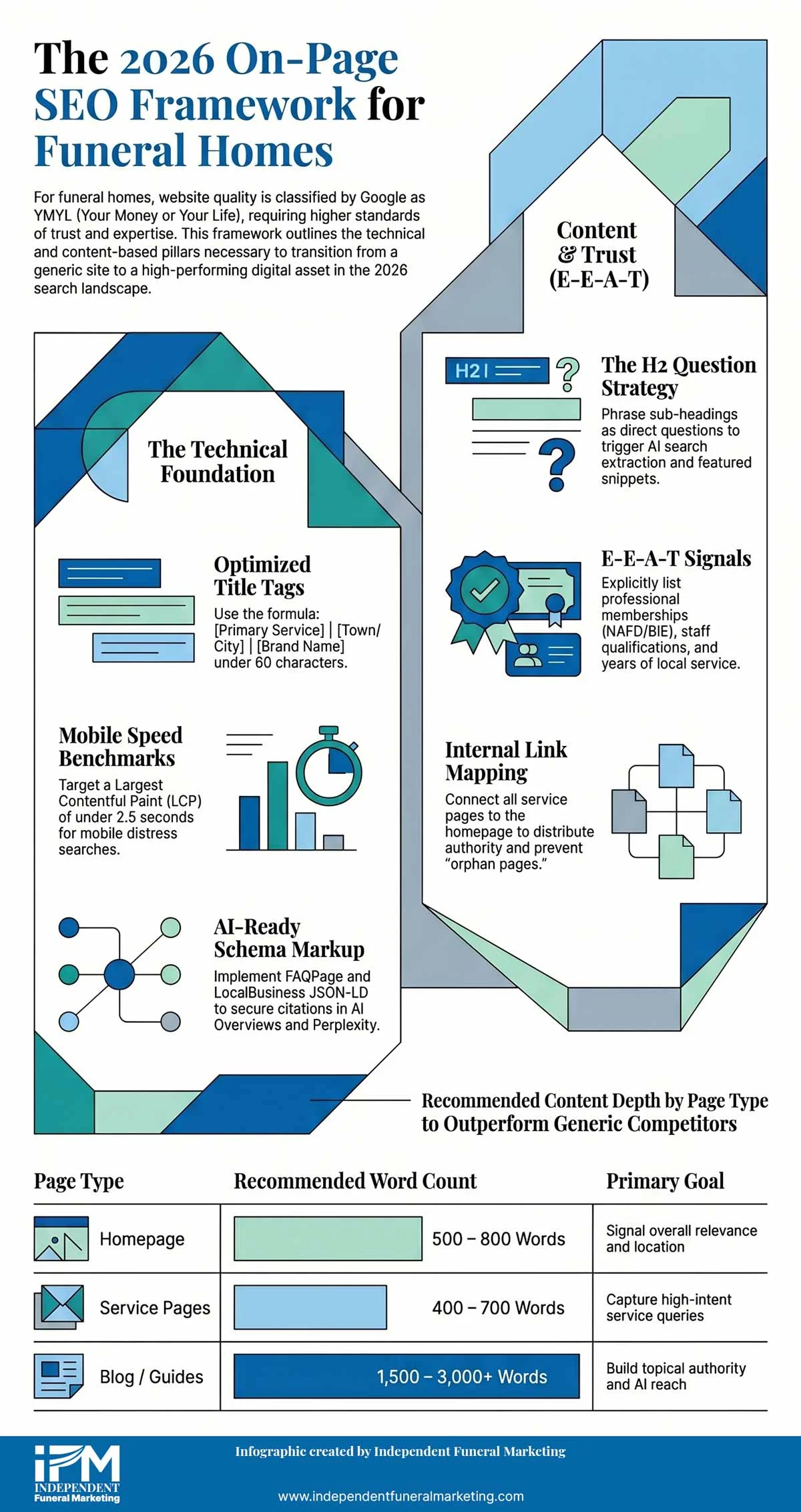
A title tag is the HTML element that defines the clickable headline displayed in search engine results. For funeral homes, the ideal title tag follows this formula: [Primary Keyword] + [Location] + [Brand Name], kept within 50 to 60 characters so it displays in full without being truncated by Google. [1]
The title tag appears in three places: the clickable blue link in search results, the browser tab at the top of the window, and as the default text when a page is shared on social media. It is not the same as your H1, although they should be closely aligned.
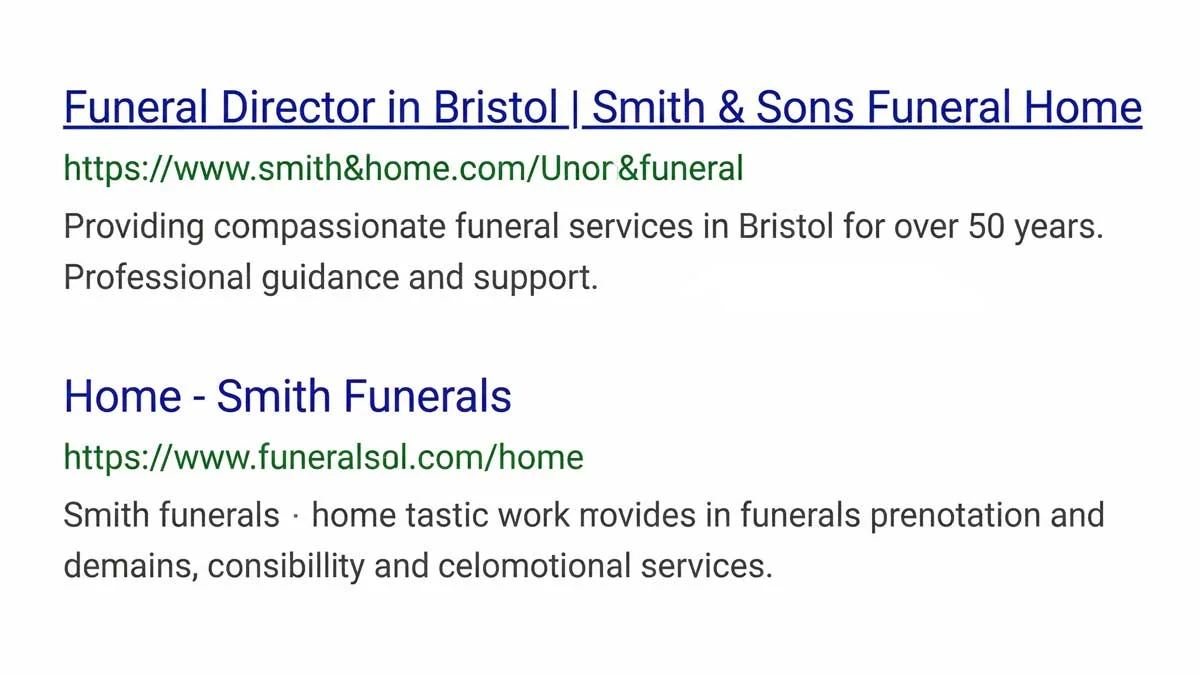
Google rewrites approximately 60% of title tags it encounters. The most common reason is that the existing title tag is too vague, keyword-stuffed, too long, or does not accurately reflect what is on the page. The best defence is to write a title tag that matches your H1, describes the page precisely, and includes both the primary keyword and location.
What is the ideal title tag formula for a funeral home website?
The formula is: [Primary Service or Keyword] | [Town or City] | [Funeral Home Name]
Three worked examples:
- Homepage:
Funeral Director in Bristol | Smith & Sons Funeral Home - Cremation service page:
Cremation Services in Oxford | Smith & Sons Funeral Home - Location page:
Funeral Director in Witney | Smith & Sons Funeral Home
Keep each title tag under 60 characters. Include the town-level location, not just the county. Do not rely on Google inferring location from your domain or GBP.
Common title tag mistakes funeral homes make, and how to fix them
| Mistake | What it looks like | What to do instead |
|---|---|---|
| Brand name only | Smith Funerals | Add keyword and location |
| Missing location | Funeral Director Services | Include town name |
| Duplicate across pages | Same title on homepage and services page | Write a unique title for every page |
| Keyword stuffing | Funeral Home Funeral Director Funeral Services Bristol | One primary keyword, one location, brand name |
| Too long | Title truncated with ... in results | Keep under 60 characters |
What is a meta description, and does it affect funeral home rankings?
A meta description is the short text summary that appears beneath a title in search results. It is not a direct ranking factor, Google has confirmed this, but it directly affects click-through rate, which does influence rankings indirectly. [2] For funeral homes, a well-written meta description that includes a clear benefit, location, and a quiet call to action can meaningfully increase the number of families who click through to your website.
Keep meta descriptions between 140 and 155 characters. Beyond this, Google truncates with an ellipsis. Avoid copying the first paragraph of your page content verbatim, and never use the same description across multiple pages.
Google rewrites meta descriptions in around 70% of cases, typically when it decides a different part of the page better matches the search query. The way to reduce rewrites is to write a description so complete and relevant that Google has no reason to replace it.
Does Google actually use my funeral home’s meta description?
Sometimes. Google tends to use your written description when it closely matches the search query. It tends to rewrite when your description is generic, too short, or does not reflect what the page actually covers. Write the description for a person, not for Google, and Google is more likely to keep it.
Meta description formula for each funeral home page type
| Page type | Formula | Example (~150 characters) |
|---|---|---|
| Homepage | [Town] funeral director. [One benefit]. [Quiet CTA]. [Brand name]. | Independent funeral directors in Bristol. Family-run, available 24 hours. Speak to our team today. Smith & Sons Funeral Home. |
| Cremation service | [Service] in [Town]. [What families can expect]. [Quiet CTA]. | Cremation services in Oxford. Simple, dignified, and fully guided. Call us on [number] to arrange a time to speak. |
| About page | [Brand name] — [years] serving [area]. [What makes you different]. | Smith & Sons Funeral Home — serving Oxford families since 1987. Independent, family-run, NAFD members. |
| Contact page | [How to reach you]. [Opening hours signal]. [NAP signal]. | Contact Smith & Sons Funeral Home in Oxford. Available 24 hours. Call, email, or visit us on [address]. |
How do heading tags (H1 to H3) structure a funeral home page for Google?
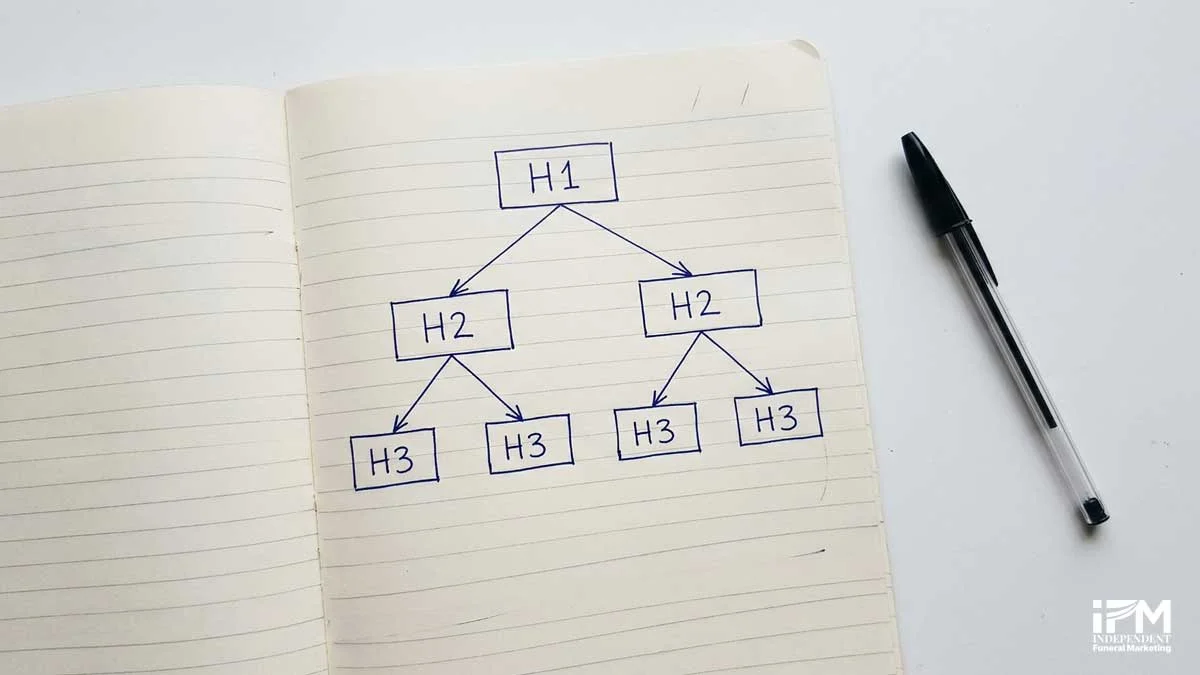
Heading tags (H1, H2, H3) create the structural hierarchy of a web page, helping both search engines and visitors understand the content at a glance. Every funeral home page should have exactly one H1 that reflects the page’s primary topic, supported by H2 headings that organise the main sections, and H3 headings for sub-points within those sections. Structured headings improve crawlability, increase the chances of featured snippets, and are a prerequisite for AI platform citation.
H2s function as section anchors. Each one should be a clear, keyword-bearing statement or question that tells Google, and the reader, what that section answers. This article uses question-format H2s throughout, which is exactly the structure recommended here.
Common mistakes to avoid: using multiple H1s on the same page, using headings for visual styling (use CSS for that), skipping heading levels (going from H1 directly to H3), and using vague labels like “Our Services” instead of keyword-bearing headings like “What funeral services do we offer in Oxford?”
How many H1 tags should a funeral home page have?
One, and only one. Multiple H1s on a single page send conflicting signals to search crawlers about what the page is actually about. Every page on your funeral home website should have a single H1 that contains or closely mirrors the primary keyword for that page. Additional sections use H2 and H3.
How to write H2 headings that rank in Google’s AI Overviews
Phrase every H2 as a direct question that a family or funeral director might actually ask. Immediately below the heading, answer it in 40 to 60 words before adding any further explanation. This is the format Google’s AI Overviews and AI platforms like Perplexity use to extract and cite content. If the answer is buried in paragraph three, it will not be extracted.
What URL structure should a funeral home website use?
A URL slug is the part of a web address that identifies a specific page. For funeral homes, the best URL slugs are short, lowercase, use hyphens between words, include the primary keyword, and omit stop words. A well-structured URL like /funeral-services-bristol tells Google, and the person reading the address bar, exactly what the page is about.
Rules to follow: lowercase only, hyphens not underscores, no dates in content page URLs, no ID numbers or query parameters, no random strings. Do not add unnecessary words.
A critical warning: if you change the URL of a page that is already live and ranking, you must set up a 301 redirect from the old URL to the new one. Without it, you will lose any ranking equity that page had accumulated.
Should a funeral home use a .co.uk or .com domain for UK SEO?
For UK-only operators, a .co.uk domain provides a stronger geographic relevance signal for UK searches and is the clear choice. A .com domain is worth considering only if you are planning to serve both UK and US markets. Either domain can rank well in local UK searches with proper on-page and local SEO in place.
URL slug examples for common funeral home pages
| Page type | Formula | Example |
|---|---|---|
| Homepage | / | / |
| Services overview | /funeral-services | /funeral-services |
| Individual service | /[service]-[town] | /cremation-services-bristol |
| About page | /about | /about |
| Location page | /funeral-director-[town] | /funeral-director-witney |
| Blog post | /blog/[topic-keyword] | /blog/on-page-seo-funeral-homes |
| Contact page | /contact | /contact |
How do you write page content that ranks, and actually helps grieving families?
Funeral home page content must serve two audiences simultaneously: Google’s crawlers, which need keyword signals and structured information to understand and rank the page; and grieving families, who need clear, compassionate, practical information delivered without jargon or sales pressure. Content that achieves both, useful, locally specific, and well-structured, consistently outperforms content optimised for only one audience.
These two goals are not in conflict when done right. Good content for a person searching in distress is also good content for a search engine evaluating quality. The mistake is writing for one at the expense of the other.
Keyword placement: Include the primary keyword in the first 100 words of the page, in the H1, and in at least one H2. Use secondary keywords naturally throughout. Do not repeat the exact keyword phrase more than three or four times; instead, use synonyms and related phrases. Search engines now read language the way humans do.
Content length by page type:
| Page type | Recommended word count |
|---|---|
| Homepage | 500 to 800 words |
| Individual service page | 400 to 700 words |
| About page | 400 to 600 words |
| Location page | 350 to 600 words |
| Blog post or guide | 1,500 to 3,000+ words |

Uniqueness: Every service page must have unique, specific content. Do not copy a generic paragraph across your cremation, burial, and memorial pages with only the service name swapped out. Google identifies this as thin, templated content, and it ranks accordingly.
Local specificity: Mention the town and surrounding areas you serve. Reference local context where it is genuine, for example the name of the local crematorium, nearby communities, or local churches. This signals relevance for local queries without over-engineering.
How long should a funeral home service page be?
A single service page needs 400 to 700 words. That is enough to cover the service fully, address the questions families bring to the page, and place keywords naturally, without padding. Longer is not automatically better. A 1,200-word service page padded with repetition will underperform a focused 550-word page that answers every genuine question a family has.
What is “helpful content” for a funeral home website?
Helpful content, as Google’s Quality Rater Guidelines define it, is content that would genuinely satisfy a person who needed that information. For funeral homes, that means answering the questions grieving families actually have: what happens when someone dies, what the arrangement meeting involves, what options exist, what it costs, and who to call. Not a sales brochure. If a family leaves your page with less anxiety about the process than they arrived with, that is helpful content.
How to write about sensitive topics without hurting your rankings
Tone calibration matters here. Write with warmth but without sentimentality. Use the language families use: “passed away” rather than “deceased”, “the person who has died” rather than clinical terminology. Avoid graphic clinical terms. This is not just a tone preference; pages that feel appropriate to the emotional state of the reader produce lower bounce rates, and lower bounce rates are a positive user signal.
What is schema markup, and which types should a funeral home use?
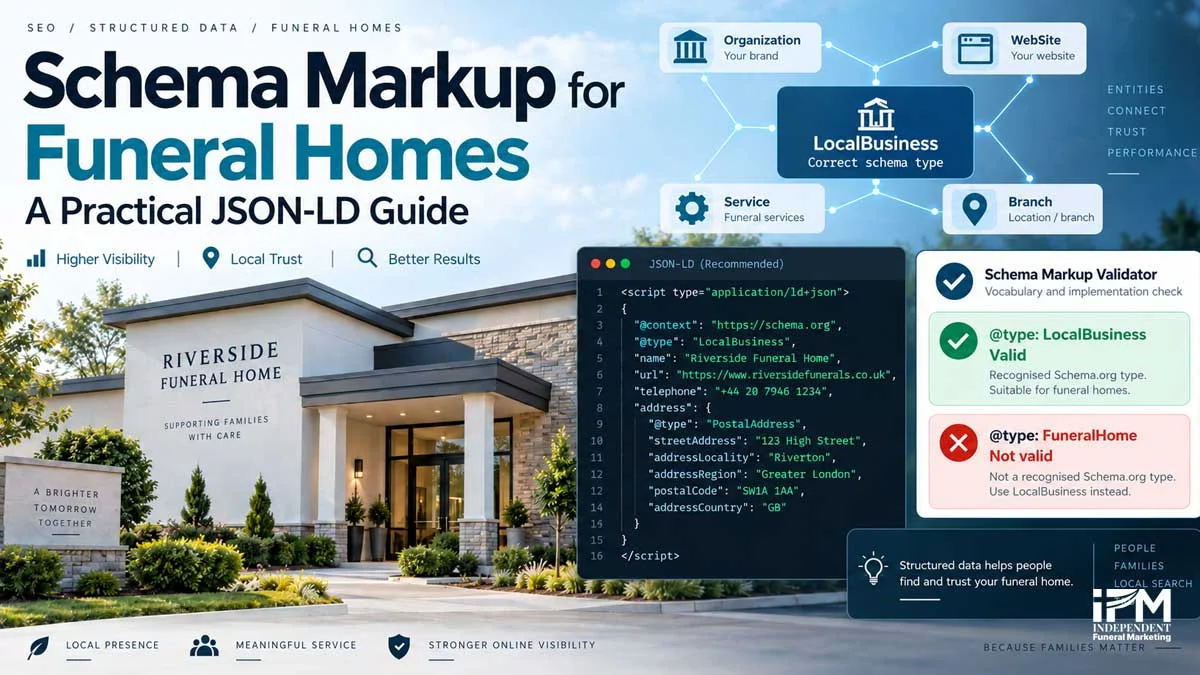
Schema markup is code added to a web page that tells search engines, and AI platforms like Google AI Overviews, Perplexity, and ChatGPT, the precise meaning of the content on that page. For funeral homes, schema helps Google understand that a page describes a local funeral business, what services it offers, where it operates, and which questions it answers. It does not directly improve rankings, but it significantly improves how and where a funeral home’s content appears in modern search results.
Always use JSON-LD format, which Google recommends. It sits in the <head> of the page and does not interfere with page layout or design.

Does schema markup help a funeral home rank higher on Google?
Not directly. Google has confirmed that schema markup is not a direct ranking factor. However, it improves eligibility for SERP features including rich results, People Also Ask boxes, and AI Overview citations, all of which increase click-through rate, which does affect rankings indirectly. For AI platforms specifically, structured data is more directly impactful: Perplexity, ChatGPT, and Google AI Overviews use it to identify authoritative, factual sources worth citing. [3]
What type of schema should a funeral home website use?
| Schema type | Where to use it | What it communicates |
|---|---|---|
| LocalBusiness (FuneralHome subtype) | Homepage | Business name, address, phone, hours, geo coordinates |
| Service | Individual service pages | Service name, description, service area |
| FAQPage | Any page with a Q&A section | Discrete question and answer pairs |
| BlogPosting | All blog posts and articles | Article title, author, date, topic |
| BreadcrumbList | All pages with breadcrumb navigation | Page hierarchy for search results |
| AggregateRating / Review | Homepage or testimonials page | Review scores from verified sources |
Only mark up content that is actually visible on the page. Invented or hidden schema is a violation of Google’s guidelines and will be ignored or penalised.
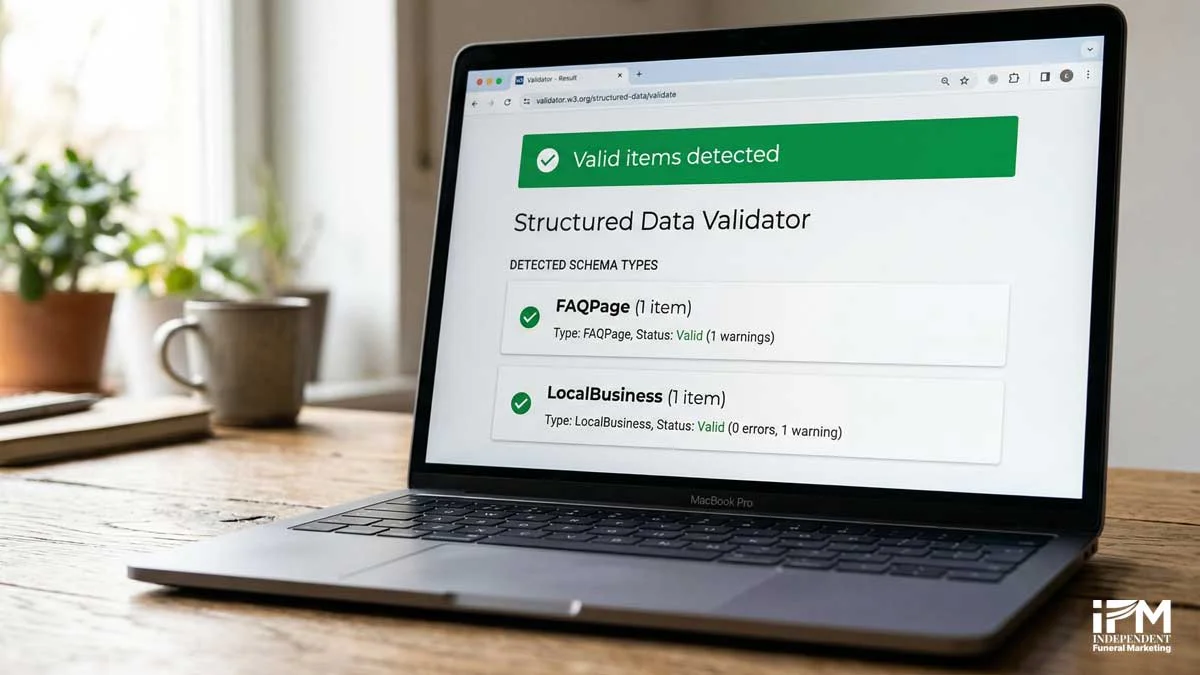
Validate every schema implementation using Google’s Rich Results Test before publishing. Invalid schema is simply ignored.
For full JSON-LD code examples, a complete property reference, and funeral-sector nuances like UK classification codes and CMA price compliance, see our full schema markup implementation guide.
How does schema markup help funeral homes appear in AI search results?
The audience for funeral home marketing over-indexes significantly on AI platforms. SparkToro audience research shows funeral director audiences use Perplexity at +28.2% above the UK average and Bing at +8.3% above the UK average. [4] AI platforms index the web and use structured data to identify credible, factual sources. FAQPage schema signals that a page contains discrete Q&A content, which is the format AI platforms prefer to extract and cite. If you want your funeral home to appear in AI-generated answers, FAQPage schema on every page with a Q&A section is one of the most direct actions you can take.
How do images affect SEO on a funeral home website?
Images affect funeral home SEO in three ways: alt text provides keyword context that search engines read; file names contribute to image search visibility; and file size directly impacts page load speed, which is a confirmed Google ranking factor. Well-optimised images improve both search performance and the user experience for families visiting your site.
Alt text: Every image needs an alt text attribute that describes what the image shows. This is read by screen readers (accessibility), search crawlers (contextual signal), and image search indexing. Formula: [what the image shows] + [specific location or business name] where relevant. Maximum 125 characters. Example: chapel of rest at Smith Funeral Home, Bristol, not IMG_4592 or just chapel.
File naming: Name images before you upload them. funeral-chapel-bristol.webp carries keyword signal; IMG_4592.jpg carries nothing.
File format and compression: Use WebP format wherever possible. WebP files are significantly smaller than JPEG at the same visual quality, which directly improves page load time. This site uses WebP for all images as standard.
What alt text should I use for funeral home images?
Use descriptive, specific alt text that tells the crawler what is in the image and, where relevant, where it is. Three examples:
exterior of Smith & Sons Funeral Home on the High Street, Oxfordchapel of rest at Smith Funeral Home, Bristol, with floral arrangementsfuneral director Paul Smith discussing arrangements with a family at Smith & Sons
Never keyword-stuff alt text. One or two relevant terms in a natural description is correct. A string of keywords is a spam signal.
What images should a funeral home website have for SEO and trust?
| Image type | Why it matters |
|---|---|
| Building exterior | Confirms physical presence; trust signal |
| Chapel of rest | Shows families what to expect; reduces anxiety |
| Arrangement room | Sets expectations; E-E-A-T signal |
| Staff headshots | Named individuals support E-E-A-T credentials |
| Gardens or grounds | Adds warmth; reduces clinical feel |
| Community or ceremony (with consent) | Demonstrates experience; social proof |
Authentic photography consistently outperforms stock images for trust signals and E-E-A-T. A genuine photo of your premises tells Google, and families, that this is a real, established local business.
What is internal linking, and how should a funeral home use it?
Internal links are hyperlinks that connect one page on your website to another page on the same website. For funeral homes, a well-structured internal linking strategy distributes page authority across the site, helps Google’s crawlers discover and index every page, and guides families from general information to the specific service they need, improving both rankings and conversions.
Every page on your funeral home website should have at least one internal link pointing to it. Pages with no inbound internal links, called orphan pages, cannot be reliably discovered by Google’s crawlers and are unlikely to rank.
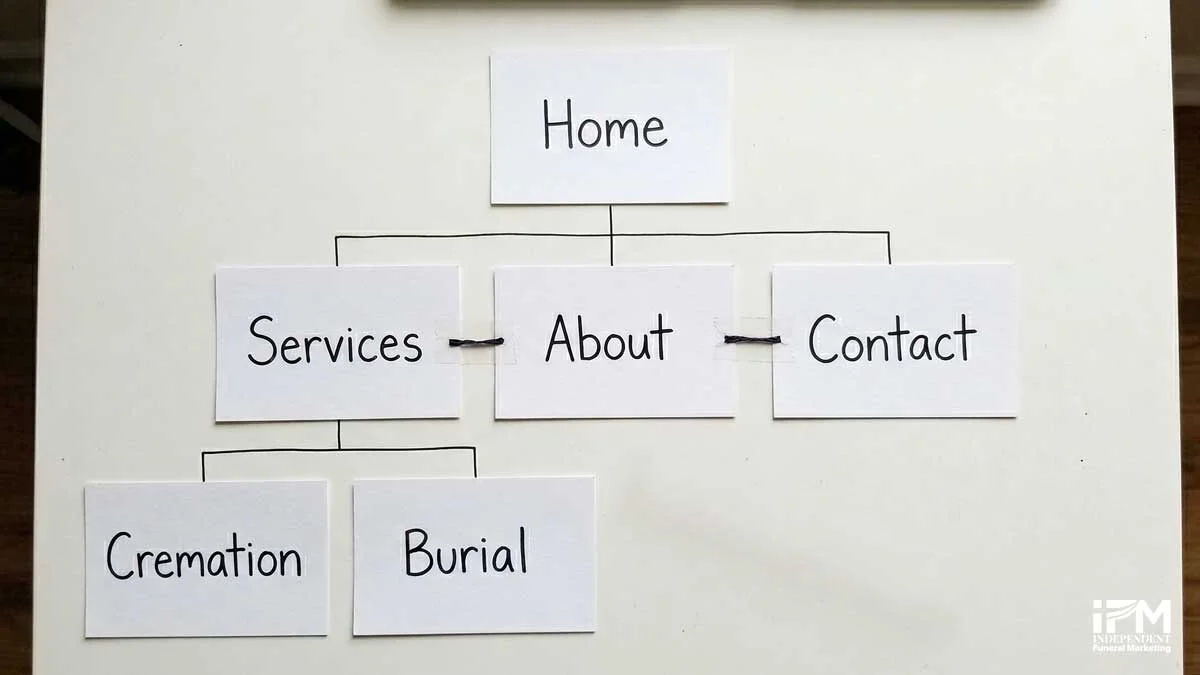
A sensible model for a funeral home site: the homepage links to all main service pages; service pages link to each other where relevant (cremation links to burial, memorial links to pre-need planning); blog posts link to two to four service pages using natural anchor text; and location pages link to services and the contact page.
A reasonable guideline is three to eight contextually relevant internal links per service page. Do not force links. They must be relevant to the reader at the point they appear.
Which pages on a funeral home website should link to each other?
| Page | Should link to |
|---|---|
| Homepage | All service pages, About, Contact |
| Service pages | Related services, Contact, relevant blog posts |
| About page | Services, Contact |
| Blog posts | 2 to 4 relevant service pages, related articles |
| Location pages | Services, Contact |
| Contact page | Homepage, key service pages |
What anchor text should a funeral home use for internal links?
Use descriptive, keyword-bearing anchor text that reads naturally in context. Good examples: “our cremation services in Bristol”, “how to manage your funeral home’s Google reviews”, “our guide to local SEO for funeral directors”. Poor examples: “click here”, “read more”, “find out”. Descriptive anchor text is a relevance signal for the destination page.
NAP consistency across directories is a foundational local ranking signal that directly supports on-page credibility.
What is E-E-A-T, and why does Google apply it strictly to funeral home websites?
E-E-A-T stands for Experience, Expertise, Authoritativeness, and Trustworthiness. It is the framework Google’s Quality Raters use to evaluate whether content is genuinely helpful and produced by credible sources. Funeral home websites sit in the YMYL (Your Money or Your Life) category, which means Google applies E-E-A-T standards more rigorously to them than to most other local business websites. [5]
Google’s December 2025 Core Update increased the weighting of E-E-A-T signals across all content. Pages in YMYL sectors with thin credentials or generic content saw ranking drops during this update. Independent funeral homes with genuine credentials, real staff profiles, and specific local content were largely unaffected.

Experience on-page: Staff bios with years of experience, photos of the premises and team, family tributes and testimonials (with consent), and genuinely local content that demonstrates first-hand knowledge of the area.
Expertise on-page: Professional qualifications named explicitly. In the UK: NAFD (National Association of Funeral Directors) and BIE (British Institute of Embalmers) membership. Named, qualified staff. Specific accreditations referenced.
Authoritativeness on-page: Community involvement, years in operation, professional association membership, press mentions, and involvement in local events.
Trustworthiness on-page: HTTPS (SSL certificate active), transparent pricing information or at minimum a clear pricing enquiry process, a visible privacy policy, GDPR compliance statement (UK), full physical address, and Google reviews embedded or referenced. Responding to Google reviews also contributes here.
The About Us page is arguably the most important page for E-E-A-T signals on a funeral home website. It should not be a generic two-paragraph description. It should function as a credibility document.
What is YMYL and why does it affect funeral home website rankings?
YMYL, or Your Money or Your Life, is Google’s classification for content where poor quality, inaccurate, or misleading information could directly harm a person’s health, financial situation, safety, or major life decisions. Funeral services qualify clearly: a family making arrangements in grief is making significant financial and emotional decisions based on information they find online. Google applies stricter content quality evaluation to YMYL sites than to non-YMYL categories like entertainment or hobbies.
How to demonstrate E-E-A-T on a funeral home About Us page
Your About Us page should include, at minimum:
- Named staff members with qualifications, years of experience, and photos
- Year the business was established
- Professional memberships (NAFD, BIE, or equivalent)
- Community involvement or local ties
- Physical address and an embedded map
- Full contact details
- A genuine account of the business’s history and values
This is not boilerplate. It is a credibility signal that differentiates a long-established independent funeral home from a faceless chain.
Does page speed affect a funeral home website’s Google ranking?
Yes. Page speed is a confirmed Google ranking factor through its Core Web Vitals programme. [6] For funeral home websites, pages should load within 1 to 2 seconds on mobile connections, the device most families use when searching in an urgent moment. A slow website does not just rank lower; it actively loses visitors before they can make contact.
Google’s mobile-first indexing means the mobile version of your website is the version Google primarily uses to evaluate and rank your site. If your mobile experience is slow, broken, or hard to navigate, your rankings reflect that, regardless of how well the desktop version performs.
What are Core Web Vitals and why do they matter for funeral homes?
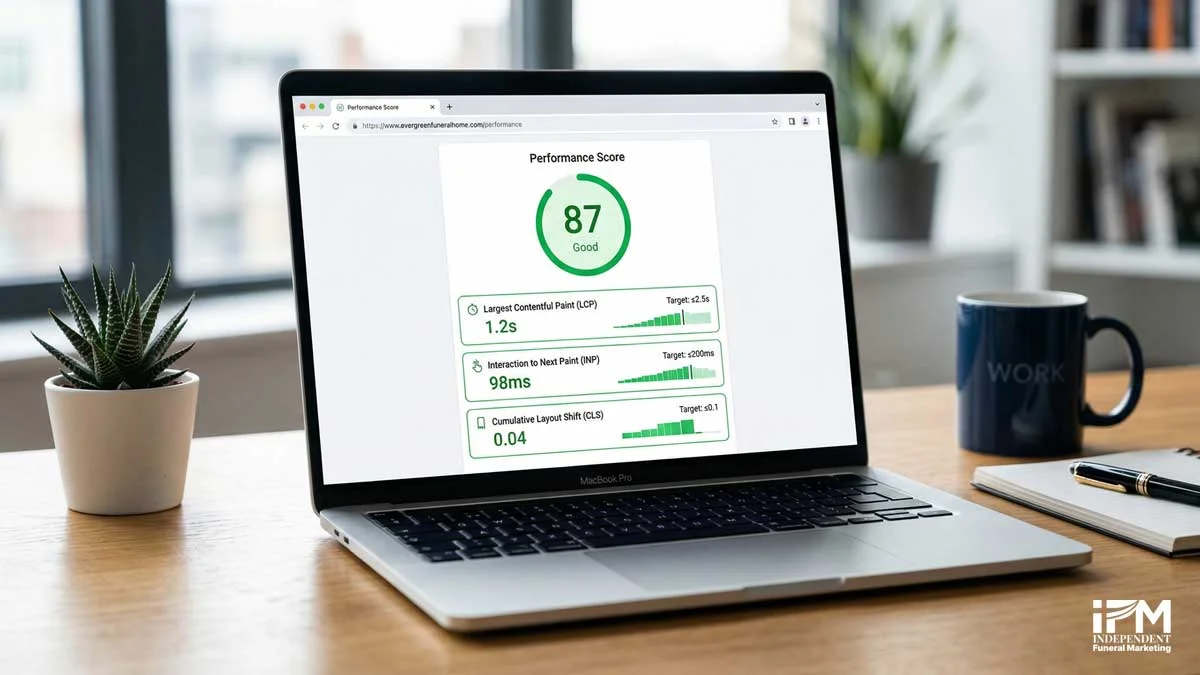
Core Web Vitals are three specific page experience metrics Google uses as ranking signals:
| Metric | What it measures | Google’s “Good” threshold |
|---|---|---|
| LCP (Largest Contentful Paint) | How fast the main content loads | Under 2.5 seconds |
| INP (Interaction to Next Paint) | How responsive the page is to input | Under 200 milliseconds |
| CLS (Cumulative Layout Shift) | How stable the layout is as it loads | Under 0.1 |
Most funeral home websites fail the LCP threshold on mobile. The most common cause is uncompressed images.
How do I test my funeral home website’s page speed?
Go to Google PageSpeed Insights, enter your homepage URL, and run the test on the Mobile tab. The report will show your current Core Web Vitals scores and a prioritised list of issues to fix. The top three recommendations are almost always worth addressing before anything else.
Should a funeral home website be mobile-friendly?
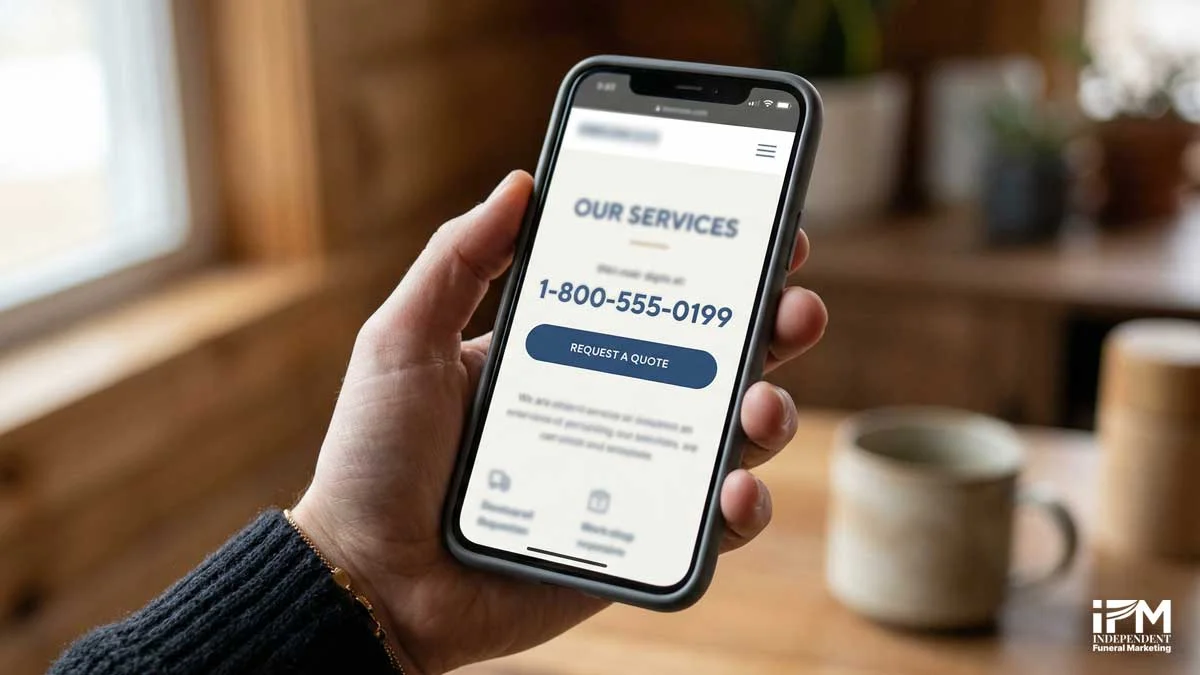
Yes, and not just for user experience. Mobile-first indexing means your mobile experience is your SEO experience. If your mobile site is slow, text is too small to read, or buttons are too close together, those are signals Google uses to evaluate quality. A family searching for a funeral director on a phone while in hospital will leave a slow, awkward mobile page in seconds.
What on-page SEO does each type of funeral home page actually need?
Every page type on a funeral home website has a distinct SEO purpose, target keyword, and content requirement. The homepage signals overall relevance and location; service pages capture high-intent queries for specific services; the About page builds E-E-A-T credibility; obituary pages drive organic long-tail traffic and community engagement; location pages target specific service areas; and the contact page should convert the visitors that all other pages attract.
Homepage
Signal who you are, where you serve, and why families should call you. Primary keyword: “[funeral director] in [town]”. Must-haves: H1 with location and service type, 500 to 700 words, internal links to all main service pages, LocalBusiness schema with FuneralHome subtype, trust signals (reviews, years of experience), and a single clear call to action above the fold.
Services overview page
Introduce all services offered. Primary keyword: “funeral services in [town]”. Must-haves: H1 naming the service category and location, 400 to 600 words, a brief description of each service with a link to its dedicated page, Service schema.
Individual service pages (burial, cremation, memorial, pre-need)
Each service needs its own dedicated page. Primary keyword: “[service type] in [town]”, for example “cremation services Bristol”. Must-haves: 400 to 700 words unique to that service, H2 sub-sections answering what the service involves, what families can expect, and the practical process. Service schema. Internal links to related services and the contact page.
About Us and team page
The E-E-A-T hub of the site. Primary keyword: your funeral home name and town, or “independent funeral directors [town]”. Must-haves: named staff with photos and credentials, year established, professional memberships (NAFD, BIE), community involvement, and a genuine account of the business. Person schema for principal staff. This page should be one of the best-written on the site.
Obituary and tribute pages
A long-tail SEO opportunity that accumulates over time. Each obituary page can rank for the name of the person and the town. Must-haves: a consistent template with name, dates, service details, tribute content, and a photo where provided and appropriate. These pages contribute to E-E-A-T through community engagement and build significant organic traffic as they accumulate.
Location and service area pages
For funeral homes serving multiple towns. Primary keyword: “funeral director [specific town]”. Must-haves: unique, locally specific content for each page, not a template with the town name swapped. Reference local context genuinely. 350 to 600 words. Avoid thin, near-duplicate location pages; Google may classify them as doorway pages and refuse to rank them.
Contact page
The conversion point. Must-haves: phone number prominently displayed and clickable on mobile, physical address, opening hours, an embedded map, a contact form, and NAP details that match your Google Business Profile exactly. Simple, fast, mobile-optimised.
Blog and resources section
Topical authority and long-tail traffic capture. Each post should target one specific informational query, use question-format H2s, include internal links to two to four service pages, and carry BlogPosting and FAQPage schema with author attribution for E-E-A-T. The funeral home GBP article referenced above is a practical example of this structure in action.
What does a complete on-page SEO checklist for funeral homes look like?
A complete on-page SEO checklist for funeral homes covers five categories: title tag and meta setup, heading structure, content quality, schema markup, and technical performance. Every page published on a funeral home website should be checked against all five categories before going live, and revisited quarterly for pages that have not been updated in six months or more.
Title tags and meta
- Unique title tag on every page (no duplicates across the site)
- Title tag 50 to 60 characters, primary keyword included, location included
- Meta description 140 to 155 characters, unique per page, includes keyword and a quiet CTA
- Title tag and H1 are aligned, not identical but closely matching
Heading structure
- Exactly one H1 per page
- H1 contains or mirrors the primary keyword
- H2s are structured as questions or clear topic statements
- No heading levels skipped (H1, then H2, then H3, never H1 directly to H3)
- No headings used purely for visual styling
Content quality
- Primary keyword appears in the first 100 words
- Content length appropriate to page type (see H2 7 guidance above)
- Each page has unique content, no copy-paste between service pages
- Local area named naturally within the content
- Tone is warm, clear, and appropriate for grieving families
- No thin or placeholder content on live pages
Schema markup
- LocalBusiness schema on the homepage with NAP matching your GBP exactly
- FAQPage schema on any page containing a Q&A section
- BlogPosting schema on all articles and blog posts
- Schema validated with Google’s Rich Results Test before publishing
- No schema invented for content not visible on the page
Images and technical performance
- Every image has a unique, descriptive alt text attribute
- Image files named descriptively before upload (not IMG_001.jpg)
- All images compressed and in WebP or optimised JPEG format
- Page loads in under 2.5 seconds on mobile (tested with PageSpeed Insights)
- Site served over HTTPS (SSL certificate active)
- At least one internal link pointing to every page (no orphan pages)
Frequently Asked Questions About On-Page SEO for Funeral Homes
What is on-page SEO for funeral homes?
On-page SEO for funeral homes is the practice of optimising each element of a funeral home website page, including title tags, headings, content, images, schema markup, and internal links, so that Google can accurately understand, index, and rank that page for relevant local search queries.
Does on-page SEO help a funeral home get more calls?
Yes. On-page SEO improves a funeral home’s visibility in search results, which increases the number of families who find the website. Combined with a clear call to action and a mobile-optimised page, better rankings translate directly into more phone calls and enquiries.
What are the most important on-page SEO elements for a funeral home?
The most important elements are: a keyword-optimised title tag with location, a compelling meta description, a single clear H1, well-structured service page content, LocalBusiness and FAQPage schema markup, optimised image alt text, and a page that loads in under 2.5 seconds on mobile.
How much does on-page SEO cost?
On-page SEO work for a funeral home can range from a one-off audit and fix (typically £500 to £2,500 from a specialist agency) to ongoing monthly optimisation. Many improvements can be made in a CMS like WordPress without developer costs, particularly title tags, meta descriptions, and content updates.
What are the 4 types of SEO?
The four types of SEO are: on-page SEO (optimising individual pages), off-page SEO (building authority through links and mentions), technical SEO (site architecture, crawlability, and performance), and local SEO (visibility in location-based searches). For funeral homes, on-page and local SEO work most closely together. For answers to the most common SEO questions from funeral directors, see the SEO FAQs for funeral homes.
How long does it take for on-page SEO changes to affect funeral home rankings?
Most on-page changes are crawled and re-evaluated by Google within 2 to 6 weeks. Significant changes to title tags and content on previously thin pages can show ranking improvements within 4 to 8 weeks. Competitive local markets may take longer. For a full phase-by-phase breakdown, see the guide to how long SEO takes for a funeral home.
Should a funeral home have a separate page for each service?
Yes. Each service, such as burial, cremation, memorial, and pre-need planning, should have its own dedicated page. Each page can then target a specific keyword and address the questions unique to that service. A single Services page trying to cover everything will rank for nothing specifically.
What schema markup should a funeral home website use?
For the client funeral home site: LocalBusiness schema on the homepage, Service schema on service pages, FAQPage schema wherever a Q&A section appears, BlogPosting schema on all blog posts and articles, and BreadcrumbList schema if the site has breadcrumb navigation.
Is it worth writing a blog for a funeral home’s website?
Yes, for two reasons: blog content captures long-tail informational search queries (funeral planning guides, grief resources, local obituary information) that service pages cannot target; and regular publishing signals to Google that the site is active and authoritative. Even 4 to 6 quality articles per year is more effective than no blog at all.
What is E-E-A-T and why does it matter for a funeral home website?
E-E-A-T stands for Experience, Expertise, Authoritativeness, and Trustworthiness. Funeral home websites fall into Google’s YMYL (Your Money or Your Life) category, meaning Google applies stricter quality standards. Demonstrating E-E-A-T on-page, through staff credentials, professional memberships, genuine reviews, and transparent information, directly influences ranking ability.
How do I know if my funeral home website has good on-page SEO?
Run the on-page SEO checklist in this guide. Specific tools: Google Search Console (free) to see which queries your pages rank for; Google PageSpeed Insights to test load speed; and a manual check of title tags, meta descriptions, and headings using your browser’s View Source function or an SEO browser extension.
Can I do on-page SEO myself, or do I need an agency?
Many on-page SEO improvements, such as updating title tags, writing better meta descriptions, adding alt text, and compressing images, can be done independently in a standard CMS without technical knowledge. More complex work, like schema implementation, site-wide audits, and content strategy, benefits from specialist support. For more articles covering keyword research, technical SEO, and timelines, see the funeral home SEO guides. IFM works exclusively with independent funeral directors.
References
[1] Google Search Central, Title Link (Title Tag) Best Practices, developers.google.com/search/docs/appearance/title-link
[2] Google Search Central, Control Your Snippets in Search Results, developers.google.com/search/docs/appearance/snippet
[3] Google Search Central, Introduction to Structured Data, developers.google.com/search/docs/appearance/structured-data/intro-structured-data
[4] DataForSEO and SparkToro Audience Analysis, IFM Keyword Research Report, April 2026
[5] Google, Search Quality Evaluator Guidelines, static.googleusercontent.com
[6] Google Search Central, Core Web Vitals and Google Search, developers.google.com/search/docs/appearance/core-web-vitals