A family searches “funeral director near me” at 2am, three days after a death. They do not see a building, a member of staff, or thirty years of service. They see three listings on a map, a star rating, a number in brackets, and a photo.
That is the whole first impression, and most of it is decided before they ever reach a website. Funeral directors spend years building a reputation in their town, then hand the first moment a grieving family meets them over to a page they rarely look at and almost never control.
This article sets out exactly what appears on that results page, in what order, and why. It covers what determines which three funeral homes a family actually sees, why so few families compare more than one option once they find it, and what is changing in 2026 as AI Overviews start to reshape the page itself.
What Do Families Actually See When They Search for a Funeral Director?
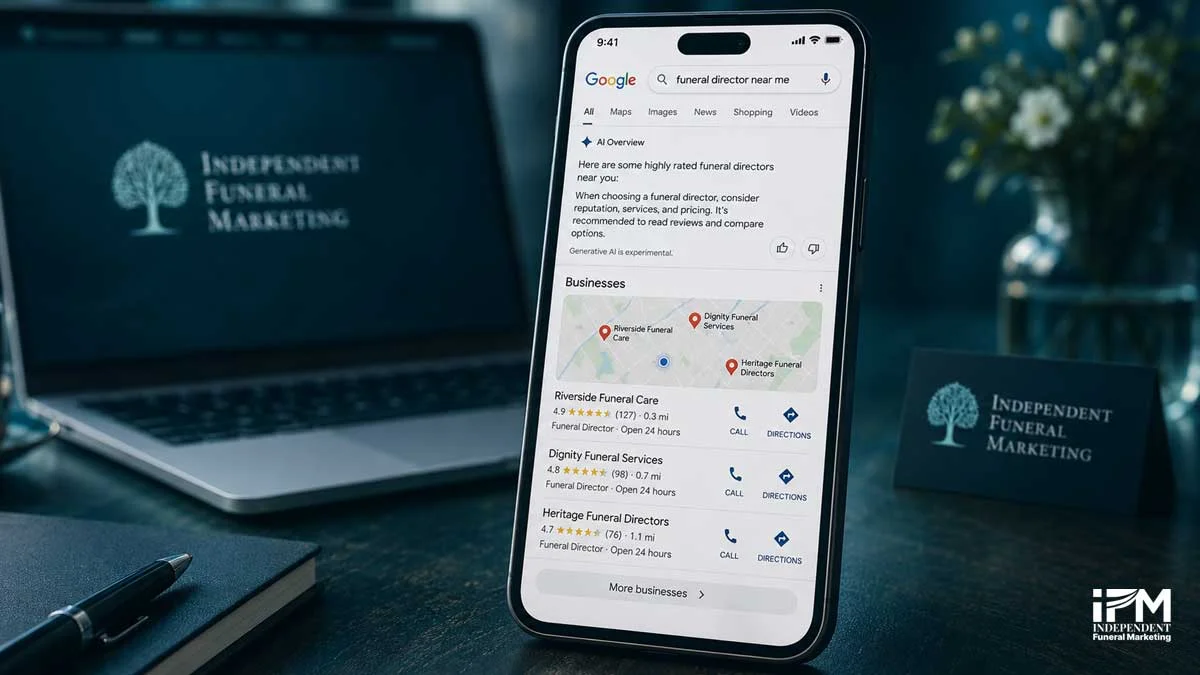
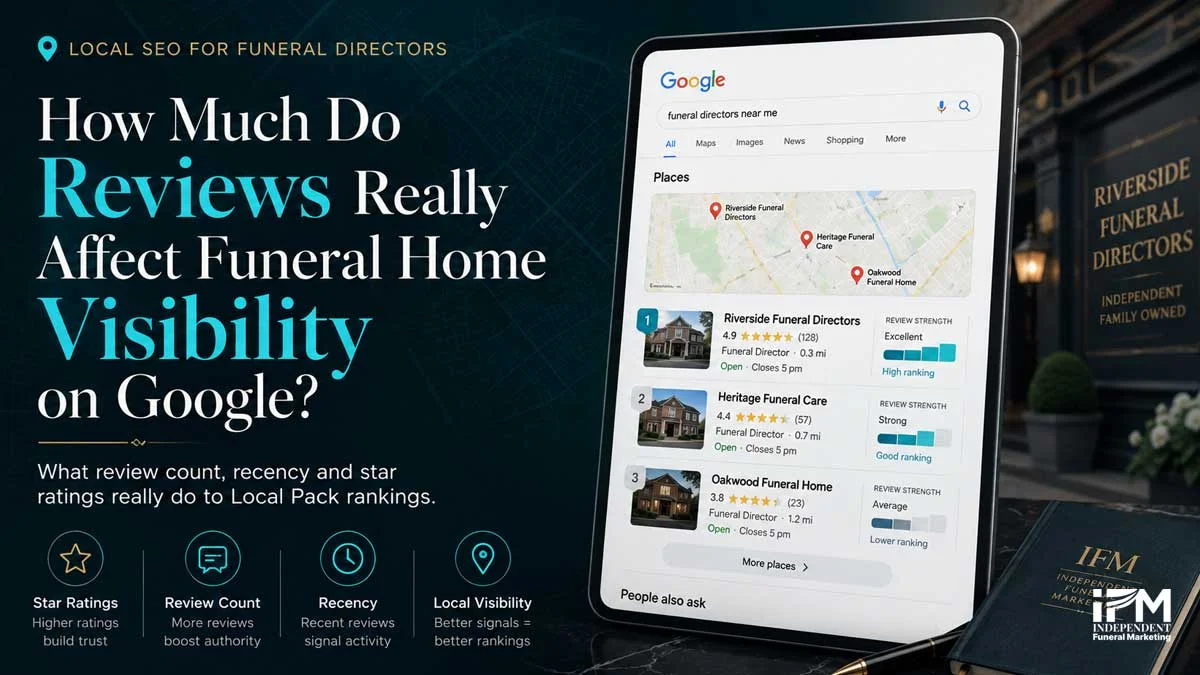
When a family searches for a funeral director, the Google results page, not the funeral home’s own website, forms their first impression. The Local Pack usually shows three businesses with a star rating, review count, opening status, and a map, and most families never scroll past it before deciding who to call.
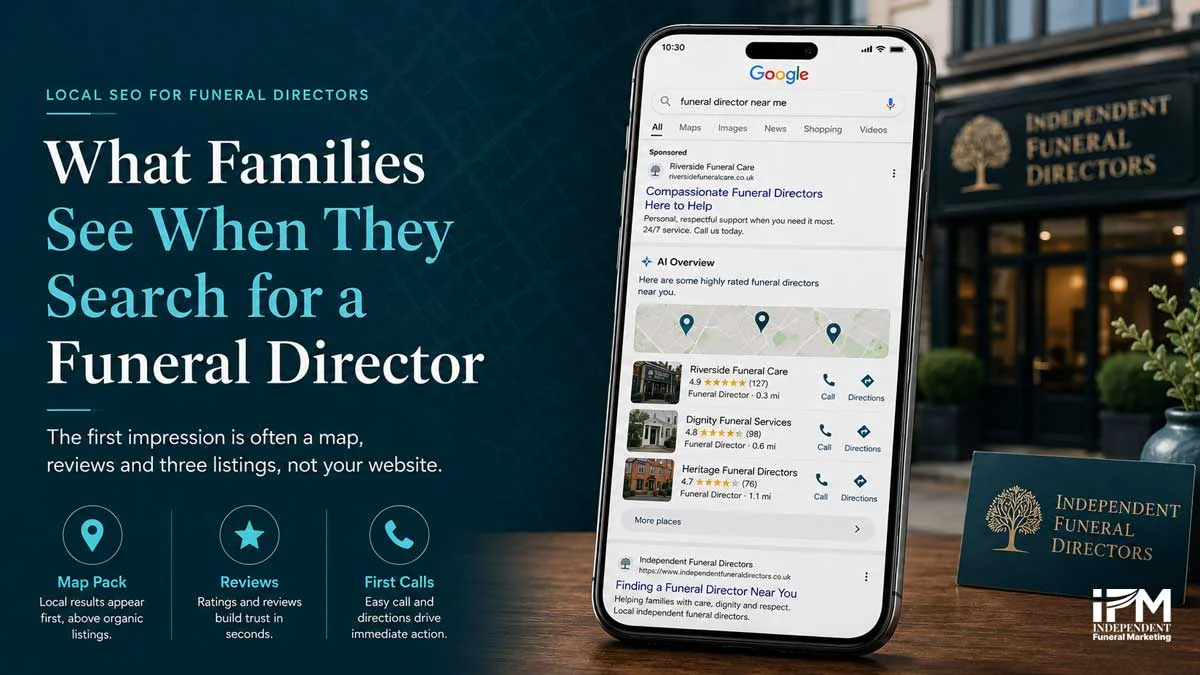
Read the page top to bottom and the order rarely changes. An occasional paid ad sits at the very top. For research-style queries, an AI Overview may appear next. Then comes the Local Pack itself, three businesses shown with a name, star rating, review count, hours, phone number and directions. Below that sit the organic results, the familiar blue links.
Those organic results below the Local Pack are frequently dominated by aggregator sites, Yell, Funeral Guide, 192.com, rather than the funeral homes themselves. That is a distinct disadvantage for an independent relying only on their own website: even ranking well organically often means sitting behind a directory a family has never heard of.
Almost everything a family uses to decide, the rating, the review count, the photo, the distance, the opening status, is drawn from the Google Business Profile, not the website. A funeral director’s own site rarely enters the picture until after that first decision has effectively been made.
Picture the actual screen. A family searching from a phone sees the map first, three pins clustered near their own location, then the three listing cards stacked directly beneath it, each one showing a name, a star rating with a number in brackets, and a single photo. There is no scrolling required to see all three. The decision-relevant information fits inside the first screen a phone displays, well before a website would ever load.
That compression matters because it is unforgiving. A funeral home with a strong reputation but a thin, unclaimed, or poorly categorised profile looks weaker on that first screen than a newer competitor with an active review programme, regardless of which firm has actually served the town longer.
Why Does the Google Local Pack Matter More Than Your Website at That First Search?
The Google Local Pack, the map and three listings shown for local searches, captures the large majority of clicks before a family ever reaches an organic website result. Backlinko’s 2024 analysis found 42% of local searchers click a Map Pack result [1], and Google’s own research shows a complete Business Profile makes a business 2.7 times more likely to be seen as reputable [1].
Backlinko’s 2024 figure, 42% of local searchers clicking a Map Pack result, is the current best estimate and the one this article leads with. An older, more widely repeated figure, 44%, traces back to a single-keyword 2015 Moz study on “personal injury lawyer” searches. It is worth knowing where that number came from, but it should not be restated as current fact.
Google’s own research, cited via Backlinko’s Local SEO Stats, adds three further figures: a complete Business Profile makes a business 2.7 times more likely to be seen as reputable, generates 70% more visits, and makes a business 50% more likely to be considered for a purchase. None of that depends on the website at all.
The original 2015 Moz study, the source of the historic 44% figure, also reported a rough split of clicks across the wider page: roughly 29% went to organic results and 19% to paid ads, alongside the 44% claimed for the pack. Even allowing for a single-keyword study a decade old, the shape of that split, Local Pack first, organic a distant second, has held up in every subsequent estimate since, including Backlinko’s more current 42%.
The website still matters, once a family clicks through it has to convert that trust into an enquiry. But the Local Pack decides whether they click through at all. For an independent funeral director, Google Business Profile for funeral directors covers exactly what drives that visibility.
What Determines Which Three Funeral Homes Appear in the Local Pack?
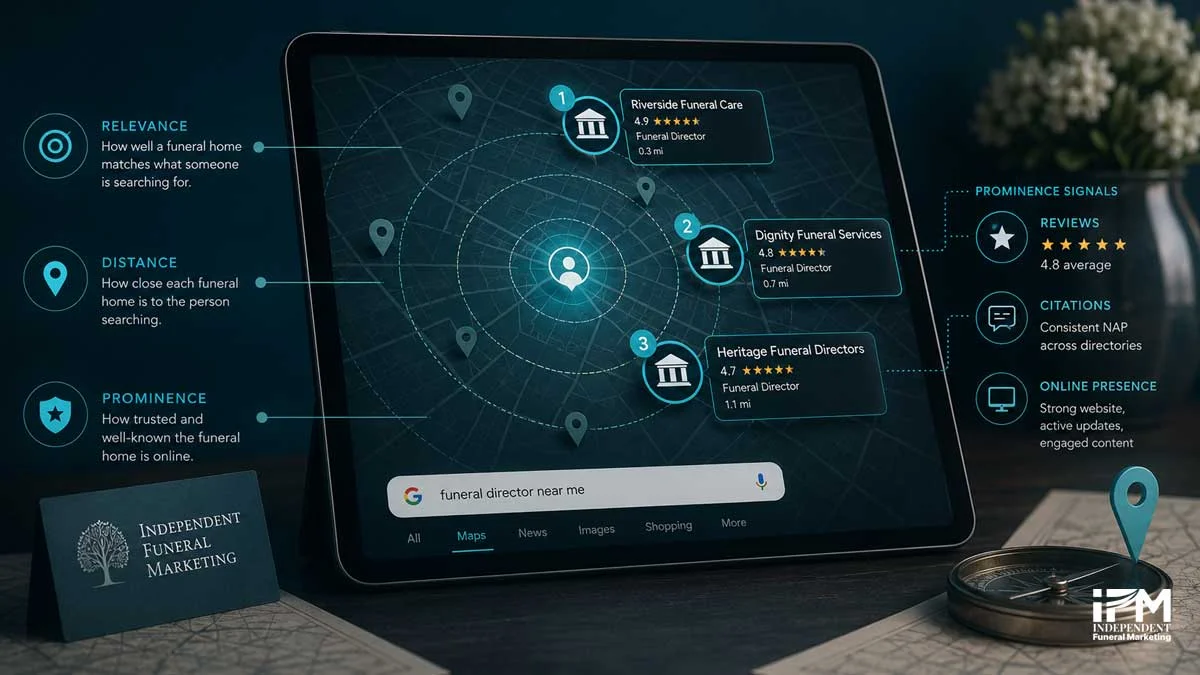
Google ranks Local Pack results on three factors it publishes itself: relevance, how well a profile matches the search; distance, how close the business is to the searcher; and prominence, how well-known and trusted the business appears based on reviews, citations and overall online presence [2].
Relevance is whether a profile clearly matches what someone typed, category, services, and business description all play a part. Distance is simply how close the business sits to the person searching, a factor no marketing budget can move. Prominence covers everything else Google reads as trust: review volume, review quality, and how consistently a business’s details appear across the web.
Of the three, prominence is the one an independent funeral home can most directly influence day to day. Distance and relevance are largely structural, set by where a business is located and how its profile is configured once. Reviews and profile completeness, by contrast, can be actively built, month by month.
| Ranking factor | What it means | Can a funeral director influence it directly? |
|---|---|---|
| Relevance | How well the profile’s category, services and description match the search | Yes, largely a one-time and periodic configuration task |
| Distance | Physical proximity between the business and the searcher | No, structural, tied to location |
| Prominence | Reviews, citations and overall online trust signals | Yes, built continuously through reviews and activity |
This is the conceptual foundation the rest of this article leans on. The practical, step-by-step work of improving each factor is covered in more depth further down.
How Much Does Position in the Local Pack Really Cost an Independent Funeral Home?
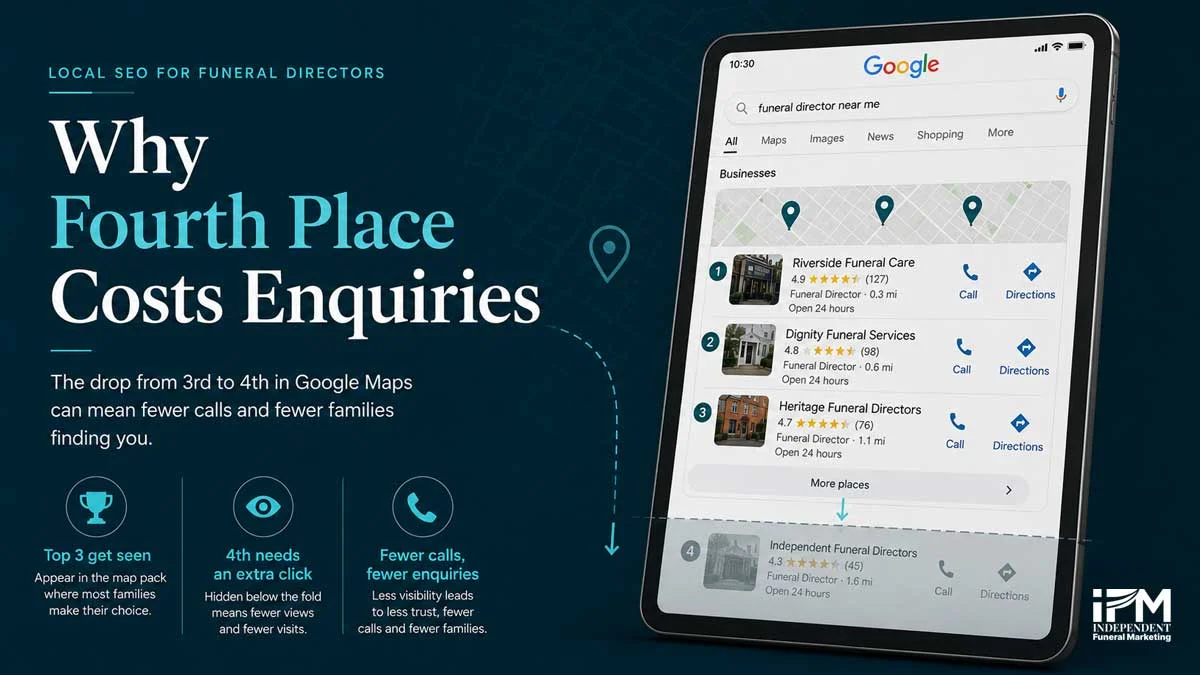
A funeral home in 4th position on Google Maps is not simply one place behind the top three, it is effectively invisible to most searchers, because Google shows only three listings by default and very few people click through to see more.
The mechanic is simple but easy to underestimate. The Local Pack shows exactly three listings. Everything below that requires an extra click into the full Maps results, a step most urgent, trust-driven searchers do not take.
That makes 3rd and 4th place a cliff, not a gradient. On a spreadsheet, positions 3 and 4 look adjacent. In real visibility, they are worlds apart, because one sits on the page a family sees and the other does not.
For a trust-driven, low-repeat-purchase decision like choosing a funeral director, this matters more than it would for a business families call repeatedly. Families are unlikely to ring several providers, so a small visibility difference compounds into a large enquiry difference.
The constructive point is that this gap is fixable. Position inside the Local Pack moves with profile completeness and review activity, not with a bigger budget or a longer trading history.
It is also worth naming why so many independent funeral homes end up in that 4th-place position in the first place. In practice it is rarely one single failing. A profile that has never been fully verified, a category set to something generic rather than “Funeral Home,” opening hours that have not been updated in years, or a review count that has stalled while a nearby competitor’s keeps growing, each on its own looks minor. Together, they are usually enough to explain why a long-established firm sits just outside the pack while a newer, more actively managed competitor sits inside it.
Why Do So Few Families Compare More Than One Funeral Director?
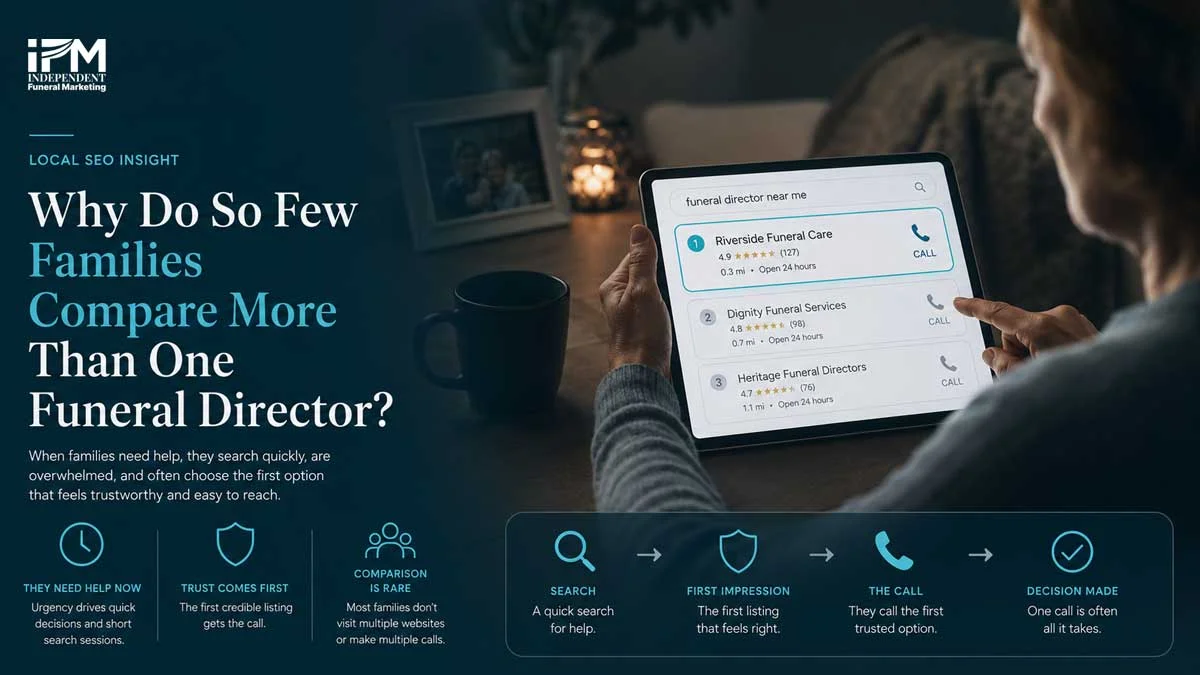
Most UK families do not compare funeral directors at all. The Competition and Markets Authority’s own consumer survey found that 78% of families did not compare two or more funeral directors before choosing one [3], and SunLife’s 2026 Cost of Dying research found 58% did not compare price between providers [4].
The CMA’s consumer survey, conducted by Ipsos MORI in 2019 on a base of 279 respondents, found only 17% compared two or more funeral directors before choosing one. A further 54% did not compare despite believing a genuine choice existed. Cumulatively, 78% did not compare at all. The sample base is modest, so headline figures are robust but sub-group splits should be read as indicative rather than precise.
SunLife’s 2026 Cost of Dying Report adds a second UK data point: 58% of people organising a funeral do not compare price between providers at all. Separately, Dignity’s 2018 consumer research found 84% chose based on reputation, recommendation or prior experience, reinforcing that trust signals, not price comparison, drive the decision.
As a directional US data point, the NFDA’s 2025 Consumer Awareness and Preferences Study found 40% of consumers had used a funeral home found on Facebook, up from 21% in 2023 [5], the same reputation-led, low-comparison pattern showing up in a second market.
| Source | Finding |
|---|---|
| CMA consumer survey (Ipsos MORI, 2020) | 78% did not compare two or more funeral directors |
| SunLife Cost of Dying Report (2026) | 58% did not compare price between providers |
| Dignity consumer research (2018) | 84% chose based on reputation, recommendation or prior experience |
| NFDA Consumer Awareness Study (2025, US) | 40% found a funeral home via Facebook, up from 21% in 2023 |
Because families so rarely compare, whichever funeral director makes the strongest first impression on the results page usually gets the call, with no second chance to correct it later. For the fuller picture of the family’s search journey, what near-me searchers actually want covers the intent behind that first search in more depth.
What Trust Signals Do Families Notice First?
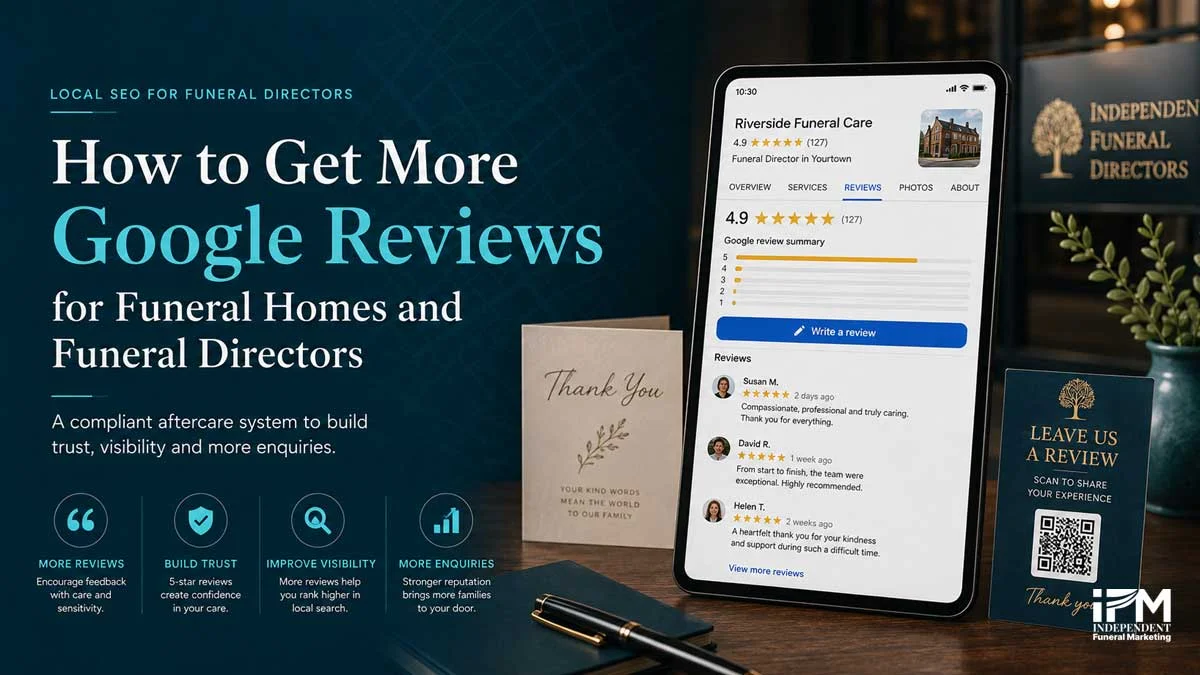
Families notice star rating and review count first, then review recency and photos. BrightLocal’s most recent Local Consumer Review Survey found 31% of consumers will now only use a business with a rating of 4.5 stars or higher, up from 17% the previous year, and 74% only trust reviews written in the last three months [6].
BrightLocal’s latest survey sets out the thresholds in detail. 97% of consumers read reviews for local businesses. 31% require 4.5 stars or higher, up from 17% the year before, and 68% require at least 4 stars, up from 55%. 74% trust only reviews from the last three months. 47% will not use a business with fewer than 20 reviews, and 89% expect an owner response to reviews left.
There is a counterintuitive point worth holding alongside those thresholds. Research from Northwestern University’s Spiegel Research Center found purchase or enquiry likelihood typically peaks between 4.2 and 4.7 stars, and a perfect 5.0 can read as too good to be true [7]. A funeral director chasing a flawless score may be optimising for the wrong number.
Photos are a secondary but visible signal families scan quickly, an exterior shot, a chapel, a reception area, before they read a single review. BrightLocal’s same survey found that 45% of consumers now use AI tools such as ChatGPT for local recommendations, up from just 6% the previous year, a sharp rise worth noting even though the Local Pack itself remains the dominant feature for a direct near-me search today.
The mechanics of responding to what families leave behind are covered separately in responding to funeral home Google reviews, the natural next step once the family notices the review.
Why Do Grieving Families Rely on Quick Trust Signals Instead of Deep Research?
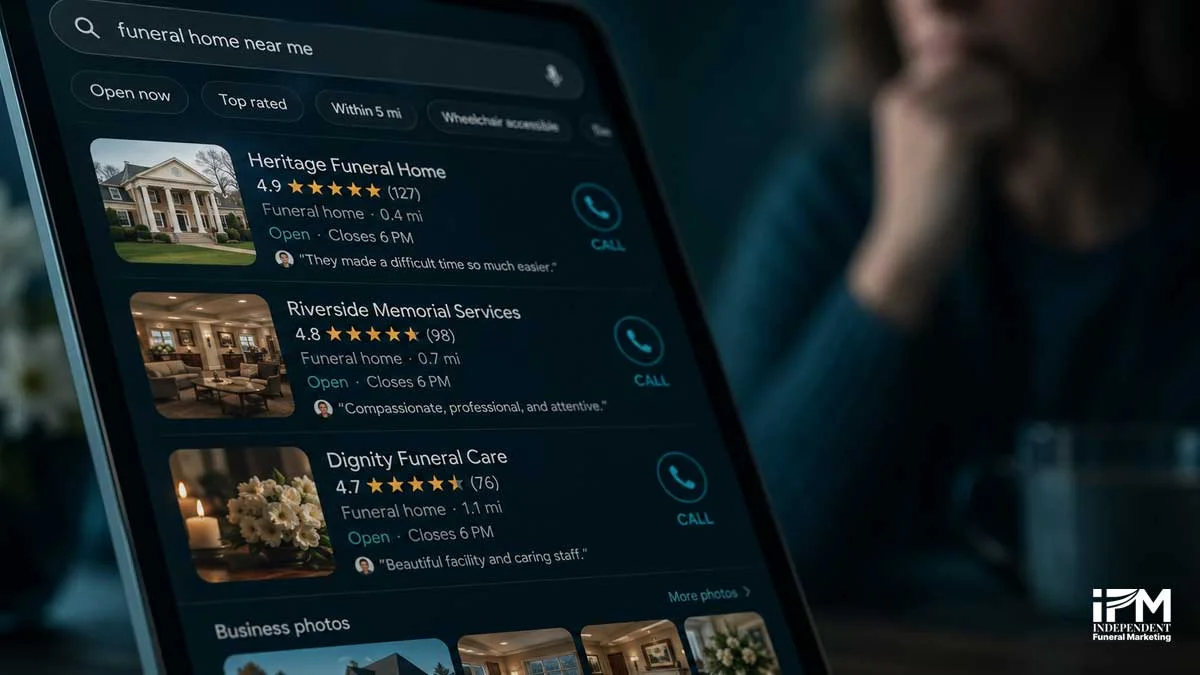
Under grief and time pressure, people rely on quick, visible trust signals rather than extensive research, a well-documented pattern in decision-making research often called satisficing, choosing the first option that seems good enough rather than optimising among many.
Herbert Simon’s concept of satisficing describes exactly this pattern: under cognitive load, people choose the first adequate option rather than the theoretically best one. Gigerenzer and Gaissmaier’s 2011 work on fast-and-frugal heuristics adds that under time pressure, people shift to simplified decision rules built around the most visible, diagnostic cues, precisely what a star rating and review count provide at a glance.
Research on cognitive load and time pressure, including Drolet and Luce’s work in the Journal of Consumer Research, shows people under stress become more reliant on easily available cues and less inclined toward effortful comparison. Work by Lerner and Keltner on emotion and decision-making adds that heightened emotional states narrow the range of information a person is willing or able to process before acting. This is general behavioural research, not a claim about any individual’s state of mind, but the pattern applies clearly here.
None of this means grieving families are making poor decisions. Choosing based on a strong star rating, a recent review, and a clear phone number is a reasonable, adaptive response to a genuinely time-pressured situation, not a failure of judgement. It simply means the visible page, not the funeral home’s underlying quality, is doing more of the deciding than most funeral directors assume.
This is precisely why the Local Pack and its visible trust signals carry so much weight. Not because families are careless, but because the moment itself demands a fast, reasonably confident decision.
How Are AI Overviews Changing What Families See in 2026?
For straightforward local searches like “funeral director near me,” most families still see the classic Local Pack, but Google increasingly shows an AI Overview above it for more research-style queries, and how far this trend extends to simple near-me searches is still genuinely unsettled.
AI Overviews sit above organic results, and sometimes above the Local Pack itself, for certain query types. Whitespark’s Q2 2025 study of 540 manual queries found AI Overviews appeared for 68% of local searches overall, but only 15% of simple local-intent queries, versus 92% of informational and 97% of hybrid-intent queries [8]. A plain “near me” search remains far less likely to trigger an AI Overview than a research-style question.
Estimates of AI Overview prevalence on local queries vary enormously across sources, roughly 8% to 68% depending on query type and methodology, and should be treated as an evolving, contested area rather than settled fact. This matters for an audience that over-indexes on newer search behaviour: this audience shows a 28.2% over-index on Perplexity use compared with UK averages, alongside an 8.3% over-index on Bing.
The practical takeaway stays grounded. The classic Local Pack remains the dominant feature for a direct “near me” search today, but funeral directors should expect AI-generated summaries to play a growing role for broader, research-style searches. The practical next step, ranking well in the Local Pack itself, is covered in how to rank your funeral home on Google Maps.
Can Independent Funeral Homes Out-Visible Corporate Chains in This Moment of Search?
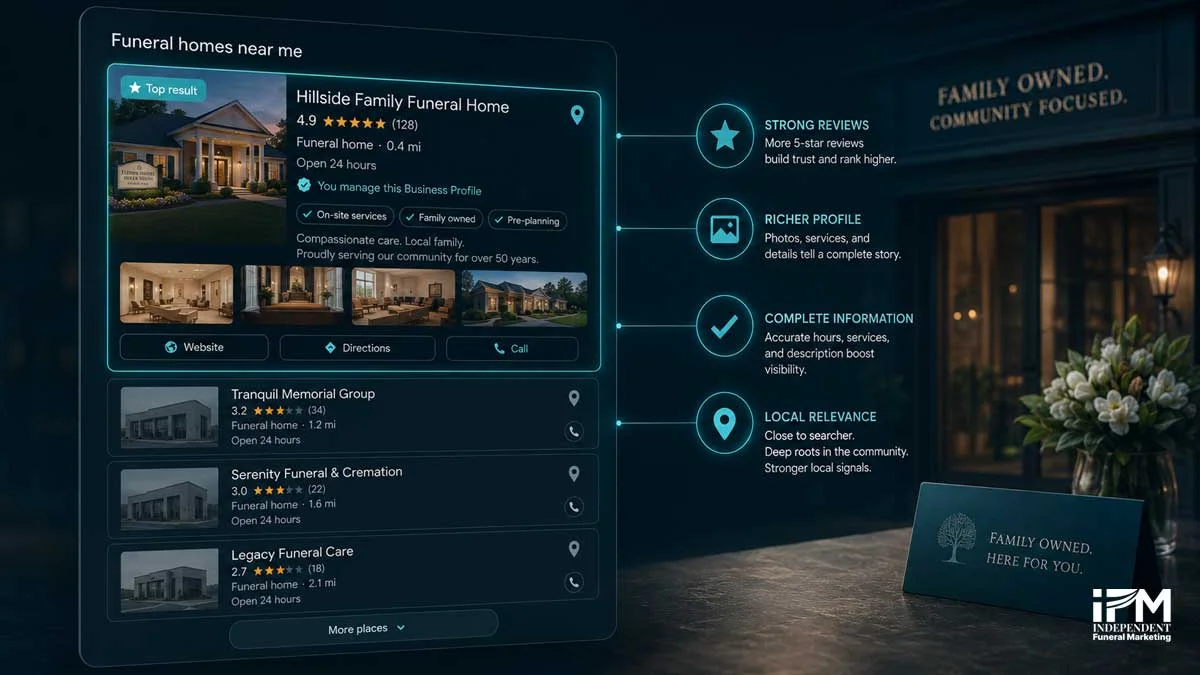
Independent funeral directors make up the majority of the UK market and are generally trusted for being local and family-run, but converting that trust into visibility depends on actively managing the same online signals, review volume, recency and profile completeness, that corporate groups increasingly invest in at scale.
The UK market is fragmented. Independents hold the majority of it. The two largest single groups, Co-op Funeralcare and Dignity, together hold roughly a quarter to a third of the market. Funeral Partners is the largest independently-owned group, at 260 to 290-plus branches. SAIF represents around 1,000 independent members across roughly 1,865 sites.
| Provider type | Approximate scale |
|---|---|
| Co-op Funeralcare and Dignity combined | Roughly 27 to 30% of the UK market |
| Funeral Partners (largest independently-owned group) | 260 to 290-plus branches |
| SAIF-represented independents | Around 1,000 members across roughly 1,865 sites |
| Remaining independent, family-run firms | The majority of the UK market by number of businesses |
No single authoritative UK study directly measures a Local Pack visibility gap between independents and chains, so this argument is inferential, built from market-structure data and general local search evidence rather than one head-to-head study. Chains typically have centralised marketing teams maintaining Google Business Profiles and soliciting reviews at scale, a structural advantage independents can match without matching the budget behind it.
Online reputation has become a genuine competitive battleground across the industry as a whole. In March 2026, the CMA opened an investigation into whether Dignity asked staff to write positive crematoria reviews, a factual, dated development worth noting as evidence of that shift, not a criticism of any specific business’s current practice.
Independents already win on the attributes families say matter most, local, family-run, personal, recommended. The task is making that trust visible in the same Local Pack signals a chain can also optimise for. The data supports opportunity here, not a guaranteed outcome.
How Can a Funeral Director Check What Their Business Actually Looks Like on Google?
The simplest way for a funeral director to see what families see is to search their own business name and “funeral director near me” in a private browser window, ideally on a phone, and compare the result honestly against nearby competitors.
A short self-audit takes a few minutes and reveals more than most owners expect.
- Search in an incognito or private browser window, so past history and location settings do not skew the result.
- Check both Google Search and Google Maps, since the two can display differently.
- Repeat the search on a phone, since most bereaved families search on mobile.
- Compare star rating, review count, photos and business description directly against two or three nearby competitors.
- Check Google Business Profile’s own Performance insights to see which search terms actually bring people to the profile.
One outside-perspective tip is worth adding to that list: ask someone who has never searched for the business before for their honest first impression. Owners consistently miss things a stranger notices immediately, an old profile photo, a review left unanswered for months, a category that no longer describes the services on offer.
That first impression on the results page, not the website, is where a family’s decision effectively begins. Everything covered in this article, the Local Pack’s structure, the ranking factors behind it, the low comparison rate, the trust thresholds families now apply, and the early signs of AI-driven change, points to the same conclusion: the page a family sees in that first search is not a minor detail beside the funeral home’s real reputation. For that family, in that moment, it is the reputation.
For independent funeral directors who want this managed as a structured system rather than an occasional check, SEO for independent funeral directors covers how IFM approaches Local Pack visibility.
Frequently Asked Questions
Why don’t some funeral homes appear in the Google Local Pack at all?
Usually an unverified or incomplete Google Business Profile, an incorrect category, inconsistent address details, or a profile too new to have built prominence. Google ranks on relevance, distance and prominence, not company size.
What percentage of local searches result in a click on the Local Pack?
Backlinko’s 2024 research found 42% of local searchers click a result inside the Map Pack. The older, more widely repeated 44% figure traces to a single-keyword 2015 Moz study and should be treated as historic, not current.
Do families compare more than one funeral director before choosing?
Rarely. The UK Competition and Markets Authority’s own consumer survey found 78% of families did not compare two or more funeral directors, with most choosing based on reputation or recommendation instead.
What star rating do most people expect from a local business?
BrightLocal’s latest Local Consumer Review Survey found 31% of consumers will only use a business with 4.5 stars or higher, up from 17% the year before, and 68% require at least 4 stars.
Can a perfect 5-star rating actually hurt a business?
Research from Northwestern University’s Spiegel Research Center found purchase likelihood typically peaks between 4.2 and 4.7 stars, with a perfect 5.0 sometimes read as too good to be true.
How much does falling to 4th place on Google Maps cost a business?
The Local Pack shows only three listings by default, so a business in 4th place requires an extra click most urgent searchers do not make, making the gap between 3rd and 4th far larger than the ranking difference suggests.
Do businesses pay to appear in the Google Local Pack?
No. The organic Local Pack is unpaid. Only the separate advertising slots that sometimes appear above it are paid placements.
Are AI Overviews replacing the Local Pack for funeral-related searches?
Not for straightforward near-me searches yet. Research from Whitespark found AI Overviews appeared on only 15% of simple local-intent queries, compared with 92% of informational, research-style queries.
Do independent funeral homes compete fairly with corporate chains online?
Independents make up the majority of the UK market and are generally trusted for being local and family-run, but must actively manage reviews and profile completeness, the same levers corporate groups invest in at scale, to convert that trust into visibility.
How can I see what my funeral home actually looks like on Google?
Search your business name and a relevant near-me term in a private browser window, on both desktop and mobile, and compare your star rating, reviews and photos honestly against two or three nearby competitors.
References
[1] Backlinko, Local SEO Stats, backlinko.com/local-seo-stats
[2] Google Business Profile Help, Tips to improve your local ranking on Google, support.google.com/business/answer/7091
[3] Competition and Markets Authority, Funerals Market Investigation, Consumer Survey Findings, gov.uk/cma-cases/funerals-market-study
[4] SunLife, Cost of Dying Report 2026, sunlife.co.uk/over-50-life-insurance/funeral-costs
[5] National Funeral Directors Association, 2025 Consumer Awareness and Preferences Study, nfda.org/news/statistics
[6] BrightLocal, Local Consumer Review Survey, brightlocal.com/resources/local-seo-statistics
[7] Northwestern University Medill Spiegel Research Center, How Online Reviews Influence Sales, spiegel.medill.northwestern.edu
[8] Whitespark, Local Search Ranking Factors 2026, whitespark.ca/local-search-ranking-factors