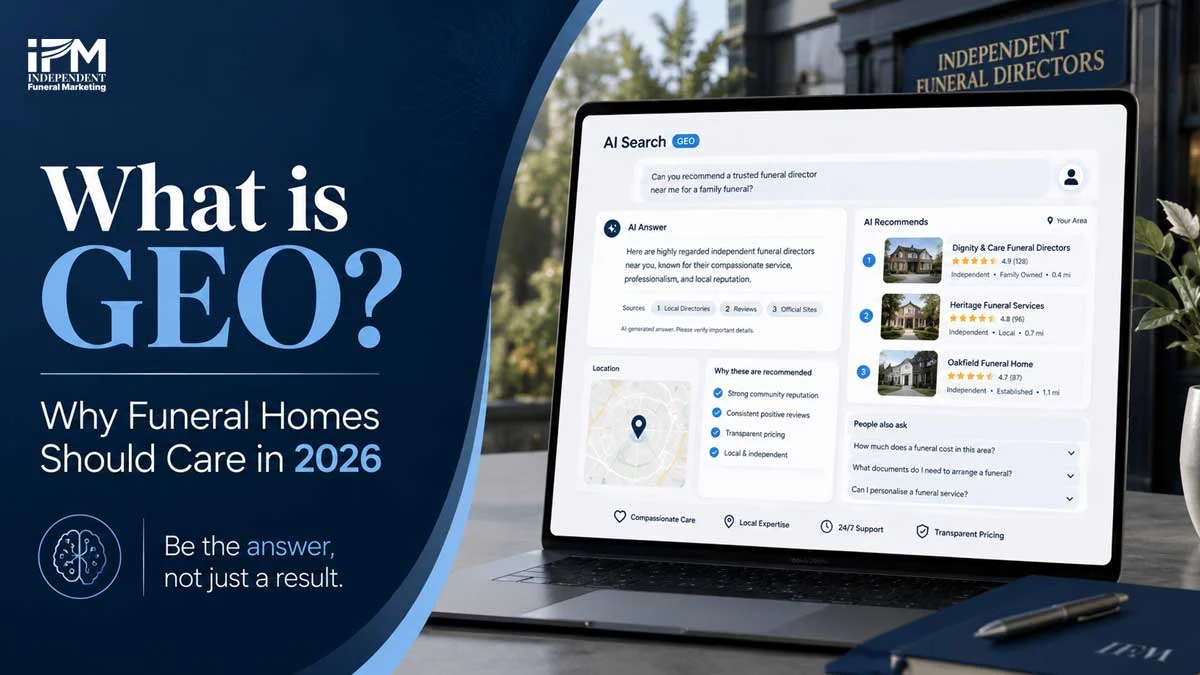
What is GEO for funeral homes? Generative Engine Optimization, or GEO, is the practice of structuring a funeral home’s online presence so AI tools such as ChatGPT, Perplexity, and Google’s AI Overviews recommend it directly to a grieving family, rather than simply ranking it on a results page.
That distinction matters more for funeral homes than almost any other local service. When a family is in the first hours of bereavement, they are not leisurely browsing twenty search results. They are asking an AI assistant a direct question, and the AI names two or three providers in its answer. Any funeral home not in that short list does not exist for that family at that moment.
UK funeral home owners are already using these tools themselves. IFM’s audience research shows independent funeral directors over-index on Perplexity by +28.2% versus the UK average (SparkToro, March 2026). The people reading this article are already using the platforms it describes. The question is whether their funeral home is showing up inside them.
What is GEO?
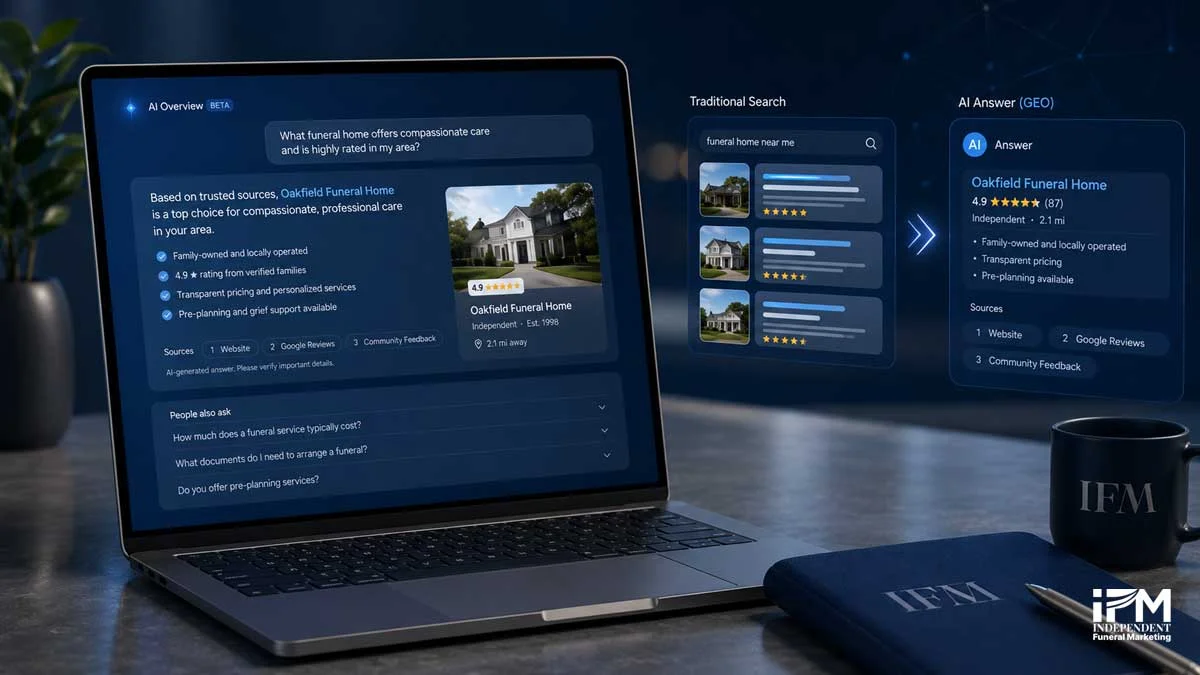
The term GEO, or generative engine optimisation in UK English, refers specifically to the digital marketing practice of making content readable and citable by AI-powered search tools. It is not related to geography, geospatial data, or the business-region use of the word. This article uses the marketing definition throughout.
The concept has real academic grounding. The original GEO framework was formalised in a peer-reviewed paper by Aggarwal et al. [1], which has since been cited by 177 other academic sources. That gives the discipline substance beyond agency marketing, it is a documented area of active research.
In practical terms, GEO works by ensuring that your content is structured in a way that large language models (LLMs), the technology underlying ChatGPT, Gemini, and Perplexity, can accurately extract and summarise. These systems do not simply crawl and rank pages the way Google’s traditional algorithm does. They pull in web content at the moment a question is asked, synthesise it, and produce a natural language answer. GEO is the discipline of making sure your content is what gets pulled.
The growth figures confirm this is not a mature category. In the UK, searches for “what is geo” are up +494% year on year. In the US, the same term is up +312% (DataForSEO, June 2026). This is actively forming search vocabulary, not a settled topic. Publishing substantive GEO content now carries a first-mover advantage that will become harder to capture as competitors catch up.
What is GEO vs SEO?
The clearest way to frame the difference is by what success looks like.
| SEO | GEO | |
|---|---|---|
| Primary goal | Rank high in a results list | Be cited inside an AI answer |
| Success metric | Keyword rankings, organic traffic | AI citation frequency, share of voice |
| Content focus | Keyword relevance, backlinks, authority | Entity clarity, structured answers, factual accuracy |
| User behaviour | Person sees a list and clicks | Person receives a direct answer |
| Discovery model | 10–20 results visible on page one | 2–3 providers typically named in AI response |
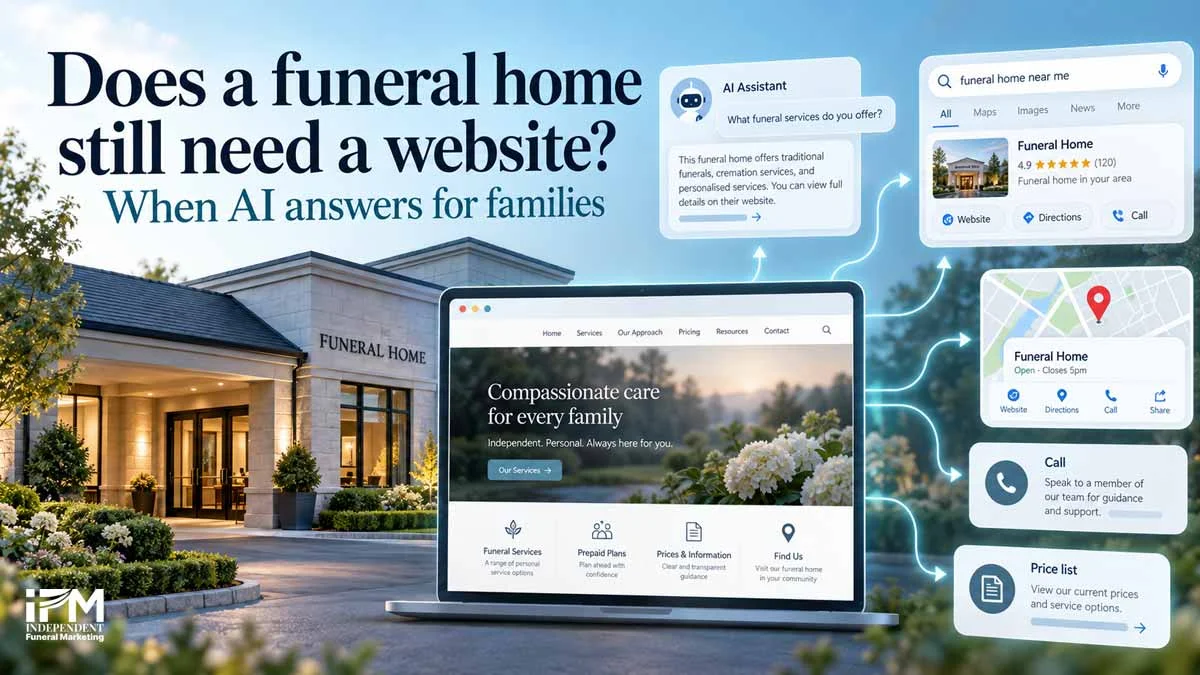
The question most funeral directors ask is whether SEO is still worth doing. The honest answer is that it has never been more important to get right, because it is now the foundation that GEO depends on. A technically broken website is invisible to AI systems exactly as it is to Google. An unindexed page cannot be cited. A business with inconsistent contact information across directories will be unreliable in both organic search and AI answers. The same reasoning settles a related worry, whether a funeral home still needs a website as AI search grows: AI answers are built from web pages, so the website becomes the source rather than the destination.
The commercial signal behind GEO is clear. The search phrase “geo is the new seo” carries a US cost-per-click of $40.93, the highest CPC found anywhere in this research (DataForSEO, June 2026). That figure signals real buyer-side interest beneath what looks like a purely informational topic. Agencies and consultants are already positioning around this shift, which means the window for funeral homes to act ahead of their competitors is narrowing.
For a practical overview of how both SEO and GEO fit into a full marketing system for funeral homes, see our AI search optimisation for funeral homes service page.
What is the difference between GEO and AEO?
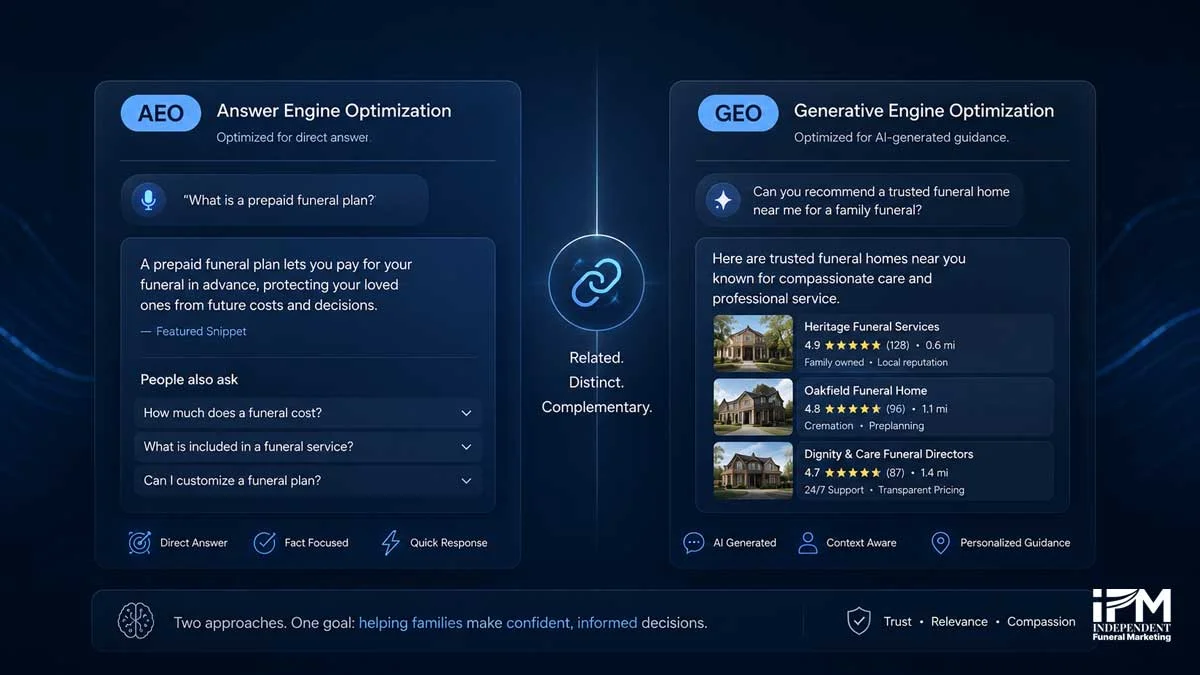
The terminology in this space is still consolidating, which is itself a useful signal about how fast the field is moving. Some practitioners use AEO and GEO interchangeably. Others draw a distinction: AEO targets the older generation of answer platforms, including featured snippets, voice assistants like Alexa and Siri, and direct-answer boxes, while GEO targets the newer generation of generative AI tools that synthesise multi-source responses rather than simply extracting a single passage.
For a funeral home, this distinction is largely academic. The content disciplines required to appear in an AI Overview are the same ones required to be cited by ChatGPT: clear entity information, structured FAQ content, factual accuracy with verifiable detail, and consistent business data across the web.
One important caution: never use the bare acronym “AEO” without spelling it out in full as answer engine optimization (AEO). In UK search, the abbreviation is dominated by Authorised Economic Operator, an HMRC customs classification, and using it unqualified creates confusion for both readers and AI extraction systems.
The trend data makes a compelling case for covering both concepts together rather than in separate articles. In the US, search interest in “geo vs seo vs aeo” is up +3,800% year on year, the single largest percentage mover in the entire keyword dataset for this topic (DataForSEO, June 2026). Searches for “what is aeo in marketing” are up +1,355% year on year in the US over the same period. The audience for this content is actively forming right now.
How does GEO actually work?
Understanding the mechanism helps explain why certain GEO techniques work. When someone asks ChatGPT “who is a good funeral director near me,” the model does not rely solely on its training data. It runs one or more live web searches, pulls in the most relevant and trustworthy content it finds, synthesises the information, and produces an answer that cites those sources. This is retrieval-augmented generation.
The practical levers a funeral home actually controls within this process are:
- Clear entity information. The AI needs to know exactly who you are, where you operate, and what services you offer. Consistent name, address, and phone number (NAP) across your website, Google Business Profile, and directories removes ambiguity.
- Structured content. FAQ-formatted pages, clear service descriptions with specific detail, and properly marked-up schema data all make it easier for the retrieval system to extract accurate information.
- Factual accuracy and verifiable detail. AI systems weight content that is specific and checkable over content that is vague or promotional. Service descriptions with real detail, named locations, and accurate pricing are more likely to be cited.
- Basic technical SEO health. Fast loading, secure HTTPS, correct indexation, and clean crawlability are the same prerequisites for AI visibility as they are for Google ranking.
GEO is not a separate project from local SEO. It is the next layer built on the same foundation. For a full picture of how these layers connect, see the AI search guides for funeral homes.
The E-E-A-T framework (Experience, Expertise, Authoritativeness, Trustworthiness) that Google uses to assess content quality is also the implicit standard AI systems apply when deciding what to cite. A funeral home’s website that demonstrates real local expertise, named professionals, specific service detail, and genuine community presence will consistently outperform a thin, generic site in AI-generated answers.
What is agentic search, and why does it matter for GEO?
Pichai made the comments on the Cheeky Pint podcast, published on 7 April 2026 and hosted by John Collison with Elad Gil. In an answer beginning at [00:08:58], he said: “If I fast-forward, a lot of what are just information-seeking queries will be agentic in Search. You’ll be completing tasks. You’ll have many threads running.” At [00:09:39] he added: “It keeps evolving. Search would be an agent manager in which you’re doing a lot of things.” [6]
In plain terms, an agent is software that works through several steps on a person’s behalf: finding options, comparing them and, eventually, acting on them. The person states a goal, and the agent does the searching.
For a funeral home, this does not call for a separate strategy. Google’s guidance states that its generative AI features on Google Search are rooted in its core Search ranking and quality systems, and that site owners do not need to create new machine-readable files, AI text files, markup or Markdown to appear in Google Search [4]. An agent comparing funeral directors still has to read something, and it reads the same web content that AI Overviews and ChatGPT draw on. The GEO basics covered above matter more, not less:
- Services and areas in plain text. State what you offer and where you cover as page copy, not only inside PDFs or images.
- Consistent contact details. Your telephone number, address and hours should match your Google Business Profile and directory listings exactly.
- Easy-to-find prices. Price information that a person can find in one or two clicks is also easier for software to read.
Treat agentic search as the direction of travel, not something UK families are using to arrange funerals today. The practical work now is making your own information complete, accurate and consistent.
Why does GEO matter for funeral homes specifically?
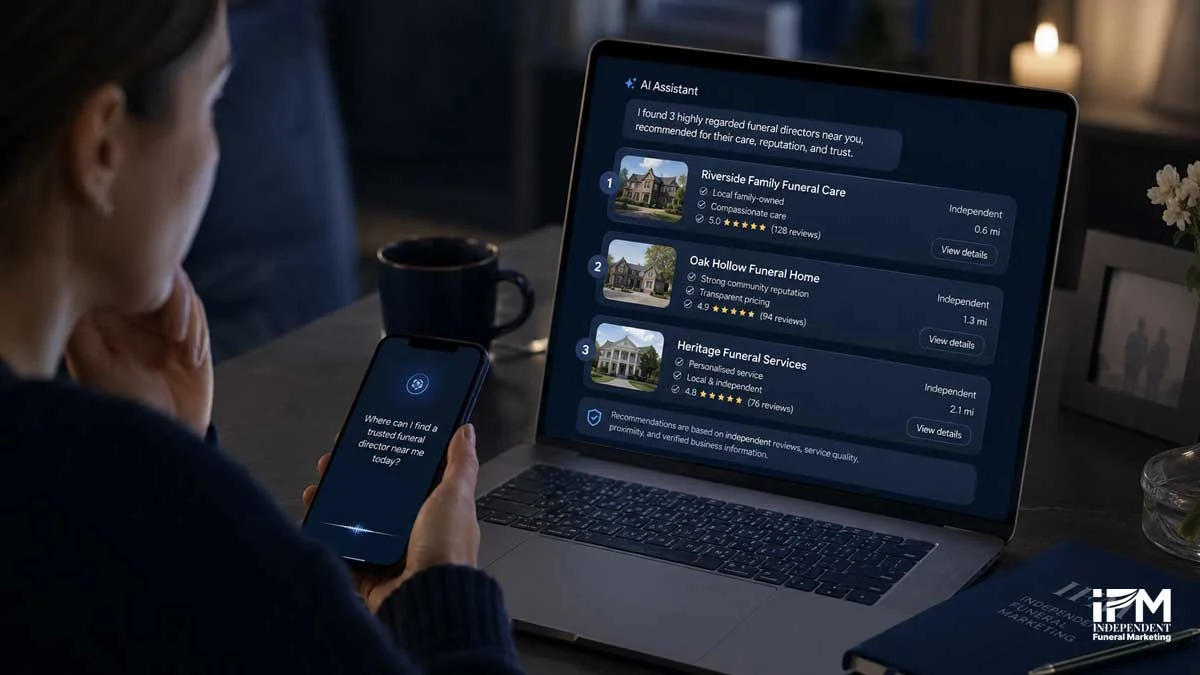
Traditional Google search is forgiving. A funeral home ranked sixth or eighth on page one is still discoverable. A family will scroll, compare, and click through to several options before making a call. AI-generated answers do not work that way. An AI assistant given a query like “who should I call when someone dies in [town]” produces a short, synthesised response naming a small number of providers with a brief explanation of why. The rest of the local market effectively does not exist for that family in that moment.
This is what practitioners call the winner-takes-most dynamic of AI search. It is not unique to funeral services, but the stakes are unusually high in this category. At-need enquiries arrive at the worst possible time for a family, and the decision to call one funeral home rather than another is often made quickly, on the basis of the first credible recommendation the family receives. If that recommendation comes from an AI assistant, the funeral home it names wins the case. The one it doesn’t name does not get a chance to compete.
There is a secondary vulnerability specific to the funeral sector: AI systems can confuse similarly named providers. A business with a vague or incomplete online description, one that does not clearly state its town, its service area, its specific offering, and its contact details in structured, consistent form, risks being omitted from AI answers entirely or being described inaccurately. An excellent funeral home with a thin online presence can be passed over in favour of a weaker competitor whose information is simply cleaner and more complete.
The funeral-director audience is already engaging with these platforms. IFM’s own audience data shows independent funeral directors over-index on Perplexity by +28.2% and on Bing by +8.3% versus UK averages (SparkToro, March 2026). These are not abstract future behaviours. The people running independent funeral homes in the UK and US are already using AI assistants as research and decision-making tools. The question is whether their own businesses are visible inside those tools when a family asks.
How are families already using AI to find a funeral director?
The shift is clearest in how people phrase their searches. Traditional Google users type keyword fragments: “funeral director Birmingham” or “cremation services near me.” AI assistant users ask full questions in natural language: “What’s the best funeral director near me who handles direct cremation?” or “What should I do when someone dies at home?”
When an AI assistant receives a local, service-specific query like that, it runs a web search, identifies the most relevant and trusted local providers it can find, and produces a short recommended list with brief descriptions. A typical response might read something like: “Based on local reviews and available information, there are a few well-regarded independent funeral directors in your area. [Provider A] in [Town] specialises in traditional services and has strong local reviews. [Provider B] offers direct cremation from [£price] with transparent pricing on their website.”
That kind of response names specific businesses and provides specific detail. The AI is not linking to a directory. It is making a recommendation. The funeral homes that appear are those whose information is clear, consistent, and structured in a way AI systems can process and trust.
Andrew Wagley of Wagley Funeral Homes, whose firm is approaching 160 years serving the same community, sees this pattern playing out in his day-to-day work. When asked whether families turn up already knowing specific details about his services before he has told them, he explained:
Funeral directors are faced with clients that have self-educated about the funeral industry. With the roll out of TikTok and Instagram funeral directors, this has given the general public a false sense of security in the knowledge that they believe they have. I have embraced this. Spending the time with families affirming that they have a sense of what it is that we do is one of the most important steps. As a funeral professional, you have the ability to prove to the family that you are the expert and can answer any question placed in front of you.
Andrew Wagley, Wagley Funeral Homes
This is an emerging, not a fully established, behaviour. It would be misleading to claim the majority of families currently choose a funeral home via AI. But the trajectory is unambiguous. Search interest in the terminology around AI search and GEO is growing at triple and quadruple-digit percentage rates year on year across both UK and US markets (DataForSEO, June 2026). The direction of travel is set. Funeral homes that wait until the behaviour is mainstream before responding will be building their AI visibility against established competitors, not ahead of them.
Not every funeral director views this shift with enthusiasm. Jill Glencross of Jill Glencross Independent Funeral Directors Ltd was candid when asked how she would feel if a family said an AI had recommended her:
We are moving into an AI world which to be honest I don’t like. I have been the target of AI generated content to try and damage my reputation so I am NOT a fan. I think AI is taking over us as people. Soon no one will have the brain to have a conversation, make a decision or even think the same as we do now. The world is changing and not for the better.
Jill Glencross, Jill Glencross Independent Funeral Directors Ltd
Her experience of being targeted by AI-generated content makes that caution entirely understandable. It is also a reminder that AI visibility is not simply about generating new enquiries. Controlling how your business is represented by AI systems, including preventing misinformation, is a legitimate reason to engage with GEO rather than ignore it.
AI Mode on Google, the platform’s expanding AI search surface, is also increasing the proportion of Google searches that produce AI-generated summaries rather than traditional blue-link results. Funeral homes optimised for GEO will be better positioned across this expanding surface, not just in standalone AI assistants.
What makes a funeral home more likely to appear in AI answers?
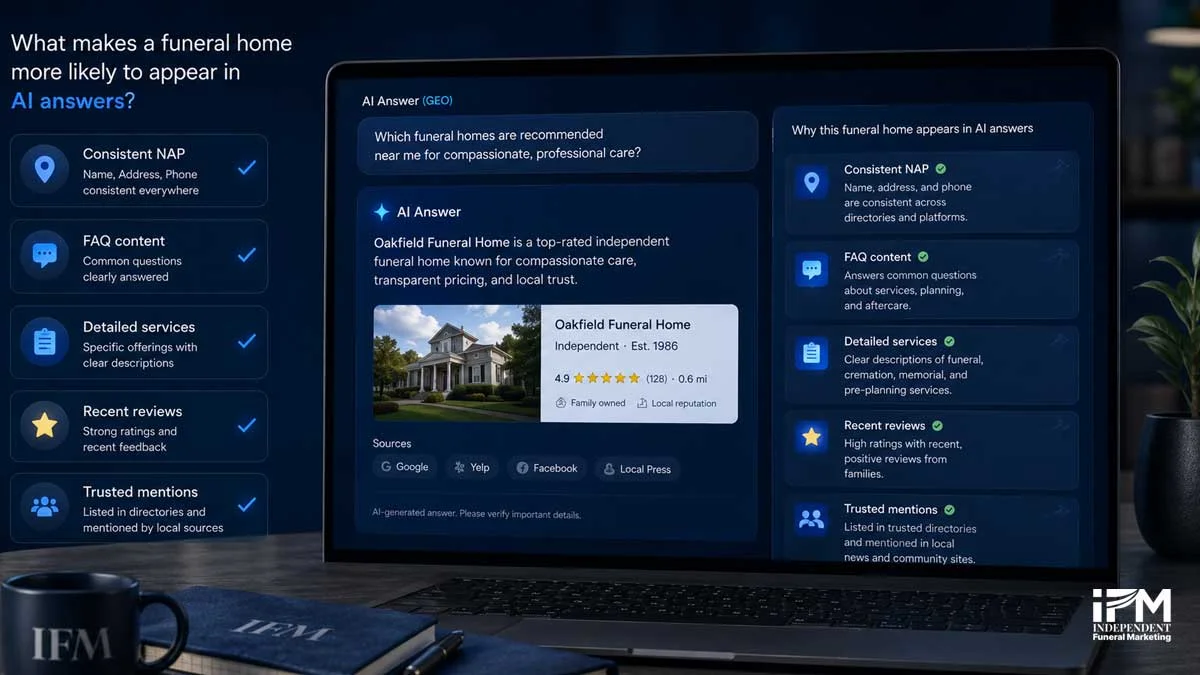
The factors that improve AI visibility are not exotic or technically inaccessible. Most are extensions of the local SEO work a well-managed funeral home should already be doing.
- Consistent NAP across all directories. Name, address, and phone number must match exactly across your website, Google Business Profile, Bing Places, Yell, funeral industry directories, and any other listings. Inconsistencies create entity ambiguity, the AI is less confident it has found the right business, and it may omit or misrepresent it.
- FAQ-formatted service and location pages. Content structured as direct question-and-answer pairs is significantly easier for AI retrieval systems to extract and cite. Rewriting key pages to include explicit Q&A sections, backed by FAQPage schema markup, directly improves citation likelihood.
- Specific, accurate service descriptions. Vague copy like “we offer a full range of services” gives an AI nothing to work with. Specific, detailed descriptions of what you offer, the locations you serve, and what families can expect are what get quoted.
- Active review management. AI systems use review volume, consistency, and recency as trust signals. A funeral home with 40 recent, detailed reviews is significantly more visible in AI answers than one with 6 dated reviews. Responding to reviews also signals active management.
- Mentions on trusted third-party sites. Local press coverage, mentions on council bereavement resource pages, listings in professional body directories, and citations from local community organisations all provide the kind of third-party validation AI systems weight when deciding which businesses to trust.
Andrew Wagley of Wagley Funeral Homes confirms the review and digital presence dynamic from direct experience. When asked how families tend to find his firm today, he explained:
We have found that Google reviews and Facebook presence really drives our organic new business. With the decline in print obituaries in newspapers, our public facing information has all become digital. This is a change that has come on quickly.
Andrew Wagley, Wagley Funeral Homes
None of these require specialist GEO tools or significant technical investment. They require consistency, structure, and a willingness to treat content as infrastructure rather than decoration.
Can an independent funeral home compete with corporate chains in GEO?
This is one of the genuinely encouraging aspects of the GEO landscape for independent funeral directors. The dynamics that favour large corporate chains in traditional SEO, including domain authority built through years of link acquisition and the budget to produce high volumes of content, are less decisive in AI search.
AI assistants answering a local query are looking for the most relevant and trustworthy match for that specific location and need. A well-structured independent funeral home that serves a specific community, has genuine local reviews, and describes its services in clear, human detail is often a more compelling AI citation than a corporate chain with a generic location page serving twenty towns from a single template.
Jill Glencross of Jill Glencross Independent Funeral Directors Ltd illustrates what this local authority looks like in practice. When asked what families already know before making first contact, she explained:
They know our reputation and they know who I am, from services, media, advertising, and also our involvement in the community. We have a 5 star review rating but I think it is generally word of mouth. People know we are a family business that can be trusted.
Jill Glencross, Jill Glencross Independent Funeral Directors Ltd
That combination of community presence, professional reputation, and authentic reviews is exactly the trust signal infrastructure that AI systems draw on when deciding which local providers to recommend.
The caveat is worth stating plainly: this is an emerging dynamic, not a guaranteed outcome. A corporate chain with a strong local presence, good structured data, and active review management will still be competitive. The advantage for independent funeral homes comes from being specific where large operators are often generic, local where they are often national, and human where they are often automated.
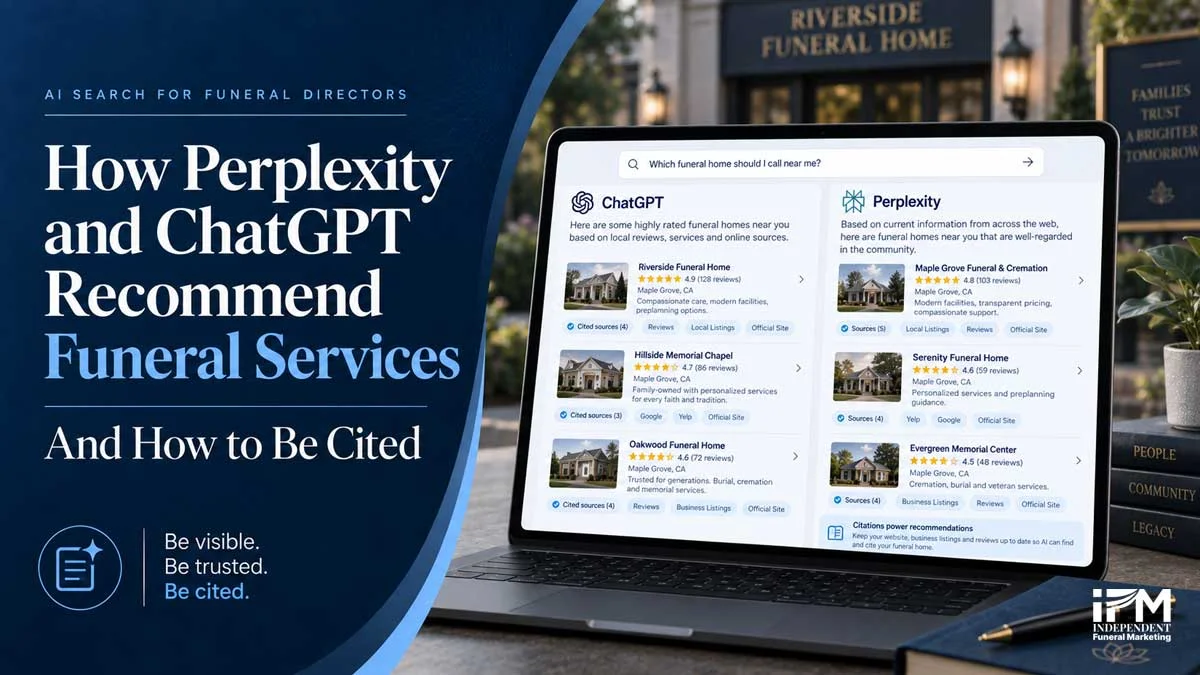
There is also a first-mover dimension. Funeral-specific GEO terms carry zero search volume in current DataForSEO data for both UK and US markets (DataForSEO, June 2026). That is not an absence of relevance, it is an absence of competition. Independent funeral homes that build their AI visibility now, while no competitor has done it, will accumulate the kind of structured presence and citation history that compounds over time. For the platform-specific mechanics behind this, including why ChatGPT’s Yelp data partnership makes this even more true, see how Perplexity and ChatGPT recommend funeral services.
What are the most common GEO mistakes funeral homes make?
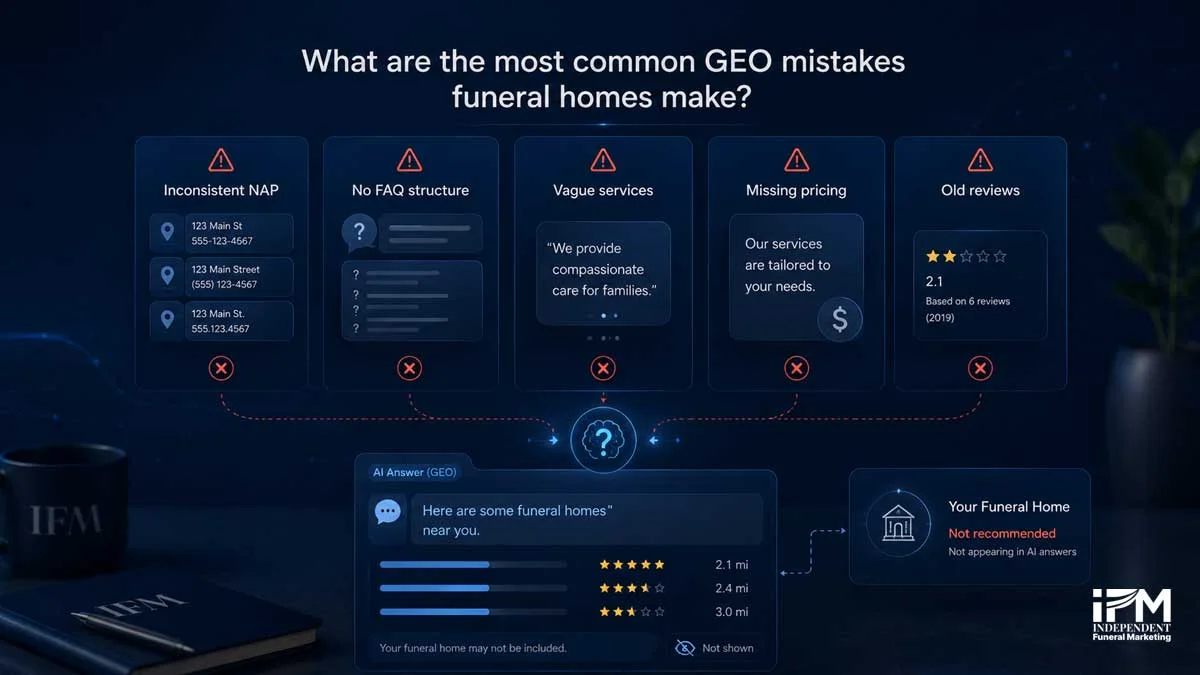
Understanding the mistakes makes the corrective action straightforward.
- Inconsistent NAP across directories. If your business name is listed as “Smith & Sons Funeral Directors” on your website but “Smith and Sons Funeral Home” on Yell and “Smith’s Funeral Services” on Google Business Profile, AI systems treat these as potentially different businesses. Consistency is the starting point for entity clarity.
- No structured FAQ content. Funeral homes with service pages that read as brochures rather than answers give AI systems nothing to extract. A page that directly answers “What does a direct cremation include?” or “How long does probate take before a funeral?” in a clear Q&A format is far more likely to be cited.
- Vague or generic service descriptions. AI systems cannot recommend what they cannot accurately describe. A service page that says “we offer compassionate, professional funeral services” without specifying what those services include, what they cost, and what areas they cover is invisible in AI answers.
- Outdated or missing pricing. Transparent, current pricing is one of the strongest trust signals for both AI systems and families. The CMA Funerals Market Investigation Order requires UK funeral directors to publish standardised pricing anyway. Ensuring this is clearly structured and regularly updated removes a major barrier to AI citation.
- Weak or dated reviews. A funeral home with reviews from 2021 and 2022 looks dormant to an AI system assessing current trustworthiness. A steady cadence of recent reviews, even a modest number, signals an active, relevant business.
Each of these is a fixable opportunity, not a structural disadvantage. The gap between where most independent funeral homes are today and where they need to be for strong AI visibility is smaller than it appears.
How should a funeral home start with GEO in 2026?
Starting with GEO does not require a complete website rebuild or a large budget. The highest-impact first steps are the same disciplines that underpin strong local SEO.
- Audit your business information. Search for your funeral home’s name across Google, Bing, Yell, Apple Maps, funeral industry directories, and any other listings you have claimed or that exist independently. Identify every inconsistency in name, address, phone number, and service description. Correct them all to match your primary listing exactly.
- Add FAQ sections to your key service pages. Take the questions your staff are asked most often by families, write clear, specific, honest answers to each, and add them to the relevant service page in a visible Q&A format. Add FAQPage schema markup to these sections. This is one of the highest-return investments in GEO available to any funeral home.
- Build a review management process. Following every completed service, make it easy for the family to leave a Google review. This does not need to be a formal system, a simple follow-up communication with a direct link is sufficient. Aim for a consistent cadence of new reviews rather than periodic bursts.
On timeframes: small improvements to AI responses, particularly corrections to business information inconsistencies, can appear within four to eight weeks as AI systems re-crawl and re-index updated content. More meaningful shifts in how often a funeral home is cited in AI answers typically take three to six months of consistent effort (consistent with established local SEO timelines).
These three steps do not require a GEO specialist. They require consistency, structure, and the same attention to detail that builds a strong local presence in any channel. The funeral homes that get this right in 2026, while the space is still uncontested, will hold a structural advantage that compounds as AI search becomes the default first step for more families.
Frequently Asked Questions
What does GEO stand for?
GEO stands for Generative Engine Optimization. It is the practice of structuring a business’s online content so that AI tools such as ChatGPT, Perplexity, and Google’s AI Overviews can find, understand, and cite it when answering a person’s question. The term is used in a digital marketing context, not to be confused with geography or geospatial data.
What is GEO in simple words?
GEO, or Generative Engine Optimization, means making your website content easy for AI assistants to read, understand, and quote in their answers. Instead of trying to rank on a list of ten blue links, you are trying to be the answer an AI gives when someone asks a relevant question. For a funeral home, that means being the recommended provider when a family asks an AI assistant who to call.
What is GEO vs SEO?
SEO (Search Engine Optimization) aims to rank a web page high in a list of search results so a person clicks through to it. GEO (Generative Engine Optimization) aims to be the answer itself, quoted or recommended directly inside an AI-generated response. SEO success is measured by rankings and click-through rates. GEO success is measured by AI citation frequency and share of voice in AI answers. Both disciplines build on the same technical foundation.
What is the difference between AEO and GEO?
Answer Engine Optimization (AEO) and GEO are near-synonyms that emerged from different communities at roughly the same time. AEO emphasises optimising for direct-answer platforms and voice search. GEO emphasises optimising specifically for generative AI systems that produce synthesised, conversational responses. In practice, almost every technique that helps with one also helps with the other, and funeral directors do not need separate strategies for each.
Is GEO replacing SEO?
No. GEO is a new layer built on top of SEO, not a replacement for it. A technically broken or unindexed website is invisible to AI systems exactly as it is to Google. Strong SEO fundamentals, including fast loading, clean indexation, and authoritative content, remain the foundation that GEO depends on. The change is that getting the fundamentals right now unlocks both Google ranking and AI citation.
Do you need GEO and SEO together?
Yes. SEO and GEO are complementary disciplines that share the same technical foundation. A well-optimised website performs better in both Google search results and AI-generated answers. Funeral homes that invest in SEO fundamentals, clear structured content, consistent business information, and strong reviews are already building the infrastructure that GEO relies on. The two strategies reinforce rather than compete with each other.
Do families really use AI to choose a funeral home?
AI-assisted search for funeral directors is an emerging behaviour, not yet a mass-market habit, but the trajectory is clear. Search interest in GEO-related terms is growing at hundreds of percent year on year (DataForSEO, June 2026), and AI assistants are already returning funeral director recommendations in response to local queries. Funeral homes that act now, while the space is uncontested, will hold a structural advantage as the behaviour becomes mainstream.
Can I trust an AI recommendation for a funeral director?
AI recommendations are only as reliable as the information the AI can find about a business. A funeral home with consistent, accurate, well-structured online information is more likely to be recommended correctly. One with vague descriptions, inconsistent contact details, or sparse reviews may be omitted or incorrectly described. This is exactly why managing a funeral home’s AI visibility matters, it directly affects whether families receive an accurate recommendation.
Why does GEO matter for funeral homes specifically?
Funeral services are a high-trust, time-sensitive category. When a grieving family asks an AI assistant who to call, the AI typically recommends two or three providers, not twenty. Any funeral home not in that short list simply does not exist for that family at that moment. Unlike traditional search, AI answers create near-binary visibility: you are either recommended or you are not. GEO is the discipline that determines which side of that line a funeral home sits on.
What makes a funeral home more likely to appear in AI answers?
AI systems favour funeral homes with clear, consistent identity information across the web, structured FAQ content that directly answers common family questions, strong and regularly updated Google reviews, and mentions on trusted third-party sites such as local press, directories, and professional bodies. Technical foundations also matter: fast loading, secure HTTPS, and correct schema markup all signal reliability to AI extraction systems.
Do reviews matter for AI search visibility?
Yes. AI systems treat review consistency and volume as a trust signal when deciding which local businesses to recommend. A funeral home with a steady stream of specific, authentic reviews is more likely to be cited than one with few or dated reviews. The content of reviews also matters: families describing services in detail give AI systems richer information to work with than brief star ratings alone.
Can small independent funeral homes compete with large chains in GEO?
Yes, often more easily than in traditional SEO. AI systems tend to prioritise local relevance, service clarity, and community presence over brand scale. An independent funeral home with clear, specific service descriptions and strong local reviews can be recommended over a large corporate chain if its information is better structured and more directly relevant to the family’s query. Local authority is a genuine advantage in AI-driven search.
How long does it take to improve AI search visibility?
Small improvements, such as correcting business information inconsistencies and adding FAQ content, can influence AI responses within four to eight weeks as AI systems re-crawl and re-index updated content. More meaningful shifts in AI citation frequency typically take three to six months of consistent effort. This timeline is comparable to local SEO, and the two disciplines are best pursued together rather than sequentially.
How does GEO work?
Most AI assistants use a process called retrieval-augmented generation (RAG). When a person asks a question, the AI pulls in relevant, trustworthy web content in real time, synthesises it into a natural language answer, and cites its sources. GEO works by ensuring your content is structured so RAG systems can accurately identify, extract, and confidently cite it, particularly through clear entity information, FAQ-formatted content, and schema markup.
Does schema markup help with GEO?
Yes. Schema markup, particularly FAQPage, LocalBusiness, and Organization schema, helps AI systems accurately identify what a business does, where it operates, and what questions it answers. Structured data reduces the ambiguity that causes AI systems to omit or misrepresent a business in their answers. FAQPage schema is especially valuable: it directly maps question-and-answer pairs in a format AI extraction systems are built to process.
Do I need a GEO specialist or can my existing SEO agency do this?
Many of the foundational GEO techniques, such as structured content, schema markup, review management, and citation consistency, are extensions of good local SEO practice. An SEO agency already doing this work well is positioned to layer GEO on top. The gap is usually in understanding how AI systems specifically extract and evaluate content, and in structuring FAQ and service page copy to meet that standard rather than just optimising for Google rankings alone.
GEO is not a separate marketing discipline that sits alongside everything else a funeral home is doing. It is the next layer of the same trust-building, visibility-building work that good local SEO has always required, applied to a new discovery channel that families are beginning to use.
Most independent funeral homes have not yet structured their content or business information for AI visibility. That is not a criticism, it is an opportunity. The funeral-specific GEO terms carry zero search volume in current data (DataForSEO, June 2026), which means there are no competitors to displace. The funeral homes that build their AI presence in 2026 will not be catching up to established competition. They will be creating the benchmark that future competitors will have to match.
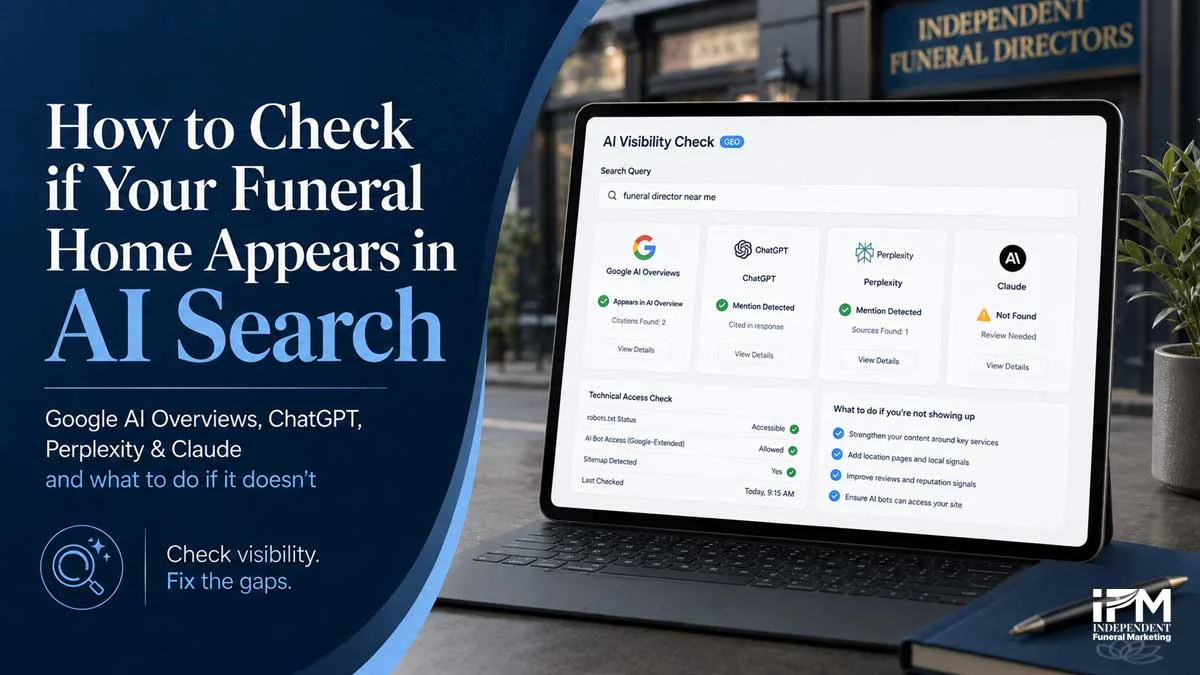
Once you’ve made these changes, the natural next question is whether they’re actually working. Our guide to checking your funeral home’s AI search visibility walks through Google Search Console’s new AI reporting tool, manual test searches for ChatGPT, Perplexity and Claude, and a crawler-access check most funeral homes have never run.
If you’d like to understand where your funeral home currently stands in AI search, and what structured steps would improve your visibility, get in touch and we’ll run through it together.
References
[1] Aggarwal, P. et al., GEO: Generative Engine Optimization, arXiv:2311.09735, 2023. Cited by 177 academic sources (Google Scholar, June 2026).
[2] Search Engine Land, Generative engine optimization (GEO): How to win AI mentions, searchengineland.com/what-is-generative-engine-optimization-geo-444418
[3] Semrush, GEO vs. SEO: A Comparative Guide for Digital Marketers, semrush.com/blog/geo-vs-seo
[4] Google for Developers, Optimizing your website for generative AI features on Google Search, developers.google.com/search/docs/fundamentals/ai-optimization-guide
[5] Wikipedia, Generative engine optimization, en.wikipedia.org/wiki/Generative_engine_optimization
[6] Cheeky Pint, The history and future of AI at Google, with Sundar Pichai, hosted by John Collison with Elad Gil, cheekypint.substack.com/p/the-history-and-future-of-ai-at-google, 7 April 2026
[6] DataForSEO Labs API and Live SERP Advanced, Keyword research for “what is geo” and related terms, June 2026. Research conducted for Independent Funeral Marketing.
[7] SparkToro, Audience research for independent funeral directors, March 2026.