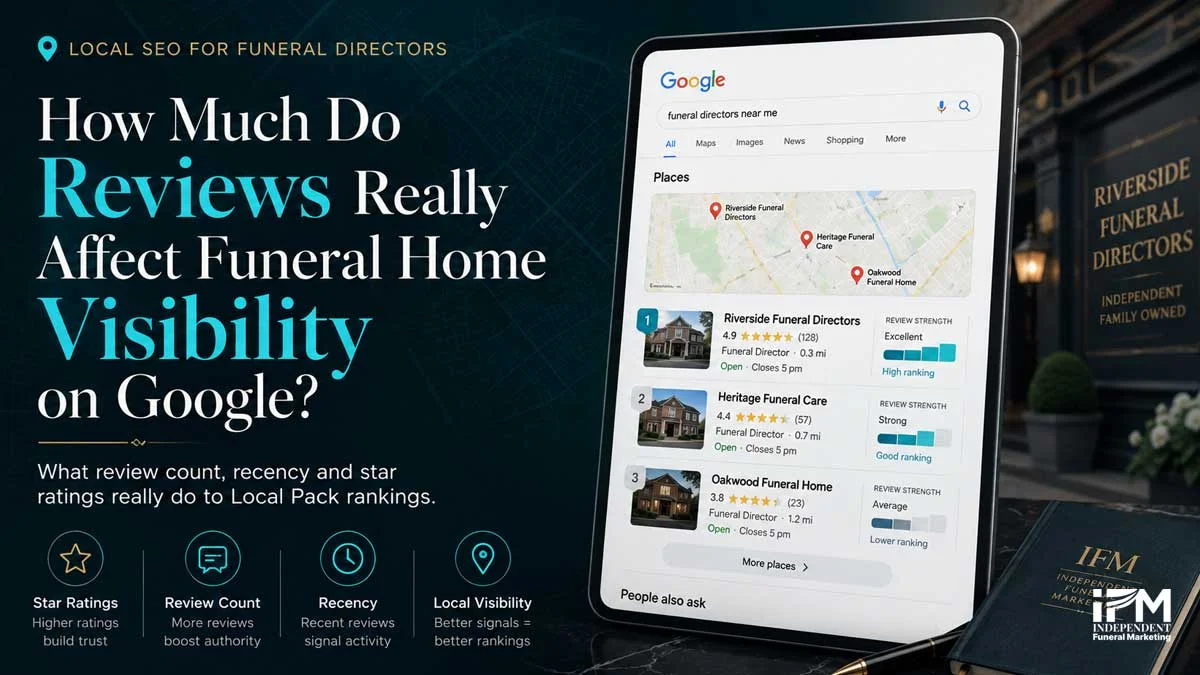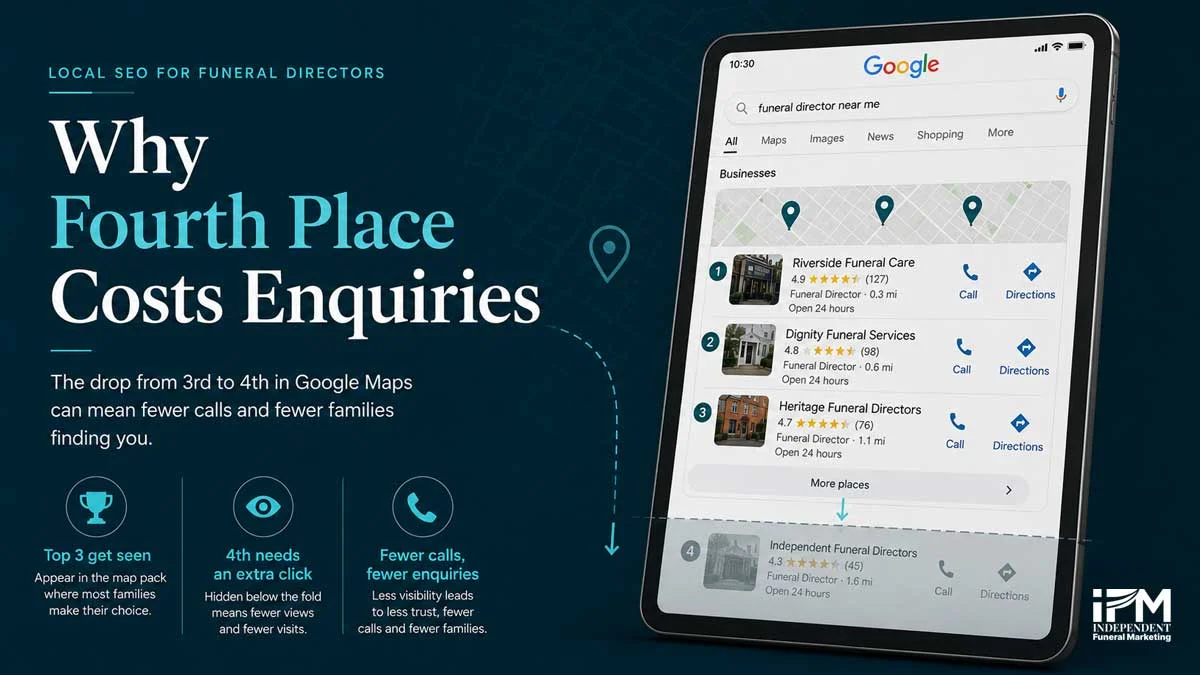
Ranking fourth in Google’s local search results can feel almost identical to ranking third, one place lower, one listing along. The click-through data says otherwise.
The jump from third to fourth is the steepest single drop in local search, organic or map-based, and it can be quietly costing an independent funeral director enquiries every single week. Not because the firm is doing anything wrong. Simply because of where a family’s eye stops before they pick up the phone.
This article sets out exactly how steep that drop is, why it matters more for a funeral director than for almost any other local business, and what actually moves a profile from fourth place into the top three.
None of this is about chasing vanity metrics. A ranking position only matters because of what it converts into, phone calls from families who need help now, and the goal throughout is to translate an abstract search-engine statistic into something a funeral director can actually act on this week.
What Does It Actually Mean to Rank ‘Fourth Place’ in Google Search?
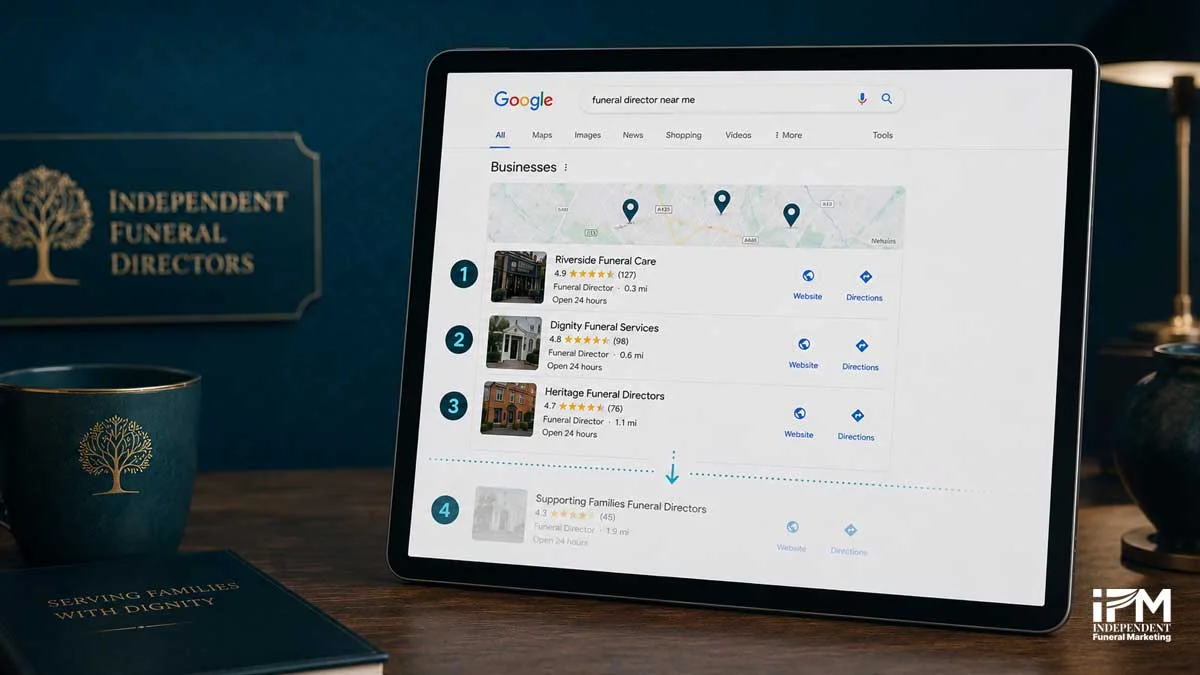
“Fourth place” in Google search can mean two different things: the fourth organic (blue-link) result on the page, or the fourth-ranked local business just outside the visible three-listing local pack. Google’s own guidance confirms local results are ranked on relevance, distance, and prominence, a separate system from the one that ranks organic web pages [2].
Most funeral directors who ask “why isn’t my business showing on Google Maps” are really asking about one of two separate rankings, and the two behave differently enough that they’re worth pulling apart before any statistic makes sense.
Local pack position 4 sits just below the three map listings a searcher sees first, reachable only by clicking “More places” to expand the Local Finder. Organic position 4 sits within the ordinary list of ten blue links, still on page one, still visible without an extra click, but past the point most searchers’ eyes actually stop.
| Local Pack Position 4 | Organic Position 4 | |
|---|---|---|
| What the searcher sees | Requires clicking “More places” to view | Visible on page one without extra clicks |
| Ranked by | Relevance, distance, prominence | Content, technical health, backlink authority |
| Typical searcher | At-need, map-based, ready to call | Broader, sometimes earlier-stage research |
Both matter. Both are covered separately across this article, because treating them as the same problem is exactly what leads a funeral director to fix the wrong thing. For the fuller anatomy of what a family actually sees on that results page, what the results page actually looks like covers star ratings, review counts, and AI Overviews in more depth.
How Much Does Click-Through Rate Drop Between Position 3 and Position 4?
Organic click-through rate falls from around 10.2% at position 3 to around 7.2% at position 4, a relative drop of roughly 29%, or about 300 fewer clicks per 10,000 searches [1]. That single-position drop is sharper than the gap between almost any other two adjacent positions below the top of the page.
The full curve makes the size of that gap easier to judge. Positions one to three fall off steadily. Position four is where the decline steepens noticeably again, before flattening out toward the bottom of the page.
| Position | Click-Through Rate |
|---|---|
| 1 | 39.8% |
| 2 | 18.7% |
| 3 | 10.2% |
| 4 | 7.2% |
| 5 | 5.1% |
| 10 | 1.6% |
This data, published by First Page Sage and updated for 2026, is a meta-analysis blended across multiple independent studies rather than a single controlled dataset [1]. It’s also worth flagging plainly: these are ‘clean SERP’ figures, measured with no competing local pack, images, or AI Overview on the page. Real funeral-related searches very often have a local pack present too, which is precisely why the next section covers that mechanism separately.
First Page Sage’s own research shows just how much a local pack compresses these numbers when one appears on the same page: the position 1 organic click-through rate falls from 39.8% to 23.7%, and position 2 falls to roughly 15.1%, once a competing local pack sits above the organic results [1]. That compression cuts both ways for a funeral director. It means organic ranking alone is rarely the full picture, and it strengthens rather than weakens the case for treating local pack position as the primary battleground.
There’s also a live debate worth naming rather than smoothing over. First Page Sage argues AI Overviews have had a minimal effect on organic click-through rates so far. Other researchers, reported by Search Engine Land, have found meaningful click declines on queries where an AI Overview appears. Neither claim changes the position 3-to-4 finding itself, but it’s a reminder that the ‘clean SERP’ curve above is best read as an upper bound, not a guarantee, for any specific funeral-related search today.
What Happens to Enquiries When a Funeral Director Sits Outside the Local Pack?
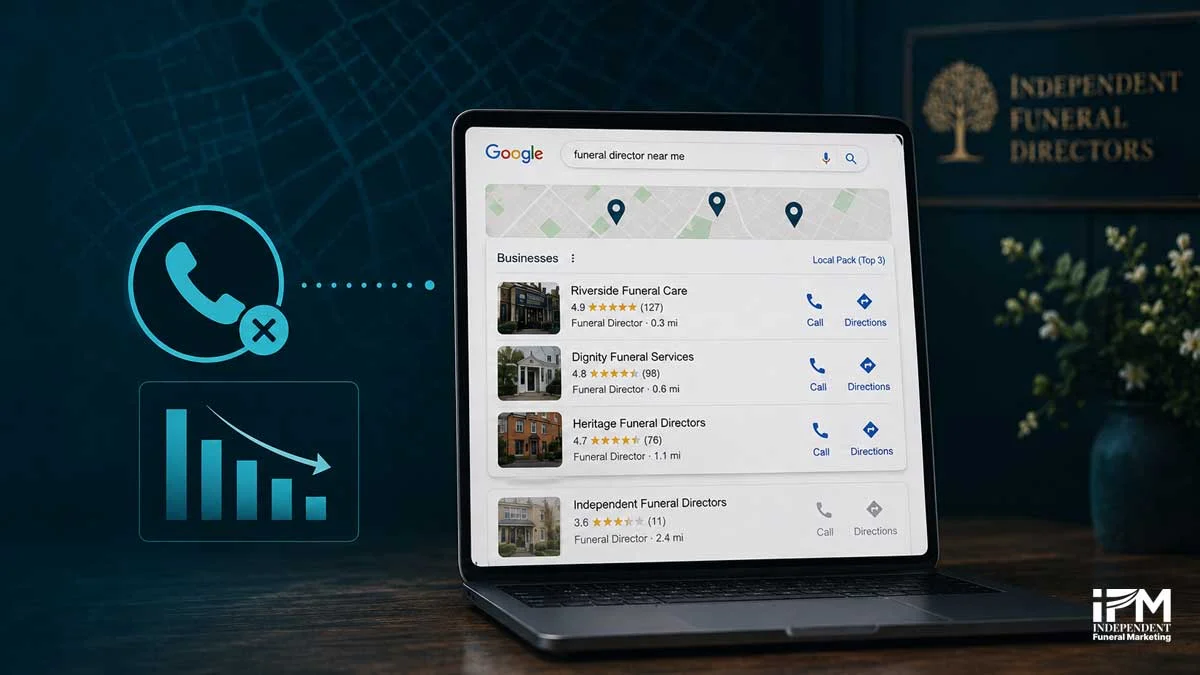
Businesses that enter Google’s local 3-pack have been found to see substantially more visibility and customer actions than those ranked just outside it. One widely-cited 2021 study of over 25,000 business locations recorded a 404% increase in profile views and a 113% increase in clicks and actions after entering the pack [3].
That MomentFeed study is genuinely useful, and genuinely dated. It was published in February 2021, before several rounds of local-algorithm changes and before AI Overviews existed, so treat the scale as illustrative rather than current.
A more recent, though still not brand-new, figure comes via Search Engine Land, citing SOCi’s 2022 analysis of multi-location brands: businesses inside the 3-pack received 126% more traffic and 93% more customer actions, calls, direction requests, and website clicks, than businesses ranked 4 to 10 [4]. That research was built on multi-location brand data, so its transferability to a single-branch independent funeral director is imperfect, worth stating rather than glossing over.
And then there’s the honest gap. A commonly-repeated figure suggests around 8% of local searchers click “More places” to see businesses ranked below the 3-pack. That number traces to a single 2015 test of one search query, and no robust, independent, current figure has replaced it since. Rather than presenting 8% as a precise modern statistic, the fairer summary is qualitative: expansion clicks beyond the visible pack are minimal, and a business relying on them is relying on the smallest, least reliable slice of search traffic available.
Local pack visibility isn’t something a funeral director can buy their way into with a bigger budget than a corporate chain’s regional branch. It’s earned through the same signals every independent firm has equal access to, which is exactly why local SEO for funeral directors is built around measurable visibility rather than outspending the competition.
Why Does Position 4 Cost a Funeral Director More Than It Costs Most Local Businesses?
Most local searches allow for casual comparison. Funeral searches largely do not. The Competition and Markets Authority’s research into the UK funerals market found only a minority of consumers compare two or more funeral directors before choosing one [5], meaning the few families who do search online are disproportionately likely to contact whichever firm they see.
A shopper comparing plumbers has time, and usually inclination, to scroll, click through a few options, and weigh them up. A family arranging a funeral in the hours after a death very often does not. The comparison behaviour that would normally soften the cost of a lower ranking simply doesn’t apply in the same way here. Why bereaved families rarely compare funeral directors covers the CMA’s fuller findings on comparison rates.
Translate that into the position-4 argument and the stakes sharpen further. Because families rarely go back and compare once they’ve found someone, being the option that’s seen, position 3, versus the option that requires an extra click, position 4, is not a minor difference. It is frequently the entire outcome. A funeral director doesn’t need to be chosen over a rival they were compared against. They need to be seen at all.
That framing is reinforced by how much weight consumers place on Google itself when they do search. BrightLocal’s research found Google (66%) and Google Maps (45%) are the two most trusted sources consumers turn to when researching a local business, ahead of a firm’s own website (36%) [9]. For most local businesses, that trust gap is softened by comparison shopping. For a funeral director, it isn’t, because the comparison step so often never happens.
How Much Could Fourth Place Be Costing Your Funeral Home in Lost Enquiries?
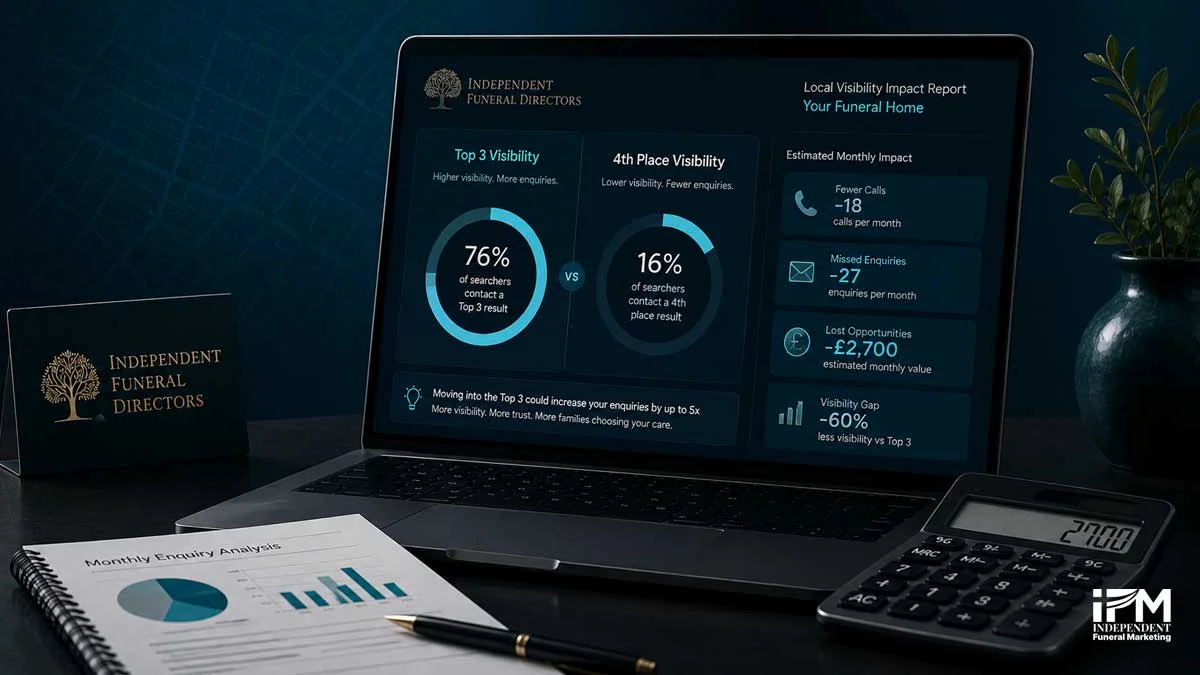
A simple, illustrative model shows the scale of what fourth place can mean: if a town generates 40 relevant monthly searches, a roughly 15% local-pack click share at position 3 versus a roughly 7% share at position 4 can mean the difference between about six and three enquiries a month, three fewer families who ever see the firm.
This is a hypothetical, clearly-labelled example, not a market prediction. Every assumption is stated so it can be replaced with a funeral director’s own numbers, pulled from Google Business Profile Insights or Search Console.
The model uses three inputs. First, a stated monthly search volume, 40 in this example, standing in for whatever a firm’s own town actually generates. Second, First Page Sage’s local-pack position 3 click-through rate of 15.1%, set against the organic position 4 rate of 7.2% used elsewhere in this article [1]. Third, SunLife’s 2026 average simple attended funeral value of £3,828, used only to illustrate the scale of what a single additional enquiry can represent, not as a guaranteed outcome, since not every enquiry converts to a booking [6].
| Assumption | Position 3 | Position 4 | Difference |
|---|---|---|---|
| Monthly relevant searches (illustrative) | 40 | 40 | n/a |
| Click-through rate | ~15.1% | ~7.2% | n/a |
| Resulting monthly enquiries (illustrative) | ~6 | ~3 | ~3 fewer |
| What one enquiry can represent | £3,828 average simple funeral value | £3,828 average simple funeral value | Illustrative only |
Read that table as a shape, not a prediction. A funeral director in a busier town could see the same pattern at a larger scale; a quieter town, a smaller one. The point the model illustrates is the ratio, not the raw count: moving from fourth place to third can roughly double the enquiries a search generates, using verified click-through figures as the only moving part.
Why Is Local Pack Ranking Different from Organic Website Ranking?
Local pack rankings and organic website rankings are governed by different systems. Google’s own guidance states local results are ranked on relevance, distance, and prominence, while organic rankings depend on content, technical health, and backlink authority [2], so a funeral director can rank well organically while still sitting fourth in the map pack, or vice versa.
| Local Pack Signals | Organic Signals | |
|---|---|---|
| Primary drivers | Google Business Profile, proximity, reviews | Website content, technical health, backlinks |
| Governed by | Relevance, distance, prominence | Content quality and domain authority |
| Where it’s fixed | Google Business Profile | The funeral director’s own website |
Whitespark’s 2026 research into local ranking factors puts a concrete number on that distinction: on-page signals carry roughly double the weight in organic local rankings, around 33%, that they do in the local pack itself, around 15% [7]. A funeral director who only ever works on their website is optimising the wrong lever for the local pack specifically. Optimising your Google Business Profile is the natural next step for the local-pack side of that distinction.
In practice, that means a firm can do everything right on its website, fast pages, clear service descriptions, strong content, and still sit fourth in the map pack because the Google Business Profile itself is thin, miscategorised, or short on recent reviews. The reverse is just as common: a strong, review-rich profile carrying a dated or thin website into the top three anyway. Neither fix substitutes for the other, which is why a firm chasing the 3-versus-4 boundary specifically should start with the profile, not the website redesign.
What Actually Moves a Funeral Director from Fourth Place into the Top Three?
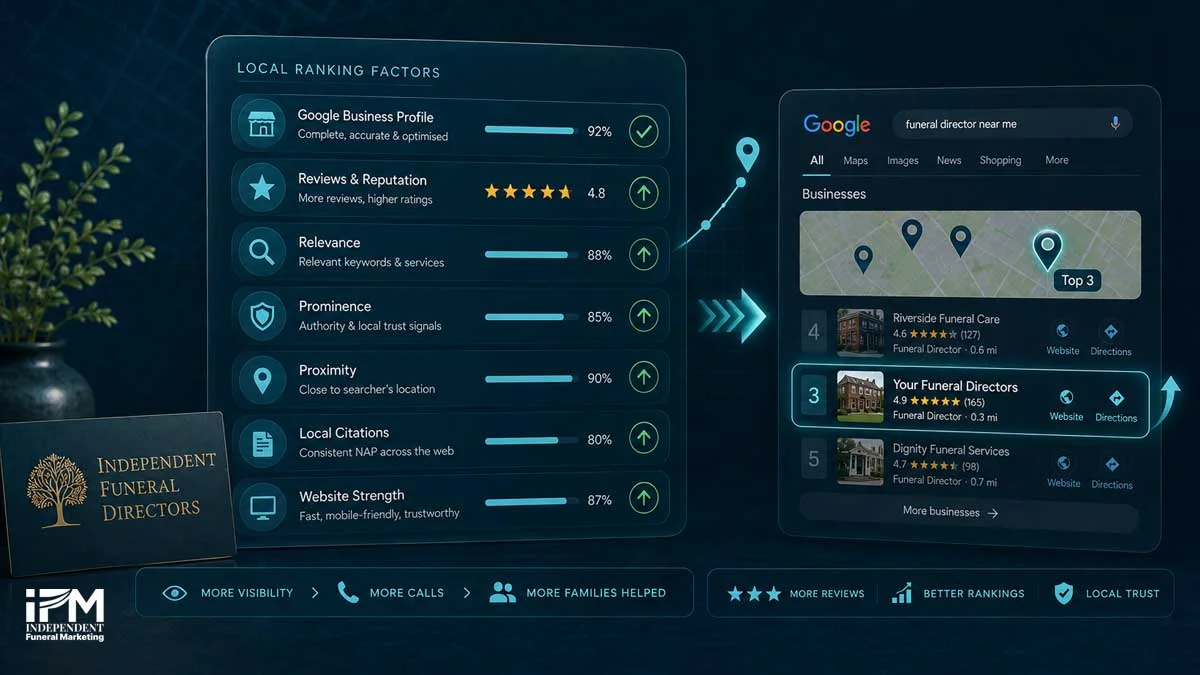
Whitespark’s 2026 Local Search Ranking Factors report, compiled from 47 expert contributors scoring 187 factors, found Google Business Profile signals account for roughly 32% of local pack rankings, review signals around 20%, and on-page signals around 15%, with primary GBP category, proximity, and business-title keywords named as the three most influential individual factors [7].
Ordered by that weighting, the actions most likely to close the gap between fourth and third are:
- Confirm the primary Google Business Profile category is exactly “Funeral Director” or “Funeral Home”, Whitespark’s number one named factor.
- Audit and complete every Google Business Profile field. An incomplete profile is a suppressed profile.
- Build a consistent, ethical review-request process. Review signals are the second-largest weighted category.
- Ensure NAP (name, address, phone) consistency across every directory the firm appears on.
- Reinforce the website with location-specific content. On-page signals still carry real weight even for local-pack rankings.
- Check Google Business Profile posting activity and photo freshness monthly.
- Track position specifically at the 3-versus-4 boundary using Search Console and Google Business Profile Insights, not just “page one.”
None of these is a single fix. Together, they’re the documented, weighted route from being technically present on Google Maps to being one of the three listings a family actually sees.
Review recency deserves a specific mention. Whitespark’s 2026 report highlights it as one of the most underrated ranking factors, now sitting inside the report author’s own personal top five, ahead of raw review volume alone [7]. A profile with fifty reviews from three years ago carries less weight than one with fifteen reviews gathered steadily over the past few months, a detail that’s easy to miss when the instinct is simply to chase a higher total count. For the fuller tactical walkthrough behind each of these seven actions, the complete guide to ranking on Google Maps covers Google Business Profile setup, review generation, and citation building step by step.
How Long Does It Take to Move from Fourth Place to the Top Three?
Moving from fourth place into the local pack is typically one of the faster local SEO wins available. Profile-level fixes, category, completeness, review momentum, can show movement within weeks, though sustained top-three positioning in a competitive town usually takes a few months of consistent activity rather than a single change.
That timeline holds specifically for the 3-versus-4 boundary. Ranking from nowhere into contention is a longer project; nudging an already-close profile the last position or two tends to move faster.
It’s worth being honest about why the range is a range rather than a promise. Google’s local algorithm updates periodically, competitors are working on their own profiles too, and review momentum builds unevenly month to month. A firm already sitting fourth, with a mostly complete profile and a reasonable review base, is in a fundamentally different position to one starting from a suspended or barely-touched listing, and the timeline should be read with that starting point in mind rather than as a fixed countdown. A realistic SEO timeline for funeral homes is covered in full elsewhere on this site for firms weighing up the wider investment, not just this one boundary.
Frequently Asked Questions
Does it matter if my funeral home ranks 4th instead of in the top 3 of the local pack?
Yes. The click-through data shows the drop from position 3 to position 4 is one of the steepest single-position declines in local search, both organically (10.2% to 7.2%, First Page Sage, 2026) and within the local pack itself, because only the top three listings display without an extra click.
What is the difference between the Google local pack and organic search results?
The local pack is the block of three business listings shown with a map for location-based searches, ranked on relevance, distance, and prominence (Google Business Profile Help, 2026). Organic results are the standard list of website links below it, ranked by a different set of signals including content, technical health, and backlinks.
How much does click-through rate drop from position 3 to position 4?
Organic click-through rate falls from roughly 10.2% at position 3 to roughly 7.2% at position 4, a relative drop of about 29% (First Page Sage, 2026).
What percentage of searchers click ‘More places’ to see businesses ranked below the 3-pack?
There is no robust, current, independent figure for this. A commonly-cited estimate of around 8% traces to a single 2015 test of one search query and has not been reliably updated since, so treat it as a directional, not precise, figure.
Why does position matter more for funeral directors than for many other local businesses?
Because bereaved families searching online rarely go back and compare multiple funeral directors once they find one. The Competition and Markets Authority’s research into the UK funerals market found only a minority of consumers compare two or more providers before choosing (CMA, 2020), which raises the stakes of being the option a family actually sees.
What happens to a business’s visibility when it enters the Google 3-pack?
One widely-cited 2021 study of more than 25,000 business locations found a 404% increase in profile views and a 113% increase in clicks and actions after entering the 3-pack (MomentFeed, 2021), illustrating the scale of the gap from the other direction.
What is the single most important factor in local pack rankings?
Whitespark’s 2026 Local Search Ranking Factors report names the Google Business Profile’s primary category as the single most influential individual factor, with GBP signals overall accounting for roughly 32% of local pack rankings.
Can a funeral home rank well organically but still be outside the local pack?
Yes. Local pack ranking and organic ranking are governed by different signals, so it is entirely possible to rank on page one organically while still sitting in fourth place or lower in the map pack for the same search.
How long does it take to move from fourth place into the top three?
Profile-level fixes can show movement within weeks, but sustained top-three positioning in a competitive town typically takes a few months of consistent activity. The full guide to SEO timelines for funeral homes covers this in more detail.
Is it worth the effort to move from position 4 to position 3?
The evidence suggests yes. The size of the click-through gap between the two positions is larger than the gap between almost any other two adjacent positions, making this specific boundary one of the highest-leverage local SEO improvements available to an independent funeral director.
Fourth place is close enough to feel like a technicality and far enough to cost real enquiries. The click-through data settles which of those it actually is. It’s also a market where a UK audience over-indexes for Perplexity by 28.2% against the national average [8], one more reason the boundary between being cited and being invisible to an answer engine matters as much as the boundary between position 3 and position 4 on Google itself.
Moving a Google Business Profile from fourth place into the top three is rarely about one dramatic change. It’s a specific, documented set of signals, applied consistently, and IFM’s structured approach to local SEO for independent funeral directors is built around closing exactly that gap.
References
[1] First Page Sage, Google Click-Through Rates by Ranking Position 2026, firstpagesage.com/reports/google-click-through-rates-ctrs-by-ranking-position
[2] Google Business Profile Help, Tips to improve your local ranking on Google, support.google.com/business/answer/7091
[3] MomentFeed, Second is First with Google My Business (2021 study), prweb.com/releases/momentfeed-study-second-is-first-with-google-my-business-879540104.html
[4] Search Engine Land, What is the Google Local Pack? How to rank in the 3-pack, searchengineland.com/guide/google-local-pack
[5] Competition and Markets Authority, Funerals Market Investigation, Consumer Survey Findings, gov.uk/cma-cases/funerals-market-study
[6] SunLife, Cost of Dying Report 2026, sunlife.co.uk/over-50-life-insurance/funeral-costs
[7] Whitespark, Local Search Ranking Factors 2026, whitespark.ca/local-search-ranking-factors
[8] SparkToro, audience research on IFM’s independent funeral director audience, March 2026, sparktoro.com
[9] BrightLocal, Local Business Discovery & Trust Report, brightlocal.com/resources/local-seo-statistics