The local three-pack decides who a bereaved family calls first, often within minutes of a death, long before they’ve read a single word on any funeral director’s website.
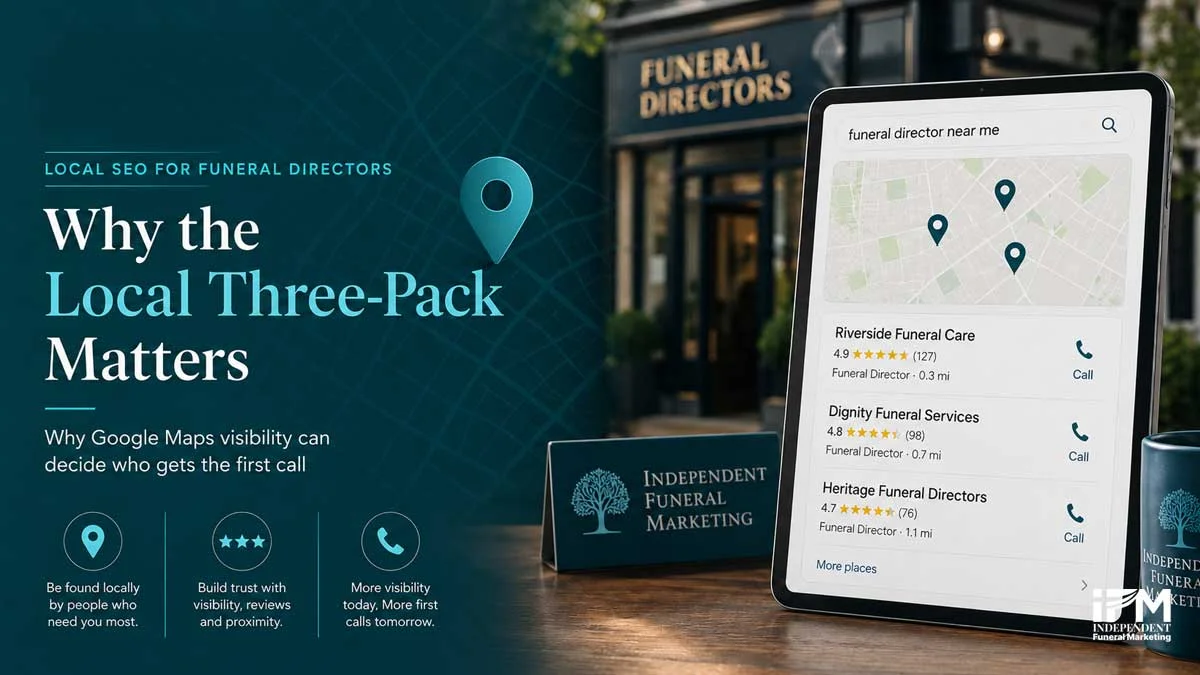
They open Google. They type “funeral director near me.” Three listings appear above everything else, each with a name, a rating, a phone number, and a map pin. Whichever three firms show up there are, for that search, the only funeral directors that exist.
This article sets out why that small block of results carries so much weight for an independent funeral director, what the click data actually shows, and why bereavement search makes the stakes higher than they are for almost any other local business.
What Is the Local Three-Pack, and Where Does It Appear?
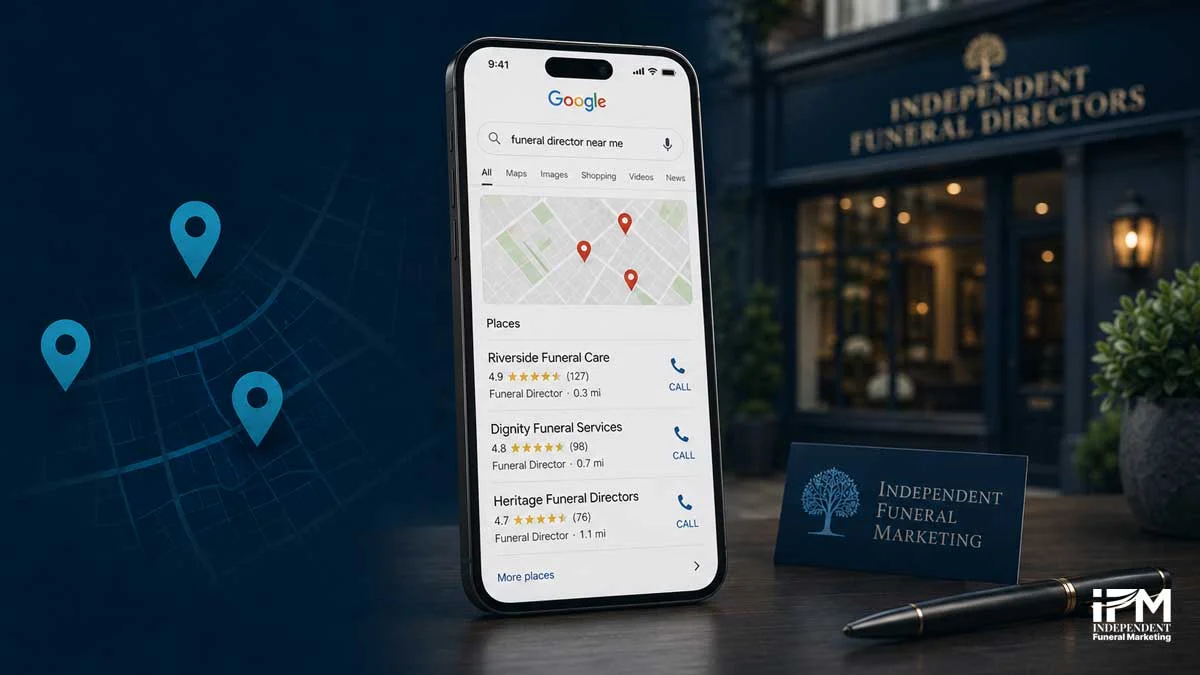
The local three-pack (also called the Google Map Pack or Local Pack) is the block of three local business listings, shown with a map, that Google displays above standard search results for location-based searches such as “funeral director near me.” Google’s own guidance confirms it is generated from Google Business Profile data and ranked by relevance, distance, and prominence [2].
Each listing in the pack shows a business name, a star rating, an address or service area, opening hours, and a one-tap button to call or get directions. It sits above the ten standard blue links, which means it’s usually the first thing a searcher sees and the first thing they act on.
Two phrasings describe the same thing. “Local three-pack” and “Google Map Pack” are used interchangeably, both here and across the wider local SEO literature [3]. There’s also a related but separate feature worth naming: the Local Finder, the longer list revealed behind “More places.” This article is about the three-pack itself, not that expanded list.
This piece is the general stakes case for why the pack matters. For the tactical, step-by-step work of actually improving your position in it, the full step-by-step guide to ranking in Google Maps covers Google Business Profile setup, reviews, and citations in detail.
Why Does Google Weight Proximity So Heavily in Local Rankings?
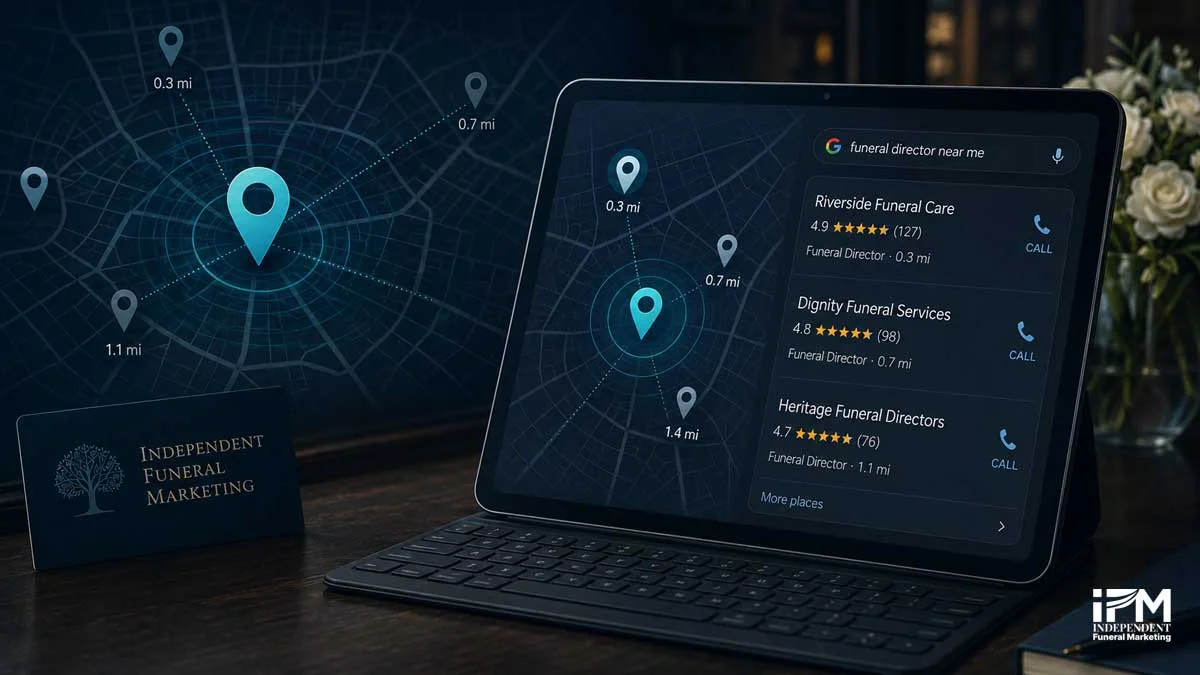
Google ranks the three-pack using three factors it names directly: relevance (how well a profile matches the search), distance (how close the business is to the searcher), and prominence (how well-known and trusted the business is, based on signals like reviews) [2]. Independent analysis of ranking-factor weightings puts Google Business Profile signals at roughly 32% of the total, with proximity estimated to drive around 55% of local-pack ranking decisions overall [4].
Relevance is whether a profile clearly matches what someone typed. Distance is simply how close the business sits to the person searching. Prominence covers everything else Google reads as trust: review volume, review quality, and how consistently a business’s details appear across the web.
Distance isn’t something a business can buy its way past. That’s precisely why a well-optimised, single-location independent firm is structurally well placed against a distant branch of a national chain, whatever budget that chain has behind it.
Because ranking depends on these specific, named signals, appearing in the pack isn’t random. It’s a direct, legible outcome of profile quality and physical proximity, which is exactly why optimising your Google Business Profile is worth taking seriously rather than treating the pack as a lottery.
How Many Local Searches Actually Click the Three-Pack Instead of Organic Results?
Roughly 42% of people who run a local search click a result inside the three-pack [1], and businesses that earn three-pack visibility receive 126% more traffic and 93% more user actions, calls, direction requests, website clicks, than businesses that don’t appear in it at all [3]. For a funeral director, that gap is the difference between being the first call a family makes and never being considered.
That 42% figure comes from Backlinko’s analysis of local search behaviour, and it’s worth sitting with: no single organic listing below the pack comes close to that share of clicks. The 126% traffic and 93% action uplift, reported by Search Engine Land citing SOCi’s research, quantifies what’s at stake for a firm that never breaks into the pack at all.
Consumer trust reinforces the pattern. BrightLocal’s research found consumers trust Google (66%) and Google Maps (45%) more than any other source for local business information [5]. That’s why the pack, not a general website search, is where trust and action tend to converge.
One honest caveat: these are panel and click-modelling studies, not Google’s own first-party click data. Each figure here is attributed to its named source rather than presented as a universal constant.
| Local Pack | Organic Results | |
|---|---|---|
| Click share | ~42% of local search clicks | Declines sharply below the pack |
| Typical action | Call, direction request, website visit | Website visit, further research |
| Driven by | Google Business Profile, reviews, proximity | Website content, backlinks, domain authority |
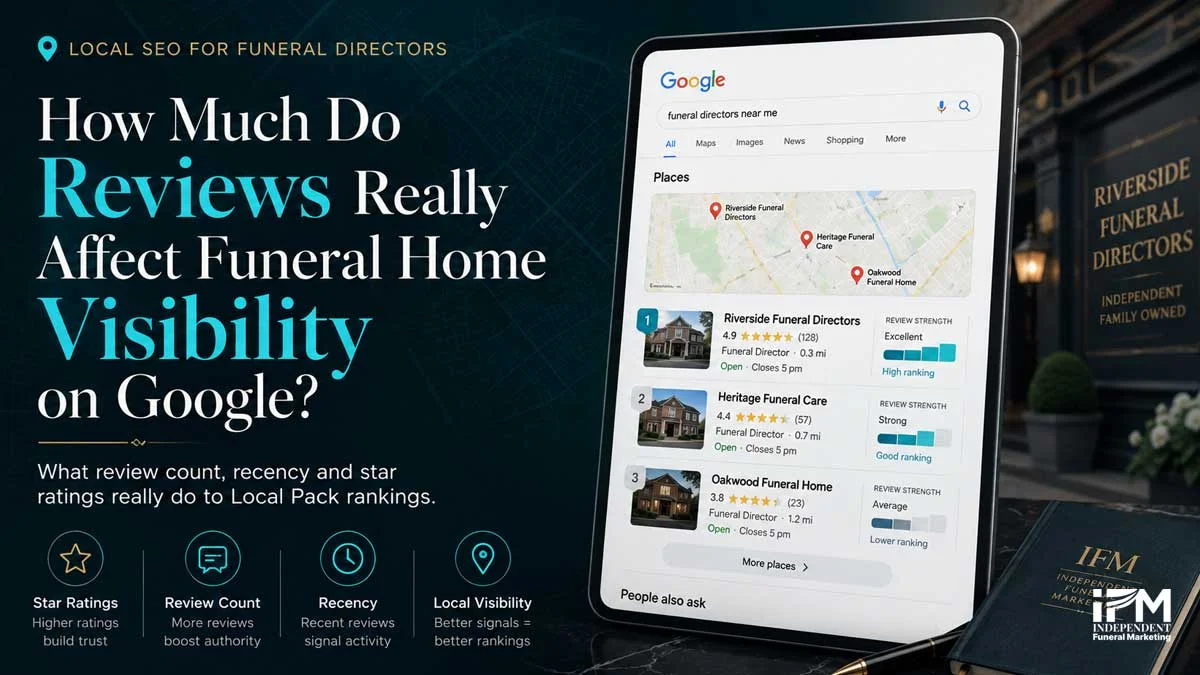
Does It Matter Whether You Rank #1, #2, or #3 Inside the Pack?
Position matters far less inside the three-pack than it does in organic results: click-through rate runs roughly 17.6% for position one, 15.4% for position two, and 15.1% for position three, a gap of only a few points [6]. The much bigger jump is moving from outside the pack into it at all, which is why this article treats pack visibility, rather than exact position, as the primary stakes.
That flat curve across positions one to three is a genuine reassurance for an owner-operator anxious about not sitting exactly first. The leap from not appearing in the pack at all to sitting third is far larger than the leap from third to first.
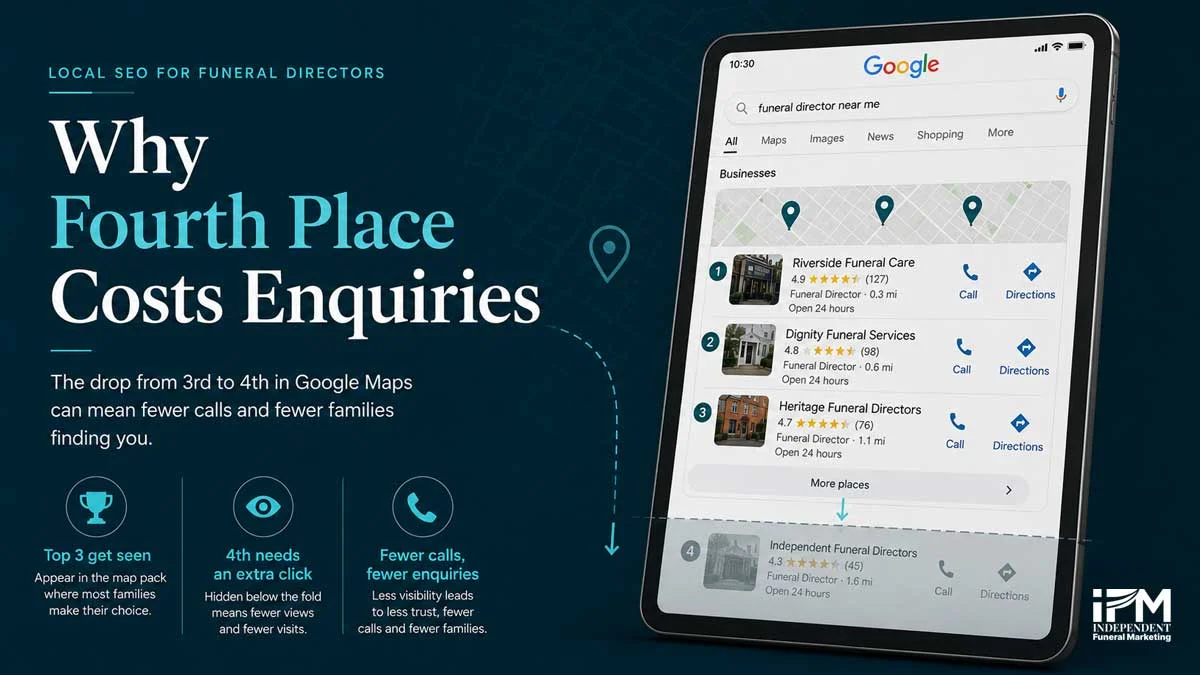
This data is modelled and aggregated across studies rather than a single Google-confirmed figure, worth noting once rather than hedging the point away entirely. The specific cost of missing the pack altogether, sitting fourth or below, is covered in more depth in why fourth place costs enquiries; this piece deliberately stops short of duplicating that ground.
Why Does an At-Need Funeral Search Behave Differently to an Ordinary Local Search?
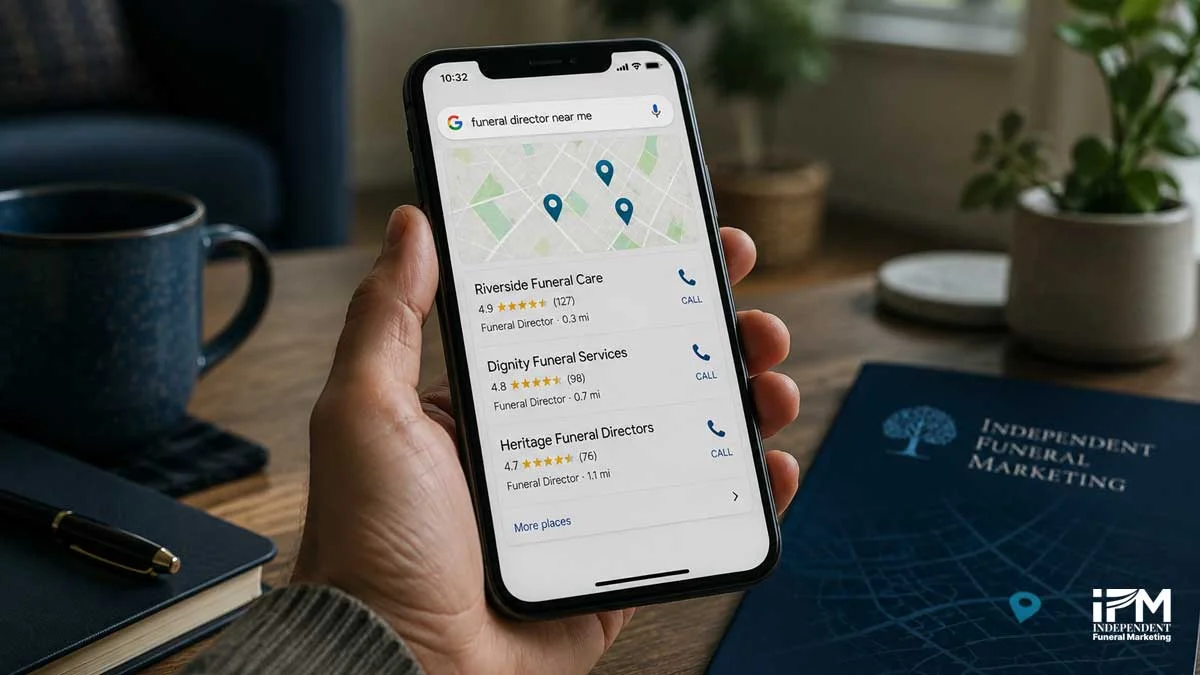
An at-need funeral search happens in the hours after a death, driven by immediate necessity rather than casual comparison, the kind of high-intent, high-urgency search Google itself describes as an “I-want-to-go” moment [8]. With 568,613 deaths registered in England and Wales in 2024 [9], and UK adults overwhelmingly reaching for mobile search and Google Maps as their default tool [10], the family behind that search is very likely holding a phone, not sitting at a desktop researching over days.
Google’s own micro-moments framework describes “I-want-to-go” searches as urgent, local, and ready to act on, a concept Google introduced years ago but still uses as its clearest articulation of this kind of search behaviour.
In 2025, Ofcom reported that UK adults spend an average of four and a half hours online a day, mostly on a smartphone, and that Google Maps is used by 77% of adults monthly, with Google Search used by 82% [10]. That’s the behavioural backdrop against which every at-need funeral search happens.
Contrast this with pre-need funeral planning, a longer-consideration, relationship-led process covered further below. At-need volume is what the three-pack primarily competes for, and it’s a very different search from someone browsing options weeks or months in advance.
Why Do Most Bereaved Families Not Shop Around, and What Does That Mean for Visibility?
Competition and Markets Authority research found that only 17% of people compared two or more funeral directors before choosing one, with 78% not comparing at all, most followed a personal recommendation or used a firm the family had used before [7]. That looks, at first glance, like a reason local search doesn’t matter. It’s the opposite: for the growing minority who do go online, and for families with no existing recommendation, the three-pack is very often the entire decision.
Isn’t a low comparison rate a reason to worry less about search visibility? Read the other way round, it’s the opposite. A family with no prior recommendation has effectively no other route to discovery than whatever three results Google happens to show them.
The CMA’s findings go further. Its Final Report estimated consumer detriment of at least £400 per funeral on average, arising from a lack of effective competition and comparison in the market [11], a market the CMA itself has flagged as under-functioning, not a claim IFM is making independently.
The same survey found most consumers used a funeral director within roughly a 20-minute drivetime of where the deceased lived. That’s direct evidential support for the proximity ranking factor discussed earlier: it isn’t an abstract mechanism, it matches how families actually behave.
How Is the Shift Toward Simpler, More Price-Aware Funerals Changing the Stakes?
A simple attended funeral now costs an average of £3,828 in the UK, with the full cost of dying reaching £5,140 once send-off costs are included, and the simple attended funeral has become the most common choice [12]. At the same time, FCA regulation introduced in 2022 now governs pre-paid funeral plans directly, banning cold calling and commission payments to intermediaries [13], both trends that push more of the real decision-making moment toward the unplanned, at-need search this article is about.
SunLife’s 2026 Cost of Dying Report tracks a clear behavioural shift alongside the price data: families are increasingly choosing simpler, more consciously price-aware funerals rather than the most elaborate option available.
Since July 2022, the FCA has regulated pre-paid funeral plans directly, authorising providers and banning cold calling and intermediary commissions. That draws a clean line between a pre-need market that’s now more regulated and relationship-led, and the at-need, three-pack-governed searches that happen when there’s been no advance plan at all.
What Happens to Enquiries When a Funeral Home Isn’t Visible in the Pack at All?
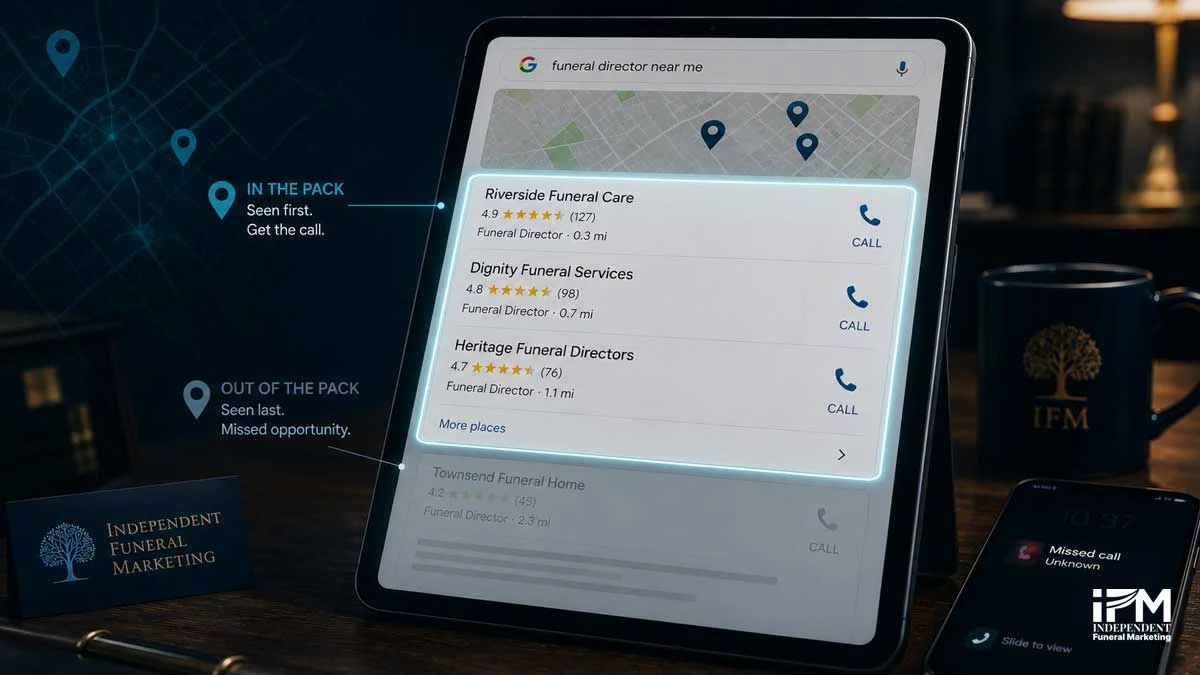
A funeral director that never appears in the three-pack is, for most searching families, simply invisible, not a rejected option, but one that was never seen. Given how few families compare providers once they find one [7], and how much of the click share the pack itself commands [1][3], visibility here is less a marketing nicety than the precondition for being considered at all.
Click dominance, position nuance, bereavement urgency, and low comparison behaviour all point to the same conclusion: the three-pack isn’t one channel among many for a funeral director, it’s very often the whole search. For the fuller anatomy of that results page, star rating, review count, photos, and the AI Overviews now appearing above it, see what families see when they search for a funeral director. Local SEO for independent funeral directors is IFM’s structured response to that gap, built around measurable visibility rather than guesswork.
This is a starting point, not a guarantee. But every month without a structured approach to local visibility is a month of compounding disadvantage relative to a competitor who has one.
Frequently Asked Questions
What does ‘local pack’ mean?
The local pack, also called the Google Map Pack, is the block of three business listings with a map that Google shows above standard search results for location-based searches such as “funeral director near me.” It’s the single most visible spot on the results page for that kind of search.
Why is local SEO important for a funeral director?
Local SEO matters because roughly 42% of people who run a local search click a result inside the three-pack [1], far more than any organic listing below it. For a funeral director, most of that traffic is an urgent at-need search, so appearing in the pack is close to a precondition for being considered at all.
What is the difference between the local pack and the Local Finder?
The local pack is the three listings shown directly on the search results page. The Local Finder is the longer, expanded list revealed when someone clicks “More places.” This article is about the three-pack itself, not the full Local Finder list.
Does ranking #1 matter more than #3 inside the three-pack?
Not by much. Click-through rate runs at roughly 17.6% for position one, 15.4% for position two, and 15.1% for position three [6], a gap of only a few points. The far bigger jump is moving from outside the pack into it at all.
Do families compare funeral directors before choosing one?
Rarely. Competition and Markets Authority research found only 17% of people compared two or more funeral directors before choosing one, with 78% not comparing at all [7]. That low comparison rate raises, rather than lowers, the stakes of being the one result a family actually finds.
Which matters more for a funeral home: the local pack or organic ranking?
Both matter, for different searches. The local pack captures urgent, at-need searches like “funeral director near me.” Organic ranking captures earlier, more informational searches. Treating this as a choice between the two misses that they serve different stages of the same family’s search.
References
[1] Backlinko, 24 Must-Know Local SEO Statistics, backlinko.com/local-seo-stats
[2] Google Business Profile Help, Tips to improve your local ranking on Google, support.google.com/business/answer/7091
[3] Search Engine Land, What is the Google Local Pack? How to rank in the 3-pack, searchengineland.com/guide/google-local-pack
[4] Whitespark, Local Search Ranking Factors 2026, whitespark.ca/local-search-ranking-factors
[5] BrightLocal, 35+ Local SEO Statistics You Need for 2026, brightlocal.com/resources/local-seo-statistics
[6] First Page Sage, Google Click-Through Rates by Ranking Position 2026, firstpagesage.com/reports/google-click-through-rates-ctrs-by-ranking-position
[7] Competition and Markets Authority, Funerals Market Investigation, Consumer Survey Findings, gov.uk/cma-cases/funerals-market-study
[8] Google, Think with Google, The Micro-Moments Marketing Model, business.google.com/ca-en/think/marketing-strategies/how-micromoments-are-changing-rules
[9] Office for National Statistics, Deaths registered in England and Wales: 2024, ons.gov.uk/peoplepopulationandcommunity/birthsdeathsandmarriages/deaths/bulletins/deathsregistrationsummarytables/2024
[10] Ofcom, Online Nation 2025, ofcom.org.uk/media-use-and-attitudes/online-habits/from-apps-to-ai-search-how-the-uk-goes-online-in-2025
[11] Competition and Markets Authority, Funerals Market Investigation, Final Report Summary, gov.uk/cma-cases/funerals-market-study
[12] SunLife, Cost of Dying Report 2026, sunlife.co.uk/over-50-life-insurance/funeral-costs
[13] Financial Conduct Authority, FCA regulation boosts consumer protection in the funeral plans market, fca.org.uk/news/press-releases/fca-regulation-boosts-consumer-protection-funeral-plans-market