What is digital marketing for funeral homes?
Digital marketing for funeral homes is the set of online channels and tactics used to make a funeral home visible to families searching for services in a defined local area, and to build enough trust online that those families feel confident making contact. It is not about brand awareness in the traditional advertising sense. The goal is structured visibility at the exact moment a family needs a funeral director, combined with credibility signals that reduce hesitation before first contact.
Funeral home digital marketing differs from marketing in most other industries because:
- The audience is often in distress when searching
- Decisions are made quickly, frequently within hours of bereavement
- Trust is the primary conversion factor, not price comparison
- The service area is geographically defined and usually small
- Volume is finite, so capturing a greater share of local searches has a direct business impact
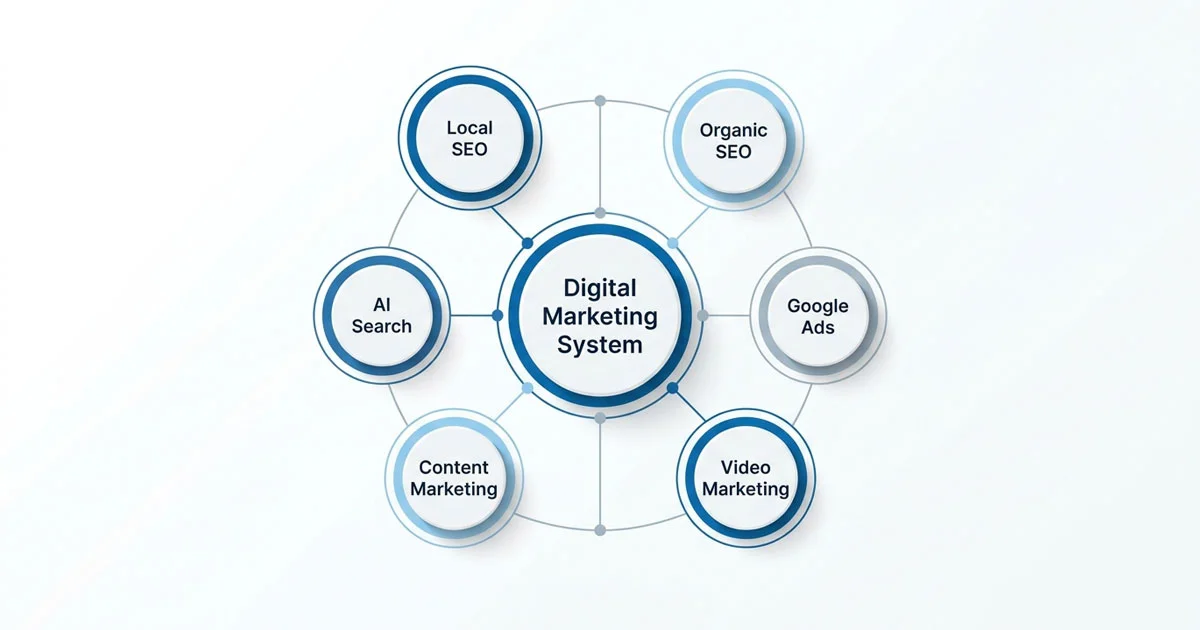
The core digital marketing channels relevant to a funeral home are local SEO, organic SEO, Google Ads, video, content marketing, and AI search optimisation. These are covered in full across this guide.
Why do independent funeral homes need a different marketing approach?
Independent funeral homes need a fundamentally different marketing approach because they compete locally, not nationally, operate on smaller budgets than corporate groups, and win on personal reputation rather than brand scale. A strategy built on corporate marketing logic will underperform in a local, relationship-driven market.
UK and US funeral markets have both seen significant corporate consolidation. In the UK, groups such as Dignity and Co-op Funeralcare operate hundreds of branches with centralised marketing teams and national advertising budgets. In the US, Service Corporation International (SCI) operates under brands including Dignity Memorial and operates thousands of locations. An independent firm cannot match that investment, and should not try.
What an independent funeral director can do that corporate groups structurally cannot:
- Build and maintain genuine local trust at a personal level
- Present consistent, personal service with the same director across every interaction
- Own a defined local area with concentrated marketing precision
- Generate authentic community relationships (care homes, celebrants, religious leaders, community groups) that produce referrals
- Respond to families with continuity that a call centre cannot replicate
| Factor | Corporate group | Independent firm |
|---|---|---|
| Brand recognition | High nationally | High locally |
| Advertising budget | High | Limited |
| Local community trust | Low | High |
| Personal director continuity | Low | High |
| Geographic focus | Spread across many locations | Concentrated in defined area |
| Referral network depth | Transactional | Relationship-based |
| CMA compliance differentiation (UK) | Standardised | Can be a genuine point of difference |
The marketing strategy for an independent funeral home should amplify the advantages in that table, not attempt to compete on corporate terms.
Which digital marketing channels work for funeral homes?
Local SEO consistently delivers the highest return for independent funeral homes because it captures families at the exact moment of need, within a defined geographic area, at lower ongoing cost than paid channels. However, no single channel is sufficient. Sustained visibility requires multiple channels working as a system.
| Channel | What it does | Time to results | Relative cost | Best for |
|---|---|---|---|---|
| Local SEO | Google Maps and local pack visibility | 3-6 months | Low-medium | At-need local families |
| Organic SEO | Long-term website keyword rankings | 6-18 months | Medium | Research-stage and preneed enquiries |
| Google Ads | Immediate paid search visibility | Immediate | Medium-high (ongoing) | At-need urgent enquiries |
| Video marketing | Trust building before first contact | Ongoing | Medium (production cost) | Pre-qualification and conversion |
| Content marketing | Topical authority and educational visibility | 6-12 months | Medium | Preneed and research-stage families |
| AI search optimisation | Visibility in AI-generated answers | 3-12 months | Low | Forward-looking brand authority |
These channels are not alternatives to each other. They serve different stages of the family's decision process and different search behaviours. The most effective funeral home marketing programmes integrate them deliberately, rather than running them in isolation.
What is local SEO for funeral homes and why does it come first?
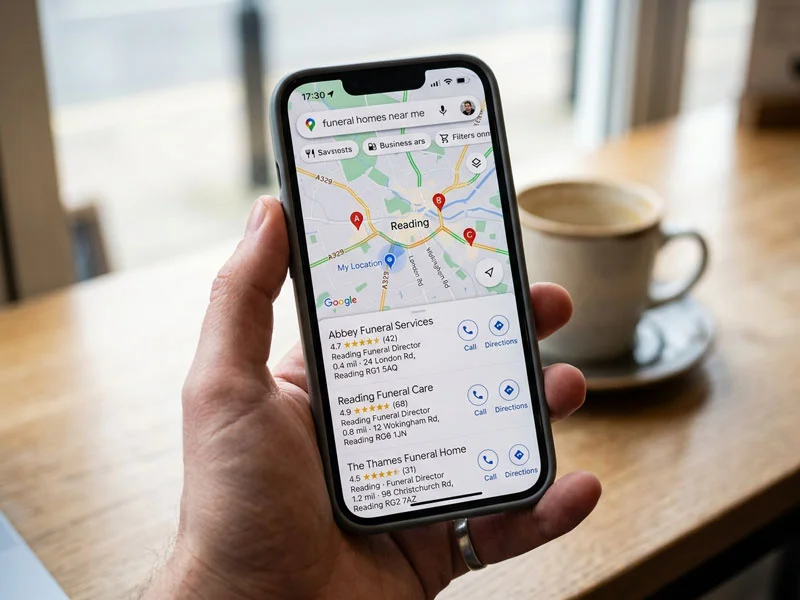
Local SEO is the process of optimising a funeral home's online presence to appear in Google Maps results and local search results when families search for funeral services in a specific area. It comes first because it is the highest-impact, lowest-cost channel for most independent funeral homes, and it is where the majority of at-need families search.
When a family searches "funeral director near me" or "funeral home [town name]", Google shows a map pack of three local results directly above standard search results. Research consistently shows the majority of clicks go to these three map pack listings. A funeral home absent from the map pack is invisible for the most important category of search query.
Local SEO for funeral homes involves five components:
- Google Business Profile (GBP), set up completely with correct categories, services, photos, hours, and description
- Local citation consistency, the funeral home's name, address, and phone number listed accurately and consistently across directories including Yell, 192.com, Thomson Local, and funeral-specific directories
- Review acquisition, a structured and sensitive system for encouraging families to leave Google reviews following a funeral
- Location-specific website content, pages targeting the specific towns and areas the funeral home serves
- Local authority signals, local backlinks from community organisations, churches, hospices, and local press
For a detailed breakdown of local SEO strategy, see our funeral home local SEO service.
How does SEO build long-term visibility for funeral directors?
SEO (search engine optimisation) improves a funeral home website's organic rankings in Google over time, making it visible for searches related to funeral services, cremation, pre-arranged funeral plans, and informational queries that families research during and before bereavement. Where local SEO focuses on map-based searches, organic SEO targets the wider set of keyword searches a funeral home website should rank for.
For an independent funeral home, organic SEO works through four main levers:
- Technical foundations, a fast-loading, mobile-responsive, secure website with no crawl errors or indexing problems
- Keyword-structured pages, service and location pages built around the terms families actually search, not the terms the funeral home assumes they use
- Authority building, earning links from relevant local and industry sources that signal credibility to Google
- Topical depth, structured content that covers the funeral home's subject area comprehensively, signalling to Google that the site is an authoritative source
Realistic SEO timelines for funeral homes:
| Activity | Typical timeframe to see impact |
|---|---|
| Technical fixes (speed, mobile, indexing) | 2-6 weeks |
| Google Business Profile improvements | 4-8 weeks |
| Local search ranking improvements | 3-6 months |
| Competitive keyword rankings | 6-18 months |
| Topical authority establishment | 12-24 months |
SEO is not a fast channel. It is a compounding asset. A funeral home that invests consistently in SEO will, over 12 to 24 months, occupy rankings that competitors who have not invested cannot easily displace. A funeral home that stops investing does not immediately lose rankings, but will gradually be overtaken as competitors build authority.
For the full SEO approach, see SEO for funeral directors.
When should a funeral home use Google Ads?
A funeral home should use Google Ads when it needs immediate search visibility, when the local area is competitive and organic rankings will take time to build, or when it wants to capture at-need searches precisely while longer-term SEO matures. Google Ads are also the only digital channel that can produce enquiries within days of launching.
Funeral home Google Ads operate in a specific context. Families searching for funeral services are often in distress and making decisions under time pressure. This has two practical implications:
- Ad copy must be composed and respectful, not promotional or urgent-sounding
- Targeting must be precise, because wasted clicks on irrelevant searches waste budget at a high cost per click
Key configuration requirements for funeral home Google Ads campaigns:
- Target at-need search terms ("funeral director [town]", "cremation services near me", "funeral home [area]")
- Set geographic radius tightly around the actual service area
- Use call extensions so families can phone directly from the ad without visiting the website
- Exclude irrelevant queries (job searches, student searches, research queries)
- Track actual phone calls and form submissions, not clicks alone
UK funeral sector Google Ads cost per click benchmarks (2025 data):
| Search term | Approximate CPC (UK) |
|---|---|
| Funeral directors near me | ~£9.50 |
| Funeral services | ~£4.80 |
| Affordable funerals | ~£5.20 |
| Cremation services | ~£4.00 |
| Prepaid funeral plans | ~£5.80 |
At these cost levels, a focused monthly budget of £500-£1,000 can generate meaningful call volume if campaigns are tightly managed. See funeral home Google Ads for a full breakdown.
How does video marketing help funeral homes build trust before first contact?
Video marketing helps a funeral home build trust with families before they make contact by showing who the funeral director is, what the premises look like, and how the service process works. It removes the unknown from what is, for most families, an unfamiliar and emotionally difficult decision.
Most families arranging a funeral have little prior experience. They are searching for reassurance as much as information. A funeral director who appears on video, speaks clearly and compassionately, and shows the environment families will visit, reduces hesitation and builds a sense of connection before the first phone call or meeting. That reduction in hesitation directly affects enquiry rates.
Video types that work for funeral homes, in order of priority:
- Director introduction: who the director is, their background, their values, and their approach to caring for families
- Premises walkthrough: what the funeral home looks like, where families meet, the facilities available
- Service explanation: what arranging a funeral involves, what families can expect at each stage
- Client testimonials: families sharing their experience (with explicit permission)
- Community presence: the funeral home's involvement in local events, charity work, and community roles
Where to distribute funeral home video content:
- Homepage (builds immediate trust on first visit)
- Google Business Profile (surfaces in local search and maps results)
- YouTube channel (searchable, embeddable, builds long-term authority)
- Social media (short-form clips repurposed for Facebook, Instagram, LinkedIn)
YouTube is the highest-affinity social platform for independent funeral home owners, based on audience research data, making it the most logical distribution channel for video content beyond the website itself.

See funeral home video marketing for the full approach.
What is content marketing for funeral homes?
Content marketing for funeral homes is the creation and publication of written guides, educational articles, and structured resources that help families understand funeral planning, while signalling to search engines and AI platforms that the funeral home website is an authoritative source on relevant topics.
Content marketing serves two functions simultaneously:
- SEO authority: structured content helps the website rank for a wider range of relevant searches, including informational queries from families in the planning and preneed stages
- Trust building: helpful, expert content communicates professional knowledge and builds credibility with families who are researching before making contact
Content types that work for funeral homes:
- Guides to funeral planning options (burial vs cremation, attended vs unattended, traditional vs direct)
- Explanations of legal requirements around funerals in the UK or US
- Pre-arranged funeral information and its benefits
- Advice for families on supporting the bereaved
- Location-specific pages serving specific towns and surrounding areas
- FAQ-format content answering the questions families commonly search for
Content that does not work for funeral homes:
- Generic, AI-generated articles with no specific knowledge or expertise signal
- Content with no relevance to the funeral home's actual service area or audience
- Articles written primarily for search engines that provide no genuine value to a grieving family
The test for whether a piece of content is worth publishing: would a family genuinely find this useful when preparing for, or dealing with, a bereavement?
See funeral home content marketing for the structured approach IFM uses.
How does AI search affect funeral home marketing?
AI search platforms, including Google AI Overviews, ChatGPT, Perplexity, and similar tools, increasingly answer search queries directly rather than routing users to a list of web results. This affects funeral home marketing because families may receive information from AI-generated answers, and the funeral homes cited in those answers gain visibility that others do not.
For a funeral home to be cited by AI search platforms, its content needs to be:
- Clearly structured around specific questions and direct answers
- Factual, specific, and verifiable rather than vague or promotional
- Marked up with structured data (schema) so AI systems can parse it correctly
- Associated with a credible author or business entity with consistent online presence
- Referenced or mentioned across multiple credible sources, not just the funeral home's own website
What helps a funeral home appear in AI-generated answers:
| Signal | How to build it |
|---|---|
| Clear Q&A content | FAQ pages, question-led blog posts, structured guides |
| Schema markup | FAQPage, LocalBusiness, Article schema on relevant pages |
| Consistent entity data | Same business name, address, phone across all directories and profiles |
| E-E-A-T signals | Author bio, credentials, professional associations, experience signals |
| Third-party mentions | Press, directories, community websites referencing the business by name |
AI search is an emerging channel. Funeral homes that establish clear, well-structured online content now will be better positioned as AI-assisted search behaviour continues to grow. For the full approach, see AI search optimisation for funeral homes.
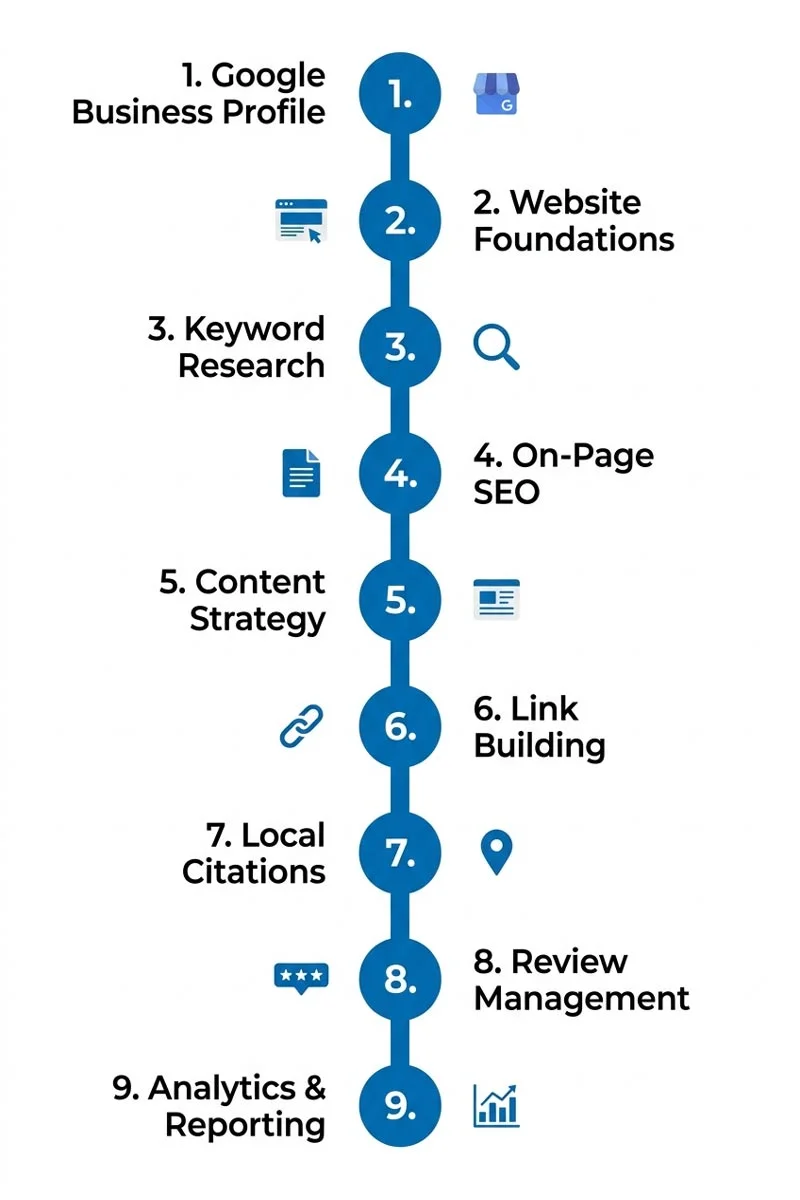
What is the right order to build a funeral home marketing system?
The right order starts with the channels that deliver the fastest impact for the lowest investment, then builds progressively toward compounding longer-term assets. Many funeral homes make the mistake of spending on advertising before their foundational visibility is correct, which means paid traffic lands on a poorly optimised presence and underperforms.
- Google Business Profile (GBP)
- Complete every field: categories, services, description, photos, opening hours, attributes
- This is the single highest-impact action for local search visibility
- Cost: time only
- Website technical foundations
- Mobile-responsive, fast-loading (under 3 seconds), HTTPS secure
- Clear contact information on every page
- No technical errors blocking Google from crawling the site
- Local citation consistency
- Name, address, and phone number identical across all directories
- Priority directories: Google, Bing Places, Apple Maps, Yell, Thomson Local, 192.com
- Review acquisition system
- A structured, sensitive process for inviting families to leave Google reviews
- Respond to every review, positive and negative
- Review volume and recency directly affect local map pack rankings
- Organic SEO
- Keyword-targeted service and location pages
- Technical SEO health maintenance
- On-page optimisation (title tags, meta descriptions, heading structure)
- Google Ads (if budget allows)
- At-need campaign targeting the service area
- Launch once the website is optimised so that ad spend is not wasted
- Video content
- Start with a director introduction video
- Build out with premises walkthrough and service explanation over time
- Content marketing and topical authority
- Educational guides supporting service pages
- Blog articles targeting informational searches
- Structured internal linking between related pages
- AI search optimisation
- FAQ schema across key pages
- Entity-building content and structured author signals
- Consistent brand mentions across the web
How do independent funeral homes compete with corporate chains online?
Independent funeral homes compete with corporate chains online by focusing on local authority, personal presence, and community trust, the three areas where corporate groups are structurally weakest. The goal is not to out-spend corporate competitors but to out-position them in the specific local market that matters.
| Competitive area | Why independents win |
|---|---|
| Google Maps and local pack | A single-location independent can concentrate all local SEO effort on one area. Corporate branches divide attention across many locations. |
| Google reviews | Families are more likely to leave personal, detailed reviews for a local director they trust than for a branch of a national chain. |
| Community links and citations | Local connections (churches, care homes, hospices, community groups) are genuine and reflect real relationships, not a corporate directory entry. |
| Personal brand | The director is the brand. A named individual with a visible presence online (video, author bio, professional profile) builds trust that corporate anonymity cannot match. |
| Content authority | An independent writing from genuine experience and local knowledge produces more credible content than generic corporate website copy. |
| Referral network | Personal relationships with celebrants, hospice staff, hospital bereavement teams, and religious leaders generate referrals based on trusted recommendations, not advertising. |
In the UK, the Competition and Markets Authority (CMA) funeral sector review has produced specific transparency requirements. Independent firms that visibly meet and exceed these standards, with clear pricing, clear service descriptions, and accessible information, have a genuine differentiation point over corporate groups managing compliance at scale.
What should a funeral home measure to know if marketing is working?
A funeral home should measure enquiry volume and source, specifically: how many calls, contact form submissions, and direct messages came from the website, Google Maps, and paid advertising, and how those numbers change month by month. Everything else is secondary.
Metrics worth tracking:
| Metric | Where to find it | Why it matters |
|---|---|---|
| Phone calls from GBP | Google Business Profile Insights | Directly measures map pack performance |
| Website enquiry form submissions | Google Analytics or form tool reporting | Measures website conversion |
| Website phone click-throughs | Google Analytics events | Mobile visitors who tap to call |
| GBP search impressions | Google Business Profile Insights | Trend in local search visibility |
| Keyword rankings | Google Search Console or rank tracker | Organic search progress over time |
| Review count and rating | Google Business Profile | Trust signal and local ranking factor |
Metrics that are not useful as primary KPIs:
- Social media follower count (vanity metric, does not correlate with enquiries)
- Total website page views (too broad, not linked to business outcomes)
- Ad impressions (quantity of impressions does not indicate quality of targeting)
- Email open rates (unless running an active email programme)
The single most useful data point that no analytics platform fully captures is the answer to this question, asked of every family who contacts the funeral home: "How did you find us?" A simple intake question, asked consistently, provides attribution data that significantly improves marketing decision-making.
Frequently asked questions
How much does funeral home digital marketing cost?
Costs vary significantly by channel and market. Google Business Profile management and local SEO with a specialist typically costs £300-£800 per month in the UK. Google Ads budgets generally start at £500 per month to achieve meaningful local call volume. Video production is a one-time cost, typically £800-£2,500 for a professional director introduction video. Organic SEO and content programmes range from £500 to £1,500 per month depending on scope and competition.
Do funeral homes need a marketing agency or can they manage it themselves?
A funeral home willing to invest time in learning Google Business Profile optimisation, citation management, and review acquisition can achieve strong local results independently. The case for a specialist is strongest when the director's time is limited, local competition is high, results are needed within a defined timeframe, or previous self-managed efforts have not produced the expected results.
How long does funeral home SEO take to produce results?
For local SEO and Google Maps improvements, results are often visible within 3-6 months of consistent effort. For competitive organic keyword rankings, 6-18 months is a realistic expectation. Google Ads campaigns produce results within days of going live. There is no ethical SEO approach that produces reliable results within weeks for competitive terms.
What is the most important marketing channel for an independent funeral home?
For most independent funeral homes, the Google Business Profile and local SEO are the most important channels because they directly determine whether a family can find the funeral home at the exact moment of need. A well-optimised GBP with consistent reviews and correct information consistently outperforms other channels in terms of at-need enquiry generation.
Should a funeral home be on social media?
Social media has a secondary role for most funeral homes. The primary goal is visibility when families are actively searching for funeral services. Social media rarely drives direct at-need enquiries, but it does support community presence, reputation, and brand awareness over time. Facebook is the most relevant platform for families in most UK and US markets. YouTube is most relevant for video content distribution.
How does a funeral home get more Google reviews?
The most effective approach is a structured, sensitive system: following a funeral, when the family has had sufficient time, send a personal message (email or letter) from the funeral director thanking them and including a direct link to leave a Google review. The key variables are timing (not too soon), tone (personal, not automated-sounding), and consistency (asking every family, not selectively). Review volume and recency are both ranking factors in Google's local algorithm.